On interfaces

I love technology.

Not only do I love what it does for us, but I love fiddling with it. Taking it apart. Seeing what makes it tick. Making it go better.

I’m the sort of person who will notice that a chromatography column is not performing optimally and do something about it (and therein is a weblog entry for another day). But my problem is that, cool as technology might be, the interface is usually really sucky.

Take a random example.

AKTAaarghhh

I am reminded (HT) that we used to have one of these babies in Cambridge. We inherited it from the lab down the corridor who’d just bought something shiny and new. We already had an FPLC, which although it had a primitive interface, was reasonably easy to use. And everyone in the lab knew how to use it.

But the AKTA. Ah.

It came with a PC (running Windows. You just know that’s gotta hurt) and some bizarre software that needed individual user accounts and a new sodding program each time you wanted to make the slightest alteration to a protocol. And the manual appeared to have been translated from Swedish to English via Serbo Croat.

By a Himalayan monk.

Fortunately for me, I managed to figure out how it worked (yes, I’m a geek) and didn’t quite get round to making an idiot’s guide to it. Which meant that while my fellow lab rats fought over time on the FPLC, I hardly ever had to book the AKTA to myself. It was mine, all mine. Mwah hah ha–sorry.

It’s not just ‘physical’ technology where the nerds don’t realize normal people are going to use it, either. Gmail went tits-up a little while ago, and I got this wonderfully informative error message:

numeric code

Now, while ‘Detailed Technical information might be useful to a technician, why the hell is it there for me to click on if all it says is ‘Numeric Code: 66’? I have no idea what that means. I don’t know if that’s a fault with my set up, the Gmail server, just my Gmail account or crabs and lobsters eating the long, damp piece of string carrying electrons across the Pacific. Which means I have no idea about its fixability: more importantly I don’t know whether I should tell Gmail technicians they have an error 66 (‘Oh, right, error 66. Yes, you need to reboot your third quadrant alpha widget’) or what. It tells me nothing–and I don’t even know if it’s the sort of error that is likely to persist.

Nothing. Bad interface.

So, anyway, I got a linkedin update this morning.

message from Linkedin

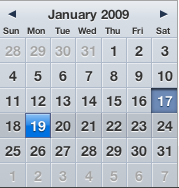
And I chuckled at the phrasing of Richard’s concern, and my finger hovered over the ‘delete’ button, when I realized ‘Monday’ was trying to get my attention. So I auxiliary-clicked it:

ooh, shiny

Ooh, I thought. How neat. And I selected ‘Show This Date in iCal’ and lo! it was revealéd unto me:

Monday

Isn’t that so totally and utterly awesome? Technology with an interface that actually makes life easier. We want more like this, please.

Continue reading

Posted in Uncategorized | 10 Comments

Coincidental Chemistry

As at least Katherine has noticed, I’ve been sleeping with other magazines moonlighting as a chemist:

It was not until A Levels and a new school brought the hunched figure of Doc Beckett, cross-eyed and stain-fingered, into my life that I was able to rekindle my love affair with the sirens of my youth–and more besides. Doc learned his craft in a different age. We dehydrated glycerol to make acrolein and staggered around the lab coughing. We dropped nitrogen triiodide on the floor and spent the afternoon in a purple haze of tiny explosions. I made black powder and glycerol/permanganate fuses. During a particularly recalcitrant reduction […] Doc returned with a brown bottle from a locked cupboard, ‘Potassium Cyanide’ written in copperplate on the label. I peeked in the cupboard once. What, I wondered, was ‘uranyl acetate’?

By a somewhat roundabout route I found waiting for me, on my return from Brisbane, a letter from the same Doc Beckett. I was somewhat surprised: he’d been close to retirement when I did ‘A’ levels too many years ago. He and the chap who’d read my Chemistry World article, and had himself written to me saying that he knew Doc, still meet once a week to ‘practice science’. Apparently a home laboratory and drinks are involved.

Doc Beckett tells me that electrolysis in U-tubes using transition metal electrodes and electrolytes of differing pHs gives nice colour changes. Redox reactions of organics, apparently, give unquantifiable results. It’s good to know that after a lifetime of chemistry some things are yet mysterious.

And talking of lifetimes, in November last year Hans Freeman died. Until a few weeks before his death he still used a small office just round the corner from my own. We chatted occasionally, and I lent him my book for a paper he was writing.

This afternoon I went into Hans’ office and took a look at his bookshelf. There was a long shelf of PhD theses, and a fair number of old text books. I have a soft spot for old books, and Kate had already been in and secured a copy of lectures by C. P. Snow, which I might review at some point. I found an 1894 edition of German log tables (you can tell they’re German. They’re better organized), and an interesting-looking book called Humour and Humanism in Chemistry by a Professor John Read.

Brilliant! I thought, thumbing through it. Endless material for the blog. And indeed, it looks like an early instance of Lab lit. Naturally, I’ve left the book at work, but googling it this evening I found some interesting snippets:

the man of science is of necessity cold, formal and aloof; narrow in outlook; insensible to the finer human emotions; incapable of expressing himself in the common tongue; devoid of humour and humanism; and a stranger to the humanities [but] Prof. Read claimed that the study of chemistry, if approached befittingly, may reasonably take rank beside the so-called ‘humanities’, as a broadly educative, cultural, and humanising influence.

But here’s the weird part. This evening I went looking for the letter from Doc Beckett, because I wanted to write about it. I picked it up and re-read it. And halfway down the page:

I remember Prof John Read (St Andrews) working in Australia… He wrote a number of books, but it might be worth reading his _Humour and Humanism in Chemistry_—it even contains a play!

Thank you Doc. And thank you, Hans. Chemistry never ceases to surprise me.

Posted in Uncategorized | 9 Comments

Shoutout

Interesting snippet in the Psci-com mailing list today.

Colin Murphy wants to publicize Pulse-Project, which offers video and audio lectured (for free!) to general and specialized audiences. Questions can be addressed to colin ‘at’ pulse-project.com.

The site needs a bit of work: I clicked on Robin Dunbar’s What Makes us Human? video on the front page, but got directed to a list of all the videos. I want to see Katharine Wright’s DNA & CSI but can’t find it! Oh, here it is. There isn’t a category index nor a search box. Both these would improve the site usuability.

But not to cavil: it’s a great start to an interesting project.

Posted in Uncategorized | 1 Comment

On the Future

Being on holiday does evil things to my RSS feed.

I like to keep abreast of the relevant literature as it is published (read: comes online), and RSS is a great way of doing that. But when I’ve had a break from the work Mac (if not actually from work) then it’s a bit depressing to find thirteen hundred items across my various feeds–and that’s before looking at all the weblogs in the ‘Personal’ toolbar folder.

While the first day back in the lab/office is usually spent deleting emails I’ve already read and catching up with gossip/hiding from the boss, that is an imperial shedload of reading to do, even if it is reduced to skimming titles. With the surfeit of scientific information available today it’s becoming impossible to keep track of what’s being published even without time off: and if Web 2.0 means that we’ll be seeing yet more published items (_pace_ Cameron and Jean-Claude ) then it’s just going to get worse.

And this is why search-based methods are so popular. Instead of browsing various journals once a week for interesting stuff, it makes more sense to construct a search, let the computer take the strain, and get the results mailed back to you (or delivered in your RSS reader). This is the way my new gig, Faculty of 1000, is going: browsing will be possible but we want you to search, rather than simply hoping for something interesting to fall out and smack you in the face.

How we actually do that is part of my brief. I also want to somehow retain the major advantage of browsing, which is how we stumble across interesting things that we weren’t necessarily specifically looking for.

Reading weblogs is going to be pretty refactory to the search-based method, however. I see them as more of an archived on-going conversation-type thing, and the algorithm that says, ‘Oi, rpg: you might find this interesting’ isn’t ready for prime-time yet. I did, this morning, mark all the ‘personal’ stuff in my RSS feed as read, too; so if you’ve written something you think I would have been interested in but I haven’t done you the honour of commenting, then please let me know.

And speaking of weblogs, I’ll be talking with various people in the next few weeks and hoping to set one up at F1000. I’ll let you know when it’s live.

Posted in Uncategorized | 25 Comments

The year of living dangerously–Finale

I hopped in the car, and a couple of pints later Peter spoke, and spoke fast. I had to ask him to slow down. (Sorry, a Private Dick moment there). As far as I can tell, Peter had been fired for being too smart and innovative, which are not qualities wanted in a small startup, apparently. At least not one run by a greaseball of a CEO who, while we were in dire financial straits, was quite happy for the company to put him up in a hotel because he didn’t want to move from Manchester. Rumours about secretaries, improper liaisons with, and tills, fingers in, are mentioned only to dismiss them. Although they would make interesting side-plots in the screenplay of my life.

I suggested to Peter that it couldn’t have been a personality clash because for that to happen the CEO would have had to have a personality to start with. Although we laughed, I learned more about corporate behaviour in that one evening at a pub in Heydon than I had in the year and a half previously.

Having been tipped off as to the slightly dishonest nature of certain people (and realizing that there was no way the company had the cojones to fire my manager so I could have his job), I began looking for something new. Back at the ranch, things started moving in even more disturbing directions. Despite my best efforts, the AutoQuitereasonablereally(TM) was not flying off the shelves (although those who had bought one were very happy and kept re-ordering consumables from us), and the company was strapped for cash. So in a stroke of genius the CEO laid off the poorest paid people–the two who who worked in production, putting together the columns to supply the AutoQuitereasonablereally(TM), the kits, and making up the reagents for Kate to run the DNA extraction service. Which not only pissed off the production manager, but also made the hierarchical pyramid even more top-heavy and holed one of our revenue streams beneath the waterline.

About the time the enormity of this error was realized I had already responded to an ad in Nature for a post-doc at the MRC-LMB. I was also able to assist Peter as a consultant in an edition of Time Team, in which we attempted to PCR DNA from a Stone Age human tooth (and if you look very carefully you can see the back of my head behind Baldrick Tony Robinson in one pan shot). By the time I was told I had to assist in Production, putting plastic columns together (because someone realized that we had to assemble the bloody things in order to make any money at all, and oh look, we have no staff to do this), I was really losing interest in the company itself.

And one day the CEO called me into his office.

Times were tough, he said. They really appreciated the work I’d put in, he said, to develop the kits and make the AutoCrap(TM) salesworthy. There was no money for a pay rise but please, he said, take myself and Kate out to a nice restaurant and the company would cover it.

To the tune of fifty quid.

I heard Please don’t leave us. I said, “Thank you.”

Then we found that the company was being sold to Whatman, apparently for our IP. We were told that our stock options were worthless, although we still had to hand them over so the sale could go through.

Kate and I went to the Jade Fountain, had a nice meal and a reasonable bottle of wine, and after I got the money back from accounts I handed in my notice.

During the next couple of months I wasn’t allowed to work on anything useful, so I spent the time documenting the AutoCrap(TM) software and re-writing the user manual. Documenting the software shouldn’t have taken that long, but I decided to make the most of it and wrote it as hyperlinked pages, which was the perfect opportunity to learn HTML 4 and CSS. My position was advertised–and they actually appointed two people to replace me, which was rather gratifying.

When I left I took a pay cut, but the MRC pumped a load of money into the system soon after, and the rather generous raises we got over the next six years more than made up for it. They were the best years of my career to date, so it all worked out rather well in the end. But it was quite the ride at the time.

And the company? A couple of months after I left, Whatman relocated it to another science park in Cambridge, right next to an expanding biotech company. When most of the staff were made redundant a year later they quite rapidly found new jobs. The only thing left now is the contract DNA extraction service, last seen operating out of a small shed in Ely.

Posted in Uncategorized | 16 Comments

The year of living dangerously–Part 2

The principle behind the AutoCrap(TM) was, actually, quite clever. There was a plastic sealed cylinder with a membrane separating top and bottom. You pipetted 1.5 ml bacterial culture into the top, sealed it, and pressed the start button. Everything was driven by hydraulics. Positive pressure forced the broth through the membrane leaving the bugs behind. Lysis reagents were squirted into the top and clever changes in pressure mixed them up. Then everything was filtered through into the lower chamber where the plasmid DNA stuck to a slight variation on the standard matrix. The normal washes, a drying step, and then the DNA was eluted in water into Eppendorf tubes.

The first thing I did was optimize the volumes of the lysis and wash reagents, and determine which of the various DNA-binding matrices we could find performed best (the best matrix for the manual kits did not perform so well in the columns). Then I went to the machine itself, taught myself TurboPascal and re-programmed the machine to take advantage of the improved chemistry. Then back to the chemistry for more tweaks, and a final round of protocol wrangling in TB. I took the new machine out to various labs in London (trying to absorb as much nonsense from the rep as possible) showing them how, this time, it actually worked. When I had finished the AutoCrap(TM) could justifiably be called the AutoQuitereasonablereally(TM).

In my spare time I fielded phone calls, sat in on marketing meetings, visited labs, showed Charlie (Venture Capitalists) around and wondered why the CEO was such a creep.

And all this time my line manager did little more than use his PC to check the football score and send emails to his girlfriend. Occasionally he’d claim he went to management meetings so that we could be spared the bullshit. The IT manager visually scanned web traffic logs for signs of wrong-doing (I stung him on this one. One day he went around telling everyone that someone had been downloading porn, he knew who it was, and they were for the high jump. An inveterate Mac-hater, he had no way of knowing that ‘G3’ and ‘hotnaked’ in the URL merely meant someone had stripped a G3 Mac and posted pictures of the internals of a computer on the web. Face, meet egg) and on Fridays (management meeting day) over half the company got locked into the meeting room.

I spent a while tinkering with the machine, making sure it was as good as it possibly could be, and wondering how Marketing were going to cock this one up.

While I had been working on this, the other ‘senior’ scientist in the company had been developing a rapid and high-throughput method for rapidly extracting genomic DNA from whole blood. The protocol was simple: add 1 ml blood to a column with a certain type of Whatman paper in it, heat for 2 minutes, wash, elute with water. Presto! PCR-ready genomic DNA.

This was called ‘gNAPS’, for ‘genomic Nucleic Acid Purification System’. We, naturally, took to calling it ‘guh naps‘, much to the chagrin of Management. ‘Gee naps,’ they said, to little avail.

As I must have been looking a bit bored, Management spake unto me, saying ‘Go thou, and make this work for large volumes of blood. Say ten to 25 ml.” And I looked at the setup, dicked around for a week and saith unto Management, “Nay, for I canst not break the laws of Physiks. Furthermore, what wouldst anyone do with that much DNA?”

“Never you mind,” they retorted. “What the customer wants the customer gets. Make it so.”

I went off, muttering that if they needed to archive material they could just run two columns instead of one, and that any fool could see that you couldn’t get heat transfer into the middle of the paper fast enough for it to work. But I talked to the tame engineer and got him to mock up a heating block, and destroyed hundreds of 50 ml syringes and burned through gallons of expired human blood from Addenbrookes (the smell of hot plastic and cooked blood still haunts me) in a futile attempt to ‘make it work’.

It was then things started getting interesting. About the same time I was preparing my report to show that really, this was not going to work, ever, we had a business meeting to talk about future directions.

A few months after I’d started Peter (the CSO, inventor of the automated column system and founder of the company) asked me if I knew anyone who could set up and start running a genomic DNA extraction service. The plan was to get clients to give us clinical blood samples, we’d prep DNA, and sell it back to the client. I said that Kate was looking for a job, and so he hired her. Kate then almost single-handedly set up and ran the service (including doing the extractions!), which I believe became the first commercial DNA extraction service in the UK. (And then the CEO realized it was a success and hired a manager over her head to run it. Which was typical, really).

Peter, naturally, wanted to expand the company’s horizons. He suggested that we started offering SNP detection services, concentrating on P450 to start with. There was the market, and any number of primers–we also had a really rather hot sequencing machine and a competent monkey to run it. But in front of the entire company (all 20 of us) the Marketing Manager stood up and said that no, we couldn’t offer that, because it was too difficult.

You might imagine the feeling among R&D at this point, being told something was too hard for us. And my line manager? Not. A. Word.

One day, Peter dug out some notes from two years previously, and asked if I could do anything with them. What he had come up with was a one-tube method for making plasmid DNA. No matrix, no spin column: just one tube and certain organic reagents. He also showed me, in an old freezer at the back of the lab, certain enzymes that no one had worked on since they were discovered. Suddenly, I had new projects.

And then Peter disappeared.

Well, that is to say, he didn’t turn up to work for a week. At the end of that week, the CEO called us all together and said, “Peter is taking some leave to consider his future.”

That evening I called him at home. “Peter,” I said, “what’s happening?”

“Richard, they’ve fired me.”

(to be continued…)

Posted in Uncategorized | 25 Comments

The year of living dangerously–Part 1

As those of you who have been paying attention will realize, I’m changing career next year. This is exciting and scary, which is as it should be. It’s not, actually, the first time I’ve left academentia, and I’d like to tell you a little story about that.

Are you sitting comfortably? Then I’ll begin.

In the latter half of 1997 I had been in Oxford for ten years, and was looking for a change. My first post-doc had gone reasonably well, but it was time to move on (and get away from the medics who kept cluttering up the lab). I interviewed for four jobs over the space of about three months: the first I thought went well but I didn’t get it (a plant biochemistry project at the John Innes), the second I came second (the chap was very apologetic; wanted to hire me but needed someone with a touch more pre-installed bioinformatic prowess) and the third I was offered. I turned it down: although it was in Cambridge I still thought I could find a plant project.

The fourth application was to a small start-up (yes, redundant, I know) in Cambridge and I heard nothing for weeks. When I’d about given up on them I got an email saying that although I hadn’t made the shortlist the first time around, they wanted to interview me on the strength of my communication skills. Which I remember being slightly odd, but went along anyway, and was offered the job.

The feeling I had on the train back to Oxford, looking out at the harvest, was not dissimilar to that of being on the plane back from London four weeks ago: a slight sadness at the passing of an era; an excitement at the prospect of a new venture; and gibbering terror at the thought of getting everything organized and sorted in time.

My boss was upset that I was leaving. I suspect there was a little bit of jealousy, and disappointment at ‘selling out’. It was only at the end of a rather tedious rant that I received a very grudging ‘congratulations’.

During my notice period I found myself fielding phone calls from the CEO, trying to get me to start earlier than my current contract would allow. He made the point quite forcefully that this was a ‘market-led’ company. As I discovered from Dilbert a few years after I’d left, this is code for ‘we blame our customers for out lack of innovation’. Oh, and ‘we can’t figure out why we’re five years behind the competition’. He had an ‘open-door policy’ and I also had to fill in one of those personality tests (not that, as I was to find out later, they took any notice of it). All these would have made a more mature head send insistent ‘run away, quickly’ signals to its legs and ‘scream, loudly’ signals to its mouth. But what was I to know? I even thought that stock options in an unlisted company wasn’t a bad idea.

And so I started in industry, as a ‘senior scientist’. On a salary that was more than my academic one but certainly well within the dreams of avarice. (According to the psychotic secretary who was employed the year after I started, we were paid ‘industry average’. This was true, as long as you figured academic salaries into the calculation.) We managed to find a nice enough house just south of Cambridge and I started commuting by car, a novel experience for me.

My first task in the new gig was to redevelop a range of manual DNA prep/extraction kits. The company was founded on the basis of a one-tube method of making plasmid DNA from bacterial cultures, but the machine that was supposed to run twelve of these simultaneously in under twenty minutes failed at market launch (because it was crap): so while it was undergoing emergency surgery the company needed to make money some other way. I also had to man the helpdesk and accompany sales reps on site visits to interpret them to the scientists and vice versa. Seeing as we weren’t actually selling much at the time, and only had two sales reps, I was mostly in the lab.

After a couple of months I’d re-vamped the kits to my satisfaction, and tested them against the so-called market leaders. My plasmid method in particular was superior in every way, compared with the brand that starts with ‘Q’ and doesn’t have a ‘u’. Better yield, longer sequencing reads, could use rich broth (2xTY instead of LB, for example) without swamping the matrix, and significantly faster. The only downside was that you had to use a matrix suspension instead of pre-made spin columns: but that helped us keep the price down (I was told that the leading brand cost 18p per prep but retailed at £1.09p. We were cheaper). I even persuaded The Powers That Be to source and include in the kit a collection tube with an extended neck so that you didn’t have to cut the lids off in the centrifuge. It took Qiagen about six years to catch up with that innovation.

My plan for world domination was foiled by the useless marketing division. My kits did not exactly fly off the shelves (although of our two sales reps one smelt like an ashtray and the other seemed to be barely out of nappies). Nonetheless, upper management were impressed with what I’d done and asked me to take on the task of making the AutoCrap(TM) machine (not its real name) ready for market. Two less senior scientists were placed at my disposal and I was told to get on with it.

(To be continued…)

Posted in Uncategorized | 16 Comments

What I want to do when I grow up

Just like her dad, my youngest (just turned nine) is keeping her career options open. This is something she wrote two weeks ago at school:

When I’m older I’d like to…
be a surgeon, a librarian, a florist, Prime Minister, an artist, a teacher, a pianist, an art teacher, a piano teacher or a scientist.

She then had to choose two and write about them.

First, I would like to be a surgeon because I don’t know what people’s insides look like and I don’t get queasy at the thought.

Which, I guess, is as good a reason as any. At least she’s honest about it; and this ties in with her final career choice, to be a scientist. I haven’t had the heart to tell her that surgeons don’t actually find out how people work: they simply put them back together after scientists have taken them apart try to mend any broken bits. A noble calling, certainly, but I do wonder what Sophie will want to do after she’s found out what a spleen looks like. And all the other interesting bits (cook them, possibly).

Then, she said that she wanted to be a librarian because she likes reading.

I’ll never be short of books there!

From what I know of Sophie that, actually, does sound like Paradise.

spleen and other organs

Posted in Uncategorized | 31 Comments

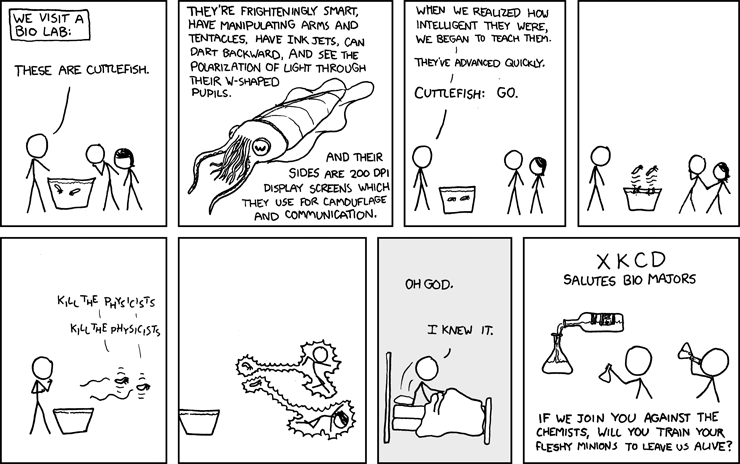
Happy Cuttlefish

Posted in Uncategorized | 7 Comments

On becoming mainstream

Here’s one for all you people desperately trying to get a senior scientist “blogging”:http://network.nature.com/hubs/london/blog/2008/11/21/so-you’re-not-interested-in-a-free-trip-to-california-then. One of my entries from earlier in the year has been cited)A03 in a peer-reviewed journal!

How do you like them apples?

(HT: Eva)

Posted in Uncategorized | 1 Comment