
I’m a member of my local U3A branch’s social media group. A few of us meet regularly to learn about social media and associated topics, taking turns to present. This week I gave a talk about LinkedIn. I don’t really consider myself an expert but I’ve been on it since 2006 so I have some knowledge of and views about it. It was a chance for me to reflect on the platform and my use (and non-use) of it, and to explore its history and how it is distinctive.
Introduction to LinkedIn
In some ways LinkedIn is just like other social media platforms: members have a profile and they can post stuff. But in addition LinkedIn has a defined purpose. Its mission is:
To connect the world’s professionals, so
they can be more productive and successful
I think this sets it apart from other general social media sites.
It’s not the biggest social media platform but it is substantial. Launched in 2003 it has nearly 1 billion users across more than 200 countries and territories. 300 million of those are classed as ‘monthly active users’. In its basic form it is free to use, but you can pay for a premium subscription. Since 2016 LinkedIn has been owned by Microsoft.
The biggest reason for using it is job seeking/recruiting, with knowledge sharing/professional networking a close second. Businesses and freelancers use it to advertise and reach customers. It’s also used for data mining.
You are probably already a user of LinkedIn, or at least have an account there. One estimate said that there are 45 million users in the UK, which I find hard to believe.
Jobs
I have posted job vacancies on LinkedIn, but never used it to look for jobs myself. A couple of times I’ve been contacted through LinkedIn by job agencies. I think the premium subscriptions can be useful if you’re seriously jobhunting, giving you additional features and communication options. For recruiters too there is a premium service that would be worth it if you are hiring frequently.
One source says that 65 million people search for jobs on LinkedIn each week and there are more than 12 million applications through the site daily. Over three million new hires each year owe something to LinkedIn. The number of job adverts on LinkedIn is ever-changing, but I’ve read one estimate that there are 14 million open jobs there. I’ve also read that up to 60% of job postings there may be fake, so be warned.
Data mining
Some people use LinkedIn for data mining, either by simple web-scraping or by paying for access to the LinkedIn API. You can use it for general market research, trend analysis or competitor analysis, or for lead generation. The huge volume of data in LinkedIn also attracts academic researchers. I heard a very interesting talk from someone who’d carried out diversity research using LinkedIn data (eg proportion of women working in IT).
The users
Who are the site’s users? There are personal accounts (individual users) and corporate accounts (businesses). It is reported that 57% of LinkedIn users are male and 43% are female. Nearly 60% are aged 25-34, and 78% are outside the USA. Plenty more statistics are available about the geographical spread and extent of usage in different industries.
Knowledge sharing – your timeline – the algorithm
Your profile on LinkedIn is closely tied with your professional profile and employer, so there’s a strong incentive to behave. In my experience people on LinkedIn are reasonably well-behaved, but your mileage may vary. Much genuinely useful and interesting information is shared, though sometimes it comes across as ‘look at me’ or ‘hire me!’ or ‘buy my product’. Posts about career milestones (promotions, new jobs etc) will usually generate many congratulatory comments that are more about social connection than anything else.
There are also groups – these are sometimes linked with real world groups. They can help you to reach beyond your immediate network.
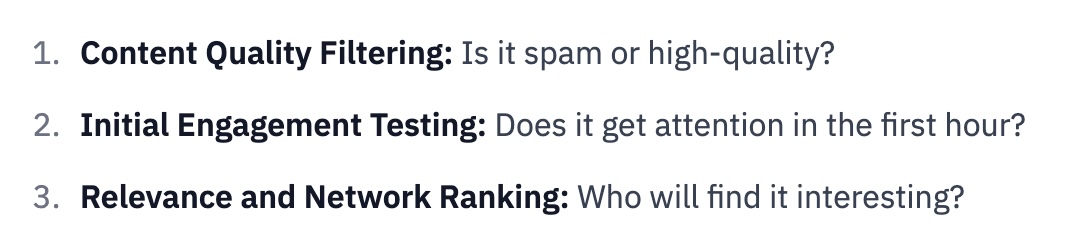
Your timeline is created partly by who you follow and partly by the LinkedIn algorithm. That’s a recommendation system that decides which posts appear in each user’s news feed. It filters and ranks content so that your feed is filled with posts that are interesting and relevant to you. It doesn’t have the problems associated with some other platforms and LinkedIn explicitly says the platform “is not designed for virality”. I think that’s very important.
Sourcegeek says there are three main elements to the algorithm:
Screenshot
If you want advice on how to get better engagement on LinkedIn you can read a 123-page report about the algorithm, full of tips.
LinkedIn and me
I joined LinkedIn in 2006, just because it seemed like something worth exploring and various people I knew had joined. It had a very pushy email invite system back then so it was hard to avoid. Once a few people in your circle had joined up you kept receiving invitations to join up too. I’m not sure if they still do all of that.
I wasn’t looking to change job so actually I used it very little at first. At some point I noticed that people were posting announcements and small articles. Some of these generated comments, even discussions, so LinkedIn became a place I visited to read stuff. Much more recently the changes at Twitter/X pushed more people to post content on LinkedIn instead of Twitter.
For me, with interests in research libraries, scholarly publishing, research culture, workplace wellbeing and DEI, I’ve found LinkedIn has plenty of content of interest.
I also use it to find out about people. Quite often when I search a person’s name in a general search engine their LinkedIn profile is among the top results. The profiles on LinkedIn include educational background and work experience, and the profile summary for a person highlights their recent posts and comments on LinkedIn so it’s good for giving you a quick impression of who they are.
LinkedIn is a successful business
Its three main income streams are adverts, premium personal subscriptions and recruiter subscriptions. It was expected to generate $6.79 billion through advertising in 2024. It generated $17.1 billion revenue in 2024, an increase of 8.6% year-on-year.
It has grown from a small site that let you post your CV online into a large multifaceted website. Here are a few significant mileposts in its development.
- 2003: Professional profiles – showcase your work history, education, skills
- 2004: Company pages – Businesses could create pages
- 2008: Groups – focused on professional topics or networks
- 2012: Publishing platform – publish your own long-form posts
- 2013: LinkedIn Endorsements – recognise your connections‘ skills
- 2017: Video upload – Native video hosting
- 2019: Stories – short-form content sharing
- 2021: Audio clips – share bite-sized voice messages
- 2022: Virtual events toolkit – templates and guidance for hosting
Boring but sensible
At our meeting someone commented that it had a reputation of being a bit boring, and I guess that’s true – it doesn’t court controversy and users tend to be focused on their work and professional interests to a large degree. But that is also its secret strength I think.


Good assessment. To my mind, LinkedIn is the best social media platform for academics, as it is the least intrusive even though there is a tiresome tendency to self-promotion and liking posts for no other reason as far as I can see except that you work in the same organisation as the person posting. Nonetheless. a lot becomes visible via LinkedIn that I would not otherwise see. It would be very interesting to see what has replaced Twitter for its very successful role for academics to share debate and content. Twitter has lost its credibility, but this use case seems to have disappeared as well.
Thanks Michael. I think there’s a lot of ‘social liking’ – a bit like on Facebook where you feel obliged to like a post or comment just to acknowledge it, to say ‘thanks’, or ‘I see you’.
Re. Twitter, i guess everyone has their own strategy but for me Bluesky and LinkedIn are the main places I go for interesting material and discussion, and have started to find Substack is interesting too.