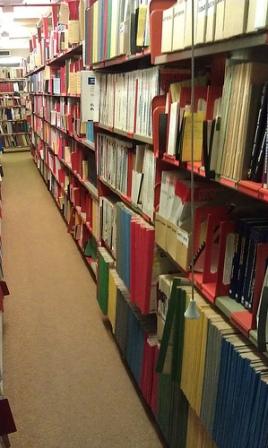
A great big store

Libraries are not all about storage these days, but for some libraries storage is still a key issue. The BLDSC is a case in point.

If you have ever asked your library to get you something that they didn´t have in stock then it’s likely that you have had the benefit of the services of the BLDSC (British Library Document Supply Service). It is a part of the British Library and is the UK’s ‘lender of last resort’ or, to put it more positively, the holder of a vast collection of books and journals that backs up the holdings of our university and specialist libraries. Much of what they hold is scientific material so the BLDSC is an important part of information provision to UK research scientists.

Located at Boston Spa, near Wetherby in Yorkshire, the BLDSC is more like a factory than a library. There are no serenely peaceful galleried spaces full of brainy scholars, just storage, storage and more storage, plus efficient mechanisms for retrieving volumes from the stores, and teams of people processing requests and scanning documents. I visited BLDSC many years ago, and I remember they proudly showed us their latest vast storage hangar. Earlier this month I was there again marvelling at their latest wonder, the poetically named ASB (Additional Storage Building), and seeing the first public demonstration of their new requesting system.

The ASB is awesome. It is a high-density warehouse, totally automated. The storage area is 23m high, with 262 km linear storage. It isn’t just rows of shelves on a large scale, it is really something else. From our vantage point in the visitors’ gallery I took some rather inadequate photos (see below) and you can see some more photos of it on the BL website. I didn´t get to see it from the ground level but this picture gives a good impression of the height. Someone more familiar with scifi movies than I am commented that it looked like the Matrix.

The ASB holds books, journals, CDs and newspapers, all contained in crates of standard sizes. What struck me on entering was the smell. This is a totally 21st-century high-tech automated storage facility, and what does it smell of? Dusty old libraries! That smell you always find in library stores and archives is there too.

The material held in the ASB has been moved there from three British Library storage sites in London (Woolwich, Micawber St and Colindale). The process for retrieving items is impressive. Vertical poles span from the floor to the ceiling and they move rapidly through the space to retrieve a particular crate, dropping it onto a conveyor roller which then takes it to another area where human operators retrieve the particular item from the crate.

Part of the ASB's retrieval mechanism.

The video on this page gives some idea, or you can view a simulation. A database of all the items in the store underpins the whole retrieval process.

After seeing the wonders of the ASB we (that is, me and a group of fellow librarians) were then treated to a preview of the BLDSC’s latest online requesting system. I won’t bore you with that, except to say that they have totally overhauled their back-office request processing and made it much easier for people to apply and track progress online. I think the idea is to help the BLDSC to reach out to parts that other libraries don’t reach – the SMEs and ventures that can’t justify in-house library services. I think it will be an improvement for all users of the service though.

What fascinates me about the whole BLDSC is the way that this world-class service, which delivers digital information to all corners of the globe, rests on mechanical and human processes which, frankly, look a bit clunky. On reflection, it is reassuring that the service is not awash with flashy furnishings and glossy IT. It is built to work and to do a job at the best possible price, and that is just what it does. I present the pictures below, therefore, in a spirit of affection and respect.

Old terminal

When was the last time you saw a terminal like this?

The flashing blue light

When an urgent request comes through this blue light comes on.

This is the older storage area, looking more like regular library shelving.

Conveyor belts move stock around

It is all functional rather than beautiful.

Posted in Document delivery | Tagged , , , , | 3 Comments

More on Wikipedia

Just a quick follow-up to my recent post about Wikipedia. Wikipedia has been in the news recently, with the BBC highlighting Cancer Research UK’s Wikipedia activity and the Guardian editorialising on the survey that the Wikimedia Foundation is running.

The BBC website story points out that if you put ‘Breast Cancer’ into a search engine the results show information from CRUK in eighth place, whereas an article on Wikipedia comes up in second place. Henry Scowcroft, scientific communications manager at CRUK, said: “Wikipedia is nearly always at the top of an internet search for cancers. It’s not always that easy to understand and sometimes it can be inaccurate or not completely up to date. We want to increase the accuracy and clarity.”

The Guardian editorial talks laconically of the tendency of science to “throw barbed wire” around itself and the need “to lure big brains into the world’s biggest seminar”, by which I think they mean Wikipedia.

We have started looking at Wikipedia and it has been suggested that we (that is, I) should write some biographical articles about some of our leading scientists. The only trouble with this idea is that biography, and particularly autobiography, is rather prone to ‘point of view’ problems. Wikipedia have strong guidelines on this, advising against autobiographical articles because they are prone to bias, or lack of balance. Wikipedia is a secondary source, so it is not the place to publish new information rather it is a place to draw together previously published information. I am not quite sure whether pages on institutional websites about staff count as unbiased sources but I rather suspect not.

It will be interesting to see how I get on with this project.

Posted in Communicating science | 6 Comments

A couple of historical exhibitions

Further to my recent musings about Walter Morley Fletcher, I was interested to see a couple of exhibitions advertised, both in London.

The Royal Society have mounted an exhibition Frederick Gowland Hopkins and the Chemistry of Life, to mark the 150th anniversary of his birth. Hopkins worked with Fletcher and I have seen his name crop up a lot when reading about that period so I was vaguely aware that he was a major figure. The exhibition celebrates Hopkins’ life and his “enormous contribution to one of the key scientific disciplines of the twenty-first century”, namely biochemistry. The Royal Society website has a nice summary of the exhibition; the final part is titled “The Father of Biochemistry”. There is also a lecture about Hopkins, tomorrow, being given by Dr Alison Thomas from Anglia Ruskin University. I was interested to note that the blurb for the lecture states

Many subsequently well known women biochemists began their careers in Hopkins’ department. This talk will introduce Hopkins’ life and work, concentrating in particular on his role in encouraging women to pursue careers in biochemistry.

The Royal Society webcast many of their lectures but I am not sure yet whether this one will be webcast.

The other exhibition is at University College, London and marks the 100th anniversary of the death of Francis Galton. Actually it is a pair of exhibitions, one at the UCL Main Library features exhibits from the Galton Papers held by UCL Special Collections and the Galton Collection; the other is at the Petrie Museum, featuring photographs that Galton comissioned Flinders Petrie to take of different ‘racial types’ on monuments in ancient Egypt. The news item linked above includes a gallery of photos from the exhibitions.

Posted in History | Comments Off on A couple of historical exhibitions

Moving towards movement, by Jove

Sometimes you look round and realise that the world has changed. It has been changing little by little so gradually that you didn’t notice but then you realise “Aha! The much predicted and talked-about convergence of TV and computing has happened!” You can buy a TV to watch YouTube videos on, you can watch regular TV programmes on your computer (or phone or tablet device), and there is a vast amount of moving image material ‘out there’ on the internet, meeting all kinds of interests and, er, predilections.

Some of that material is of scientific interest and a useful post on Nature Network includes a list of video sites of interest to a scientific audience. They range from scientific lectures, to YouTube clips and others with a public engagement angle, to schools material. Also included is JOVE, the Journal of Visualised Experiments which calls itself a video journal for biological research.

JOVE is an interesting journal. It started in 2006 as a free, community, site but reality kicked in and three years later they changed business model with submission fees and subscriptions. I occasionally get asked whether we subscribe, but it has never seemed to be a sufficiently important journal for enough people that we can justify the expense.

JOVE is a US-based operation but they have recently opened a UK presence and are looking to make a bigger impact over here. I spoke to them at a conference last week and they admitted that their pricing structure does not fit well with the UK market, so we can expect changes some time this year. It may still end up too expensive of course, but here’s hoping. Meanwhile, about 30% of their content is open access so you may be able to access the article you want.

Posted in Journal publishing | Tagged | 6 Comments

Wikipedia is quite engaging

Wikipedia and its role in science keeps cropping up on my radar recently. Matt Jukes pointed out last week, in a talk to a group of Science Communications people, that a decent article in Wikipedia about a science topic would reach a far bigger readership than printed booklets, newspaper articles, or webpages on our local websites. Hence if we want scientists to engage with the widest possible public and disseminate scientific knowledge most effectively, we should be encouraging them to start writing for Wikipedia.

A guest post by Dario Taraborelli on the Wellcome Trust blog alerted me to a questionnaire put out by the Wikimedia Research Committee to help it understand why scientists, academics and other experts do (or do not) contribute to Wikipedia. Dario makes some suggestions as to why scientists do not contribute

  • the lack of incentives from the perspective of a professional career
  • the poor recognition of one’s expertise within Wikipedia
  • the widespread perception of Wikipedia as a non-authoritative source

WikiMedia UK is a body that supports the aims of Wikipedia and helps to “collect, develop and distribute freely licensed knowledge”. One of the ways it does this is by organising Wiki Academies. Matt Jukes describes his experience at one of these last weekend in Bristol. I was interested to see that Cancer Research UK (CRUK) are hosting a Wiki Academy for their staff soon. WikiMedia UK also have a program called GLAM-WIKI that aims to get galleries, libraries and museums involved in Wikipedia. And finally, the BBC reports that Imperial College is also getting in on the act with a Wiki Academy next month, recognising that Wikipedia is a resource that students use.

Wikipedia is an interesting phenomenon. In some ways it is hard to believe that the model can work – if you let anybody edit a page you would expect chaos to ensue. Wikipedia avoids chaos by enforcing a strict method with structures and controls. Many people still refuse to believe that Wikipedia does work and that it is a benefit to the information landscape.

I think Wikipedia is the cream of the interwebz. In a world of chaos it is organized. In a world of trash it is full of jewels. In a world of partisanship it attempts to remain unbiased. That is not to say that it is always the best of the best, rather that it has the potential to be good and if you use it with some caution (e.g. look to see whether the article you are interested in is well-referenced) then it is a useful information resource.

Broader participation of scientsits as Wikipedia contributors will make it more useful still.

Posted in Communicating science, Scientific literature | 9 Comments

Walter Morley Fletcher

The lecture hall in my Institute dates back to the 1930s. It has a simple design with excellent acoustics, typical of its era. It is called the Fletcher Memorial Hall, which begs the question – who he? Just outside the hall there is a clue in the shape of a bust on a marble plinth. It portrays Sir Walter Morley Fletcher (1873-1933) who was the very first Secretary of the MRC.

Bust of Walter Morley Fletcher

This bust of Walter Morley Fletcher stands outside the Fletcher Memorial Hall in NIMR, Mill Hill


Research career at Cambridge
Fletcher graduated from Cambridge University then gained his clinical training at St Bartholomew’s Hospital in London and later spent some time at Hans Meyer’s laboratory in Marburg, Germany. But his intellectual home was Cambridge and he spent most of his research career there. In 1897 he won the Trinity Fellowship, which gave security for a life of scientific work in Cambridge. He was a loyal Cambridge man and participated in the affairs of both Trinity College and the University, serving for a time as Proctor.

Fletcher was a physiologist and he quickly gravitated to research on muscle respiration. He used techniques from biophysics and biochemistry to elucidate the chemical exchanges in contracting muscle. He published an important series of papers in Journal of Physiology between 1898 and 1914 that are still cited even today. His first contribution, in 1898, was a substantial paper of nearly one hundred pages, documenting the elaborate apparatus that he used to measure carbon dioxide. His 1907 paper with Gowland Hopkins showed that contraction of excised muscle is accompanied by an increase in lactic acid but if the muscle is placed in oxygen the lactic acid disappears. In his last published research paper, in 1914, Fletcher showed that none of the processes leading to the release of carbon dioxide was directly concerned with muscle contraction. Fletcher’s work ushered in the lactic acid era and opened the way for his student AV Hill’s work on muscle physiology. Fletcher, with Gowland Hopkins, gave the Croonian Lecture in 1915 on the story of the respiratory processes in muscle.

Research administration at the MRC
Fletcher’s success in research was not enough for him. John Ledingham wrote

It has been said that Fletcher’s soul was not fully and entirely satisfied by the strivings and triumphs of laboratory toil and that he sought a wider arena in which his intellectual versatility and his flair for managing might have full play.

Fletcher’s friend and colleague T.R. Elliott wrote that

after 20 years at Cambridge [Fletcher] came to that critical period nel mezzo del cammin di vita when men who know their powers for administration and see around them occasions that would with certainty yield good results to their controlling hands, are inclined to abandon the laboratory and its slowly moving quest for knowledge.

The Medical Research Committee was established by the UK government in 1913 and Fletcher was appointed to lead it in 1914. The career change seemed to suit him. Elliott said that Fletcher’s “peculiar gifts thenceforward shone with the brightest power for the aid of medical science“.

Fletcher took up his position with the MRC in 1914, just before the First World War started. The war could have been a disaster for the MRC, but Fletcher was able to convince the government that research could be beneficial to the war effort. During the next four years the resources of the MRC were given almost wholly to the pressing medical problems of war-time, e.g. studies of wound treatment, poison gas, and renal disease among men in the trenches. The MRC gained the full confidence of both the medical profession and academic staff and emerged from the war with its reputation established and its future secure.

Fletcher worked harder in the 20 years he was at the helm of the MRC than he ever had at Cambridge and he became the guiding spirit of the MRC in its formative period. In 1920 he re-established it as the Medical Research Council with its own independence and Royal Charter. This made the MRC virtually autonomous, having considerable freedom and responsibility.

George Trevelyan, speaking after Fletcher’s death, said:

He was anxious to prevent the Medical Research Committee (Council) from becoming a mere Department of State like any other in Whitehall. Its spriit was to be scientific, not at all political, and not merely administrative.

The MRC also gained a high degree of esteem in scientific circles, partly as a result of the close links with the Royal Society that Fletcher developed, following his own election as FRS in 1915.

Fletcher guided the research of the MRC, focusing particularly on developing new areas of medicine and forging closer links between basic science researchers and clinicians, including funding clinical science research positions in hospitals across London. By the end of the 1920s, Fletcher was considered one of the guiding lights of British medical research.

Fletcher the man
Landsborough Thomson said of Fletcher:

His was a vivid personality – spectacular physique, striking features, dyunamic energy, quickness of thought, and an elegance in the spoken and written word – but with a ‘hovering stutter’ when excited. … warm human qualities as well … also masterful and he could be vehement in controversy if principles that he valued were assailed. … He had a veneration for truth and an intense belief in the value of science in the service of humanity

Others noted his “quick attractiveness of manner and a gaiety that broke out unexpectedly and could not long remain submerged by serious thought“.

Walter Morley Fletcher

Walter Morley Fletcher

Fletcher’s parents were from Yorkshire and were non-conformists, Congregationalists. Thomas Elliott wrote that

In each of them religion was blended with a sensitiveness to art and culture that made goodness and beauty seem to them almost the same. Fletcher never lost these spiritual impressions … His praise of clean scientific work rose to its highest appreciation when he spoke deliberately of its beauty…

Montagu James, Provost of Eton, wrote of him as “the truest and kindest of counsellors, and magnificently keen in his appreciation of all that is best in the works of God and man“.

Where principles affecting freedom for scientific research seemed to him to be at stake his courage to resist was unfaltering and outspoken. One colleague described him as ‘like a rock’.

Protecting medical research

Fletcher was tough-minded in protecting the scientific rigour of medical research. He argued that medical practitioners were incapable of co-ordinating scientific activities. Christopher Booth describes Fletcher’s dealings with Thomas Lewis and the Royal Colleges with regard to clinical research in the UK, citing a letter from Fletcher in which he said that physicians had alienated scientific opinion by their “insistence that headship among successful practitioners is a qualification in itself for leadership in scientific work“. Joan Austoker concurs, saying

his views on medical research differed radically from the opinions of those in the daily routine of clinical medicine .. and vigorous criticisms and intolerance of medical practice did not endear him to many in Harley Street

He believed that the problem of cancer had “passed beyond the realms of clinical observation, and clinicians do not possess the requisite education either to add to or even to supervise work which demands highly trained biologists“.

Austoker also describes the battles (I don’t think that is too strong a word) that Fletcher had with the leaders of the Imperial Cancer Research Fund (ICRF) and later with the founders of the British Empire Cancer Campaign (BECC).

He was displeased with the refusal of the ICRF to comply with his request for some formal cooperation in the administration of funds for cancer research. He was determined that all medical research in the future should come directly or indirectly under MRC control.

He was not pleased when he learnt of the formation of the BECC, writing to its leaders thus:

I ought I think, to remind you that the MRC is the body specially charged by the Government and Parliament with the duty of supporting and encouraging work in all branches of medicine.

Fletcher was also influential in a wider context. Landsborough Thomson says that he was

personally consulted by potential benefactors of medical education and research wishing to apply funds directly to particular objects. In the middle 1920s much of his time was taken up in planning the future London School of Hygiene and Tropical Medicine.

Interestingly, he was named in Henry Wellcome’s will as one of the scientific trustees, alongside Henry Dale, but sadlly Fletcher died before Wellcome. I wonder what Fletcher would have thought of the major role played by today’s Wellcome Trust?

Thomas Lewis said, in his memoir of Fletcher, that

he looked out over England and saw how little her people were receiving in bodily welfare from all the newly woven science. The need for a fuller use of biology in every branch of statecraft became the theme which he later urged so strongly in public addresses… It was not the delight of the intellect in research … that became his lifelong motive .. [but] instinctive sympathy with high and selfless aims in public service

He added that Fletcher “continually emphasized the need for the application of every discovery to control of ill-health and … urged the measures that were taken to test or use their value“.

Microbiologist John Ledingham, in his obituary notice for Fletcher used a colourful analogy:

Fletcher was the conductor of a great orchestra of many and strange instruments, and it was his business to harmonise and co-ordinate the tunes of each to the greater glory of medical progress

The future of medical research
The year before he died Fletcher summarised his ideas about medical research in two articles in Nature, entitled ‘The scope and needs of medical research’. He draws attention to the science of genetics, saying “we can form almost illitimable hopes of betterment in body and mind that fuller knowledge in this subject may hold out to the human race” before warning against the pitfalls and false assumptions of eugenics. He also talks of the importance of prevention, nutrition, and industrial health. He concludes in saying

It is better mastery over living matter, and the improvement of the bodily and mental powers of man, that are needed for the real betterment and enrichment of the race. By powers of a kind that we are already in process of gaining by medical research we may hope to transform human life in ways almost unimagined now and to make a new world indeed.

Fletcher died in 1933, greatly admired as both a scientist and a public servant. After his death the MRC published an appreciation of his contribution, mentioning his research career, his teaching, his culture “in which scientific and humane studies were well and fruitfully balanced” and his mastery of practical affairs. It continued:

He was always and even painfully aware of the suffering and disorder of mankind and profoundly convinced that their root lay in ignorance. The zeal and unmistakable honesty with which he held this conviction were the foundation of his singular power.

The memorial

Over five hundred subscribers donated to the Walter Fletcher Memorial Fund set up after his death. The intention was originally to fund both a memorial statue and to contribute to the cost of a new laboratory for research in nutrition in the new NIMR building at Mill Hill which was then being planned. Fletcher had considered nutrition an important – and overlooked – facet in human health. However, plans for the Mill Hill site changed and a nutrition laboratory was not deemed to be a suitable memorial to Fletcher. Instead it was decided that a more fitting tribute would be to provide a hall for meetings and lectures at NIMR and thus the Fletcher Memorial Hall came into existence. The memorial statue, was first installed in the library at NIMR on its Hampstead site, and was later incorporated into the design of the lecture hall in the new building at Mill Hill.

Bust of Walter Morley Fletcher, in its original location in the Library at NIMR, Hampstead

Bust of Walter Morley Fletcher, in its original location in the Library at NIMR, Hampstead

A ceremony was held at NIMR, Hampstead, on 11th Nov 1936 at which subscribers to the memorial fund were invited to view the portrait bust of Walter Fletcher, sculpted by Dora Clarke. Fletcher’s old colleague Hopkins gave a speech, commenting that

very near to [Fletcher’s] heart were the interests of the National Institute … and he felt great pride in the important gains to knowledge which have arisen from the devoted and brilliant labours of its staff. The Institute has been a home of the team spirit in research. This spirit calls for self-forgetfulness, but here it has been abundantly justified in its results.

Sir Henry Dale, the then Director, accepted the custody of the memorial bust saying that all who worked in the Institute

could never forget what they owed to Walter Fletcher … this fine portrait would daily remind them of what he meant to the Institute in its early years and would transmit to those who came after them a hint of his inspiring personality.

Sources

A history of the Imperial Cancer Research Fund, 1902-1986
Joan Austoker, Walter Bodmer (1988)
Oxford University Press, p. 375

Clinical research and the MRC.
C C Booth (1986)
The Quarterly journal of medicine 59 (229) p. 435-447

Half a century of medical research
A. Landsborough (Arthur Landsborough) Thomson (1974)
London, HMSO.

Memorial to Sir Walter Fletcher
F. G. Hopkins Stanley Baldwin (1934)
British Medical Journal, 1 (3832) p. 1091

Memorial to the late Sir Walter Morley Fletcher (1873-1933) secretary of the Medical Research Council, 1914-1933.
Walter Fletcher Memorial Committee (1937)
Oxford, OUP.

Obituary Notice: Walter Morley Fletcher. (1873-1933.).
J. Ledingham (1933)
The Biochemical journal 27 (5) p. 1333-6

Sir Walter Morley Fletcher. 1873-1933
T. R. Elliott (1933)
Obituary Notices of Fellows of the Royal Society 1 (2) p. 153-163

The bright countenance a personal biography of Walter Morley Fletcher
Mary Frances (Cropper) Fletcher (1957)
Hodder and Stoughton

The Scope and Needs of Medical Research (part 1)
W. M. Fletcher (1932)
Nature 130 (3275) p. 190-192

The Scope and Needs of Medical Research (part 2)
W. M. Fletcher (1932)
Nature 130 (3276) p. 224-227

Walter Morley Fletcher and the origins of a basic biomedical research policy
Joan Austoker (1989)
In: Historical perspectives on the role of the MRC, edited by Joan Austoker and Linda Bryder. Oxford, OUP. pp. 23-34.

See also details of Fletcher’s archives and papers.

Posted in History, Research Councils | 10 Comments

Peer review inquiry – written evidence

I wrote a couple of months back about the background to the Science & Technology Select Committee’s inquiry into peer review. The Select Committee has published all the written evidence submitted to its inquiry. The publication of written evidence provides a useful pointer to what are the key issues under consideration, though with 87 submissions I must confess I have not read them! The next step will be for the Committee to invite some witnesses to give oral evidence and submit to questioning by the Committee.

The list of those submitting evidence is impressive, from publishers and their representatives:

  • Elsevier
  • Wiley-Blackwell
  • PLoS
  • BioMedCentral
  • Publishers Association
  • ALPSP
  • STM
  • BMJ group
  • Richard Horton (Lancet)
  • Philip Campbell (Nature)

From funders:

  • HEFCE
  • RCUK
  • Wellcome Trust
  • Cancer Research UK

From learned societies (many of these of course are also publishers):

  • Royal Society
  • Royal Society of Chemistry
  • Institute of Physics
  • BMA
  • Society of General Microbiology

From other bodies with an interest in publishing and scholarly communication:

  • Committee on Publication Ethics
  • UK Research Integrity Office
  • Sense about Science
  • JISC (for the OA Implementation Group)
  • Iain Chalmers (James Lind Library)

And there is also evidence from a whole host of academics and individuals, across a range of disciplines (e.g. Nikolaus Kriegeskorte, Mark Bretscher, David Taylor) including a couple of pro vice chancellors (Ian Walmsley, from Univ Oxford; Thomas Ward, from UEA). Some of those connected with or commenting on the “Climategate” affair provided evidence: Thomas Ward, John McLean and Lawrence Souder. McLean’s evidence is fascinating as it includes some of the Climategate correspondence that relates to the peer review of particular articles. Ralph Kenna and Bertrand Berche give an analysis of the consistency of the RAE process, while Alastair Gill and Nigel Gilbert present evidence on the quality of science, from their QLectives project.

That is just a partial list of the evidence, highlighting what look to be more substantial or interesting submissions, and ignoring most of those outside the biomedical field. I don’t envy the Committee members who must read and digest all of this.

Posted in Journal publishing, Peer review | 1 Comment

Copy – right or wrong?

Copying is entwined with technology, and ideas about copyright have changed as technology changes. In the days of stone tablets I don’t think many people worried about copyright. The invention of pen and ink (see this lovely brief history of writing) made it easier to make copies of texts but it was still a slow process. Gutenberg’s development of printing made it possible to produce larger numbers of a particular text. Last year I visited the Gutenberg museum, devoted to the history of Gutenberg and printing – worth a visit if you find yourself near Mainz – and I saw some of the Bibles he produced. The copyright owner could not be contacted for permission but I don´t think He is too concerned about copying.

The Gutenberg museum in Mainz

The birth of the photocopier really changed the copzing game. Its widespread adoption in offices and then libraries meant that by the 1970s it was very quick and easy to make a copy of a page, and copyright owners began to be concerned. We started to see journal publishers charging a higher rate to institutional subscribers (usually libraries), in the knowledge that articles in journals sold to libraries would not just be read but also photocopied.

Now we are in the online age things have changed again. Whereas a photocopy of a page is never quite the same as the original, a copy of a pdf file is indistinguishable from the original. Publishers impose tight restrictions on institutions which purchase licenses to access journal content and they monitor usage for suspicious activity, such as excessive downloading of articles. Publishers have also developed DRM (Digital Rights Management) to restrict copying of ebooks.

Recently I printed a short article about copyright by Robert McCrum in The Observer and was surprised when 22 pages spewed out of my printer, thanks to vigorous comments thread that I hadn´t spotted was there. McCrum highlighted some of the challenges to copyright in the age of “free content” and the Free Culture Movement, but argued that technology was the real threat to copyright. The comments developed into a real scrap between proponents of the public domain and those wishing to protect the rights of authors, even well after their death. The comments came alive once Michael Hart entered the fray. Hart is the founder of Project Gutenberg and I remember receiving his emails in my inbox back in the 1990s, arguing intelligently and eloquently about copyright and the public domain. He had the uncanny knack of typing perfect prose in precisely 80-character wide paragraphs, i.e. perfectly right-justified with no extra spaces. He is still well worth reading.

Alex Wade, writing the following day in The Guardianabout new media , also drew attention to the way that the “Web 2.0 zeitgeist of openness” was challenging corporate distrust of “notions of sharing and connectivity”. Wade quotes media lawyer Graham Hann:

“the next 12 to 24 months will see a fascinating series of developments as consumers and businesses seek to find a level playing field… The law has to play catch up and deal with this tension between consumers and suppliers”.

Francis Gurry, Director General of the World Intellectual Property Organization (WIPO), agrees. Speaking last month at a conference on Future Direction in Copyright Law he said that “the old principles of intellectual property regulation are strained in the Age of the Internet” and asked:

How can society make cultural works available to the widest possible public at affordable prices while, at the same time, assuring a dignified economic existence to creators and performers and the business associates that help them to navigate the economic system?

His answer involves a series of balances, between availability and control, consumers and producers, society and individuals, consumption and culture. He says that digital technology and the Internet have changed the balance and that the copyright system must adapt or it will perish. He then enumerates a number of principles that should guide policy change:

  • Neutrality to technology and to business models developed in response to technology
  • Comprehensiveness and coherence in policy, through a combination of law, infrastructure, cultural change, institutional collaboration and new business models
  • More simplicity in copyright.

His article is thoughtful, informed and well worth a read. I was reassured that WIPO is in such good hands since it drives copyright policy throughout the world.

More parochially, last week saw the close of the call for evidence for the Hargreaves Review of Intellectual Property and Growth. This review was announced last November and covers all aspects of intellectual property, including copyright. The call for evidence asks specific questions on copyright, seeking among other things to compare the UK copyright framework with that in other countries, to review whether it has adapted to the digital age and identify problem areas, and to find non-legislative changes that could help.

The list of people consulted includes the British Library and LACA (Libraries and Archives Copyright Alliance) as well as copyright owners groups and publishers. On his blog Ian Hargreaves says they’ve had more than 180 submissions and hope to report to Ministers some time in April. What happens after that is anyone’s guess but hopefully it will be published.

Hargreaves is hopeful that he can propose improvements, saying:

the review will not be reckless in pursuit of change: it will seek reforms which are designed to improve the economic contribution not only of the UK’s creative industries, but also of the many other industries which rely, increasingly, upon intangible intellectual property assets, the internet and innovation for their success.

I’m not sure whether scientific research counts as an industry, but for sure it is an activity that relies heavily on “intellectual property assets”, or knowledge as some people call it. I have written before about the problems caused for science when copyright laws are set to benefit the film and music industries. I was quite timid in that earlier post but inspired by Peter Murray-Rust (also this one) I think I should now come right out and say that copyright in scientific research is a nonsense, a barrier to the flow of knowledge and it has no place in science. It is interesting that both the WIPO Director General and the Hargreaves Review call for evidence mentioned cultural change as being just as important as legislative change. I think the science community should embrace the culture of Open Science, Open Access and Open Data. Leave copyright to creative industries.

Update
In the comments Cath points out that this post appears twice on the OT home page. I had a problem here yesterday that Richard helped me with. But I then edited and published the post not realising that version had him as the author. I then copied and reposted the item and deleted the first version. Unfortunately deleting it from my blog doesn’t seem to delete it from the front page of OT.

In addition I am now not able to comment on the post, hence I have put the comment here. I think it’s the copyright demons exacting their revenge.

Posted in Copyright and IP | 5 Comments

Is this the killer application for researchers?

Colwiz stands for ‘collective wisdom’ (terrible name!). It advertises itself as ‘research management, collaboration and productivity in one place for free’ and has just been launched by a group of scientists at Oxford University. They say it will help you to “manage the entire research lifecycle from an initial idea, through a complex collaboration, to publication of the results”.

The idea of Virtual Research Environments (VREs) has been around for a few years but they have remained niche tools. JISC has funded some projects in its VRE programme mainly carrying out particular tasks or targeted at a specific research area. myGrid is perhaps the most versatile tool to have come out of the programme, and has spawned a number of other tools. I saw a demo once of the British Library’s RIC (Research Information Centre), developed in partnership with Microsoft. It looked very interesting as an idea, and potentially powerful, but I haven’t heard much about it recently. I see that their website says a beta release is due in March 2011.

It is of course very easy to make a large number of claims for a new software tool, much harder to deliver. It’s too early to judge Colwiz yet but its ambition is commendable.

Posted in Research tools | 3 Comments

Monaco film festival award

I was surprised to see some familiar faces on the front cover of my local freesheet newspaper recently. This paper, The Archer, is not a typical freesheet, but a community-produced monthly newspaper which has a good deal of local content, not just advertising. The photo on the front page of the February issue showed three local people: the well-known British actor David Jason, sandwiched between the slightly less well-known artists Denise Wyllie and Clare O’Hagan. All three had recently been out to the Monaco Film Festival to collect awards.

Their film First Darkness won two awards at Monaco – Best Art Short Film and Best Original Music Short Film. The film has a sombre subject:

It charts the progress of someone’s grief through the seasons, starting in winter with its sombre landscape and feelings. Gradually a lifting of the spirits comes as the seasons
move through spring to summer.

See this page from The Archer for the full story about Monaco. The film is now bound for Brazil, having been selected for the Short Films Competition program of a documentary film festival there.

Denise and Clare are an interesting artistic partnership, going by the name Wyllie O Hagan. I first got to know them back in 2003 through some science-inspired works that they had produced. That year was the 50th anniversary of Crick and Watson’s discovery of the structure of DNA and there were various celebrations. Francis Crick’s old school, Mill Hill School, celebrated his association with the school by inviting their students to an event held at NIMR, which is where I work and is just down the road from the school. The school also purchased for their conference centre some prints from Wyllie O Hagan that took DNA as their theme. To mark the occasion further the 2003 issue of NIMR’s Mill Hill Essays included some of the Wyllie O Hagan images and, as editor of that august volume, I became involved in negotiating with Claire and Denise for permission to use their work.

Vision of Rosalind 2 © Wyllie O Hagan

The image shown above is my favourite from their series on Rosalind Franklin and DNA. It is a small section of their extraordinary installation Transformations in Science and Art – a 42 metre long cross-media, textile artwork that they developed following a residency with cancer researcher John Hartley. I love it because of its vibrant colours, and the way it straddles abstraction and representation. You will spot the double helix in there and also photo 51. A few years later NIMR hosted an exhibition of the Wyllie O Hagan Rosalind Franklin series, including a portrait of Rosalind Franklin, alongside some posters (that I had prepared) about some notable NIMR women scientists. The exhibition was very well-received by the NIMR scientific staff.


Rosalind Franklin: Discovering DNA’s structure © Wyllie O Hagan

Denise and Clare are two of the most delightful people you could hope to meet, so it has been a pleasure to meet up with them periodically. They have kindly invited me to one or two of their other showings, and I remember attending a St Patrick’s Day Film Festival that they organised in 2007. I’m not sure exactly when or why they started making short films but their YouTube channel dates from 2006. I particularly enjoyed the brief film The Wild Swans at Coole, a deft interweaving of poetry, printmaking, nature photography and music. The film and the print are both enchanting.

The Wild Swans at Coole © Wyllie O Hagan

I love the work of Wyllie O Hagan. It is always interesting, thought-provoking and attractive. I’m sure they would never think to describe any of their work as ‘sci-art’ (that term should be banned!) but some of their work does take its inspiration from science and that gives it an extra fascination for me. I love what they do and recommend you to take a look too. They have a website, a Facebook page, a YouTube channel and a blog.

Posted in Art, Film | 3 Comments