Library Day in the Life 2013 – Tuesday

Here goes with my second Day in the Life post this week (see Monday’s post for some background).

I had planned to get in super-early this morning, but a disturbed night thanks to the thunderstorms put paid to that. I arrived at my desk about one hour before my visitors were due to arrive.  This gave me time to make a few tweaks to the blogpost for Occam’s Corner, mentioned yesterday, and do my daily news scan. Highlights today were the announcement of the various Royal Society awards and honours, a rant about big grants and a paper about the future of the German research funding system.

My visitors then arrived, slightly early. They were two of the winners of our 2013 School Essay Competition, aged 15 and 17.  As well as a small cash prize the winners get to spend a day at the Institute and to tour some of the labs and facilities.  I started by telling them that if they had ambitions of becoming scientists they must learn how to be consistently five minutes late for every meeting, then I brought them upstairs and explained how the Institute works, its science and its history, plus a bit about the Library and science publishing (including a quick explanation of Open Access). They didn’t look too shell-shocked. Luckily their next appointment after me was a resuscitating coffee in the Restaurant.

Then I worked on another news item about a forthcoming paper, this one about polyQ repeats. It sounded interesting but I won’t say more as it’s not published yet. I worked on it during the day and sent it off to the PI early afternoon for checking.

I was interested to see an email about a new comment on a blog post I had tracked some time ago. The comment mentioned a page on the CRUK website about finding information on the internet.  Looks like a useful set of reminders about how to assess the reliability of sources. It took me back to the glory days of OMNI and its work on resource evaluation.

In the last 12 months we have had several new research groups start up. We encourage new group leaders to introduce themselves to the rest of the Institute by writing a few paragraphs about their new research programme, to go in our weekly newsletter. When I suggest it they all agree this is a good idea but it can take a good deal of urging before they get round to doing it. I was therefore pleased to receive such a piece this morning, ready to go in this week’s newsletter.

I was also pleased to see that a couple of requisitions in our ordering system have now been converted into purchase orders, which means that I can process two invoices which have been waiting on my desk. One of them is for a payment to the JISC APC pilot.  This should make it much easier to process those pesky Open Access payments to publishers.

In the mail I received our annual checklist of journal subscriptions, sent by our serials agent. I plan to cancel a few outstanding print subscriptions for 2014 but hope to retain most online subscriptions. I need to take a deep breath and go through this list soon, then return my instructions to the agent in good time.

A corridor conversation with someone in HR gave me a bit of the glums. One of the Library staff is leaving us, having found a new job.  She joined us under a trainee scheme and has now graduated as a qualified librarian, so getting her first professional job as a Librarian (capital L) is the culmination of what we have been working towards and of course great news for her. But it’s not such good news for the rest of the Library team. The training scheme no longer exists so we need to recruit someone to fill her position, but in the public sector these days recruitment is severely circumscribed. I am still waiting to hear for sure whether it is thumbs up or thumbs down, but the HR person gave me to understand that the news may not be good.  I have started thinking about what tasks we will have to ditch or downgrade. There’s no way the remaining staff can take on 33% extra work to cover the loss of a post.

Another visitor came to see me briefly after lunch to pick up a copy of our Open Day programme. The Open Day was dedicated to her late husband and the programme mentioned this so I saved a copy to give her. He did a great deal of work for the outreach programme at the Institute (including setting up the School Essay competition).

Another small task (perhaps one for chopping if necessary?) I do is to check the weekly list of new additions to our database of staff publications. This database feeds into the website and the annual report, amongst other things, so it is important. But it’s just one more thing to do.

This year’s Mill Hill Essays are way behind schedule, so I was pleased to finally hand over most of the text to our PhotoGraphics people to start assembling for publication. I still have to do a few things, but gave them the bulk of the essays.

I ticked off a few things today from my to-do list, but I hope tomorrow I can tackle some big tasks.

Posted in Libraries and librarians | Tagged | 6 Comments

Library Day in the Life 2013 – Monday

Sadly the Library Day in the Life project has ended. It provided a chance twice a year for librarians round the world to explain what they did each working day for a week.  I took part twice, in 2011 and 2012. The project ended earlier this year – it had grown quite large with many participants and its originator realised that it needed new goals and better focus. Sadly she felt she was not able to devote time to refocusing it so she decided to close it, though the archive is still on the original site.

On a whim this morning I decided I would do my own Library Day in the Life each day this week.


My first task on arriving was to put together a few words about the retirement of our Assistant Director after 45 years’ service. Yes: 45 years.  There was a party for him on Friday evening and I made some notes from the speeches. I decided on Friday that it wouldn’t be a good idea to try and write something after a few glasses of champagne and wine, so had to do it first thing today.  I sent it off to the editor of the MRC’s internal news magazine in good time before the deadline.

Then I carried out my regular scan looking for news about science policy and related things. The best piece today was from James Wilsdon about Demos, but I also liked the Labguru piece on motivating your lab team.

The next task was to assemble a short news item about a recent paper from one of our PIs. This is to go onto our external website. Mostly I just rearrange words from the abstract, introduction and discussion, trying to make a single story emerge. I don’t have the skill or time to write a lay-friendly piece, but our website is mainly aimed at scientists not the general public. It took a couple of hours, with various interruptions from visitors, phone calls and emails. Happily the PI liked what I had done so I made it live after lunch.

Many of those interruptions were open access queries. One postdoc was submitting a paper to a journal that apparently required that a licence to publish be signed at the time of submission.  That seemed unusual. Eventually she decided to submit to a PLOS journal instead. A divisional administrator (DA) asked me for help as one of her PIs wanted to make several of his articles open access, going back to 2009. The publisher of the articles in question did not have a paid OA option, so the PI would need to deposit the accepted manuscripts into PubMedCentral (PMC). The DA is going to come back to me once she has checked if a) he still has the manuscripts b) he knows his PMC username and password. Someone else also wanted to make a recent paper OA and wanted to know how to deposit into PMC.

I envisage this level of enquiries on OA will continue. The Director has just sent out a message (written by me) to all staff advising them that we need to improve our OA compliance.

Another interruption was about the renewal of a key database product. The rep who called me is trying to persuade us to add on some additional products to our basic subscription (almost no chance). The subscription is not due to expire until end of September, but may be a bit complicated so it’s good to start thinking about it now. The cheapest option is the three-year renewal, but that takes us well into 2016, by which point this Institute will have ceased to exist and will be part of the Crick. We have only just begun to discuss arrangements at the new Institute for online resources. Hence this apparently simple renewal raises all kinds of questions, not the least of which is how the new JISC banding arrangements will apply.

I delved into Twitter occasionally throughout the day, for light relief. I noted some adverse comments on David Cameron’s plans to filter the Internet, and was intrigued to see something called Radical Library Camp being planned for September. I am not really a radical, but I do find radical ideas stimulating – they shake me out of my tendency to cosy complacency. Definitely considering going along to that event.

Right after lunch I was supposed to have a meeting with someone about transition plans.  This was to discuss some documents but as we hadn’t prepared the documents yet I suspected it would not be a productive meeting. Then it turned out that he wasn’t actually in work today, so that settled that. It was a relief to have a bit more time, but I do really need to sort out our transition plans soon.

Next job was to finish off my contribution to a piece for Occam’s Corner. This is in connection with Thursday’s Wikipedia event, so I won’t say more here.  The main event is fully booked, but I am still getting some requests for extra people to come.

Finally, I just need to figure out what I am going to say to our School Essay Competition winners, who are visiting tomorrow. My task is to give them a quick overview of the Institute and its history, plus an introduction to the Library. I can do that in my sleep, but I just need to plan it out a little.

See you tomorrow!


Posted in Libraries and librarians | Tagged | 2 Comments

The building takes shape

My Institute will vanish in a couple of years’ time and will be reborn as part of a brand-new Institute: the Crick. One of the advantages of working in an Institute that is going through these difficult times is the chance to peek into the developing new Institute – the largest single-site construction project in the UK. It is quite something.

I was lucky enough to go along to the topping out ceremony last month, though I remained firmly on the ground – I was not part of the select party that went aloft to witness the actual topping-out. Down below, I got to witness the speeches by Sir Paul Nurse, the Francis Crick Institute Director,

and by Chancellor George Osborne (I even found myself clapping at the end of his speech – that’s a first!).

However, only a small group actually went upstairs after that to ladle cement into a little hole on the roof.

Image courtesy of Francis Crick Institute. http://www.crick.ac.uk

Last week though we did get to go up on top of the building.  They have regular site tours for staff and we arranged for all the Library staff to go.  I rather expected that post-topping out it would feel like an almost complete building, but I was wrong there. It is still very much a building site and much of the building is still open to the elements. We had to get kitted out in boots, hardhat, safety glasses and gloves. We walked up and down many flights of steps (the scary wobbly kind with holes in) and took a very slow hoist up  a few floors. We went down into the basements, as much as 17m deep, and went up onto the 7th floor (almost the top), with fairly impressive views of London.  Sadly photographs are not allowed so I wasn’t able to get any snaps of my own. (You can see a regularly updated album of photos on the Crick’s Facebook page, and some more in their Construction news pages).

It still needs a bit of imagination to see how the final building will look, but being inside it I got some sense of the scale of the building (i.e. big). The exterior is now starting to look more like the artists’ impressions, as they have put much of the glass on and are putting the lovely terracotta cladding on. We were told to come back again in Spring 2014 when it should look more like a completed building, though there will be another 12 months or so of fitting out work after that.

Posted in Crick, Uncategorized | 1 Comment

An 80th annivirusary

For most of us, appearances on TV are still unusual enough to generate some excitement.  Even just a slight chance of a televisual encounter can get the pulse racing. Last December I became briefly excited on hearing that the BBC were to do some filming here about the Institute’s influenza research. They wanted to film the Library’s model of the structure of influenza haemagglutinin and there was a passing mention of a remote possibility of them maybe wanting someone to read out a text if a suitable person was available (pleassir, me sir, me, me!). Well, on that occasion fame didn’t beckon but they made a good video piece about the Institute’s flu research, past and present, interviewing staff from the WHO Influenza Centre here.

As part of my getting-carried-away-with-myself I fished out a few books and reprints connected with influenza to make a little display. I chose some articles from around the time that NIMR scientists first identified the flu virus, as well as some older books. I dont think the BBC film crew noticed my efforts and I confess it was a bit of a half-hearted attempt.  But at least one person did notice it – one of our esteemed virologists (now retired but still very much involved in flu work) remarked on the display, and I admitted that it was my work. He also pointed out that 2013 would be the 80th anniversary of the landmark paper identifying the flu virus, published 8 July 1933 in The Lancet. He said there was an idea to mark this with some kind of event, so I asked him to let me know when the plans were finalised.

Over the next few months I asked again from time to time but soon realised that the idea had faded away. But it seemed to good an opportunity to let pass, so last month I pressed another of our esteemed virologists (not retired) to write something about the anniversary to put up on the Institute website. He sent me something just before our Open Day at the end of last month. I was too madly busy with preparations for the Open Day to do anything with it right away.

The Open Day went off well, with a wonderful unexpected visitor. The day kicked off with three science talks, one of them on influenza.  At the end of that talk a hand went up to ask a question and a certain Dennis Busby stood up and said “I joined the influenza research group at NIMR in 1934, and then in 1936 I was the first person to be injected with the flu vaccine”. Heads turned to look at him, a piece of living virological history. The more cynical members of the audience probably thought he had been planted, but I can assure you he wasn’t – everyone was taken by surprise. Dennis became the centre of attention after that.

Next day I got into action and discovered that Tilli Tansey had interviewed Den Busby for her 2008 article on research technicians, including a number of quotes from him. He joined NIMR in 1934 aged 15 and gradually worked his way up to head technician before retiring in late 1979. I also found a few photos of him in the archives.  I dashed off an email to my colleagues in the MRC Press Office, hoping to inspire them with some influenza history – an anniversary and a human interest story. A few days later and I was rewarded with the news that there was to be a blogpost on the MRC blog (a version of the piece that our virologist had written), plus another piece on the Guardian‘s history of science blog, the H-word, guest-written by Michael Bresalier. I remembered Michael from a few years ago when he visited to look at our archives.  His PhD thesis is about the history of influenza, and I see that he has  a book coming out soon about the subject so he is well-qualified to write about this anniversary.

So, these are the three (overlapping) pieces that came out this morning on the Guardian, MRC and NIMR blogs/websites, variously on some combination of influenza, MRC, NIMR, 1933, and Dennis Busby:

It’s also worth mentioning another account that came out as a Mill Hill Essay a few years back:

So, what of my little book display about influenza? In the face of all this historico-virological scholarship I feel shy to highlight my random assemblage of biblio objects.  But it’s now or never, so here goes. They are just a few things that were easy to find and seemed significant or interesting to me.

  1. Pride of place must go to the 1933 Lancet paper. (Elsevier have kindly agreed to grant universal access to this paper in perpetuity).
    • Wilson Smith, C.H. Andrewes, P.P. Laidlaw (1933) A virus obtained from influenza patients. Lancet 222(5732): 66–68. Article fulltext

  1. A couple of years later Christopher Andrewes gave a brief introduction to a meeting on influenza, and highlights some of the issues that were still unclear at that time about the virus.
    • C.H. Andrewes (1935) Influenza in Man and Animals Proc R Soc Med. 28(7): 941–950. Article fulltext.
  2. Patrick Laidlaw gave the 1935 Linacre Lecture on influenza, relating the background to their 1933 paper and the research leading up to it.  He also highlights the questions remaining to be decided, about the apparent variation in the virus. The lecture was published in the Lancet.
  3. Later Andrewes gave another overview of influenza, this time to a BMA meeting. He mentioned the early work in testing a vaccine, and noted the differences between strains of virus saying “the tangle is not going to be an easy one to unravel”. He concluded that “there are grounds for hope that an effective prophylactic against influenza may be found”.
    • C. H. Andrewes (1937) Influenza: Four Years’ Progress. Br Med J. 2(4001): 513–515. Article fulltext

Going back in time, I fantasised that these next three books might actually have been consulted by the team of Andrewes, Smith and Laidlaw.  Unfortunately closer inspection suggests that probably none of these items were actually in the Library in 1933.

  1. Die Grippe-Epidemie im Deutschen Heere 1889-90. Berlin, Ernst Siegfried Mittler und Sohn, 1890. [The flu epidemic in the German army. With a rather nice cover.]

  1. M.C. Winternitz, Isabel M. Wason and Frank P. McNamara. The pathology of influenza. Yale Univ Press, 1920. [Observations during the 1918 epidemic in New Haven, USA. Has very fine illustrations, including this Aubrey Beardsley-like picture.]

  1. University of Pittsburgh School of Medicine. Studies on Epidemic Influenza; Comprising Clinical and Laboratory Investigations. Univ Pittsburgh, 1919. [Investigations during the epidemic at Pittsburgh, 1918. This seems like a good summary of knowledge about the disease at that time. It also has some illustrations].

Finally, a short overview of influenza written in 1976 by two more names to conjure with from the history of flu research at NIMR:

  1. Influenza: the virus and the disease. Charles H. Stuart-Harris and Geoffrey C. Schild. London, Edward Arnold, 1976.

Handling these books and typing this post I find myself sneezing a little.  I’m not sure whether it is the high pollen count today, or the dust from the old books, or just a sympathetic immune response to the idea of the flu virus.  I hope that reading my words hasn’t induced a similar effect in you.

Posted in Books, History, Uncategorized | 2 Comments

MDPI – another OA publisher

I recently was alerted to the existence of an Open Access (OA) publisher that I had not heard of before:  MDPI. Their name stands for “Multidisciplinary Digital Publishing Institute” and they are based in Switzerland. They publish more than 70 journals  and all journals are members of the Committee on Publication Ethics (COPE). They started in 1996 and expanded slowly but since 2009 have launched quite a few new titles. The oldest title has published more than 5,000 articles, and 18 of their titles have published more than 200 articles.

MDPI publishes on quite a range of subjects – sampling the title list I find aerospace, agriculture, antibodies, crystals, entropy, genes, environment, molecular sciences, materials, remote sensing, and viruses. They have quite a few biomedical titles, though many of these are new and hence small at present.

Their fees vary quite a bit. Articles in new journals are published free of charge, but otherwise the fees range from CHF 300 to CHF 1800.

Are they a reputable publisher?  The answer seems to be ‘yes’, though perhaps their marketing can be overzealous. MDPI is a member of OASPA, which suggests strongly that they are reputable. Their journals are not high impact journals maybe but it seems they are serious publishers wanting to serve science.

Posted in Journal publishing | 6 Comments

Last night I dreamt I went to Mendeley again

Two weeks ago I was down in Bournemouth at the UKSG conference – a great gathering of library and publishing people.  As usual I took my running kit along and unusually I actually used them instead of just thinking about running. I usually enjoy running by the sea, with the sun and the sea breeze. I went out on the Monday morning, and it was perishing cold.  There was too much breeze and not enough sun so I was well-wrapped up against that chilly easterly wind. There were a few other hardy souls running, mostly equally well-wrapped-up. One of these seemed to recognise me and I half-thought I recognised him but it was hard to tell.

Later that day I spotted someone I knew who worked for Elsevier and said “Hello”.  He said – “Ah, so it was you out running this morning?” and I admitted it was. We chatted about the terrible wind, and this and that.  He used to be our Elsevier rep, dealing with our annual subscription renewals, but he now has a more strategic role in the global sales team. I asked an innocent question about the rumours earlier this year that Elsevier were to buy up Mendeley. “That rumour seems to have died down – I wonder if it was just someone at Mendeley flying a kite? It seemed an odd idea to me.” He professed to having no inside knowledge, and said that decisions like that were taken higher up in the company.

Well. The conference first day went by quickly – there’s always plenty of interest at UKSG – and in the evening I met up with a conference buddy for a few beers, getting back to my hotel fairly late.  I checked my email just after midnight and I found one message titled “Team Mendeley Joins Elsevier”.

The next morning, I couldn’t be sure whether I had dreamed that news or it had really happened. Was it a beer-induced nightmare?  I looked again and found a twitter-storm to confirm that it had really happened.

Back at the conference I saw my Elsevier contact again and he apologised that he hadn’t been able to be completely truthful with me – the deal was just in the process of being signed on Monday and he was sworn to secrecy until it was officially announced. I did quiz him a little about the implications for Mendeley. I had seen that Victor Henning was to have a title like “Vice-President for Strategy” within Elsevier.  My contact told me that the idea was not that Elsevier would change the culture of Mendeley, but that Mendeley would change the culture of Elsevier. I tried not to look too sceptical. I find it hard to believe that, but perhaps there is a real desire within Elsevier to change.  We will have to wait and see.

Later in the day I chatted with other library colleagues about the implications of the sale. We agreed that perhaps it was not highly significant for the majority of Mendeley users.  While Mendeley has been the poster boy for open access in some quarters, I think that many users adopt it because it is a useful tool to help with storing references and preparing bibliographies. They just want it to do a job for them, not for it to change the world. This will not change under the new owners.

Posted in Bibliographic management | Tagged , | 7 Comments

Ferreting (2)

Following on from my previous post, my last bit of ferreting around last month was in support of the Strictly Science exhibition, organised by colleagues at the MRC Clinical Sciences Centre. This high-profile exhibition is open (free) until 14 April, at the Imperial College foyer in Exhibition Road. It features three laboratories – yesterday, today and tomorrow. The lab of yesterday is based on a typical lab from 1913 or so and focuses on three historical MRC scientists – Henry Dale, Almroth Wright and Harriette Chick. The first two worked at my Institute, in its very early days, and Dale later became its first Director. The team putting the exhibition together have sourced laboratory artefacts from all over the place, including a few items from my collection. They came over recently to pick up the items they had selected: a sign, that has a nice period feel, a weighing balance, and the first volume of our Visitors’ Book, with a lovely embroidered cover. The latter deserves a separate blogpost one day as it is stuffed full of signatures of eminent scientists from years past.

Lab sign

Balance

Visitors’ book

There was a slight mix-up over one other item, an old microscope from ca. 1915, that I had not been able to locate initially. At the last minute we discovered where it was and I hand-carried it down when I attended the exhibition opening on 5 April. It was good to see everything assembled in one exhibition, and there was a wealth of information about the early MRC. The whole thing was nicely designed and proportioned so that it was not overwhelming. The estimable Tilli Tansey gave a fascinating lecture about the Institute and its early development as the MRC’s flagship.

When arranging for the items to be collected the curator also asked whether I could help source some images from an old MRC Special Report: number 77 published in 1923. Well, of course I could. The MRC Special Reports are our pride and joy. This one was a report on rickets in Vienna, with a chapter by Harriette Chick who spent time there at the Kinderklinik. Sewn into the front and back of the report are about a dozen pages of very shiny plates, containing many X-rays of cases of rickets. I think they are some kind of silver-based images, and look quite advanced for that date. The curator wanted two particular X-rays that had been cited in a later research article, and sent me the low-quality images that he had from that later article. But to my inexperienced eye one bone X-ray looks much like another, and as there were about 90 of them altogether it was like looking for a needle in an ossuary. Further research revealed that the images were on Plate 4 and I was able to identify them.

Xray of rickets

Also in the same chapter of the report are many photos of babies, presumably suffering from rickets. When I opened up the book it fell open on these pages, and it was a delightful surprise to see these photos of (mostly) smiling babies from 90 years ago.


Posted in Uncategorized | Comments Off on Ferreting (2)

Ferreting (1)

After commenting on my last post that I am only called on three or four times a year to ferret out interesting old documents, here I am again with more tales of history. It seems to be a boom year for history around my way, perhaps because of the MRC Centenary celebrations this year.

My first historical enquirer, in the weeks leading up to Easter, was from a fellow MRC research unit. They asked for help in tracing anyone who had worked with Peter Medawar and who would be prepared to talk to camera, as part of a series of short videos that they are making on the history of transplantation – for the MRC Centenary. This was an easy request to satisfy – two people leapt to mind and a few emails later both had agreed to help out. Peter Medawar is one of the most recognised names from our Institute’s history, and was an extraordinary man. Those who knew and worked with him have great regard for him as a scientist and as a man.

Next I received an email asking about any records of research at the Institute that was relevant to pregnancy testing. This one was not so obvious. The email mentioned Alan Parkes, who worked among other things on reproductive biology but I was not sure whether there was a direct link from his work to pregnancy testing. After a little digging I decided that there probably is something of interest, but I couldn’t guarantee it – the researcher would need to come and look for themselves to decide. It’s not always easy to decide how much digging to do. Partly I feel that it is the enquirer’s job to do the hard digging, but they need to be reassured that it is going to be worth their while before committing time to visit.

A third enquirer emailed from the USA. She was researching into the history of a particular scientific topic for their PhD, and were interested in one of our past scientists and his colleagues in the same Division. I confirmed that we had some material useful for her and she popped over the following week to take a look. I picked out about 15 years’ worth of our (published) annual reports and the same number of years of (unpublished) reports from the Division to the Director. The latter are detailed papers that each member of scientific staff was expected to submit to the Director as a detailed summary of their activity in the previous year. The printed Annual Reports have rather briefer accounts of the research, but give more context with staff lists, photos, and general Institute news. She spent a few hours looking through these, and also spent some time talking to a retired scientist who had known the person in question. At the end of the day I arranged for her to visit another retired scientist living nearby who had worked closely with him. I think she got good value from the visit and will probably be back again to look at more material. I will need to do a bit more work to identify that. I haven’t mentioned the name here because the person is still living, and one needs to be über-discreet in such a case.

My last example is, sadly, of someone who died unexpectedly last month. Michael Sargent was a researcher at the Institute for many years, starting in microbiology but then moving to developmental biology, and devoting much time over the last 20 years to developing our schools outreach programme. Though retired, he continued to help with the schools outreach. He was also an author, and his book Biomedicine and the Human Condition: Challenges, Risks, and Rewards won much praise. Henry Gee commented that it was “a popular science book that deserves to be much better known than it is, partly because it’s the only one I’ve ever read that makes immunology intelligible”.

I worked with him quite a bit over the past dozen years and it came as a real shock to learn of his death. He was uniformly respected for his intellect and enthusiasm and liked for his bonhomie and humour. It was, therefore, a labour of love to assemble an obituary notice for our website. After some digging I found a few basic facts about his career then contacted several of his colleagues who supplied me with their own impressions and experience of Michael. Together they made up a good account.

The history of people is what makes history of science interesting for me, and makes me want to help when enquirers come calling. We have had some great people at the Institute.

Posted in History | 1 Comment

High altitude boots

I received an email today with the subject line “High altitude boots”. For a moment I thought it was going to be an advert for extreme high-heeled shoes, but it turned out to be a request for a copy of a somewhat obscure article by Griffith Pugh (1909-1994). He was a physiologist who worked here 1950-1975 and is most well known for his contribution to the success of the 1953 Everest expedition (see the piece in the MRC Network newsletter in 2008).

Pugh was an estimable character. His full name is Lewis Griffith Cresswell Evans Pugh, and I always think that someone with four forenames deserves some respect. He had an interesting life – he was a climber and a skier (he was selected for the 1936 Winter Olympics skiing team but was unable to take part due to injury). During the second world war he spent time training troops at the School of Mountain Warfare in the Lebanon. Then he joined the MRC and had to be content with the rather lesser hills of Hampstead and Mill Hill, until he became involved with the Everest expedition.

Someone really should write a book about his life … luckily someone has. His daughter, Harriet Tuckey, has devoted several years to researching her father’s life. Her biography of Pugh Everest – The First Ascent: The untold story of Griffith Pugh, the man who made it possible is due to be published in May. Harriet spent some time looking through our archives, at records of the time that he spent working here, and it was she who emailed me this morning to ask if I could track down a rather obscure article related to him. She had seen it somewhere but the exact details had slipped through the cracks of her usually meticulous note-taking. We aim to have copies of most items published by staff from that period, but when I saw what the item was I was a bit dubious:

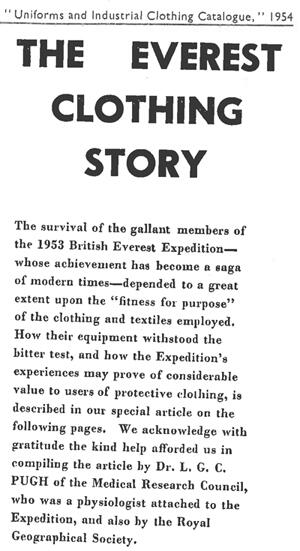
The Everest Clothing Story, in Uniforms and Industrial Clothing Catalogue (1954)

A clothing catalogue??? I didn’t hold out much hope so I started by checking in Google.  The 1954 catalogue was in fact listed in Google Books, so it is  something that some libraries had collected.  Sadly the content of the book was not accessible online. I was also heartened to see that UCSD libraries (which hold the majority of Pugh’s archives) had a copy of the item in question:

Box 18, Folder 2: Everest Clothing Story, 1954. Reprint, galley proof and correspondence.

Not sure what to expect, I ventured to our dusty library store. There is one catalogue of papers written by MRC staff , covering ca. 1950-1980, with boxes of reprints to match.  I searched and found the article listed under Pugh’s name (which was mildly surprising as the article is not actually by him, though it references his work extensively), but when I checked the appropriate box the reprint was not there. That is not unexpected – not everything in the catalogue has a corresponding physical item. We also have a second, larger, catalogue (and collection) of reprints and pamphlets going back to 1920; this has things of interest to staff but necessarily written by them. The article was listed in this catalogue too and luckily this time the item itself was in the corresponding box. The abstract is below.

I couldn’t help but feel a debt of gratitude to those cataloguers and typists nearly 60 years ago who had produced the index cards, and to the accurate filers who had placed the reprint in the correct box. Their painstaking work back then made it possible for me to supply the item to Harriet.

The article explains how Pugh tested several different kinds of boot for possible use in the expedition. The ideal boot needed to be both warm and lightweight, and should not interfere with the wearer's balance on rock and ice. It also describes the rest of the clothing selected for the expedition.

The article explains how Pugh tested several different kinds of boot for possible use in the expedition. The ideal boot needed to be both warm and lightweight, and should not interfere with the wearer’s balance on rock and ice. It also describes the rest of the clothing selected for the expedition.


Posted in History | Tagged , | 9 Comments

Moves to extend NIH open access mandate

We all love to be different – it seems to be a feature of much human activity that we cherish little foibles that set us apart. This is certainly true in the scholarly communications arena, though more recently journals have tried to harmonise some of their rules and requirements. Research funders too have a history of individuality, again with moves towards harmonisation.

Open Access is rife with disharmony though. Every funder and every publisher has their own take on what are appropriate rules. This makes life interesting but confusing, and sometimes plain difficult.

I was pleased to see therefore that one source of inconsistency stands a chance of being removed.

The US National Institutes of Health (NIH) has an open access mandate, requiring all NIH-funded research to be deposited into PubMedCentral. They allow a maximum embargo period of 12 months. In other words, the articles can remain invisible in PubMedCentral until 12 months after initial publication.

MRC and Wellcome Trust have a similar policy, but they allow a maximum embargo period of 6 months. (I was told once that when the NIH and Wellcome policies were in discussion back in 2004/5, both were considering a 6-month embargo. NIH subsequently changed to 12 months, but Wellcome went ahead with 6 months, and MRC followed Wellcome’s lead).

This embargo difference has caused some problems. Publishers have swallowed hard and accepted a 12-month embargo period. For example, Elsevier allows NIH-funded papers (author manuscripts) to be deposited into PubMedCentral with a 12-month embargo. But many publishers will not accept a 6-month embargo period. Elsevier does not allow deposition of author manuscripts with a 6-month embargo, so Wellcome and MRC-funded authors must choose the paid open access option.

This difference makes it harder to negotiate with publishers, and also makes compliance harder. If you have MRC or Wellcome funding and you collaborate with an NIH-funded researcher, they will not see the need to go for the paid-OA option and so you end up having to pay the cost from your own budget. This can cause some feelings of resentment which does not help the cause of open access.

The difference in policies may be about to change, if a new Bill in the USA gets through.

The Fair Access to Science and Technology Research Act (FASTR) would require federal agencies with annual extramural research budgets of $100 million or more to provide the public with online access to research manuscripts stemming from funded research no later than six months after publication in a peer-reviewed journal.

It has bi-partisan support in the House and in the Senate, but I have no idea how likely it is to be successful.

Richard Noorden has written about the new Bill in Nature News and SPARC have put up an FAQ about the Bill.

Posted in Open Access, Uncategorized | Comments Off on Moves to extend NIH open access mandate