Latest posts

The Things You Don’t Know You Know

It is very easy, at any stage in a career, to look at your peers and think they have everything solved while you are wandering around in the dark. This is, of course, an illusion. They will be looking at you and, as likely as not, thinking exactly the same in reverse. That’s true, I believe, of everyone apart from an obnoxious few who have no idea of their (in)capabilities, and assume that everyone else is looking at them in awe. For myself, given my fellow heads of house (heads of the Cambridge colleges) come from a wide range of backgrounds, the majority of which are not academic, I find it all too easy to think ‘well they went on a change management course’, or whatever particular facet of leadership one currently feels one is lacking, and hence feel relatively ignorant about the case in hand. Of course, being an academic, I haven’t been on such a course but, in reality, they may be struggling to grasp the academic cycle or something similar which is, by this point, second nature to me. How would I know?

I was brought up by a mother who always suffered under the belief – as she frequently told me – that there were rules that she alone didn’t understand. I think this came from being a teenager in the Second World War, someone who got roped into adult situations without any instruction. For instance, she was a rare female member of the Royal Observer Corps as soon as she hit 16, but was also the daughter of the local head of the district team, so had an awkward path to negotiate. But she instilled in me this belief there were ‘rules’ I needed to find out if I were to succeed. And of course, I failed, because as often as not there are no such rules and everyone else is also muddling around trying to make the best of some complex situation or other.

Whatever stage of your career you’re at, therefore, it behoves you to remember things that others apparently know but are a closed book to you, are not the only things that matter. You will have a battery of knowledge up your sleeve that others are looking at and being impressed by. It may be that you have green fingers when it comes to making some particularly recalcitrant piece of equipment fire on all cylinders; perhaps it’s because in a previous role you had come across some obscure paper that has the precise answer to the question your team are struggling with. Maybe it’s that you’ve spoken at a conference before and can reassure the newest member of the team about what to expect, or perhaps it’s further removed from your research and concerns information on local schools or nurseries. The chances are you an ‘expert’ in something who can pass on that knowledge to someone who is feeling adrift. But it is all too easy to take this ‘expertise’ as given, and not notice that you have many skills to hand that others perhaps lack but would like to learn from you.

Nevertheless, at a moment in time when it’s you that’s feeling adrift, it is important to realise that a feeling of being out of your depth is not likely to be a permanent state of affairs. And yet, just as it’s far too easy to fall into the trap of only remembering the negative comments (those that stick like Velcro) when perhaps you got something not quite right, and forget the times when you were the one with the knowledge others were seeking.

One of the behaviours that we should all worry about is when a belief in our own excellence becomes inflated. As fellow head of house Simon McDonald (Master of Christ’s) puts it when discussing the process of making appointments with fellow senior diplomats

‘We behaved as if we were a circle of perfection. Assuming ourselves to be perfect, we looked assiduously for candidates in our own image. We labelled such candidates the ‘full package’…. Of all the odd ideas expressed in our talent meetings, this seems to me the oddest. No one is the full package.’

So, remember that. You may be ignorant about some aspect of your current role, but no one around you is perfect, nor the ‘full package’. You are not alone in sometimes, even frequently, feeling you don’t know what is going on. Equally, you almost certainly know more than you, yourself, recognize.

Posted in experts, Science Culture, Simon McDonald | Comments Off on The Things You Don’t Know You Know

What I Read In October

Screenshot 2023-10-06 at 16.59.30David Mitchell: Unruly Just so you know, this is not the same David Mitchell who wrote those modern fantasy classics Cloud Atlas, The Bone Clocks (this last reviewed here) and others. It is a different David Mitchell. This David Mitchell is the broadcaster and thinking-person’s comedian who happens to be married to Victoria Coren (another broadcaster and thinking-person’s comedian) and co-writer with Robert Webb of a number of amusing shows and sketches. My favourite is the one about the laboratoire, which should appeal to readers of Occam’s Typewriter. There are probably other David Mitchells. You might be one of them. If you are, please don’t write in. But I digress. Here the author – a history graduate – looks at the kings and queens of England from mythical times (Arthur) to the death of Elizabeth I in 1603 — and the advent of Shakespeare, who, in the mouths of the kings in his history plays, accorded his characters a degree of self-knowledge that they probably never possessed in real life. After Elizabeth, the monarchs of England were monarchs of Scotland as well, so that would be a different book. Although Mitchell has many criticisms of monarchy, he feels that it’s nonetheless a cornerstone of the constitution, that unwritten compendium of more than a millennium of precedent, habit, tradition, kludge, fudge and bodge that explains and perhaps obscures the character of this Septic Sceptred Isle. At first, monarchs were the biggest thugs, who could marshal the most under-thugs. When Christianity came into the mix, the thuggery was papered over: monarchy was seen as something sacred, the monarch holding his (mostly his) office by God-given right. The rot set in when Henry Bolingbroke deposed Richard II and got away with it, becoming Henry IV, leading (eventually) to the Wars of the Roses. If God-given kings could be deposed, wherefore the God part? Before that, people had to put up with the monarchs they got, and sought to restrict their often dreadful government with institutions such as Magna Carta and what came, eventually, to be Parliament. The rich people did, anyway. The poor ones just had to suffer in silence. I listened to the audiobook version, narrated with brio by the author, with characteristic rantings and ravings. Notwithstanding inasmuch as which he is one of the  aforesaid thinking-person’s comedians, I learned a lot. This is perhaps not for those who cannot tolerate Anglo-Saxon Epithets (perhaps those who still think in Norman French, as English kings did for several centuries) for the good reason that two of the kings were a right couple of Cnuts.

UntitledA. M. Homes: This Book Will Save Your Life A few months ago I reviewed a collection of short stories by this author. I loved it, so was keen to try her work at novel length. It concerns the static life of Richard Novak, a wealthy freelance stock-exchange speculator who lives alone in his beautiful home in Los Angeles, seeing no-one but his housekeeper, nutritionist and personal trainer. Until the day when he is gripped with an inexplicable all-over pain, and his life slowly unravels into a series of seemingly random events. Richard runs into a variety of characters from the scriptwriter next door; the movie star who lives up the hill; the man who runs a donut shop downtown; and the horse that mysteriously materialises in the sinkhole that appears in his yard and into which his house threatens to disappear. Like her short stories, Homes’ novel has the same absurdist whimsy you’d associate with James Thurber (whose work, while dated in many ways, I like very much), but at novel length it threatens to degenerate into a case of one damned thing after another, and as such has echoes of Catch-22 (which I confess I liked very much less). This Book Will Save Your Life does seem to have a purpose, though. As much as he seems to be a ball-bearing batted around on some cruel pin table, Richard does find that life can be forced to have meaning, if only one can surmount the hazards.

UntitledBen Elton: Time and Time Again You might recall that a while back I reviewed Making History by the national treasure that is Stephen Fry, a comic SFnal romp in which an academic historian and a quantum physicist work together to see if they can change history. It was a book very much in the ‘Let’s Kill Hitler’ Alt.Hist. micro-genre. Quite by chance I came across another work in what now might be a nano- or even femto-genre, that is, a book in the ‘Let’s Kill Hitler’ mode of Alt.Hist. by celebrated British comedians and writers not normal associated with SF, and that’s Ben Elton. Very far from his 1980s stand-up heyday of ‘knob jokes’ and poking fun at Margaret Thatcher, and even his glory days as writer of Blackadder, Elton has proved himself many times over as a novelist of some skill, tackling ever more serious subjects that have fewer and fewer laughs. One of his best was The First Casualty, about a pacifist police detective sent to investigate a murder on the Western Front, a place where killing is just normal. This was deeply dark, and full of memorable and ghastly imagery. The one that stuck most in my mind was of the over-laden soldier who stepped off the duckboards laid over the sodden ground and disappeared into the mud without trace. There’s more imagery of this kind in Time & Time Again. Compared with Making History, it’s darker, slicker, and much more cleverly plotted. It starts with a well-known episode in the life of Isaac Newton. After the Principia and other light classics, Newton entered a phase of deep depression. He eventually emerged, but did little serious physics again. Instead he dabbled in alchemy, Biblical numerology and became head of the Royal Mint. In Elton’s novel, Newton became depressed after discovering that gravity affected the passage of time, thus anticipating Einstein. Rather than being linear, time could twist and turn in serpentine ways, and even swallow itself. For example, Newton discovered that were you to stand in a space the size of a closet in the basement of a building in Istanbul at a certain time in 2025, you’d be transported back to 1914. He leaves his calculations to posterity, and time travel is the fate of former soldier and celebrity adventurer Hugh Stanton, who goes back to 1914 to prevent Archduke Franz Ferdinand from being assassinated in Sarajevo  — thus preventing the Great War — but then going to Berlin to bump off the militaristic Kaiser Wilhelm II. Without giving too much away, Elton has borrowed this scene from Frederick Forsyth’s novel The Day Of The Jackal but made it much better — even for that acme of thrillers. However, Stanton finds that just his very existence in the time stream into which he has so rudely dropped changes the course of events unexpectedly. And he is not the only person who’s had the idea of rebooting history. But hey, I’m telling you the plot. Savage, dark and disturbing, this is one of the best thrillers I have read — and one of the best alt.hist SF novels too, right up there with Kingsley Amis’ The Alteration (and that’s saying something).

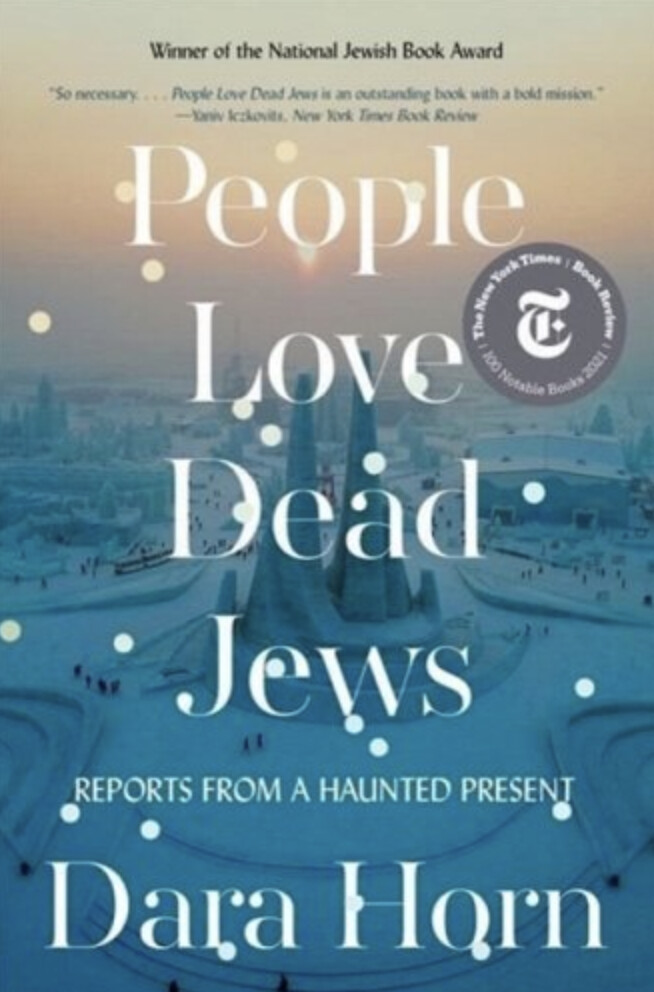
Screenshot 2023-10-21 at 20.10.27Dara Horn: People Love Dead Jews There is a day in the Jewish calendar that commemorates the dead of the Holocaust. It’s called Yom Ha’Shoah. Given that this exists, why should there be a different Holocaust Memorial Day? I have always wondered why I felt a bit uneasy about the latter, and this book articulates it perfectly. Holocaust Memorial Day is a convenient way in which people other than Jews can join in an orgy of virtue-signalling about how sorry they are about it all, piously observing that they’ll never let the slaughter of Jews happen again. As all Jews know, this is poppycock. For the same reasons I have never watched Holocaust porn such as Sophie’s Choice, Schindler’s List, The Boy in the Striped Pyjamas or The Pianist. (I did once watch The Piano, which is ghastly. But I digress). Time and time again, the world lets Jews be slaughtered, only later on to commemorate the deserted synagogues and say how sorry they are about it (if they can be bothered). People charged with Diversity and Inclusion always forget to mention Jews, because, in David Baddiel’s words, Jews don’t count. They are dispensible. In a disturbing, depressing (but endlessly interesting) book that takes in Jewish history from Renaissance Europe to 1920s China, Dara Horn shows that the world is only interested in Jews when they are dead. This is illustrated perfectly by the story of a real, live Jewish member of staff at Anne Frank’s house in Amsterdam being told not to wear his kippah in public… for fear of giving offence. I write this in a state of barely repressed anger, when after the brutal murder and mutilation of around 1,400 Jews — the most lethal pogrom since the Holocaust — followed by apocalyptic death unleashed on Gaza — some 100,000 people march in London calling (in effect) for the destruction of even more Jews, with even the drivers of tube trains joining in, and the police just standing by and doing nothing about it. Plus ca change.

Comments Off on What I Read In October

Being Festive about Women in STEM

Last week I attended an event at Murray Edwards College, a Women in STEM Festival. Dorothy Byrne, their President though not herself a scientist (she studied Philosophy at Manchester), had done a fantastic job in bringing together a wide range of speakers to discuss the thorny topic of the lack of women across the STEM disciplines. Should pride of place go to the discussion she chaired between the Vice Chancellors of Oxford and Cambridge? For the first time both are women, and both come from a science background. Irene Tracey is Professor of Anaesthetic Neuroscience at Oxford (as well as former Warden of Merton College) and Debbie Prentice, rather freshly arrived in Cambridge from Princeton where she was Provost, is a psychologist. To hear them talk about their ambitions in their roles, and their wish to see collaborations grow between their universities, was refreshing. They emphasized the importance of ensuring the academic environment does not allow so many female academics to ‘leak’ from the career ladder (see the write-up already published in the THE) and making sure there are on-ramps at different stages in a career.

Or maybe the highpoint was Chi Onwurah’s slightly breathless visit to talk about her career as an engineer (she studied Electrical Engineering at Imperial, a place she appears not to be very fond of judging by remarks I heard her make previously when I interviewed her during the pandemic). Not only did she talk about the satisfaction she got from her engineering career, including setting up the networking infrastructure in Nigeria encompassing her father’s home town, but also about what an incoming Labour Government has its eyes on doing in this space. She talked with great passion and commitment and, of course, is – through her role as a Shadow Minister for Business, Energy and Industrial Strategy – well-placed to see these ideas come to fruition. Someone definitely committed to facilitating careers for women in STEM.

Her talk was followed by that from another key woman in the engineering world, Hayatuun Sillem, CEO of the Royal Academy of Engineering, another person with the opportunity to make a real difference for nascent engineers. After her speech she joined a panel discussing STEM careers ‘image problem’, as the programme put it. All speakers were clear that engineering covered so many areas but, sadly, too many teachers did not know the breadth of opportunities that the field opened up. As Hayatuun put it, there is a hard hat problem in images (for instance on Google), as well as a lack of gender diversity. Indeed, she pointed out there was more diversity in hat colour than sex to be found in such photographs.

I am quite sure that for many in the audience – itself diverse in age although less so in gender, ranging from Murray Edwards’ alumnae from the college’s earliest years to KS4 girls from schools in Cambridge and the East End of London – the highlight was the inaugural talk from Jocelyn Bell Burnell. Jocelyn was characteristically modest, but her wry comments about some of the statistics she presented highlighted the problems women still face in their careers. One point she identified that I had never myself previously put into the ‘unconscious bias’ category, is the habitual way forms requesting people to identify their sex as M or F, always put the M box to tick first. Not, as she pointed out, alphabetical order but a symptom of bias. My somewhat similar bête noire is when lists (e.g. of committee members) identify the woman with an F, while not identifying the male as anything: male by default as the head of my university’s HR put it some years ago when I complained. I am not convinced the practice has been wholly eradicated though. Allowing for non-binary choices may mean all such identifying initials disappear in the future.

There was far too much that was excellent to spell it all out, but the one additional point I will make which worries me was identified explicitly in the Q+A after my own talk about my book. Aren’t you preaching to the converted? was the question. And of course the answer was yes: within the specific audience at the Festival who were, I believe, all invited and who were overwhelmingly female, this was definitely the case. But also more generally, the wider world does not necessarily notice the issues which arise in this arena. I’ve said before, I wish I could find a way of reaching teachers, because I believe the problems of stereotyping around what boys and girls ‘should’ do and find interesting arise at very early ages. Teachers have the opportunity to try to counter the stereotypes portrayed in the media and in the way toys are marketed but, as far as I can see, advice to do so, let alone how to do so, do not form part of a teacher’s training. Certainly, the remarks Katharine Birbalsingh made to the Commons Diversity in STEM enquiry last year showed how ill-informed even highly-rated (head)teachers can be.

But there is also the problem of women talking to themselves. That there were few men there, as at so many similar talks, is also a concern. Women cannot solve this problem by themselves. Men have to understand the loss to the economy and to scientific research, as well as the damage to the individuals who lose out due to our current structures. And then, they need to recognize what needs to change. Many women are fed up with fighting this fight; many men seem oblivious to how the system propagates so that women need to go on fighting. When I talk, for instance to student or early career researcher talks, I am always pleased to see the men in the audience nodding at my arguments, but sometimes they may be thin on the ground.

And finally, and perhaps more controversially, is it right that an event should have no male speakers? Many a conference has been pilloried for not having an adequate percentage of female speakers. Although I totally understand why there were no men on the platform in Murray Edwards and all the women I heard (I missed the final afternoon) were absolutely outstanding in their talks and discussions (I exclude myself!), nevertheless, this is a problem for the whole population and we should all be talking about it, thrashing out solutions together. I always feel conflicted about this, just as I do when I’m asked, as I was, about whether an all-woman’s college – as Murray Edwards still is at student level – has a place in the UK today. I understand why some people still feel it has, and appreciate the splendid things it does, and yet…we don’t want to reinvent all male colleges. I worry about the asymmetry of this situation.


Posted in Chi Onwurah, Dorothy Byrne, Jocelyn Bell Burnell, Murray Edwards College, Women in science | Comments Off on Being Festive about Women in STEM

Voice: Finding Yours

Last week I was the protagonist in the curious ritual called a ‘post-prandial’ talk at my College (Churchill). In other words, after the whole Fellowship had met for the formal governance activity known as ‘Governing Body’, and after dinner (prandium is actually the Latin word for the midday meal, but somewhere along the way this name for the after-dinner seminar has stuck), I had to give my talk. The last time I had to go through this particular ordeal was as part of the interview process for the job of Master at Churchill, when I was asked to talk for about 20 minutes to a general audience of the Fellowship (ie scientists and non-scientists alike, who all had a vote as to who they wanted to be the next Master back in 2013) about my research after dinner. A challenge to make it both exciting to the former and accessible as well as accessible to the latter. Now 10 years later, I was asked, at about 3-days notice, to step in and talk about anything I wanted (I chose some of the work I’ve been doing about science policy) to a similar generalist audience.

Of course, the first thing to get through on such an occasion, is dinner, with quizzing from some younger members of the College. “Do I still get nervous?” – yes. “Really?” – yes, and as I said to them, it’s definitely worse talking to your friends and colleagues than to a much larger group of complete strangers who you’ll never see again. How do the nerves manifest themselves? My voice does not often shake these days (I’m sure it used to). But in the circumstances of the Labour Party Conference Fringe event I wrote about in my last post, undoubtedly my fluency departed, as confirmed afterwards by a friend in the audience. On that occasion, I was largely reading from my scripted notes, to make sure I covered all the bases that I intended, rather than ad-libbing around a Powerpoint presentation. Since the notes had had to be hastily amended in scrawled handwriting, as I described before, I felt both thrown out and overly anxious. My speech was more jerky than fluent as I tried to piece it together into something coherent. On this more recent occasion in College, with a rapidly written Powerpoint to hand, once I’d got underway I felt the words flowed quite easily (I had not drunk much of the wine proffered over dinner; flow is different from slurring).

My observations on my own research students and postdocs suggests a shy demeanour and/or nerves does not necessarily manifest itself in any visible or audible signs, nor is an excellent presentation predicated on daily exuded confidence. One of my Friday dinner companions remarked their voice tended to rise when tense, but you’d have to know the person well to detect that. However, there is no doubt that voice pitch can matter, at least to some people. I have never forgotten the comment made to me many years ago by a well-meaning departmental colleague, to the effect that perhaps I should take voice-coaching lessons to lower my voice. I was utterly appalled by this, the very idea that gravitas is more readily conveyed by a low (presumably male?) voice, regardless of content stunned me. But, this was a trick Maggie Thatcher clearly believed in, even though the rumour that she went to a voice coach may be apocryphal. Nevertheless, she certainly did lower her voice and, if the article in that link is to be believed, probably damaged her vocal chords in the process since she had not apparently had any coaching.

If you’re concerned about your voice, there are those who advocate thinking yourself powerful before giving a talk apparently, not a tactic I’ve ever used. I’m usually more concerned about content than sonority. However, this specific study suggested those who imagined themselves in a ‘powerful condition’ deliberately raised the pitch of their voices, in contrast to the comments about Thatcher. I suspect, as this commentary about the publication in Forbes points out, there are gender issues at play here, that are not pursued in the original paper. However, as this comment piece spells out, and in line with what I say above, ‘In fact for me, what conveys power is the substance of what the speaker says, not the pitch or the variability of volume.’ Quite. This journalist and I are both more interested in content than auditory tricks.

But voice has other meanings, such as that of authenticity. Management gurus such as Brené Brown are great believers in authenticity as a powerful way for leaders to speak. I think it would be true that, when at the Labour Party fringe event the words were carefully chosen for that audience, and in that sense less authentic than many of my talks, since political speech is not my natural language. At the post-prandial I would have been talking about my own doings (in that particular case, also in the policy arena) and not some hypothetical wishlist for policy-makers to hear. I hope that more recent talk made me sound convincing, as well as fluent.

Psychologist Carol Gilligan’s 1982 book, In a Different Voice, which I am currently re-reading, discusses yet another sense in which ‘voice’ is used. Gilligan is talking about how adolescents, and particularly young women, develop a voice (in the sense of content, not pitch) that is what they believe to be right, even if it isn’t what they genuinely believe. They lose their authenticity in order to fit in with what they perceive to be expected of them or, as Gilligan puts it, they lose their connectedness with their inner self. She sees this as one of the ways in which women shortchange themselves, and are shortchanged, by a patriarchal society where the male voice/view is taken as the norm and any deviation as ‘less developed’, allowing women to be seen as sub-standard men rather than fully-rounded women. These are ideas she builds upon in her much more recent (2018) book Why does Patricarchy Persist?, co-written with Naomi Snider. These approaches are not ones that I utilised in my own book, Not Just for the Boys: Why we need more women in science, but perhaps I should have done. My book is rested far more in the social sciences (such as gender and educational studies) than in psychology.

Voice is not simple, and we each develop our own tricks for survival and for communication. Sometimes what we use relates to our audiences, and sometimes – perhaps not often enough in our daily lives – to our inner selves.

Posted in authenticity, Carol Gilligan, Communicating Science, giving talks, Maggie Thatcher, Women in science | Comments Off on Voice: Finding Yours

It Has Not Escaped Our Notice

Screenshot 2023-10-20 at 09.25.19
This one from our correspondent Dr R___ H___, of a sign on a boardwalk at Qingdao, China, in what looks like rather threatening weather.

Comments Off on It Has Not Escaped Our Notice

As I have some time free…

I was recently encouraged by a certain gentleman of this parish to return to blogging. Great, I thought, but when will I get the time? But over the weekend I was struck down by Lurgy-19, and as this is a particularly bad week for doom-scrolling on Twitter, I could either write a blog post or review manuscripts for said gentleman of this parish. Not a diffcult choice.

Recommendation to the editor: Reject and encourage resubmission, but to a journal who’s editor in chief you hate. Let them trawl through the 377 pages of supplementary information to work out what bifurcated spindles are, and how they are measured.

Recovering from Lurgy-19 is hard work.

Comments Off on As I have some time free…

Beyond the Comfort Zone

Last week started off in unfamiliar ways. I’ve written before about the challenges of doing something for the first time, and this week I had two consecutive days of things that felt stressful and unusual to me. These issues of strangeness do not necessarily go away with age and experience, or at least not if one is pushing oneself.

On Sunday I travelled, with some difficulty due to tube closures in London, to ExceL to participate in New Scientist Live. I’d not been to this conference before, but was delighted to be able to talk about my book Not Just for the Boys to a general audience. The venue is massive, and in a single large hall there were four platforms with simultaneous speakers, plus an exhibition. I’d been slightly startled, when I arrived and asked the security man at the door where to go for speaker registration, to be greeted by a surprised look, and the response ‘Speaker? For New Scientist Live?’, as if he’d never met a female speaker before (although there were plenty on the programme). It felt symptomatic of my topic.

Standing on the platform I was very conscious of the background hum from everything going on around me, indeed rather more than hum, even though the sound system for my particular platform was excellent.  There was a good-sized audience who seemed receptive to my topic, and fired plenty of questions at me, and the book signing was also well attended. But, whereas a recent talk to scientists on the Biomedical Campus felt familiar because I had a good idea of the background of the audience – although one never knows at talks about my book, whether there will be many men present; at LMB there were – this isn’t true when talking to a more generalist audience. Judging from the questions, both publicly and even more from those who came up to me privately afterwards or who came to the book signing, there were a significant number of year 11-13 girls, those thinking about their futures and wanting encouragement to stick with science and, even more, the physical sciences. I felt I had definitely reached them.

From London I went straight on to Liverpool, to do something even more unfamiliar. On behalf of the Royal Society’s new Science2040 project I was talking to a Fringe event at the Labour Party conference, a joint reception with the New Statesman. Never having been to a party conference of any hue, this was walking into the unknown. Just trying to work out which of the multitude of Fringe events I would try to get to, distributed within and beyond the secure zone, was complicated enough. In the end, I only got to a couple; another one I was aiming at was standing room backed up so far into the lobby that I gave up. The whole conference was an extremely well-attended event. Those who know more about such things seemed to think it was overfull, no doubt reflecting the state of attitudes in our current politics.

My job was to give a brief speech about this new Royal Society project, initiated to explore what the science system should look like in 2040, and the need for long-term funding commitments regardless of the persuasion of the Government. This project is exploring the breadth of issues from the economic to the people dimension, from infrastructure to our place in a changing world. In other words, what needs to be done to address the major problems we are all facing. The centrepiece of my speech was meant to be a call for Labour to commit to long-term funding, talking after the Shadow Secretary of State for Science, Innovation and Technology, Peter Kyle, and before the Shadow Minister for Science, Research and Digital, Chi Onwurah.

By the mid-afternoon it was clear my  speech needed to be rewritten, as Peter Kyle – in his major speech to the main conference – had made precisely the commitment we were seeking, saying: “a Labour government will create certainty with 10-year R&D budgets.” So, a hastily scribbled-on piece of paper was what I had to read from at the event, reworking my words in an anxious way. I certainly felt my fluency was diminished, however much Kyle’s announcement was welcome news. I am used to being able to modify my written words on the fly, to suit the specific composition and reactions of an audience, but this required a more fundamental rewrite, and I hadn’t brought the technology into the secure zone to do this in more than an illegible way on the script to hand. Unfortunate, but I hope I could still deliver an appropriate message.

There were good things about attending the conference, not least a long chat with one of Chi’s new aides, and I am glad to have had the experience. But it is a salutary reminder that things that feel like old hat to some – colleagues both scientific and from the media who make the trek every year to wherever the party conferences are being held – can feel very strange and stressful when doing them for the first time. For those just setting out everything may feel unusual and uncomfortable, but it is worth remembering everything gets better with practice and you are not alone in your discomfort. Most people feel it, even if less often.


Posted in Communicating Science, Labour, New Scientist Live, Peter Kyle, Science Funding | Comments Off on Beyond the Comfort Zone

In which the wheel turns

Time is a wheel, speeding me along in ever quicker circuits. As individual moments rush towards me, flare into immediacy and then blur past, most are soon forgotten save for those captured as digital images, or in some dashed lines of ink in my journal. While the tune is largely the same each year, certain themes progress irrevocably: the height of my son, once a helpless baby and now a ten-year-old whirlwind of humour, intelligence and stubborn self-sufficiency. The consistency of my skin, gathering millions of tiny wrinkles and spots, making me stare sadly at my ankles and think, girlfriend, you are old. Aging, my own and my family’s, is a fiducial marker by which I can gauge the eventual end of this crazy road trip. Still a good ways out of sight, I hope, but no longer an infinity away, as it seemed when I was my son’s age.

Bowl of garden produce

The beginning of the end

There are multiple annual cycle start points in my life. Of course there is the first of January, when the calendar year resets and I think about personal changes I might want to make in my life, both physical and mental. The garden cycle starts in February, when I begin propagating the earliest seeds, a months-long and arduous process that will fill our plots and greenhouses – and weekends – for the year. And then there is the end of September, when the academic year kicks off and the new students arrive, emitting youthful enthusiasm and anxiety in equal measure, when I dust off my lectures and gear up for months of pretty heavy stress until the Christmas wind-down.

The lab has its own internal cycles that are far more chaotic than the annual circuits framing my individual life. Team members come and go on a random timescale, meaning that the group dynamics are always fluctuating in terms of personality, experience and some unquantifiable aspect I might unscientifically call “vibe”. Our recent move to the new building has added an additional dimension: the camaraderie of working together to find out where things are, how things work, how we fit into the ecosystem – and whether we can really trust the “decontaminated” lab fridge in the kitchen to store our lunches.

There’s no point in getting too comfortable with a current vibe, as soon another new postdoc will be joining our team (hooray!), alongside the small phalanx of annual undergrad and master’s project students who will brighten up the atmosphere even further in their brief tenures with, one hopes, a minimum of broken glassware and yeast-infested cultures. But the vibe is great now, making coming into work something I anticipate. There is also the welcome excitement of accepted papers, invited lectures, press interviews, public engagement activities and new collaborations to keep things lively. It’s a weird job by any measure, and often challenging, but one that still keeps me interested, more than thirty years since that timid PhD student first ventured into a real lab to start her own scientific journey.

Posted in academia, careers, Domestic bliss, Gardening, Joshua, Research, The ageing process | Comments Off on In which the wheel turns

What I Read In September

IMG_6823Andrew Smith: Moon Dust I was no more than seven years old, but I can still remember the towering model of a Saturn V rocket in my bedroom. I can still remember, like it was yesterday, or even earlier today, going to Woolworths with five shillings and elevenpence in my pocket (those old copper pennies were heavy) to buy an Airfix kit of the Lunar Module, whence the Apollo astronauts disgorged onto the surface of the Moon. So, so much has changed. Those copper pennies, even Woolworths, are long gone, along with the Apollo space program. But the memory is still green. It all happened in a heated rush, between 1969 and 1972 (the time it took for Led Zeppelin to release their first four albums). But it’s been more than half a century since Apollo 17, the last mission to place a human foot on the Moon. Only twelve people have ever left their bootprints there. All were American, white and male, and they are dying off. When journalist Andrew Smith sought to catch up with as many of them as he could, only nine (as of 2005) were left. None of them was able to answer Smith’s question — what was it like to stand on the Moon? — and have variously suffered in the years since for what seems to be an existential inarticulacy, a failure to quite live up to an experience they can never quite express. To be sure, they have groped for answers in various ways. Some have got religion, of various sorts, from conventional Christianity through Buddhism to New Age philosophy. Others have gone into politics, or business, with varying success. One, Alan Bean (Apollo 12)  has become an artist, trying, and trying again, to capture the moment on the Moon in paint. Almost all suffered a fearful personal toll — the divorce rate among Apollo astronauts was huge. What was it all for, then? What justified the immense cost (though much less than the war in ‘nam)? The personal sacrifice? For Smith this is a personal story — as Apollo will ever be to all those little boys with models of rockets in their bedrooms — and we get a lot of personal anecdotes as well as documentary. He even falls into the trap (as I did once, pointed out by a reviewer of one of my own books) of citing the model of rental car he was driving as he sought his ageing and often reticent interviewees. His conclusion was that Apollo might have, in part, been many things. An urge to put one over the Soviets, certainly. A desire to explore new technology, possibly. A wish to keep people employed in the aerospace sector in three states with large numbers of voters (Florida, Texas and California), cynically. But what it was, most of all, was theatre, spectacle on a grand scale. Spectacle never to be repeated. More than 400 people have since gone into space, but never more than low-Earth orbit. Only the Apollo astronauts ventured further. There are those — a minority, but a sizeable one — that thinks the whole thing, the Moon landings and attendant hoopla — was an elaborate hoax. Perhaps it was all a dream. Even before my Airfix models, I came across a book in my elementary school library. It was called You Will Go To The Moon. Funny, most of one’s dreams are forgotten soon after waking. A few, though, remain vivid.

Screenshot 2023-09-07 at 08.58.49Mike Gayle: A Song of Me and You I feel I owe author Mike Gayle one. After all, he was on the judging panel for last year’s Royal Society Science Book Prize that selected my recent tome as the winner. Thanks Mr Gayle! I spotted one of his novels on my sister’s sofa so I thought I’d dive in, and selected this one more or less randomly as an audiobook. I had no idea that it was a romantic novel, probably of the genre once patronisingly called ‘chick lit’, but it was very enjoyable for all that, and I looked forward to a daily dose of it while walking the dogs each morning. Two months before the story opens, Helen, a 45-year-old, part-time primary school teacher from Manchester, is deserted by her husband Adam for a younger model, leaving her with two teenage children. The story opens just after Adam has taken the teenagers away on a camping trip. Helen, deflated, sublimates her anger and frustration in housework before the doorbell rings again. At the door is Ben, who just happens to be the lead singer of the world’s biggest rock band. He is hiding from the press and seeking a break from his roller coaster career. He asks Helen if he can lie low for a few hours. But why would Ben turn up at Helen’s door: her, of all people? Well, there’s more to this than meets the eye. Ben and Helen grew up together and were childhood sweethearts before events took each of them in their own separate directions. It’s a good summer read (indeed, I was looking for something suitably light) and it is enviably well constructed, with some twists subverting what might otherwise be a predictable plot. My only criticism is one of style. There are a lot of sentences that begin with phrases starting with a present participle, like this: ‘thinking that this book review was going on too long, Henry sought a convenient ending’. And there were similar sentences of this form: ‘as Henry was winding up his book review, his thoughts wandered to the possibility of making another cup of coffee’. But nothing that a sharp-eyed editor couldn’t have sorted out.

IMG_6840Andy Weir: Artemis You might remember Andy Weir as the author of The Martian, a rather fine near-future SF adventure about an astronaut stranded on Mars, and the mission sent to rescue him. It was made into a heartwarming motion picture film magic-lantern production starring Matt Damon. A characteristic that set The Martian (book and magic-lantern production) apart from much recent SF was its entirely unpretentious style. It was hard SF in the old-fashioned sense. That is, the plot turned around entirely believable and achievable science, without resorting to hyperspace or quasi-mystical woo. The same is true for Artemis, Weir’s second novel. This is set in the eponymous city (really, no more than a small western frontier town) on the Moon, a short distance from the landing site of Apollo 11 (which has its own visitor centre) and concerns the exploits of Jazz Bashara, a porter and sometime smuggler of contraband. One of Jazz’s contraband clients asks her to perform an audacious act of industrial sabotage that propels her into a nail-biting adventure. So as well as being a good old-fashioned SF romp, it’s a great thriller. Weir gets a gold star and a tick for diversity points (Jazz is female and Muslim; Artemis is a wholly owned subsidiary of a Kenyan aerospace company), and even more gold stars and ticks for the hard science (the plot turns, in places, on quirks of  industrial chemistry). But most of all, because it’s a well-knit, pacy read. Highly recommended.

IMG_6848Adam Kay: Undoctored I am sure that you’ll both (if you are in the UK at least) have heard of Adam Kay, a hospital gynaecologist who was so beaten down by the relentless pressure of working for the National Health Service (NHS) that he quit and became a writer instead. He turned his considerable talents to a best-selling memoir, This Is Going To Hurt, which was made into an affecting TV series starring soon-to-be national treasure Ben Whishaw (yes, him, the voice of Paddington Bear). This Is Going To Hurt (and its modest sequel, The Nightshift Before Christmas) were, in places, laugh-out-loud funny, though often in the dark-tinged humour that clinicians use to get through each endless, blood-soaked shift. Undoctored is a collection of further anecdotes from Kay’s medical life, mixed in with recollections from his subsequent often hand-to-mouth existence as a jobbing stand-up comic and writer, until he made it big with T. I. G. T. H. If you have read T. I. &c., you’ll know what to expect — or you’ll think you do — but be prepared. If you thought that some parts of T. I. &c were dark, then Undoctored is as dark as The Dark Lord Sauron teaming up with Voldemort to track down an eyeless black cat in a coal cellar during a power cut. While wearing sunglasses. At night. Snippets of Undoctored occasion a wry smile: whole scads are almost too hard to read. To say that Undoctored is confessional is accurate, but hardly gives the flavour of say, Kay’s pages-long account of suffering from an eating disorder, or of being raped. To put things down on paper is brave. To let such experiences out of doors deserves a medal. Beneath the thin (and often absent) humour is a serious message, and it’s the same as that hammered home in T. I. &c. And that is that many health-care professionals suffering from overwork, stress, fatigue and a range of problems possibly connected (or exacerbated) by the above, do so in silence, fearful of letting the side down. What should change? To say that the NHS is underfunded, as Kay does explicitly, is a given, but then, it’s in the nature of organisations such as the NHS always to be underfunded. What Kay says, more often, but not quite so directly, is that what needs to change is an attitude, found among doctors themselves. Some senior doctors, or consultants, come over as arrogant and entitled, and assume that because they had to suck it up at medical school (and before that, at their public school, and, before that, at home) then everyone else must do so, too. The selection of medical students should also change. To get into medical school one not only has to demonstrate stellar academic ability but still have time for a range of hobbies and voluntary work. This is all commendable, but do such things automatically translate into being a good doctor? Kay thinks not, but does not offer any alternative prescription. As a wise doctor once wrote, ‘h9:{(*&^SH\ £$%^(•¶∞’.

Untitled  Robert Harris: Act of Oblivion By now you’ll both know that I am a fan of Harris, writer of peerless historical thrillers (Fatherland, Pompeii); so-so SF (The Fear Index, The Second Sleep); and the best novel about old men in frocks you’ll ever read (Conclave). This one concerned a period of history about which I knew little – the English Civil War and its aftermath. The early 17th Century was a period of pronounced religious strife in Europe. Europe saw the Thirty Years War (1618-1648), in terms of population loss and displacement, one of the most destructive conflicts to hit the continent. In Britain, religious and political turmoil led to the execution of the king, Charles I,  and a decade or so in which England was a republic governed occasionally by parliament, but mostly by the fiat of a military dictator, Oliver Cromwell. After Cromwell’s death England reverted to being a monarchy under Charles II. Parliament forgave all those who’d participated in the interregnum under the so-called Act of Oblivion: all except for those men who’d signed the death warrant of the late king. Harris’ novel concerns the exploits of Richard Naylor, the manhunter charged with tracking down the regicides and bringing them to justice (which was — be warned — unbelievably gory, and described in lurid detail). Two of the regicides, the puritan Ned Whalley and his even more millennial son-in-law William Goffe, managed to elude his grasp by escaping to New England. Just about everything in the novel really happened — Whalley and Goffe were real people. The only fiction is the character of Nayler himself. And given that you can look up all the events, and get some idea of the ending, it’s a testament to Harris’ skill that he keeps the pages turning nonetheless.

Screenshot 2023-09-28 at 19.20.43Richard Osman: The Last Devil to Die Tucked away in the section of the shop labelled ‘Cosy Crime’ you’ll find the sensationally successful thrillers by man-on-the-telly Osman. The Last Devil to Die is the fourth, after — in order — The Thursday Murder Club, The Man who Died Twice, and The Bullet that Missed. If you were thinking that he sells shedloads of novels simply because he’s the man on the telly, you’d be wrong. Each one is devilishly plotted; beautifully wrought; contains characters you can believe in and root for; and are also very funny. In short, they deserve all the acclaim that has been heaped upon them. If you’ve been living on a remote asteroid for the past few years, the novels concern the crime-fighting exploits of a seemingly ill-assorted group of pensioners living in an upscale retirement village in Sussex, England. There’s Ron, a pugnacious former trade union leader and West Ham supporter; Ibrahim, a semi-retired psychiatrist who’s definitely on the spectrum; Elizabeth, a former MI6 operative who still has Contacts; and Joyce, a chatty ex-nurse who’s always there to solve all problems with bakery products, and through whose eyes we see much of the action. And that’s really all you need to know. Osman sidesteps the pitfall that could so easily befall novels like this — that one could easily get bored of the schtick of doddery senior citizens standing up to (and outwitting) robbers, drug lords, jewel thieves and assorted lowlives, not to mention the police. He does this by deepening the characterisation with each novel by discussing the pains, problems and consolations of age. Without giving anything away, The Last Devil To Die discusses Alzheimer’s Disease in some depth, from the perspective of a sufferer and those looking on helplessly, in a way that is both sensitive and deeply moving. I read the first three in the series in print: the fourth I listened to as an audiobook, read by Fiona Shaw.

Comments Off on What I Read In September

New Scientist Live and Other Talks

It’s the start of a new term in Cambridge and this weekend the streets around the city will be full of nervous looking parents trying to find somewhere to park to unpack their anxious looking children. (One of the many advantages of Churchill College is that, as an out-of-town-centre college it has far more space for parking and unloading.) This cohort, like the last several, will arrive burdened with the consequences of the pandemic and social and educational isolation in ways we have yet to discover for this particular age-group. It will be many years before the lasting effects of Covid are no longer an issue for students.

Over the summer I received a fair number of invitations to talk to different groups of students and postdocs around the University about my book, Not Just for the Boys: Why we need more women in science during the upcoming term. I am pleased to realise that the book has penetrated many different departments locally, although whether it has reached the people who might be able to act upon some of my recommendations as much as the early career researchers who have to work through the challenges, I don’t know. I could also wish such penetration were true in other universities too, that the leadership of departments look at how their staff – and indeed other students – are behaving and act accordingly. However, one only has to hear about the comments some men think it is OK to put out on air about women and whether or not they are to their taste sexually (I won’t repeat the remarks Laurence Fox made, but they were outrageous) to believe that our universities will not be exempt. They will contain men who rate the women on their courses or in their research groups not for their brains but for their bodies and convey such views in their words and actions. Of course, such harassment is common across many sectors but, if numbers start out low in subjects like engineering, physics and computing, isolation may make an unpleasant situation much harder to cope with.

This week I start the term by talking to researchers at the University School of Clinical Medicine and the MRC Laboratory of Molecular Biology in a joint event on Monday (in person and online). At the end of the week, I go further afield to talk at New Scientist Live at Excel in London. I may have a fair idea of what sort of lecture environment I’ll be talking in for the former, but what size audience and what age and occupation distribution I will encounter for the latter is much less clear to me. Of course, one always has to respond to the audience one finds, modify the way one talks about each Powerpoint slide in the face of the faces in front of you, but public talks feel very different to the more familiar one of an academic venue. The New Scientist Live talks I believe will also be live-streamed, opening up an invisible channel to people sitting in their own homes, or potentially down the pub given I’m talking at lunchtime. Keeping remote audiences engaged is yet another challenge, but it is one that it is almost impossible to judge with what success.

With the various talks lined up for the months ahead about my book (there’ll be another one in London at the Royal Institution on November 16th), I am conscious how each organiser has put slightly different demands on me. Not just a question of audience, but of length of talk and how long to set aside for questions from the audience. Sometimes the talks are not talks but discussions, as for instance the upcoming event I will be participating in with Diane Coyle and Tabitha Goldstaub about ‘Why we need more women….’ through the Bennett Institute. Diane has written plenty about the dearth of women in her own subject of economics. What this all means is that each and every talk has to be written separately. If you think I just turn up and deliver the same talk as I have already given multiple times before, you’d be wrong. I’d be very bored if I did, and so would the audience.
I learned the hard way a long time ago, when still very early in my career and travelling, as it were, with my one and only talk (back in the day when it was hard copy transparencies and 35mm slides that were the norm), that repeating the same talk over and over again leads to a lack of attention and animation in the speaker. Sometimes, even, a complete loss of the thread of one’s words: have I said this before to this particular audience? being a particularly vicious thought as a source of confusion as one stumbles along.

The one audience I fear I am not reaching through my talks, blogs etc are teachers. I hope there will be many at New Scientist Live, but I have had no correspondence from anyone who recognizes the issues from their own schools. When I went to Parliament to meet MP Carol Monaghan(see image), a former Physics teacher from Glasgow, she recounted some of her own methods to ensure girls felt fully integrated and belonging in her classes. I wish more teachers had given the matter so much thought. Carol was a member of the Commons Science and Technology Committee which carried out an enquiry into Diversity and Inclusion in STEM, a committee chaired by Greg Clark and to which I gave evidence. The report from the committee received a bland and defensive response from the Government which did not please Clark. I wish I had a way of reaching out to teachers, as I feel they have an absolutely key part to play in encouraging more girls to follow their dreams into technology and physics.

Carol Monaghan in HoC June 23

So, talks aplenty coming up for me in the weeks ahead, along with the normal busyness of a Cambridge term. Not only do I have a talk to give about my book on Monday morning, but my last speech to Freshers after their formal welcome dinner that evening.

Posted in Carol Monaghan, Not just for the boys, talks, Women in science | Comments Off on New Scientist Live and Other Talks