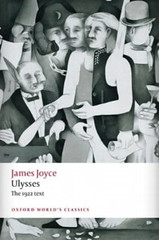
 James Joyce: Ulysses Many years ago when the world was young Mrs Gee asked me what I’d like for my birthday. Uncharacteristically (I usually like a book, and maybe a box of Liquorice Allsorts) I asked for a night out at the theatre. A production of Samuel Beckett‘s play Waiting for Godot was coming to the Theatre Royal in Norwich, starring Patrick Stewart and Ian McKellen, touring before it got to the West End. Not only would we get one up on our sophisticated London friends, who imagine that they and they only are so far up the zenith of their own apotheoses that the sun don’t shine and that Norfolk is the proverbial arse end of nowhere, but we’d see Gandalf and Jean-Luc Picard slug it out on stage. Waiting for Godot is a famously ‘difficult’ play — but, you know what? — this was one of the best and most entertaining nights out we’d ever had. This could be a sad reflection on our social lives, but I rather think it had more to do with the quality of the production. Most productions over-think the play, pandering to its supposed modernist obscurity. This production, though, adhered closely to Beckett’s very precise stage directions. And also, according to the producer, that if one is going to have a play which (apart from one short scene) is a two-hander featuring two old geezers who have known each other all their lives, there is no better way to cast it than with, well, two old geezers who’ve known each other all their lives. The unselfconscious result was pure entertainment. The same goes for Ulysses, which, like Waiting For Godot, is a work viewed as so notoriously difficult that it tends to be more admired than read. So, taking advantage of my currently altered state of consciousness, I dived in. The premise of Ulysses is simple. It follows a small group of characters through their lives in Dublin, Ireland, during the course of a single day, specifically, 16 June 1904. On the way it challenges, reflects, refracts, subverts, transmogrifies, distorts, compresses, explodes, eviscerates, reassembles, thesaurizes and recycles everything we think we know and understand about how human thought gets processed into language, or words on a page. Like many specimens of Anglo-Irish literature through the ages (by that I mean literature in English by writers who self-identify as Irish), all the way from Jonathan Swift and, as it happens, Thomas Beckett, to Spike Milligan and Roddy Doyle, Ulysses is marked by a strong sense of the absurd. Now, this doesn’t mean that there don’t exist writers from places other than Ireland who are absurdist, nor that there might be writers from Ireland who write in a more conventional style. But — and this isn’t just because the action takes place in Dublin — one does tend to find reading this easier if one’s internal voice takes on an Irish accent, and rather than trying to think too much about what’s going on, simply go with the flow. And it is, in general, a modernist work, which seems odd for a book that was published almost exactly 100 years ago, but if you’ve read the poems of T. S. Eliot, such as The Love Song of J. Alfred Prufrock, you’ll know what to expect. The erudition (especially long quotations in Italian); the rich allusion; sometimes disconcerting contrasts between the internal worlds of the characters and their everyday circumstances; and above all the long, seemingly meaningless and certainly incomprehensible diversions. In the room the women come and go, talking of Michelangelo. What the Actual? Which room? Which women? And what’s with this Michelangelo business? And I thought this bus went to the station? Don’t sweat it, just enjoy the sounds of the words as they roll past: Ulysses is not so much a novel as a prose poem. What Joyce tries to do in Ulysses, apart from simply do things for — oh, heck, I’ll say it — the craic, is chart the interior monologues of characters as they happen. That is, quite literally, a stream of consciousness. So when the main protagonist, one Leopold Bloom, decides to go to a friend’s funeral, we don’t see him — as an omniscient narrator would, directing Bloom as a puppet — putting on his black suit and hat and going to the funeral, making small talk with his fellow mourners as they share the cab ride to the cemetery. Yes, we get that, but at the same time we witness every thought that passes across Bloom’s mind, whether everyday anxieties (he has a business appointment, and he needs to find time to do some shopping) or bubbling up from his subconscious, such as his sexual fantasies, and the state of his bowels, and all in the order in which they would happen — uncurated, unedited, unexpurgated and in real time — with no sense of propriety or logical order. This is no more than honest reportage of how people think, but our mind’s editor is as self-deluding as it is fierce, so what reaches the outside world is usually the cleaned up version — even more so for characters in fiction. But if this is really how people think, it’s a wonder we can make any sense of our lives at all. As far as I know, no writer has worked harder to craft a work in such detail (Ulysses has a particularly knotty textual history and arguments persist to this day about the most authentic version) and yet at the same time remove himself from the process of his own creation. It is a remarkable book. Perhaps the most remarkable I have ever read. Will I read it again? Not on your Molly Bloom. But did I enjoy it? O yes, very yes I did yes yes YES!!
 Deborah Moggach: The Black Dress Every so often Mrs Gee looks at the pile of reading matter by my bedside, clucks ‘Oh, Your Poor Brain’, and passes me something possibly more restorative. This one was a rebound read after Ulysses. Deborah Moggach is one of Britain’s better writers in the Middle-Class Aga-Saga genre, in which she concentrates on relationships, particularly among older people, as well as being an accomplished adapter of the works of others for the screen. The Best Exotic Marigold Hotel is her own adaptation of one of her own novels. The Black Dress is her Lockdown Novel, and starts off very conventionally. Pru, pushing seventy but still very fit and with it, appears to Have It All. There’s the comfy life in a five-bedroom house in Muswell Hill and a doting husband Greg who is a retired academic and expert cook (O! Ottolenghi!) There are the troops of friends in the Lazy, Liberal Guardian-reading mode, all very much in favour of the working classes as long as they don’t let them shop at Waitrose, and for whom places outside London only exist as locations for a dacha. And last and very much not least a zany Best Friend with whom to have wild adventures provided there is the well-feathered nest to which she can return. Except it all unravels when Greg unexpectedly leaves to ‘find himself’, after which Pru’s life takes a series of alarming handbrake turns and scree slides. I shan’t say more for fear of spoiling it, except that ‘finding oneself ‘ is the theme of this occasionally comic and sometimes very dark romp. Nobody in the book — except perhaps for Pru’s curtain-twitching neighbour Pam (very much a Daily Mail reader) — is what they seem, and it turns out that Pru herself is an unreliable narrator. Although I promised no spoilers, there are a couple of places where shock revelations land like munitions dropped from orbit, rather as they do in Gillian Flynn’s Gone Girl. I dislike such blatant authorial manipulation and find it dishonest. Another thing is that everyone is at it like rabbits (ethically sourced and organically farmed, naturally). Perhaps it’s something to do with living in Muswell Hill. Or reading the Guardian.
 Alastair Reynolds: Inhibitor Phase Oh the joy when during a very recent excursion, suitably masked and in a Class 4 Hazmat suit, I ventured forth, or, arguably, fifth, and found myself in Waterstones in Norwich where I encountered an Alastair Reynolds novel the existence of which had yet to penetrate the Gee armamentarium. Reynolds is a leading exponent of the moderately recent upsurge of space opera, in which that scruffy pulp genre (basically, westerns in space) got an injection of brains and literary sensibility, and all in a very British mode. Perhaps the leading light was the late and very much lamented Iain M. Banks, with his stylish, sassy and riotously colourful novels set in the Galaxy-spanning civilisation called the Culture: though once could legitimately mention in the same breath the cerebral Justina Robson, the techno-marxist Ken MacLeod, the grisly Neil Asher , the sesquipedalian Peter F Hamilton and the exuberant Charles Stross. To name but
 six five. Reynolds, in my opinion, is right up there at the top of the tree, though his Revelation Space fictional universe is very much darker and gothic than Banks’ Culture, for all that it has more realistic constraints. Faster-than-Light travel doesn’t happen in Reynolds’ Universe, and all the action takes place in that small region of the Galaxy a few light years away from Earth. Reynolds is very fond, for example, of Epsilon Eridani, one of the Sun’s closest neighbours in space, where he has set the fictional planet Yellowstone, scene of much of the action in the Revelation Space stories. This limitation enhances rather than limits the action, and we see all the likely consequences of human societies diverging in ethos and biology as a result of time dilation and exposure to space. Not that Reynolds lacks humour – there are quite a few pop-culture references that won’t escape People of a Certain Age (the Glitter Band, the Spiders from Mars) – although the dialogue tends to subside into long series of sarcastic asides. At some point in the Revelation Space sequence, humans have unwittingly woken a contagion of artificially intelligent entities, the Inhibitors or ‘Wolves’, whose purpose is to extinguish any sign of intelligent life they come across, though I should say at this point that Offspring#1 tells me that there is no intelligent life on Earth as he is only here until the Lizard People return and claim him for their own. But I digress. Inhibitor Phase opens when humanity has been all but defeated by the Inhibitors. Ageing spaceman Miguel de Ruyter has managed to keep the light on for a small remnant living a rather straitened existence inside a hollowed-out asteroid in an out-of-the-way location. When a spaceship ventures too close to home, De Ruyter takes it upon himself to intercept and destroy the craft before it draws the attention of the ever-vigilant Inhibitors. The crew of the craft, however, has other plans. De Ruyter is abducted and forced to take part in a seemingly hopeless quest to find a way to stop the seemingly relentless course of the Inhibitors. For De Ruyter is not the man he appears to be, and the quest peels off layers and layers of past lives and past crimes for which he has yet to atone. Although Inhibitor Phase does draw extensively on earlier stories in the Revelation Space canon, it works perfectly well as a stand-alone novel, if one allows oneself to regard the frequent references to earlier episodes as background that enriches the current story. And, yes, it’s definitely a story, full of all the action, adventure, alien intelligence, futuristic technology and apocalyptically-powerful-super-weapons-created-by-long-vanished-civilisations that one has come to expect in the very shiniest space operas.
 Bill McGuire: Hothouse Earth, an Inhabitant’s Guide This is a short, sharp, shock of a book. It is the most concise and authoritative summary of the current state of the world’s climate of which I am aware. As to short, it’ll fit in a pocket, and I read it in one sitting. It’s also up-to-date, having been written in what seems like a furious frenzy just after COP-26, the latest United Nations convention on climate change. As for its sharpness, it doesn’t waste time laying out the threats faced by all of us imposed by climate change created by human actions. And the shock? These threats are imminent, and they are dire: the book will be a salutary reminder and rallying call for even most informed climate-change watcher. Within the next few decades, there will be times when large parts of the Earth will be uninhabitable to humans and the crops on which humans depend. The heat is destabilising weather, leading to unseasonable heatwaves in the Arctic and blizzards in Texas. It’ll be hot, but it’ll also be dry. Drought also afflicts much of the world, not least those parts that are politically unstable and from which millions of migrants are on the move. Rivers and reservoirs are drying, leaving hydroelectric power dams high and dry. Wildfires are everywhere. Amid the drought, it’ll be wet. Not English fine-drizzle wet, but suddenly, Biblically wet, inundations that’ll cause overwhelming floods. The short and sharp end of the shock is that all these things are happening now, and are getting worse as you watch. The Earth is no stranger to climate change (McGuire sets this out too) but the difference between then and now is that anthropogenic climate change has been so sudden, and although people have been aware of it — and have been doing things to mitigate it — much more needs to be done. The book deserves to be read by everybody, and not just climate activists. It’s a shame, then, that he preaches solely to the choir and seems to show contempt for the very people this book needs to reach.
Raising the alarm, in our current circumstances, is a good thing. It fits with … the idea that we need to really know our enemy — in this case global heating – and how well it is armed, if we want to defeat it. My view is that, currently, most members of the public, and indeed most world leaders, simply do not. [p. 160]
He continues, evoking shades of Marie Antoinette:
The fact that the word ‘cake’ was mentioned ten times more than ‘climate change’ on UK television in 2020 says it all about how true appreciation of the nature and scale of the climate emergency has yet to break through. [pp160-161].
Advocating direct action, public transport, walking and cycling is all very well for a middle class Guardian reader, but is less likely to impress the small-town mother of three who has to do a weekly shop, and three different school runs, before her 13-hour shift as a nurse, or her tradesman partner, for whom the price of an electric vehicle is way out of reach; and for whom privileged people who have the leisure to disrupt fuel supply and transport are at best irrelevant and at worst a threat to their livelihoods and those on whose presence they depend. Yet these are the people — ordinary, regular people, not the metropolitan elite — who need to be convinced. To call for boycotts of and disinvestment in fossil fuel companies sounds nice but is naive, and doesn’t take into account the policies of those companies which, if they are wise, will plough their profits into renewable energy schemes. Rather than boycotts, one could argue that the sensible strategy would be to invest more, not less, and so have a restraining voice at shareholder meetings. And to rail against free-market capitalism is to castigate the very system that has enabled this author to acquire the expertise necessary to write this book and the freedom to to express his views. It is flawed, to be sure, but takes no account of the alternatives. The planned, collectivist economies of Russia and China caused famine and hardship on an industrial scale, and they did it all on their own — climate change was neither here nor there. DISCLAIMER: This review is based on uncorrected proofs sent to me by the author.
 John Wyndham: The Midwich Cuckoos A recent televisual adaptation of this mouldy old slice of mid-1950s cheese by the same author of The Day of the Triffids and other bagatelles was enough for me to drag it off the shelves for a re-read. As I was doing so, the US Supreme Court severely curtailed access to abortion for many women in the United States, days after increasing access to firearms despite hesitant moves in Congress to propose gun-control measures — and this in a country where children going to school run the risk of being shot to death. All of which added overtones to what is essentially a tale of alien invasion by stealth. Midwich is the quintessential English village. Somewhere vaguely in the leafy Home Counties and yet some way off the beaten track, it’s the kind of sleepy place where nothing ever happens. (Having said that, there’s a village near me called Little Snoring, but that has its own airfield — Midwich doesn’t even have that). Connected by thin arteries of country lanes to three other villages, it’s very much cut off. Even by the standards of the 1950s it is a deliberate caricature. It has the pub, the church, the Manor House, the village green, the class system in which a few tweedy toffs expect deference from an assorted cast of rude mechanicals — and get it. Conventional religion in the form of the milk-and-water vicar is a thin veneer over country superstition and tradition. Against this background, the events that befall Midwich seem all the more startling. After a September day in which all the people in Midwich fall asleep, it is found that all the women of childbearing age in the village, irrespective of whether they are married, are pregnant. This is the cause of much shock, shame and soul-searching. Remember that this was an unenlightened age, barely touched by TV, let alone the internet. Most people lived their entire lives a few miles from where they were born. The church was still an important part of the life of any country village. Having children out of wedlock was seen as a sin. Even in the UK, abortion was still not yet legal. When the children of Midwich are born, they all look identical, and different from their parents. The children are slender and blond (memories of Hitler’s Aryan Master Race were still raw). The women of the village feel that they have been used, their maternal instincts exploited, cruelly subverted — even violated — by a power no-one understands. Their menfolk keep their simmering rage stopped up beneath a thin layer of English respectability. (An aside – it’s no wonder that Brian Aldiss and David Wingrove, in Trillion Year Spree, their critical history of SF, coined the term ‘cosy catastrophe’ for Wyndham’s fiction, as well as pointing out a preoccupation in English SF with ‘submerged nations’). In this way, The Midwich Cuckoos has a distinct sense of time and place, very much exploited in the 1960 movie version Village of the Damned, all B-feature horror and accents you could use to etch glass — but lacking in the 21st-Century TV version, which is conventionally multicultural; the children ethnically diverse; the class divides muted; in which women have (one hopes) some governance over their own bodies; and birth outside marriage is no longer anything to be wondered at. For these reasons, the modern version lacks the claustrophobia of the original, so much so that one wonders why they bothered to make it at all. Except… that the children grow up to dominate every aspect of life in the village, and possibly beyond. An existential threat, they have to be eliminated (something that peaceable Middle England dreads to contemplate), and this can only happen if an adult who has gained their trust goes down with the ship. In 1957, the adult was the patrician Gordon Zellaby, successful author and popular philosopher, and resident in the manor house, whose long discussions are plainly far too allusive for most people to understand (one can imagine him on the Brains Trust). In 2022, Zellaby has become a child psychologist, played by Keeley Hawes, equally imprisoned by her own gobbledegook. But I digress. The sanctity of motherhood; the invasion without consent of that most intimate of spaces — the womb — by outside forces; the enslavement of the progenitors by the products and their eventual violent destruction; all made me think that modern Middle America, not Middle England, might be a more apposite background for a remake. The monoculture, the superstition and the religion are all in place, with the sense of Right and Wrong and the entitlement of a few to determine the reproductive and social rights of the many. In such a remake, one might imagine the Supreme Court doing something unlikely and almost science-fictional — oh, I don’t know, let’s say banning abortion (yes, I know, I know, ridiculous in this day and age, but this is fiction, so hear me out), but at the same time making it easier for adults to carry weapons so that the resulting Offspring might more easily be used as target practice. Cue much heart-rending discussion about the gunning down of innocent children. But hey, says the Judge, if the children were unwanted anyway, why should anyone complain? Praise the Lord and pass the ammunition.






 Take a grain of sand and hold it up at the sky at arm’s length. That grain of sand covers a patch of sky equivalent to that captured by