Latest posts

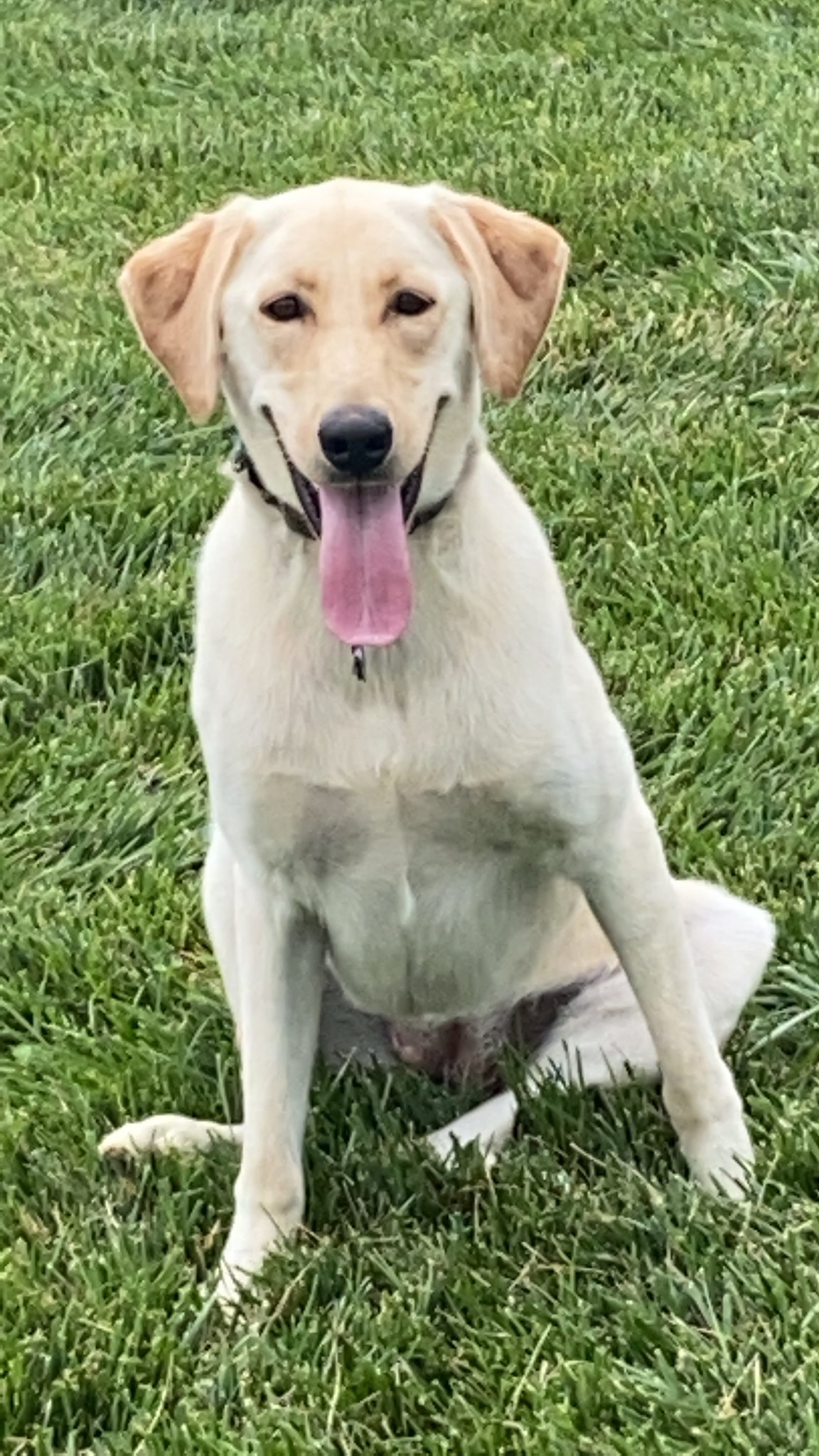
Introducing Golgi, the Labrador Retriever

Golgi

Golgi waiting for a tennis ball throw. For now, we are forced to keep her in “the Golgi Compartment” (a bedroom) when we leave the home, so she will not destroy it!

I as reported not long ago, we recently had to say a difficult goodbye to our 12-year old rescue dog, Ginger, who was (even by the standard of those outside our family) an exceptional dog in her friendliness and great nature. While the grieving process will go on for the rest of my life, it did not take me long to realize that I was in need of new canine companionship.

. Untitled

Our grieving process include putting together a book to commemorate Ginger’s life with us. It’s a great reminder of what a wonderful time we had with her.

Coming home from work without being excitedly greeted (no matter how many grants or papers were rejected), not having a partner for hide-and-seek and throwing a tennis ball, I knew that at some point I would look to adopt another rescue dog, to rescue me. What I didn’t realize was how quickly this would happen. Or how much energy a younger dog has!

I spent time looking online at nearby humane societies and rescue shelters, in Omaha and Lincoln Nebraska, nearby Kansas, Missouri and Iowa, seeking a relatively young Labrador Retriever-like dog (preferably female, because akin to the human species, females are generally less aggressive and better natured…), but not a puppy. About 3 weeks ago, a cute ~1-year old female Labrador Retriever showed up on the website for the Sioux City, Iowa Humane Society, about 90 miles away. It was a Saturday evening, and knowing that many dogs are quickly adopted (especially nice-looking ones), my son and I drove out to be first to see her at opening on 12 pm Sunday the next day. I didn’t even wait for my wife to return from out-of-town (but did have her approval if we liked the dog). Within an hour we were driving back to Omaha with our new family member, renamed “Golgi” (what do you expect from a cell biologist?! Endoplasmic Reticulum just doesn’t have the same ring!).

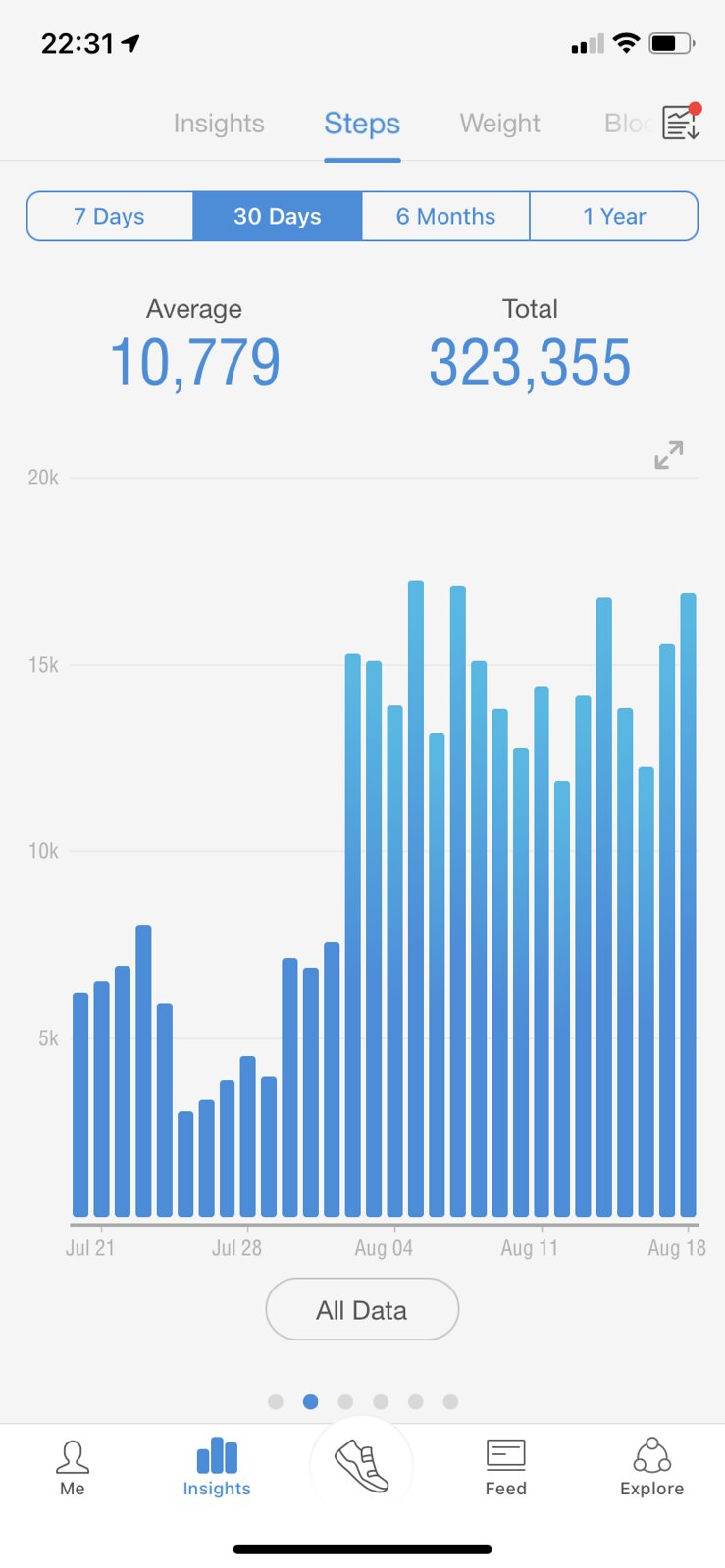
Golgi is a sweet and affectionate dog, with boundless energy. I perhaps underestimated the  lack of maturity of a 1-year old dog, thinking that she would be less puppy-like, and a little calmer. But hopefully with consistent training and lots of exercise, she will calm down and we will get back into a routine (one that doesn’t necessarily include 5 am wake-up on weekends!). On the positive side, I am certainly not lonely, with a shadow by my side everywhere I go, from the shower to the kitchen to the garden. In addition, while there are many reports detailing how dogs increase the quality and length of human lives, anecdotally I can easily see how they induce one to walk and exercise more. Indeed, this graph of my “steps” from before and after adoption on Aug. 2 clearly demonstrates a trend. Untitled

Any guess as to when we adopted Golgi?! Almost like the graphs in papers with pre- and post-treatments…

But leaving aside such health considerations, despite the huge effort and amount of work in training Golgi, I feel happier with a new canine companion in my life again.


Posted in dogs, Golgi, Labrador Retriever | Comments Off on Introducing Golgi, the Labrador Retriever

August

August is a funny month. The nights start to draw in rather quickly as summer draws to a close with what seems like unseemly haste. Keen, fitful gusts of autumn are followed by a rumble of thunder.

I am in the garden, pulling up the last of the carrots (yummy) and the garlic (will weave into a plait and hang up somewhere); harvesting courgettes that have grown as large as zeppelins under what seems to be a jungle of tropical leaves; and seeing if we have any tomatoes yet (everything this year is late, late. late). I’m digging over the plot and will be sowing spinach and kale for overwintering; pricking out tiny baby leeks; and trying again with lettuces (a failure this year – usually we are awash with them).

When the sun shines it’s brassy and hot but somehow melancholic, as if it’s having its last hurrah. There is a kind of torpor.

And some people do not seem to have enough to do.

Twice, in as many days, I have received somewhat impatient emails from friends (two different ones), complaining why a third person (again, different in each case), with whom I am acquainted but over whose actions I have no responsibility, hasn’t responded promptly to some inquiry or other. One of these was actually complaining to said third person about the inaction of a fourth person of whose existence I had not previously heard.

I respond that, in August, that fag-end of blowsy summer, one must be patient. People are probably taking a well-deserved vacation. Or they might be beset with travails of which one knows nothing. Oh, yes, and COVID, that contagion/ government plot/ excuse for inaction (delete as applicable) which, whatever else one might say about its origins and career, seems to make everything take three times as long as it usually does, and that’s quite long enough.

In any case, what do people expect me to do about it? I have not the judgment of Solomon, nor, thankfully, the responsibility, and although I may Walk the Walk and Talk the Talk, reports of my omnipotence are greatly exaggerated.

Sometimes it feels as if the whole world wants a piece of me. But, really, I’m just as lost as everyone else.

Posted in August, Gardening, responsibility, Solomon, summers lease hath all too short a date | Comments Off on August

In which academic dreams come true: a belated professorship

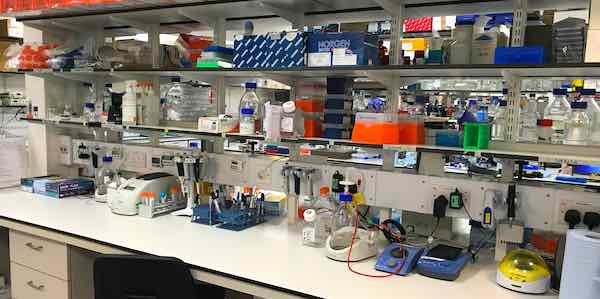
Lab scene

I have wanted to be a scientist since before I can remember.

I did all the right things: I studied hard, finished my homework, raised my hand in class, failed to hide the fact that I loved learning, even though the other children teased me for it – and worse. (Those Hollywood movies about the cruelty of the American school system? It’s all true.) I didn’t care. I was going to become a scientist one day, even though no one in my family had ever earned a PhD, and even though I had never met any scientists, let alone a female one. I’d only encountered them on the page, in the novels I devoured, teetering-library-stackfuls at a time. These characters were heroic and colorful, leading the sort of exciting lives that seemed so far away from suburban existence in small-town Ohio.

I was going to be a scientist one day, even though I constantly received pushback: the well-meaning high school guidance counsellor who suggested that nursing might be more “appropriate”. The male senior researcher in a summer lab internship at the National Institutes of Health who sneered that women made terrible scientists, and convinced the boss to redirect me from experiments to photocopying journal articles for him. Years later as a postdoc, the lab heads who told me I wasn’t cut out for academia because I had outside interests in writing, public engagement and activism. I’m sure they thought they were being kind, doing me a favor. Tough love.

Every time I hit setbacks, or I was told I couldn’t do it, I tried harder. At university, when I couldn’t get a lab job, I got a part-time position scrubbing shit from mouse cages, just so I could wear a white coat and be closer to action. In senior year when I didn’t get into any of the biomedical research labs for my Honors project, I persuaded a new group leader to let me work on plant genetics. Even that NIH internship didn’t happen straightaway; the summer before I’d papered my CV all over the Bethesda campus, but the only job offer I received was in the Health and Safety department. I took it anyway (and had a blast, teaching myself C from Kernighan and Ritchie and doing all sorts of bizarre odd jobs with my newfound programming skills).

The very worst set-back of all was after such a promising start – a PhD from the University of Washington, a postdoc in a prestigious London lab and a group leader position in biotech – it all unravelled in just a few months. The biotech bubble burst, I was made redundant and was on the dole in Amsterdam. The few interview offers I did receive dried up after my unemployment was official, and I was forced to go into scientific publishing to put food on the table. I don’t regret this now, as I learned a tremendous amount during those times. I wrote novels, I started a freelance writing career that continues to this day, I helped launch new journals, I found out what I was made of. But at the time it was devastating, and for several years afterwards I suffered from depression and a complete lack of self-confidence. Being a scientist had become my identity; now that had been stripped away, what was left?

Of course you all know how the story ends. I made it back into academia eventually, even though it took years to find my true calling. Re-starting a scientific career with no prior line of research to build on, in a new discipline where you don’t know anyone and no one knows you, is a very lonely business. For me, the worst was the sensation of having been left behind. First it was seeing postdocs with whom I’d shared a lab become professors. Then it was PhD students I’d supervised. I knew I was swirling in the dust when the PhD student of a PhD student I’d supervised became a professor too. When I ran into such former colleagues at conferences, I always felt awkward and embarrassed, even though I was sure they weren’t aware of how lowly I felt, and wouldn’t have dreamt of judging me. To them, I was that interesting person who’d published novels and organized a memorable political demonstration. But inside, I was the failed scientist who didn’t even have a permanent position, who was surfing, hard and desperate, on a wave of rolling short-term contracts, who was kidding herself, who wasn’t doing justice to the second chance she’d been given. I even allowed myself to be bullied on several occasions because deep down, I thought I deserved it.

Fast forward to today, a full fifteen years after re-starting my academic career. It is only now that I finally feel like I belong, and deserve, to be running a lab. I lead with a light but steady hand, confident in my choices; I have a clear scientific vision; I am respected in my new field. I play a pivotal role in the university. It hasn’t always been smooth sailing – a shocking and protracted incidence of collegial abuse a few years ago nearly threw me back into that roiling surf. But I got through it, and kept my head above water, and now I know that such terrible things happen all the time, but the trick is not to let those incidents define you or undermine your confidence or sense of self. The perpetrators are to be pitied, not feared or hated, and one day they will undoubtedly reap what they sow. Meanwhile, it strengthens my resolve to never be the sort of person who seeks to advance themselves by treading on others; to break the cycle of abuse by refusing to be bitter or changed; to encourage my trainees to shine brightly, to become their best possible selves.

Earlier this month, I found out that my promotion bid had been successful, and that from October I will officially be known as Professor Rohn. After all the heartache, obstruction and deviation, it seems almost unbelievable. I think this is why it took me so long to process the information enough to write about it. Somewhere inside me, a young girl is still rinsing rodent poo from hundreds of cages; as she walks the corridors on her way out, tired and back-sore, she is peering into the brightly lit labs to the left and right and wondering what it would feel like to belong to one of them. But the long-dreamt of moment has finally arrived. I survived. I made it.

The other day, on a whim, I looked up the sneering senior scientist online and found that he’d vanished without a trace from PubMed within ten years of our encounter.

Yet I am still here. In fact, I’m only just getting started.

Posted in academia, careers, Nostalgia, Research, staring into the abyss, The ageing process, The profession of science, Women in science | Comments Off on In which academic dreams come true: a belated professorship

Ultramarine

One or two of you might have read By The Sea, my Gothick Bodice Ripper with Detectives, which was originally serialized by my Occam’s Typewriter Compadre Jenny Rohn on her LabLit website, but now published in book form and available on all good e-book platforms, and even as a paperback. One of the readers was my friend Mr J. W.-V., a fellow Norfolk resident, musician and newsroom journalist. Continue reading →

Posted in adapted screenplay, by the sea, Jenny Rohn, Lablit, tolkien, Writing & Reading | Comments Off on Ultramarine

Today’s Curiosity is Tomorrow’s Cure: The Case for Basic Biomedical Research

9781032065953

I am very excited to finally have my most recent book, “Today’s Curiosity is Tomorrow’s Cure: The Case for Basic Biomedical Research” in press and now available for preorder. 

For a very long time I have been concerned that there is decreasing appreciation (and hence investment) for very basic, curiosity-driven research, with many political leaders and the public (and even Continue reading →

Posted in basic research, book, CRC, curiosity-driven research, disease-related research, education, Francis & Taylor, great discoveries, History of Science, Research, Routledge, science, Today's Curiosity is Tomorrow's Cure: The Case for Basic Biomedical Research, translational science | Comments Off on Today’s Curiosity is Tomorrow’s Cure: The Case for Basic Biomedical Research

Nautilus

I really can’t believe it.

I’ve been writing books for thirty years, but have never seen the anticipation that’s buzzing around my fifthforthcoming tome, A (Very) Short History of Life on Earth.

When a book of mine is published, it’s usual for me to receive translation offers in one or two languages, but only after it’s been out for some time. This time, it’s ra Continue reading →

Posted in a very short history of life on earth, David Attenborough, flabbey road, Korg Nautilus, Life on Earth, Music, Picador, St Martins Press, Writing & Reading | Comments Off on Nautilus

In which summers shrink

Academics talk nostalgically about rosy-tinted times of yore when summers meant a lull in lecturing duties.

The months would unfold before you, a vast landscape of research possibilities. It was a time to write papers, craft grants, catch up with the technical literature, come up with new hypotheses, spend more time chatting with your team. It was a time to dream big, and then work out how to m Continue reading →

Posted in academia, careers, Nostalgia, Research, students, Teaching, The ageing process, The profession of science | Comments Off on In which summers shrink

Picture a Scientist – Who Do You See?

I am often asked who inspired me. I feel embarrassed to admit the answer is no one, it seems like the wrong answer. Certainly there was no female scientist who triggered my love of science at an early age; I was far more inspired by my reading matter. In this category I would single out The New Science of Strong Materials by JE Gordon, I’ve written about the significance of this book at length bef Continue reading →

Posted in discrimination, Equality, harassment, Jane Willenbring, MIT, Nancy Hopkins, Raychelle Burks, Women in science | Comments Off on Picture a Scientist – Who Do You See?

The Imperative of Skills

Whereas academic scientists too often only think in terms of producing the next generation of academic scientists like them, the reality is many would-be PIs would be lost without the technicians who keep the equipment running, train newcomers and generally make sure the lab is in a fit condition for work. They aren’t always visible, but they are crucial in many areas. Last week an article appeare Continue reading →

Posted in BEIS, careers, Chatteris, education, Further Education, technicians, training | Comments Off on The Imperative of Skills

Pride

Here’s a story about Pride, and the best party I ever attended.

It started in 2017, when the Gees had a wonderful family holiday in Northumbria. The fact that I could never seem to find Hadrian’s Wall, no matter how manically I drove along country lanes trying to find it, became a family joke. I had somehow expected some imposing structure like the Great Wall of China when, in fact, mu Continue reading →

Posted in Apparitions, Apsperg-O-Meter, camp, dirtyfilthysexy, Hadrian's Wall, LGBTQ+, Monty Python and the Holy Grail, you'll always find me in the kitchen at parties | Comments Off on Pride