Latest posts

Infectious opinions

It’s been a funny old 18 months as world events suddenly came crashing into my corner of science – the immune response to viral infections in the lung. One of the unexpected outcomes of the pandemic was that I wrote a book (Infectious: Pathogens and how we fight them). In the book I cover the history of infectious disease research and the enormous strides that have been made. One of the great joys of writing the book was learning about all the scientists who have helped us in our battle with infections. Thanks to these women and men, we had a COVID19 vaccine within 100 days of the virus first being sequenced, a truly remarkable feat. I think it is fair to say that the pandemic has seen the return of some level of respect for expertise.

That we are emerging from the other side of the pandemic is thanks to expertise of many sorts – the healthcare workers who treated patients throughout, the epidemiologists and behavioural scientists who plotted the tricky course of how nations should respond, the lab scientists who developed and ran the diagnostic tests and the immunologists who developed a vaccine at unprecedented speed.

Of course, not everyone has respected scientific expertise. There has been a congealing of conspiracy theories on social media during the pandemic. These rumours invariably hurt the people who believe them – the rates of infection were much higher in the no-mask/ anti-vax states of the US. The ongoing digestion of toxic guff and the polarisation of society are beyond this article, but if the virus deniers found catching COVID a surprise, just imagine how shocked they are going to be when they discover climate change is real and their house is 6 foot under water and on fire.

Shouting at other people electronically has not been reserved for the scientifically illiterate. Science-COVID twitter has (like Saturn) devoured its children. Which is a crying shame. In the spring of 2020, Twitter had been the go-to source for information about the spread and the evolution of a fast-moving pandemic, but in the summer 2021 it was a cesspool. You were just as likely to see scientists trolling each other as members of the public. Though maybe this shouldn’t be such a surprise – it harkens back to a bygone era that I had mistakenly assumed was long gone, when academics let their feelings for each other be known very publicly.

In researching my book Infectious, I discovered that infectious disease research has always had a shouty streak, with antipathy between key players. Anthrax research and the Franco-Prussian war fuelled enmity between two of the grand messieurs of infection science: Louis Pasteur and Robert Koch. Jonas Salk and Albert Sabin, who both raced to develop polio vaccines, were not exactly on speaking terms. Salk’s inactivated vaccine won that race, much to the chagrin of Sabin who described him as a ‘mere kitchen chemist’. Ignatius Semmelweis, who in the 19th Century first demonstrated that washing your hands between touching dead bodies and delivering babies might be a good idea, also experienced intense acrimony but this was less from a single person more from the entire medical establishment.

And finally, my favourite – Félix d’Hérelle, a French-Canadian microbiologist who lived the kind of colourful life no longer seen in career academics. Amongst other things, d’Hérelle lost all his money in a failed chocolate factory, worked in Guatemala, Mexico, France, India, the USA and Egypt (not trivial before international flight), had a brief run-in with the secret police in Soviet Russia when his mentor fell in love with the same woman as Beria (the notorious head of the Stalin’s secret police) and was put under house arrest by the Wehrmacht in the Second World War. Scientifically his main contribution is as an discoverer of the bacteriophage (in parallel with Fred Twort), but he antagonised Jules Bordet, a Nobel Prize winner, to such an extent that d’Hérelle ended up threatening Bordet with a scientific duel. Though it is not clear what a scientific duel entails – pipettes at dawn possibly?

So, Covid-19 disputes are nothing is new really. Some people argue that competition can drive progress. I am not convinced.

Where do we go from here? As someone observed recently, science Twitter could definitely do with a reboot. Whilst debate is healthy; entrenched opinions based on sketchy data are not. I certainly preferred it when scientists passively-aggressively slated each other off in reviewer’s comments rather than this all-out warfare. The simplest answer is to step away from social media and talk to people in the real world, most of whom are simply happy that the pandemic is by and large over. Or maybe retreat into a good book? Ideally one taking a long view of our progress in Infectious disease research.

John Tregoning is reader in respiratory infections at Imperial College London and author of the upcoming book INFECTIOUS published by OneWorld.

Posted in art, COVID-19, education, Guest posts, Hobbies, Infectious, vaccine, virus | Comments Off on Infectious opinions

The Problems of Measurement

How should we measure what is a good outcome from a university education? As David Willetts puts it in his latest report published through the Higher Education Policy Institute (HEPI) ‘The Treasury cast their beady eye over the evidence and worry universities are not delivering the earnings boost which they used to’, demonstrating one sort of answer to the question. Another recent publication, this time from the Institute for Fiscal Studies (IFS), considers social mobility and the lure of London using earnings as the framing of a good outcome for the individual. Is it all about money? Should it be all about the money? It seems to me a very narrow figure of merit for either society or the graduate.  Furthermore, I believe the IFS analysis is oversimplifying the interesting data they have analysed.

The IFS study explores the mobility of those with and without degrees, considered by socio-economic status and ethnic origin, but it is framed as mobility – and this is geographical mobility that is being analysed, not social mobility – as necessarily desirable, as if anyone who doesn’t move has ‘failed’, although that is not their explicit phrasing. I worry about this framing, relevant though it may be to the levelling-up agenda. For instance,

“Places with high average earnings attract graduates through migration. Graduates who grew up in places with low average earnings are more likely to move away.”

They note that non-graduates are less likely to move to London and other large cities than graduates.  Inevitably, these patterns of behaviour also lead to their final conclusion that ‘patterns of mobility exacerbate regional inequality in skills’, so that there is a ‘brain drain from the North and coastal areas’. By framing what is a good outcome of a university education in terms of money, the implicit messaging being given to graduates is ‘it’s all about the cash’. This is a travesty of what a university education should be about. The idea of public good, as opposed to personal gain, cannot be seen in that framing, but becomes relevant when trying to determine what might be done for the areas (Grimsby and Wisbech are pulled out as examples) where the current loss of graduates is marked, and social deprivation is highly visible.

Let us take the specific example of a Muslim woman who wants to stay close to her family and teach in a primary school: she will neither be a high earner nor have demonstrated an appetite for mobility, but she will be of huge benefit to her community, and an excellent role model for younger women. Such a woman should be highly valued, not put down as a statistic of someone who didn’t aspire to geographical mobility. (I wonder how the likely increasing trend to working from home, possibly home being located far distant from the location of the employer, will skew future analyses.) Interestingly, the IFS findings show that Asian women who do move earn less than those who stay put (in contrast to every other group), and that young adults of Indian and Pakistani heritage are significantly less likely to have moved by age 27 than their white peers of otherwise similar backgrounds.

Income can be measured.  Value to a local community is much harder to quantify, but it is still value. It is obvious that high paying jobs are often in metropolitan areas which will therefore act as an attractor to many, and if income is used as the only figure of merit, then the metropolitan areas look ‘good’. It becomes a self-fulfilling prophesy that the well-heeled parts of the country are the ones to which graduates may aspire to move, which will definitely exacerbate inequality.

How should we measure what is a good outcome from a university education? As David Willetts puts it in his latest report published through the Higher Education Policy Institute (HEPI) ‘The Treasury cast their beady eye over the evidence and worry universities are not delivering the earnings boost which they used to’, demonstrating one sort of answer to the question. Another recent publication, this time from the Institute for Fiscal Studies (IFS), considers social mobility and the lure of London using earnings as the framing of a good outcome for the individual. Is it all about money? Should it be all about the money? It seems to me a very narrow figure of merit for either society or the graduate.  Furthermore, I believe the IFS analysis is oversimplifying the interesting data they have analysed.

The IFS study explores the mobility of those with and without degrees, considered by socio-economic status and ethnic origin, but it is framed as mobility – and this is geographical mobility that is being analysed, not social mobility – as necessarily desirable, as if anyone who doesn’t move has ‘failed’, although that is not their explicit phrasing. I worry about this framing, relevant though it may be to the levelling-up agenda. For instance, “Places with high average earnings attract graduates through migration. Graduates who grew up in places with low average earnings are more likely to move away.” They note that non-graduates are less likely to move to London and other large cities than graduates.  Inevitably, these patterns of behaviour also lead to their final conclusion that ‘patterns of mobility exacerbate regional inequality in skills’, so that there is a ‘brain drain from the North and coastal areas’. By framing what is a good outcome of a university education in terms of money, the implicit messaging being given to graduates is ‘it’s all about the cash’. This is a travesty of what a university education should be about. The idea of public good, as opposed to personal gain, cannot be seen in that framing, but becomes relevant when trying to determine what might be done for the areas (Grimsby and Wisbech are pulled out as examples) where the current loss of graduates is marked, and social deprivation is highly visible.

Let us take the specific example of a Muslim woman who wants to stay close to her family and teach in a primary school: she will neither be a high earner nor have demonstrated an appetite for mobility, but she will be of huge benefit to her community, and an excellent role model for younger women. Such a woman should be highly valued, not put down as a statistic of someone who didn’t aspire to geographical mobility. (I wonder how the likely increasing trend to working from home, possibly home being located far distant from the location of the employer, will skew future analyses.) Interestingly, the IFS findings show that Asian women who do move earn less than those who stay put (in contrast to every other group), and that young adults of Indian and Pakistani heritage are significantly less likely to have moved by age 27 than their white peers of otherwise similar backgrounds.

Income can be measured.  Value to a local community is much harder to quantify, but it is still value. It is obvious that high paying jobs are often in metropolitan areas which will therefore act as an attractor to many, and if income is used as the only figure of merit, then the metropolitan areas look ‘good’. It becomes a self-fulfilling prophesy that the well-heeled parts of the country are the ones to which graduates may aspire to move, which will definitely exacerbate inequality. However, here as in so many instances, metrics should be used with care.

Willetts highlights the dangers of using, as a proposed criterion for the OfS (Office for Students), graduate outcomes a mere fifteen months after graduation as a means to determine university performance, a time when many (if not most) graduates are still finding their feet in their careers. Fifteen months is far too soon, as he makes clear, and it still relies on using earnings as the figure of merit, this time to score university courses. As so many commentators have pointed out, such a metric will necessarily imply that many courses are inherently seen as low-value; not necessarily the STEM careers I typically consider on this blog, but courses in music and the arts, for instance, and those wishing to become nurses, work in the charity sector (a popular choice for Cambridge graduates I understand) or who aspire to be that primary school teacher I mentioned above.

Willetts is a great believer in universities of all complexions and wishes to see less distinction made between academic and vocational pathways, as well as less between those institutions providing either. He has, it would seem, little time for his alma mater of Oxford, or indeed mine of Cambridge, accusing them of snobbishness, in large part because they don’t teach non-academic courses (while, a little confusingly, simultaneously pointing out that engineering and law are vocational, courses very much taught here). He highlights the potential benefits to the local economy if new universities were to open up in towns from Wigan to Peterborough. Such benefits would pertain at least as much to workers in low-paid jobs as to the graduates themselves. However, the IFS study would imply such graduates would, possibly should, then migrate to the bright lights of London or Manchester, removing the possible gains to the community.

What about Oldham? I highlight this town, sitting within Greater Manchester, because it is in the process of carrying out an economic review, led by Alun Francis, the head of the local Further Education college, Oldham College. (Willetts sees FE Colleges as a great undervalued resource in the education landscape.) What can a run-down old mill town do to improve its economic performance, pushing up median wages from their current miserably low level, and to keep those young people who get qualifications at level 4 and above in the area to boost the economy? As long as the public discourse is framed in ‘geographical mobility is necessarily good’ – to paraphrase the IFS study – or graduate earnings are the only measure of the value of further and higher education, as the Department for Education appears to want OfS to think about the matter, we will not get anything approaching levelling up, because those who can, will migrate to the city lights, and those who advise them will encourage them to do so.

How should we measure what is a good outcome from a university education? As David Willetts puts it in his latest report published through the Higher Education Policy Institute (HEPI) ‘The Treasury cast their beady eye over the evidence and worry universities are not delivering the earnings boost which they used to’, demonstrating one sort of answer to the question. Another recent publication, this time from the Institute for Fiscal Studies (IFS), considers social mobility and the lure of London using earnings as the framing of a good outcome for the individual. Is it all about money? Should it be all about the money? It seems to me a very narrow figure of merit for either society or the graduate.  Furthermore, I believe the IFS analysis is oversimplifying the interesting data they have analysed.

The IFS study explores the mobility of those with and without degrees, considered by socio-economic status and ethnic origin, but it is framed as mobility – and this is geographical mobility that is being analysed, not social mobility – as necessarily desirable, as if anyone who doesn’t move has ‘failed’, although that is not their explicit phrasing. I worry about this framing, relevant though it may be to the levelling-up agenda. For instance, “Places with high average earnings attract graduates through migration. Graduates who grew up in places with low average earnings are more likely to move away.” They note that non-graduates are less likely to move to London and other large cities than graduates.  Inevitably, these patterns of behaviour also lead to their final conclusion that ‘patterns of mobility exacerbate regional inequality in skills’, so that there is a ‘brain drain from the North and coastal areas’. By framing what is a good outcome of a university education in terms of money, the implicit messaging being given to graduates is ‘it’s all about the cash’. This is a travesty of what a university education should be about. The idea of public good, as opposed to personal gain, cannot be seen in that framing, but becomes relevant when trying to determine what might be done for the areas (Grimsby and Wisbech are pulled out as examples) where the current loss of graduates is marked, and social deprivation is highly visible.

Let us take the specific example of a Muslim woman who wants to stay close to her family and teach in a primary school: she will neither be a high earner nor have demonstrated an appetite for mobility, but she will be of huge benefit to her community, and an excellent role model for younger women. Such a woman should be highly valued, not put down as a statistic of someone who didn’t aspire to geographical mobility. (I wonder how the likely increasing trend to working from home, possibly home being located far distant from the location of the employer, will skew future analyses.) Interestingly, the IFS findings show that Asian women who do move earn less than those who stay put (in contrast to every other group), and that young adults of Indian and Pakistani heritage are significantly less likely to have moved by age 27 than their white peers of otherwise similar backgrounds.

Income can be measured.  Value to a local community is much harder to quantify, but it is still value. It is obvious that high paying jobs are often in metropolitan areas which will therefore act as an attractor to many, and if income is used as the only figure of merit, then the metropolitan areas look ‘good’. It becomes a self-fulfilling prophesy that the well-heeled parts of the country are the ones to which graduates may aspire to move, which will definitely exacerbate inequality. However, here as in so many instances, metrics should be used with care.

However, here as in so many instances, metrics should be used with care. Willetts highlights the dangers of using, as a proposed criterion for the OfS (Office for Students), graduate outcomes a mere fifteen months after graduation as a means to determine university performance, a time when many (if not most) graduates are still finding their feet in their careers. Fifteen months is far too soon, as he makes clear, and it still relies on using earnings as the figure of merit, this time to score university courses. As so many commentators have pointed out, such a metric will necessarily imply that many courses are inherently seen as low-value; not necessarily the in the STEM arena, as I typically consider on this blog, but courses in music and the arts, for instance, and those wishing to become nurses, work in the charity sector (a popular choice for Cambridge graduates I understand) or who aspire to be that primary school teacher I mentioned above.

Willetts is a great believer in universities of all complexions and wishes to see less distinction made between academic and vocational pathways, as well as less between those institutions providing either. He has, it would seem, little time for his alma mater of Oxford, or indeed mine of Cambridge, accusing them of snobbishness, in large part because they don’t teach non-academic courses (while, a little confusingly, simultaneously pointing out that engineering and law are vocational, courses very much taught here). He highlights the potential benefits to the local economy if new universities were to open up in towns from Wigan to Peterborough. Such benefits would pertain at least as much to workers in low-paid jobs as to the graduates themselves. However, the IFS study would imply such graduates would, possibly should, then migrate to the bright lights of London or Manchester, removing the possible gains to the community.

What about Oldham? I highlight this town, sitting within Greater Manchester, because it is in the process of carrying out an economic review, led by Alun Francis, the head of the local Further Education college, Oldham College. (Willetts sees FE Colleges as a great undervalued resource in the education landscape.) What can a run-down old mill town do to improve its economic performance, pushing up median wages from their current miserably low level, and to keep those young people who get qualifications at level 4 and above in the area to boost the economy? As long as the public discourse is framed in ‘geographical mobility is necessarily good’ – to paraphrase the IFS study – or graduate earnings are the only measure of the value of further and higher education, as the Department for Education appears to want OfS to think about the matter, we will not get anything approaching levelling up, because those who can, will migrate to the city lights, and those who advise them will encourage them to do so.

Willetts highlights the dangers of using, as a proposed criterion for the OfS (Office for Students), graduate outcomes a mere fifteen months after graduation as a means to determine university performance, a time when many (if not most) graduates are still finding their feet in their careers. Fifteen months is far too soon, as he makes clear, and it still relies on using earnings as the figure of merit, this time to score university courses. As so many commentators have pointed out, such a metric will necessarily imply that many courses are inherently seen as low-value; not necessarily the STEM careers I typically consider on this blog, but courses in music and the arts, for instance, and those wishing to become nurses, work in the charity sector (a popular choice for Cambridge graduates I understand) or who aspire to be that primary school teacher I mentioned above.

Willetts is a great believer in universities of all complexions and wishes to see less distinction made between academic and vocational pathways, as well as less between those institutions providing either. He has, it would seem, little time for his alma mater of Oxford, or indeed mine of Cambridge, accusing them of snobbishness, in large part because they don’t teach non-academic courses (while, a little confusingly, simultaneously pointing out that engineering and law are vocational, courses very much taught here). He highlights the potential benefits to the local economy if new universities were to open up in towns from Wigan to Peterborough. Such benefits would pertain at least as much to workers in low-paid jobs as to the graduates themselves. However, the IFS study would imply such graduates would, possibly should, then migrate to the bright lights of London or Manchester, removing the possible gains to the community.

What about Oldham? I highlight this town, sitting within Greater Manchester, because it is in the process of carrying out an economic review, led by Alun Francis, the head of the local Further Education college, Oldham College. (Willetts sees FE Colleges as a great undervalued resource in the education landscape.) What can a run-down old mill town do to improve its economic performance, pushing up median wages from their current miserably low level, and to keep those young people who get qualifications at level 4 and above in the area to boost the economy? As long as the public discourse is framed in ‘geographical mobility is necessarily good’ – to paraphrase the IFS study – or graduate earnings are the only measure of the value of further and higher education, as the Department for Education appears to want OfS to think about the matter, we will not get anything approaching levelling up, because those who can, will migrate to the city lights, and those who advise them will encourage them to do so.

 

Posted in careers, education, Further Education, inequality, mobility, skills | Comments Off on The Problems of Measurement

Office

Small spaces at home, hitherto neglected nooks and crannies, have begun to assume a far greater importance in our lives than they once did. These are those closets, spare bedrooms, cupboards under the stairs, corners of bedrooms, edges of dining tables or breakfast bars and so on where many people now do their work, when once they would commute to somewhere perhaps more suitably equipped.

I’m lucky in that even before the Present Unpleasantness I have worked at home for most of the time. When the Gees first moved to Cromer, in 2006, I really did work in a cupboard under the stairs, though back then I commuted more. In 2011 we remodeled the house, adding a kitchen diner at the back, so I moved into (most of) the old galley kitchen. And that’s been my office/ studio/ man cave/ dojo/ fun palace/ library ever since. This is what it looked like a couple of weeks ago.

I did most of the working (and music-making) at the far end. Although it’s a long narrow room, it seems much longer because I used a wide-angle lens to get it all in. In actual fact the total floor area is less than six square metres.

After working hard all summer at the Submerged Log Company, as well as finishing my latest book — and recording the audiobook version thereof — I felt that it was high time for a refurb. I spend quite a lot of time in the home office, whether for the day job; writing on my own account; writing and recording music; or just relaxing; and after ten years of occupation it had begun to look a bit scruffy. There were some ugly stains on the ceiling (a result of minor flooding from the bathroom above), and I realized that behind the bookshelves there was still some raw plaster and even a few holes from when the room had once been a kitchen. Even the wire that had powered the cooker still protruded from the wall. So I decided to take some time off to gut the place.

It took four days — FOUR DAYS — to remove the hundreds of books, sound equipment, sundry gewgaws, bibelots, unicycles, girrafes, and other stuff. Luckily we have a capacious garden summerhouse.

It took another three days to prep the place for repainting. I pulled up the scuzzy floor tiles. I filled up all the holes. I vacuumed. I threw out trash. I vacuumed again. I sugar-soaped the walls. I did more vacuuming. The dust, my dears, the DUST.

The time came at last to apply, you know, actual paint.


And here it is after the first coat of Homebase Pure Brilliant White. One thing I discovered while doing this job is that, like Michelangelo, I don’t like painting ceilings very much. A friend suggested I send the bill to the Pope. So His Holiness might soon be getting a receipt for a large tub of the aforementioned Homebase Pure Brilliant White. and a paint roller.

After two coats — and two days — Offspring 2, who has far greater attention to detail than I, came in to touch up the bits I’d missed.


Then the time came to install a large shelf with legs, which has pretensions to being a desk.

The next task was to attach fourteen vertical runners to the walls, for the shelves. This meant drilling a lot of holes, with a power drill. Another thing I discovered while doing this job was that I am not fond of power tools, especially in a confined space. The NOISE. You might ask why I didn’t use the same holes as before. Well, that would have been too easy. Besides, I wanted some of the shelves in different places.

This took two days. Or, rather, four hours, spread over two days. I could only take so much of the noise (and the vibration), and I wanted to spare the neighbours. After that I could put up the shelves.  Quietly.


After a lot more vacuuming it was time to install new carpet tiles. Last time I did this I glued them down with special tile adhesive, and after some time in this confined space I felt that I was being cheered enthusiastically on by Harvey the Giant Pink Octopus and his All-Star Orchestra featuring the Crustacean Choristers, with, towards the end, Agama Gekko and the Iguana Brass. This time the tiles were thicker and backed with bitumen, so could simply be laid flat on the ex-council lino, without adhesive of any kind, not even hallucinogenic, although I still had to cut a few to fit. This only took an evening, but took longer than it might have done because the dog felt she had to come and ‘help’. This meant that short bursts with a sharp knife and straight-edge were interspersed with longer intervals of rolling around on the floor admiring whichever soft toy was the dog’s favorite that day.
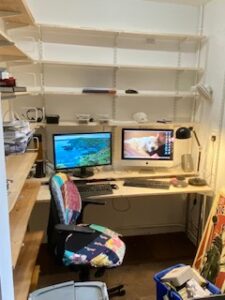


Only then could I install the computers and associated electrical equipment – much easier to do before the books come back.

In the meantime, comments had been made on Social Media about the scruffiness of my chair. Well, I have had that chair for at least a quarter of a century. I have written many books while seated in that chair, notwithstanding inasmuch as which processed many thousands of submerged logs. That chair was good enough for me. But Mrs Gee very kindly re-covered the chair with the fabric from some very colorful but worn-out trousers she once wore, giving the chair a fetching and funky new appearance.


And now, the books. The refurbishment was an excellent opportunity to have a cull. I really don’t like getting rid of books, but as I am fast coming up to rapidly approaching my seventh decade, I made one of two executive decisions – that if I have read a book and am unlikely to read it again, then I should donate it to a charity shop so someone else can have a go. This picture shows a huge pile of crates filled with books destined for our favourite secondhand bookstore, which is at Blickling Hall, a local National Trust property. Almost all of these books are from the Office, though Mrs Gee and I have been thinning out drifts of books that have accumulated elsewhere chez Gee. Working at a publishing company, as I do, I tend to accrete books without knowing it. I also had a large pile of generic thrillers, acquired in two episodes. The first was when a elderly neighbour was in hospital for some weeks trying to shake off pneumonia. He was a voracious reader, and before each visit I’d trawl charity shops for airport-lounge-style thrillers and whodunits. Sadly his pneumonia won in the end, and after his death, his widow returned the books. The second episode was when I broke an ankle in August 2018 and was confined to bed for a couple of months, and neighbours and friends kindly gave me lots of entertaining reading. Much of it now read – the rest, I’m unlikely to – so off they go.



The remaining books re-shelved, the last task was to reinstall Flabbey Road, my home studio. Which I did. The second executive decision I made was that my days of live playing are over. I really don’t much like wiring things up, taking all the wires out again, schlepping huge boxes around in the middle of the night, wiring them up again, playing for a few bored punters wildly enthusiastic crowds, and doing it all in reverse when I could be comfily at home watching Strictly with the family. Besides, lockdown has taught me that I can record whole albums at home, as well as audiobooks.



Here is what it looks like from the other end.

And that’s it. It took the full fourteen days, or even a fortnight. And it was exhausting. Some days all I could do of an evening was flake out in front of the TV while I felt the blood pounding in my arms and legs. All that moving of books and equipment, all that stretching and bending, toting barges, lifting bales, while wielding a paint roller/ vacuum cleaner/ carpet knife/ etcetera.

But I’m very glad it’s done. I must say I couldn’t have done it without the support of the family, who had to tolerate the mess and dust and fumes and general chaos. Should be good for at least another ten years. Next stop – tidy the toolshed.


Posted in Domesticrox, Home Office, working from home | Comments Off on Office

University Traditions

This is the time of year when students are in the process of returning to their many campuses (or going for the first time as Freshers). Cambridge University term starts later than many, and as a result few students are yet back. Consequently, the University has been cramming in, in the diary but not in numbers attending, ceremonies in the Senate House to confer degrees and to celebrate those who took their degrees in absentia last summer. The occasions are not what they would once have been – no proud parents or friends in the Senate House, no clasping of the hands while the degree is conferred – but I hope they still feel like a special occasion. (I wrote about the form of my University’s ceremonies, as indeed other graduation events in which I’ve participated in different guises, in a relatively early post on this blog).

The pandemic has changed everything, across University occasions and well beyond the Senate House. A few people still seem intent on shaking hands in social situations – and I’ve been giving them a metaphorical cold shoulder – but I wonder whether the Cambridge tradition of clasping hands in the Senate House will ever return, although I certainly hope the presence of families will. There are so many aspects of life, traditional customs which may seem totally inappropriate in the future. The Continental way of hugging – be that with two or three pecks on the cheek, I was always confused which to expect from whom – which increasingly seemed to be replacing the cool British handshake, even between academics, seems as unsuitable in these pandemic days as that handshake. I don’t think the bumping of elbows is very likely to catch on, more appropriate though it may currently seem.

I am very conscious of the approaching start of the Cambridge term, with its formal sequence of events, ceremonial and pedagogical, but also looking back, almost with horror, as I realise the 50th anniversary of my own matriculation is fast approaching. While Churchill finesses what new procedure we will follow – not all freshers coming into the Master’s Lodge one after the other and shaking my hand and then my husband’s, while a couple of sentences are exchanged at close range – I try to remember what my own matriculation was like. No formal dinner, it would seem. I’ve found the letter I wrote to my mother all those years ago, and it is not very enthusiastic:

‘I may say the matriculation ceremony was a farce (I didn’t even wear a gown for it – tatty old jeans instead!). It consisted of filing into the praelector’s office and signing our name in two places – one swearing to obey the rules, regulations, ordinances [which I couldn’t spell, getting confused with ordnances] etc, and the other the college register. No pomp and ceremony and not even a glass of port.’

Was I disappointed or relieved? I’m not sure. There is no doubt that too much ceremony can overwhelm freshers who aren’t used to that sort of formality and are convinced they will get things wrong. The matriculation dinner so many colleges – including ours – do have, may simply feel like an opportunity to demonstrate their ignorance by using the wrong knife or putting water in the wine glass. I always feel sorry for those who are placed next to me, in case that makes their anxiousness soar yet higher, although I’ve had some amazing conversations with students who have done phenomenally enterprising things before they left school, or simply thought deeply about the issues that matter to them and which they are keen to discuss.

Nevertheless, myself as a fresher had little positive to say in this same letter about ‘the Mistress’s reception’ (I was at Girton College, then for women only, and which has always had a Mistress).

‘Tonight was the mistress’s reception which was another farce. A sweet looking old woman, who gave the impression of being unused to making speeches and it didn’t really look as if she was going to try to make personal contact with everyone – so we made off.’

Oh dear. Is that how people regard me, sweet and unused to giving speeches? Checking Wikipedia, I see that the said Mistress was rather younger than I am currently so ‘old’ feels, to my present self, very harsh. It is undoubtedly wholesome for me to look back at what a young student may feel about the strange events that greet them when they first arrive in this venerable University. I should remember this! I still have to write this year’s speech for the Fresher’s dinner, but I’ve been getting plenty of practice at giving speeches to other cohorts of students and alumni, so I hope I don’t resemble that ‘old’ Mistress of mine.

It is intriguing to note that, in my next letter home, I refer to being exceedingly exhausted:

‘I have just returned from playing squash for an hour at Churchill. Made a real fool of myself but at least I know better what it entails.’

As far as I recall, that was the only time I set foot in Churchill during the six years I was in Cambridge completing my first and second degrees. I was pleased to note that my opponent from that day came up to me at an alumni event a few years back, remarking (with pride, perhaps?) that he had been the one to introduce me to Churchill. We had not, to my memory, spoken from that squash day to the alumni event; he clearly had not been impressed by my squash-playing skills either. My defence is that it was my first time.

We may all be hoping for an academic year that is closer to the ‘normal’ we used to know. However, I think we also understand that all kinds of differences will assail us, ranging from what incoming students will know, how confident they are and how they settle into a life that is still going to be punctuated by mask-wearing, one-way systems in buildings and – on top of the pandemic fall out – limited food choices in our catering facilities as much as in the supermarkets. It will be a long time before we know what the new normal looks like, and what habits and customs will never return.

Posted in admission to degrees, education, Freshers, Girton College, matriculation, Senate House | Comments Off on University Traditions

Spayed

It’s been a funny old day. It started in a celebratory mood as my book finally got to be published in the UK. And also, in Dutch, in Holland. I have been basking in congratulatory messages, which has been lovely, and if you want to know what the fuss is all about, you may visit the book’s very own website, which is here.

But the day was also deviant in its routine as I had to get my faithful dog Lulu to the vet to be spayed.  This is an appointment of long standing, and calculated from the end of her last being in season. She is now back from having been spayed, surprisingly perky withal, and modelling a very smart babygro. But I’ll be nursing her this evening.

And it also happens to be Yom Kippur, a day in which publishing books and nursing spayed dogs should really be very far from one’s mind. Real life, eh?

Posted in Domesticrox | Comments Off on Spayed

‘Pure’ versus ‘Applied’ Science

When I started this blog, more than ten years ago, I imagined I would write about physics, and specifically about physics at the interface with biology. Perhaps, I thought, I would write about exciting papers I’d read; indeed, I asked a couple of other researchers in my field to join with me in doing this, to be met with little enthusiasm. In practice, things have turned out very differently. The science itself has not featured greatly here; I’ve largely written about the doing of it – who does it, how it should be done (and equally important, how it should not be done), and how it is funded; the political landscape for science; and the diversity angle. Interdisciplinary work – of the sort I was doing at the time – has certainly featured, particularly in the early days. So have its challenges, not least around funding, but not much about the science itself. I don’t regret that. I’ve had fun with writing this blog. I’m sure it has helped my writing skills (never too late) and I’ve enjoyed the interactions I’ve had, initially through posted comments although now much more usually over Twitter. But today I want to revert to something closer to my original concept, although still without detailed science.

I am prompted to write this by reading an editorial in the newsletter of the Institute of Physics’ Biological Physics Group written by my Cavendish Laboratory colleague, Pietro Cicuta, who is stepping down as Chair. I was instrumental in setting up this group nearly fifteen years ago, and I was its Chair for the first few years. As far as I can tell, this editorial is available to all, and not just IOP members, so I encourage you to read Pietro’s thoughtful views. He says

‘Today, many of us capably handle living systems within our physics departments, or in genuine cross-disciplinary environments, making entirely new research possible, for example integrating new tools and designing experiments that are as systematic as many other areas of condensed matter physics.’

In the early 2000’s, physics departments did not expect to have cell culture facilities, for instance, nor to teach material that might be called ‘biological physics’, although the field has various equivalent names (e.g. biophysics). Things have undoubtedly moved on; many departments are now well equipped with facilities for working with live organisms and with teaching relevant material.

However, I absolutely share Pietro’s concern

‘that despite the excitement of our field, the new teaching courses we developed, the fundamental progress that it is possible to achieve even with relatively small teams, the relevance to real challenges that matter to the public…. despite all this, we are still seen as one of the various sectors of “applied physics”. We have not impacted the “physics culture” very much: particle physics, astrophysics or cold atoms are not considered as physics applied to particles, stars or cold atoms… they somehow are still “the physics”.

Readers who are not physicists might wish to consider what the topics are that they immediately think physics covers, and it probably wouldn’t involve malaria (I wrote about Pietro’s work in this area in the Guardian, back in 2014 when that paper was committed to science blogs), or Covid (more on that shortly), or tumour evolution (to cite the work of another Cavendish colleague Sarah Bohndiek). On the contrary, their thoughts are more likely to turn to black holes and the Higgs’ Boson, or perhaps how to manipulate single atoms at ultracold temperatures. As Pietro says, the rest is, somewhat derogatorily, described as ‘applied’. Dirty stuff, that might be useful….not seen nevertheless as differently exciting and full of wonder.

Back in 2010, when this blog was still largely on the topic of biological physics, I asked ‘Where’s the Wow Factor?’ for this very reason: mainstream physicists think there can be no beauty or amazement in areas away from the sorts of topics I list above. Pietro’s editorial indicates how little things have changed in the last decade. Yet, physicists working in this area can contribute very substantially to our wellbeing, potentially to ‘healthy ageing’, as through work on cancer. If physics is being applied to cancer, why does that not attract a sense of amazement? It baffles me why our culture, and this includes the media in the way they report stories, see so-called applied physics as less worthy of interest than black holes. It isn’t that everyone believes ‘applied’ is bad in all disciplines, because they have made so much – rightly so – about the work of Sarah Gilbert’s team on vaccine development. ‘Pure’ (as that must be the opposite of applied, I suppose) work may have underpinned the development, but its current wow factor sits in enabling it to be applied to our real world, in moving us gratefully on from total lockdowns.

I mentioned physicists’ contribution to Covid. Here I will cite theoretical physicist Mike Cates (educated in the Cavendish, but now Lucasian Professor – the Chair formerly held by Stephen Hawking – in Cambridge’s Department of Applied Maths and Theoretical Physics) who, early on in the pandemic, kickstarted an initiative known as RAMP (Rapid Assistance in Modelling the Pandemic) under the auspices of the Royal Society. This brought together, essentially via crowd-sourcing, over 1800 scientists who felt they had something to offer. Mike’s latest co-authored paper from this programme Efficient Bayesian inference of fully stochastic epidemiological models with applications to COVID-19 takes tools from other areas of physics to apply to this current problem, relying also on the late Dave Mackay’s (another professor at the Cavendish) work on inference. Why is all this work not seen as mainstream?

It seems to me right and proper that fields should evolve. We should remember that James Clerk Maxwell was fascinated by light and colour, but also how our eyes worked to perceive that colour (see, for instance, Basil Mahon’s biography The man who changed everything). In 1855 he presented a paper Experiments on Colour, as perceived by the Eye, with remarks on Colour-blindness to the Royal Society, and five years later he followed up with On the Theory of Colour Vision  to that same august institution. People back then were much more open-minded about what ‘physics’ might be. Certainly his work in this area, along with all his other notable achievements, did not stop him becoming the first Cavendish Professor of Physics at Cambridge – when the Cavendish Laboratory was first opened – in 1871.

Somehow, in the intervening century and a half, scientific culture has become much more narrow-minded, putting us into boxes unless we fight hard. This is the problem for researchers attempting to break down disciplinary boundaries. The interface between physics and biology is one which has become much more blurred; for those of us working at that interface the work is fascinating, intriguing and infinitely worthwhile, and comes in many different flavours. But some of our colleagues seem stuck in a time-warp and, inevitably, that message may rub off on those they teach. I look forward to the world of physics in this country (other countries do rather better as far as I can tell) losing its hang-ups about pure versus applied, what is ‘proper’ physics, and what is not. I hope many members of the Institute of Physics read Pietro’s editorial and consider their positions.


Posted in Biological Physics, education, Interdisciplinary Science, James Clerk Maxwell, Mike Cates, Pietro Cicuta, Research | Comments Off on ‘Pure’ versus ‘Applied’ Science

Name-calling, Favourites and Bystanders

Name-calling of any kind is painful. My first experience of it that I recall, dates back to primary school when the other kids used to call me teacher’s pet. Probably deserved as an appellation, in so far as I undoubtedly applied myself more to my lessons than some of my more troublesome peers. Nevertheless, looking back I feel aggrieved that I was so castigated because of the teacher’s slightly creepy predilection for me, obvious even to my eight or nine year old brain. Indeed, that probably upset me as much as the name-calling. I had no time for the teacher, not least because he was so ignorant he classified bats as birds.

That was merely a mild form of childhood bullying, albeit one which certainly left me feeling isolated amongst my classmates. There are many worse ways in which bullying can occur; name-calling is just one of them. I wrote previously about Jane Willenbring, who was repeatedly referred to (amongst other things) as ‘slut’ by her then PhD supervisor David Marchant during a season of fieldwork in Antarctica. Although on the surface impervious to this – according to a fellow student present at the time – it ate into her, so that a decade later she finally filed a complaint leading to his dismissal from his faculty post at Boston University. But comments eating away inside are immensely damaging. The facile statement that sticks and stones can break your bones, but words can never hurt you, is just rubbish. Words can colour who you think you are and, if you are a researcher may mean you simply turn your back on research because the pain is too bad. Mentally, the labels that are applied in the insults can become part of your inner being.

Labels come in many forms. I don’t recall ever being called a slut, but I’ve had plenty of comments fired in my direction, derogatory and dismissive of me simply because I’m a woman.

“You only work on starch because, as a woman, domestic science is all you can do”

may have no explicit word of insult in it, but the message is still insulting to receive (this, after I had given a talk about several years’ worth of cutting edge physics research on starch).  PhD students who are repeatedly demeaned by peers or more senior members of their team or department are, in far too many cases, going to quit, whatever their intrinsic abilities may be. That is why I believe observing such behaviour – say, in a group meeting – and doing nothing makes that individual complicit. It is so much easier for the person who isn’t the one being bullied, or otherwise verbally attacked, to step in, than for the victim. Too often, if the latter attempts to speak up, they are accused of not being able to take a joke or, worse, the severity of the attacks increases. Such a ‘bystander’ intervention is much easier done when all that is under consideration is verbal abuse, not unwanted physical attention, but practice always makes perfect.

Catherine Sanderson has written a whole book, The Bystander Effect, about when people do and do not speak up against a bully or harasser (looking across many sectors and situations, although education is one she mentions). It provides both information on the psychological responses people experience when watching bad things unfold, and insight into how you can improve your toolkit to do something when things do go wrong in front of you. She certainly believes in the importance of practice; having ready phrases at hand makes it easier to intervene in the heat of the moment. It is always frustrating when, with the best of intentions, the moment slips by and your mind remains a blank and what you should have said only comes to you some minutes later when it’s far too late. But, as she reminds us, you can always go and give support to the victim later, even if you haven’t actually confronted the aggressor.

Bullying is well recognized, even if rarely well dealt with. It’s a problem in academia as in any workplace. But I also want to highlight a second kind of demeaning behaviour from the lead in any team, something I certainly was on the wrong end of during my first postdoc. That is, the case of a supervisor/Principal Investigator who has favourites. If you’re the blue-eyed boy or girl, you get all the attention. Any others in the group are all but ignored. This is the situation in which your work gets presented at a conference by someone else while you stay at home kicking your heels; your name does not appear where you feel it should in the list of authors on a paper; and you are not tapped on the shoulder to apply for a relevant postdoc the PI hears about, or some major fellowship scheme. This is insidious and can be quite hard to spot.

In my case, I really only worked out what had been happening much later. I am quite sure, in this specific case, a lot of the fault was down to the fact that, at the time, I was completely unmotivated. That is, however, a vicious circle. I was unmotivated not only because it was not a project that I felt any enthusiasm for, but also because, being ignored a lot of the time, there was nothing to stimulate me coming from my supervisor. I was not inspired to try harder, but just spiralled down. Luckily for me, my second postdoc was utterly different. Not everyone is so lucky.

By the time I was back in the UK with a Fellowship under my belt and grants to hand, I hired as a postdoc a student from that very same group I had worked in a few years before, with whom I’d overlapped. He regaled me with how he had been so fed up with Professor X because of the favouritism he had shown to another student, while he and others had been given very little attention, and how he’d seen that happen to me compared with another postdoc. That was a lightbulb moment for me, albeit the other postdoc had accomplished a great deal more than I had (and went on to join the faculty in the department and thence to have a very successful academic career in various US institutions).

The constant passing over of one student in favour of another is all too common, as is the unevenness with which academic benefits of any kind are handed out. I am not sure though whether it is always the case, as my freshly-hired postdoc opined in the case of our mutual professor, that this is because the supervisor only feels they can handle one student and one postdoc at a time, regardless of the size of their group. I think, too often it is simply that they respond more to one person than another, someone, perhaps who is the one that reminds them of the student they once were. In other words, they are swayed by affinity bias. Here gender and race are undoubtedly likely to play a role. All kinds of bias – against a woman doing physics, against a woman or black researcher in an otherwise all male/white research group and so on – can come into play. The upshot may be the kind of favouritism I am describing. Like name-calling and bullying, it can be immensely detrimental, but even harder to put a finger on let alone counter.

Academia, like any work-place, has a long way to go to be a truly fair and comfortable place to work. Each of us have our work to do, to support others being unreasonably treated and to make sure we are not ourselves guilty of these sins.

Posted in bullying, Equality, insult, intervention, Science Culture, Women in science | Comments Off on Name-calling, Favourites and Bystanders

Publishing incrementally – micropublications

Looking back and looking forward

I recently received a reminder that it was my 13th anniversary of joining Twitter. I signed up to Twitter as a result of attending the Science Blogging conference in London in 2008 where I heard how useful it could be. I’d heard about Twitter previously, but was not persuaded it would be useful to me.  Well, it has proved enormously useful over the years.

It was at that event I also first heard about Open Notebook Science – an idea that blew my mind.  It still feels pretty radical to consider sharing all your research results as they are generated, and not many researchers have followed this path. Maybe it’s still something for the future.

A report produced in 2019 by Elsevier and Ipsos MORI envisioned what the world of research will look like in 2029. They reviewed the literature and interviewed futurists, research funders, publishers, technology experts and researchers. The report makes interesting reading, with a number of possible scenarios outlined.

I don’t think it is any surprise that one of the conclusions about research outputs was that “the article structure is evolving and new forms will become the norm”.  But it’s instructive to note that many of their respondents expected that articles would become further atomized, breaking into standalone elements.

Science Matters

Ten years after I learnt about open notebooks, a publisher called Science Matters came to give a talk at my institute. Someone working for them had earlier been a postdoc with one of our researchers and he’d arranged for her to visit. Science Matters  at that time published two journals:

Instead of publishing stories, Matters and Matters Select publish single, validated observations, thus highlighting the fundamental unit of scientific progress – the observation.

After the talk I did discuss whether the institute should sign an agreement with Science Matters for unlimited publishing by our researcher. I decided against it. I couldn’t justify the upfront costs without clear evidence that this new publishing platform was something our researchers would be motivated to use. Also, the costs of publishing five single-observation micropublications seemed to work out higher than those of publishing one regular paper with five observations.

Sadly the Science Matters’ website has now disappeared from view and is only available on the Wayback Machine. Their Twitter account still exists but is silent.

Micropublications

Learning about Science Matters was my first introduction to what I now know to be micropublications. I’ve since seen other examples of micropublications – for instance Flashpub, Experimental Results (from Cambridge University Press) and microPublication Biology. These micropublication platforms are another approach to the early sharing of research results. They are less radical than open notebooks but still represent a bold move.  They will soon be joined by the new Octopus platform.

As I’ve explored the world of micropublications I have observed that the term ‘micropublishing’ seems to have a variety of meanings – see this Wikipedia entry – but I’m using the term ‘micropublication’ as it seems to be reasonably well understood.

A micropublication, also called a Single Figure Publication, is “a peer-reviewed report of findings from a single experiment”. You could say that micropublications are the ultimate in salami slicing – the least publishable unit of research.

Another term I’ve seen is ’nanopublication’ – basically a single statement such as “misexpression of DUX4-fl, even at extremely low level, can recapitulate the phenotype observed in FSHD patients in a vertebrate model” expressed in a formalised way.  For me this rather stretches the concept of what is a publication, but it seems to be a term used in the semantic web community.  A recent article by Fabio Giachelle, Dennis Dosso, Gianmaria Silvello provides a useful introduction to nanopublications in life sciences.

In theory

In a thorough exposition in 2014 Tim Clark, Paolo Ciccarese & Carole Goble laid out their ‘micropublications semantic metadata model’:

The micropublications model is adapted to the Web, and designed for (a) representing the key arguments and evidence in scientific articles, and (b) supporting the “layering” of annotations and various useful formalizations upon the full text paper.

The micropublication approach goes beyond statements and their provenance, proposing a richer model in order to account for a more complete and broadly useful view of scientific argument and evidence, beyond that of simple assertions, or assertions supported only by literature references.

This is a re-imagining of research outputs for the 21st century, designing them to build into a corpus of knowledge that is fully formalised and evidenced. It is quite a theoretical vision of a micropublication and I am not sure to what extent current micropublication platforms have been guided by this kind of theoretical approach.

In practice

A more pragmatic vision from Long Do and William Mobley in 2015 describes the Single Figure Publication (SFP) as a more manageable method to inform research. They define an SFP as:

consisting of a figure, the legend, the Material and Methods section, and an optional Results/Discussion section, reduc[ing] the unit of publication to a more tractable size. Importantly, it results in a markedly decreased time from data generation to publication. As such, SFPs represent a new means by which to communicate scientific research.

They also look towards a more structured corpus of scientific literature:

It will serve as a forerunner of the nanopublication, a modular unit of information critical for machine-driven data aggregation and knowledge integration.

Adoption

What will it take to see a large-scale adoption of single-figure publishing? Will researchers see micropublications as a quicker and more manageable way to keep informed about new results?  Or will they see them as a new fad in publishing that only ‘publishing types’ are talking about?

Richard Sever (co-founder of bioRxiv) at a recent meeting suggested that the latter was the case and said that he saw no evidence of strong interest from researchers in publishing single-figure publications.  Indeed many researchers are not aware of what exactly SFPs or micropublications are.

On the other hand, if ten years ago you had asked a typical biomedical researcher what they thought about preprints then I suspect you would have received a pretty blank (at best) or negative (at worst) response.

Perhaps SFPs will be mainstream ten years from now, whether on new publishing platforms or in existing journals.

Open Research London – 29 September 2021

If you want to learn more about micropublications, then you can register for a virtual event organised by Open Research London on Wed 29 Sept 2021, 3pm – 4.30pm (BST).

Titled “Micropublications: publishing science results piece by piece”, it will be chaired by Michael Markle, publishing director of F1000Research, with the following speakers:

  • Kaveh Bazargan, Director, River Valley Technologies
  • Paul Sternberg, Professor of Biology, Caltech; Editor-in-chief, microPublication Biology
  • Alexandra Freeman, Executive Director of the Winton Centre for Risk & Evidence Communication, University of Cambridge; creator of Octopus.
  • Nate Jacobs, Chief Executive Officer, flashPub Inc.
  • Michael Nevels, Reader in Virology, University of St Andrews; Chief editor, Life sciences, Experimental Results

Register via this Eventbrite page.

Posted in Journal publishing, micropublications, Open Research London, Open Science, Scientific literature | Comments Off on Publishing incrementally – micropublications

Getting Universities’ People and Culture Right

Regular readers of my blog will have noticed there has been nothing to read for some time, regularly or irregularly. As for so many of us, this has been a tough year culminating, for me, in a chest infection (non-Covid) that knocked me back for weeks. I haven’t felt so ill and weak since I had ‘flu in 1990! Hence, I have lacked all energy to do anything on top of the bare essentials. A blogpost was well beyond me, even walking off the College site defeated me for quite a while. It is no doubt wholesome to be reminded of one’s fragility, particularly in the middle (or perhaps towards the end?) of a pandemic, but it is depressing to realise how much one’s physical and mental state can go into precipitate decline without warning. I am looking forward to my ‘get up and go’ being back in full strength soon.

Burnout is, of course, to be seen across academia. Our lives have been upended as we have been caught between government requirements to protect staff and students and the imperative to teach and otherwise support the student body and staff. I have not had to teach during this period, but the number of additional meetings (Zoom, naturally, occasionally broken up by Teams or even Googlemeet) required to ensure we complied with everything demanded for an establishment such as a Cambridge College, has been astonishing. I am looking forward, perhaps too optimistically, to my diary reverting to something less horrendous as we learn to live a new normal existence, whatever that may look like.

Around the time I got completely knocked off my feet this summer, BEIS published its R+D People and Culture Strategy, long trailed by Science Minister Amanda Solloway, with its sub-title ‘People at the Heart of R+D’, so here is the blogpost about this that should have been written weeks ago. How could I not be in favour of such a document? Putting people at the heart of the R+D enterprise is exactly how it should be. But…..full of laudable sentiments though the strategy is, it appears to lack any clear indication of the path from where we are now to where BEIS aspirations would take us.

It has always been heartening to hear the minister talk so passionately about the importance of people and their well-being, with her own first-hand experience of bullying in the workplace (not in the university sector) to spur her on to find ways to improve the situation. Likewise, over many years I have heard – indeed more than once shared a platform on this topic with – Ottoline Leyser talk about the importance of improving our lab culture, to eradicate the bullying and ensure all members of a research team are treated fairly and the breadth of their work respected beyond mere numbers of grants or papers. Nevertheless, fine words butter no parsnips, as my mother was prone to say.

The concluding statement about the whole document, headed ‘Making it a reality’ says ‘We invite and encourage institutions, businesses and the people who work in them and the wide range of other partners in the sector to work with us to drive change, making a difference in their own sphere of influence and thereby contributing to change across the sector.’ Such a statement would appear to lack any teeth, although one cannot argue with the intent. However, what is likely to change on the back of it? Universities should be already striving in this direction – as schemes such as Athena Swan (however unsatisfactorily revamped) and the Race Equality Chartermark highlight. These are schemes, note, that have been demoted by Solloway’s and her pair Michelle Donelan’s (Universities’ Minister) own actions, so that they cannot be linked directly to funding. So what we see is an overall plan of action that hopes for wide buy-in without any explicit mechanisms or levers attached. In this context, it is perhaps worth pointing the reader to a recent paper by Alison Phipps and Liz McDonnell in which they talk about ‘institutional polishing’ and ‘airbrushing’ as ways to look as if ED+I issues are being addressed in a university without any structural change ensuing. It is a depressing read that should give all of us wanting to work in this space pause for thought.

I would highlight two particular aspects of the BEIS paper that are admirable and need addressing, but where I can see nothing spelled out that is likely to lead immediately to change and improvement: the issues facing early career researchers (ECRs) and bullying and abuse of power in hierarchies within universities.  A consultation process with ECRs is envisaged, yet their problems are well-known already and I wonder what more will be gained from such a consultation. Many of the problems relate to the lack of permanent positions, meaning that the majority of postdocs end up not in the tenured ranks of faculty. Unless some dramatic reconstruction and expansion at the top of the academic pyramid is envisaged, or a radical decrease in the number of funded PhD students and postdocs to reduce the supply, it isn’t clear what solutions there are to this conundrum. (Neither, of course, are envisaged in the strategy document. Neither are likely to be popular.)

Sometimes people talk as if the answer was to create a new tier of permanent positions, lab managers or senior researchers with responsibility for key equipment, for instance. For those who got such a position it would be a satisfactory outcome, and there are many good reasons why research overall would benefit from their creation, instead of the hand-to-mouth, or rather grant-to-grant, uncertainty PIs face with keeping their research going on a steady basis. Nevertheless, looking back to the lecturer jobs bonanza of the 1960s, when a new swathe of universities was created, and how that led to stagnation in the job market for decades thereafter as those appointed at the time sat tight for years and practically no further jobs opened up, it is clear that such a ‘once in a lifetime’ job creation scheme would not provide a lasting solution for future generations of ECRs.

To my mind part of the needed solution is a much more honest dialogue about the nature of the pyramid, so that those embarking on a PhD have realistic expectations of what is likely to come next. The Royal Society (through a piece of work I was involved with) tried to set out such expectations and responsibilities on the sector some time ago. I’m not sure it got much traction, but it holds true. Students should be aware that, for most of them, moving swiftly, or even slowly, up the ranks to professor is an unlikely outcome, but that there are many other enticing opportunities for which their research training will stand them in very good stead. Their PhD supervisor is probably not the best person to inform them about these, given that the vast majority will only have worked in a university themselves; I would myself fit into that category. There are of course careers services available to researchers, which they should avail themselves of early on. Nothing of this gets a mention in the recent document, unless it is the idea – a good one – of facilitating porosity between academia and other sectors including industry.

The other issue, of bullying and harassment, is something I have often written about on this blog and elsewhere (e.g. see a rather personal account on this). We can – and should – all deplore this, but what does this latest document suggest should be done about it? As a colleague rather unkindly said, it is sadly vacuous. There are no teeth or levers provided, just that the sector should work together to stamp it out. That, one could argue, is how it has been for decades and that much-desired eradication shows no signs of happening. Again, to quote the document, we are told BEIS will ‘encourage the recently established Forum for Tackling Bullying and Harassment to develop sector-wide definitions for all forms of bullying; and to establish clear guidelines to inform future policy and action.’ I don’t need a definition to know when bad behaviour is going on; on the other hand perhaps some people want to hide behind formalities rather than tackle the issues; I refer the reader again to the Phipps and McDonnell paper illustrating just this point.

Sexual harassment should already be covered by clear guidelines in place in every institution. The trouble is more usually the inability to create an environment in which people feel safe bringing forward allegations, with confidence they will be appropriately treated. For every Fred Marcy convicted of such outrageous behaviour (and eventually kicked out of the National Academy of Sciences) there will be plenty of others who either are permitted to slip beneath the radar because no one feels willing to speak up for entirely understandable reasons, or whose behaviour is nevertheless tolerated because the leadership does not want to see a major player be disgraced. This is the reason why Non-Disclosure Agreements are so pernicious (as argued here by Mark Geoghegan), since a complainant can be paid off without disgrace being attached to the perpetrator, who then feels able to continue their appalling behaviour without restraint.

Bullying is perhaps harder to identify with confidence, since what a PI feels is legitimate language addressed to a researcher about ‘pulling up socks’ or working harder may feel to the recipient like unreasonable pressure. However, I am not convinced definitions will help get round this, as much as appropriate dialogue between the parties. There are times when pulling up socks really is the only way a PhD will be accomplished, after all! But this is where I believe sector-wide reconsideration of incentives is important.

The pressure an organisation puts on all its staff – multiplied during the current pandemic – can be excessive and that pressure can be onward transmitted to researchers in the spirit of the office boy kicking the cat. If all that matters for progression is the value of grants, the impact factor of journals published in (and it is surprising how many DORA-signatory organisations at the highest level still permit panels to factor IF’s in decision-making, even if it’s not written down as an explicit criterion) or size of group, then there is no incentive for a PI actually to worry about their students’ wellbeing. Narrative CVs, which UKRI are introducing, may allow panels – appointment or promotion – to assess whether an applicant has worked towards ED+I initiatives or shown particular interest in mentoring ECRs, but if no value is actually attached by the institution to such actions, such assessment may carry no weight. Expectations should have been set higher in this space in the People and Culture document, even if mandating all institutions should always pay heed to such factors might have been a bridge too far.

Maybe I’m too pessimistic. Maybe the very fact that BEIS has mentioned such thorny issues at all is a hopeful sign our institutions will change. But I, for one, will not be holding my breath that any change will be consequent on its publication, much though I’d like to be proved wrong.

Posted in Amanda Solloway, BEIS, bullying, ECRs, Equality, Science Culture | Comments Off on Getting Universities’ People and Culture Right

Failure

I’ve seen a lot of eructations on social media lately consoling those who might not have achieved the grades they wanted in order to go to their preferred job or institute of higher learning. Therefore I thought I should contribute to the now-customary general outpouring and effusion of platitudes by people saying that there are more things in life than exams, that things happen for a reason, and so on, and so forth, notwithstanding inasmuch as which I invite you to consider, therefore, my so-far stellar career…

— I failed my Eleven-Plus.

— I failed my Common Entrance for public school. I did however make the subs’ bench and was asked for an interview. I took my fossil collection to show the headmaster and didn’t let him get a word in edgeways. I got in.

— I failed A-level maths. That is, I got an ‘E’, which wasn’t good enough. I had to re-take a year. In the end I got a ‘C’, which was honestly the best I could manage, and enough (just) to get into University.

— I failed my entrance exam to be an undergraduate at Cambridge. ‘Don’t worry’, my Mum said, ‘you’ll get there as a graduate student’. Which I did. I did my undergraduate degree at Leeds, which I loved, and was much more fun than Cambridge would have been. I got a 1st and went to Cambridge to do a PhD.

— I failed my PhD viva. They offered me an MSc as a consolation prize. No, I said, I’d rewrite my thesis. Which I did. I got my PhD.

— While I was writing up (the second time) I was invited to join the staff of the Submerged Log Company. That was more than 33 years ago. So despite the three six five failures listed,  I haven’t done too badly. For more advice on the sometimes circuitous route one can take to career success, I refer you to this recent eructation from my colleague Professor Rohn.

Posted in Career advice, failure, Leeds, Research, Science Is Vital, University of Cambridge | Comments Off on Failure