
What century are we living in, again?

Could be worse, I guess. They might have been running MT4.
What century are we living in, again?
Could be worse, I guess. They might have been running MT4.
Oh my God, we’re all going to die, exclaimed the Daily Mail today.
Well, we are all going to die some day, but not because of the paper from the J. Craig Venter Institute, published in Science.
I’m having a little trouble understanding the fuss. Admittedly it’s a quite stunning technical achievement, but it doesn’t really tell us anything, does it? It’s simply a brute-force approach to turning one single-celled organism into a different one, isn’t it? Like nuclear transfer, refined to its bare essentials. A technical tour-de-force, and a stunning example of what we can do when we try, and it’s probably ironed out a lot of problems for the rest of us, but it’s more a triumph of marketing than anything else (a bit like the human genome first draft, perhaps?).
It’s not even as if the method is particularly applicable or transferable–dozens of researchers, ten years and 40 million nicker, for, as @Tideliar put it,
just the worlds biggest BAC. Please get a grip.
I will be impressed when, starting only with abiotic chemicals, Venter produces flowers from a genetically-modified top hat. Or am I missing something, and I should expect to see the army of radioactive gorillas marching down up Tottenham Court Road next Tuesday?
Jenny has a new shiny. It’s a device for imaging chemiluminescence–a standard procedure in any lab that works with proteins. The traditional way of doing this is on film, but it seems a lot quicker, safer and environmentally-friendlier to do it with one of the imaging gizmos.
Except…
Except I’m a little bit worried. I was reading a paper just now, trying to figure out how to summarize it for our Faculty Dailies, and came across this figure:

Now I have no idea how this image was obtained (the Methods section mentions neither film nor fancy-schmancy new devices), but either way that is one butt-ugly blot (BUB for short). I am worried that it is obtained with a FSND, because you really have to be a bit of an imbecile to get that level of pixellation when digitizing a blot by scanning a film. I wouldn’t ever want to publish something that looked like that–accusations of over-processing aside, it simply looks wrong.
Are we likely to see more BUBs as FSNDs gain in popularity? Is a whole way of life and aesthetic pleasure at stake here? Say it ain’t so, Jenny.
Say it ain’t so.
It’s just not funny any more.
This tweet:
Dangerous advice. Fever of +105F go to the ER! RT @homeopathyworks: Hot baby, less is better for your Children’s fevers http://om.ly/jgzJ
made me fall off my chair. The argument is that if a child has a fever of 105°F (40.5°C) or more, you should give them … water. The retweeted twitterer (‘twat’?) ‘@homeopathyworks’ says in her profile
Joette Calabrese is a certified homeopath, she has become a trusted voice in achieving robust health that is decidedly educated, experienced and committed.
Tell me, would you trust someone who recommends giving just water to your feverish child?
We should note that homeopaths often take the moral high ground, attacking ‘big pharma’ for selling drugs and making lots of money of the back of illnesses. It’s been pointed out time and time again by people with two brain cells to rub together that the homeopaths are also making money, and indeed their profit margins are probably much greater (because there’s no active ingredient).
But I didn’t realize just how much more money homeopaths are making.
Take this fever ‘remedy’ for example. On the Boots website, you can get a packet of ‘pillules’ for five quid. That should clear your fever within five days according to the dosage instructions (let’s ignore the fact that most, non-life threatening, fevers are self-limiting over that period anyway). And most homeopaths will tell you that you should go along to their ‘surgery’ and get the stuff made up the ‘proper’ way, which means you’re looking at substantially more dosh than that.
Aspirin caplets are 75p. If you take them at the recommended dose a pack will last you two days. Even if you bought three packs (to last five days) that’s still only £2.25; plus you get an active ingredient.
So who are the immoral money-grabbers now: ‘big pharma’ or homeopaths?
But seriously, if you have a temperature of 105 you should be in hospital already. As another twitter friend of mine put it,
They’ve obviously not read the book – stupid people are supposed to remove themselves from the genepool, not innocent children.
Two months ago now I wrote about the upcoming election in the UK, and what the two major parties (and Labour) intended to do about science engagement and communication. It was one of my usual off-the-cuff rants, full of piss and vinegar, and I promised to write the second part soon after.
But then MT4 happened and I couldn’t log in and it was just all too much for a while, and I never got around to it–and the election is in three days’ time so I can’t really be arsed, to be frank.
That’s not to say I don’t care about the election–I do, very deeply, and will be trotting off to the polling station early on Thursday morning to make my mark (not that it actually matters in Southwark, the safest flaming LibDem seat in the country–but that’s not really the point). I also care about a number of issues, and having spent a few years in a foreign country paying taxes and whatnot and not being able to vote, I was not unsympathetic when Jenny mooted the idea of a Thames Tea Party.
What we’d do, she said, was get a bunch of scientist friends who were working in the UK but who couldn’t vote, and throw some tea into that great river of ours to remind people (a) how unfair things still are and (b) that, actually, science depends on immigrants and maybe there should be some recognition of that fact. I would photograph the occasion for posterity, and we started drumming up support on twitter, with the hashtag #ThamesTeaParty.
On a whim I pinged Mark Henderson at the Times, and he put me in touch with Judith Evans, who runs the Election blog.
And so it happened: a bunch of us turned up at Greenland Pier, Jenny handed out some tea leaves and we made a very, very weak cup of tea. Kat Brown at the Times really got behind the idea and wrote it up on the Election Blog.
A fun afternoon; we all had a great laugh and a jolly little post-revolutionary barbecue afterwards. But it was a serious point–after wars have been fought over these things, why are people still disenfranchised (at local and national levels)? We’re not talking about economic refugees or any sort of undesirable here: these are professional scientists who work, pay taxes, own property–yet can not have a say in the democracy they live in. It’s not just the UK being reactionary either; we at least allow Commonwealth citizens to vote in elections, although the arrangement is not reciprocal. And most graduate supervisors in the UK will encourage their charges to go to the US for at least their first post-doc, where they will face the same issue.
We scientists are an itinerate lot, highly-trained and relatively well off (which means we pay a lot in taxes) but a great many of us have no representation at any level. You’re not telling me that’s not worth a pack of tea.
Copyediting is an activity that when not being actively maligned tends to be overlooked. But it’s a necessary step in science communication and publishing because clarity of expression is pretty darned crucial to getting your message across and avoiding misunderstandings. It’s doubly important when the language of publication is not the native language of the authors.
A shame, then, that even top journals do not employ copyeditors. Take the following sentence, that I found in an EMBO J abstract earlier today:
Abasic sites represent the most frequent DNA lesions in the genome that have high mutagenic potential and lead to mutations commonly found in human cancers.
Tell me, reading that, are abasic sites the most frequent DNA lesions, or are they rather the most frequent lesions that have high mutagenic potential and/or lead to cancers? I had to go and look it up, because proper journalism involves getting your facts straight and if I get something wrong then the excrement truly hits the air circulation device.
From the same abstract, I also found this wonderfully tortuous construction:
This amino acid templating mechanism was corroborated by switching to pyrimidine specificity because of mutation of the templating tyrosine into tryptophan. The tyrosine is located in motif B and highly conserved throughout evolution from bacteria to humans indicating a general amino acid templating mechanism for bypass of non-instructive lesions by DNA polymerases at least from this sequence family.
I know what you mean, but man, that’s painful.
This is not the authors’ fault. Were I to write an article for a German language publication I would hope that a good German speaker would be editing my prose to check for precisely that kind of ambiguity. Which means that I’d expect a copyeditor to be on staff (or based in India), which in turn (because these people need to eat occasionally) means that either I have to pay to publish, or pay to read.
And you know what? This is why science publication should never, ever be kostenlos, no matter where you stand in the Open Access debate.
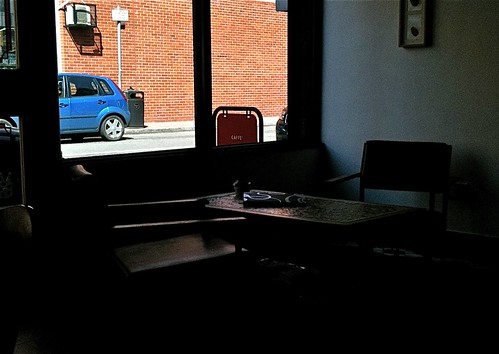
There’s an Italian cafe/deli round the corner. It’s a quiet place, which seems to suit the proprietors well in a Black Books-sort of way (although without the personality defects): they open when they feel like it and there are rarely more than three people in at any one time. They do a fine line in double espressos and ciabattas, and sell cheese.
As we perused the cheese counter last weekend we came across something neither of us had heard of before–taleggio cheese. Sounded interesting, and through the wonders of the internets, iPhones and (despite local mad environmentalists objecting to phone masts) a wavering GPRS signal we found out that it is a ‘semi-soft, washed-rind cheese from the Valteggio region in northern Italy.’ Sounded good, and Bernard the East End/Italian proprietor said it would go well in a salad, so that’s what we’re having with dinner tonight.
The unfortunate side of this story is the actual website I found describing the taleggio. The URL is www.artisanalcheese.com, and if that doesn’t make you laugh, maybe the following rambling anecdote might give you a clue.
{FX: wavy lines}
Back when online publication of journals (how did we get from cheese to journals? Well, never mind) was still relatively new and exciting, my boss at the time was editoring a certain journal. And because online publication was still relatively new and exciting, he and the rest of them were quite interested in hit counts for the papers (article-level metrics; way before PLoS got in on the act). And they noticed, as the story was related to me, one paper getting masses of hits. As in orders of magnitude more than the rest. ‘Strange,’ they thought, ‘what’s so exciting about Molecular dissection, tissue localization and Ca2+ binding of the ryanodine receptor of Caenorhabditis elegans ?’
Then someone read the abstract, and all became clear. This quiet, unassuming paper, which was getting absolutely hammered by search engines, happens to bear, in the abstract (which is freely searchable, even if the rest of the paper isn’t) the line (and bear in mind that ‘and’ is usually treated as an operator, not a search term)
CeRyR was found in the body wall, pharyngeal, vulval, anal and sex muscles of adult worms and also found to be present in embryonic muscle, but not in non-muscle cells.
There’s a moral here, but I can’t think what it is.
Oh dear sweet mother of God.
My eyes turned green and my legs turned to MatriGel with jealousy when Jenny interviewed Billy Bragg (we are not worthy, we are not worthy, we are not worthy) a couple of weeks ago. But I read her writeup of the Q&A in Nature with interest nonetheless.
Then I went back and saw that the comments had turned into a bitching ground over Bragg’s politics, faux-man-for-all-seasoning, whatever. This was a great shame because Bragg said some interesting things, and it’d be nice to talk about some of what he’d said, especially as he said more than there was room for in that article. So I commented as much.
Big mistake.
Would anyone care to take on the last two (at the time of writing) commenters? Coz my brane hertz.
/toddles off to listen to England, Half English.
Scurry has written about memories. The skies over London have been similarly homeopathic this weekend–clear blue skies (like water), with no aeroplanes (like homeopathic preparations).
The Memory of Air Flight.
I went up Stave Hill yesterday and shot the video you see above. Usually the skies of London are criss-crossed with contrails: City Airport is to the east, just beyond Canary Wharf and Heathrow is southwest of us. Both very busy airports. But yesterday there was nothing. If I said that if you looked carefully you could see where the aeroplanes used to fly, you’d laugh at me, and rightly so. No memory of flight, there.
But the muppets are still at it. Homeopaths without borders? Oh please. If this isn’t a joke, it’s immoral and obscene. Playing on the good name of Médecins Sans Frontières to go and wave dehydrated water (yes, I know) at people who really need proper, medical help. Just in case you wondered, Muppets without borders is “Not associated with Doctors Without Borders”.
Oh, that’s all right then. Excuse me, I think I need to go and have a decidedly non-homeopathic vodka.
Buy me a coffee: 


