Running, motivation and toys

Mo Farah, double gold medal-winning distance runner, showed us this summer how important strategy is to winning a race. He runs the race from the back of the pack and then over the last 500m or so accelerates to the front to take first place. I decided to try the same tactic recently, running in Alexandra Park (home to Alexandra Palace).  I had no problem in running most of my race at the back but haven’t quite mastered the second ingredient, of acceleration to the front. I ended up second-from-last, though I did come second in my age bracket (there were only two of us).

This was a 5k race last Saturday morning and was my first experience of a parkrun. These are free weekly runs held across the UK, at 9am every Saturday morning. They are run over a carefully measured course, and are timed races. Once you have registered with parkrun then you can turn up to any event with your individual barcode and run. Some technical jiggery-pokery puts the results up on the parkrun website – you can see the results for the AllyPally run that I did here. It also calculates things like your PB and your “age grade” (how well the runner has done relative to their age and sex). You can see a summary of all your results too.

I first noticed parkrun on Facebook.  A couple of my friends (notably Dr. B.D. from Yarm, and Mr. T.R. from Seaford) would post status updates  like “Ran a 5K PB of 21:42 in parkrun”. For some time I just thought they had been for a run in a park but after a year or so I finally twigged that parkrun, despite the lack of an initial capital, was in fact a proper name. I quickly registered on the website and printed out my barcode, and finally last Saturday got around to running with the group.

There is nothing new about organised running groups of course – there are many groups across the country – Run England has a directory including many beginners groups. Many of these require to join and pay a fee, though.  The beauty of parkrun is that it is free but highly organised. It started as a single event back in 2004 in Bushy Park. Three years later it spread to Wimbledon and Banstead, and then spread more widely. There are now nearly 140 parkrun events taking place each week in the UK, with another dozen or so overseas. Regular running clubs see parkrun as complementary – people may start with parkrun and then join a more formal running club as they become hooked on running.

I have run on-and-off for several years; never really seriously (though I have done a few marathons) but just for some exercise and for the pleasure of doing it. Ten years ago I started to get knee troubles and have done less running – fewer runs and shorter runs – which becomes a downward spiral. As I run less I become less fit (and more fat) which makes it harder to run, so I run less. I can break out of the spiral but need some external motivating factor to help me.  Often that motivation comes from someone asking me if I want to go for a run –  the place where I work is surrounded by lovely footpaths and fields so quite a few people go running at lunchtime.

I have just started using an app on my phone to record each run I do. Runkeeper uses GPS to record the route, and also tracks the time and running speed, plus altitude.  The app then exports this to the Runkeeper website, where you can view the whole run on a map and see how you performed. I think it is quite fun. I first noticed it because someone I follow on Twitter for his science policy tweets (Dr. S.H of Swindon) started tweeting about runs he had completed with Runkeeper. I had previously mapped out routes on sites like Mapometer or MapMyRun but I find Runkeeper better because of the phone app tie-in. More Android apps are listed here and I see that there is also an iPhone app for parkrun.

I think the parkrun could be another motivation for me – 9am every Saturday morning – with the added benefit of seeing how my 5k performance progresses over time. And if (when) my time starts to improve I can even share (boast about) it on Facebook.


Posted in Uncategorized | Tagged , , , | 6 Comments

A look back at the future

I am indebted to Dr R.A.C. for bringing to my attention a spoof exam paper drawn up by J.B.S. Haldane. Originally published in the journal Brighter Biochemistry (“the illustrated journal of the Biochemical Laboratory, Cambridge”), the paper was republished in Trends in Biochemical Sciences in 1981. I had not come across Brighter Biochemistry before but it sounds like it would have been an entertaining read.

For the 1931 issue J.B.S. Haldane, then a Reader in the department of Biochemistry at Cambridge, looked into his crystal ball and produced an examination paper for 1956. Some of it is a bit obscure (well, to me anyway), some of it sounds quite far-fetched, but I have a suspicion that some of it would be answerable – though probably not in 1956.

Here are some of the questions.

Write down the structural formula of human type C oxyhaemoglobin, and briefly summarise the evidence on which it is based.  (Structural formulae should be written stereoscopically. A stereoscope is provided.)

“Enzyme action is only intelligible in terms of wave mechanics.” (Meldrum). Discuss this statement.

“Taxonomy must in future be based on biochemistry.” (Haldane). How have the confers been reclassified on the basis of their terpenes?

Describe briefly the biochemical functions of each of the 17 genes concerned in chlorophyll production in Zea Mays.

Contrast the function of glutathione in (a) yeast, (b) cabbage leaf, (c) mammalian liver, (d) mammalian erythrocytes.

“The beginning of consciousness in the developing hen’s egg can be placed with certainty on the 19th day.” (Needham and Holmes). Describe the substances which determine the appearance of this function, and the analytical methods employed for their detection.

Contrast the immune bodies developed by man in response to (a) Taenia, (b) cobra venom, (c) Pneumocossus type III. What points regarding their composition are still doubtful?

Contrast the structure of the receptors for adrenaline and acetyl-choline in heart muscle.

How good were Haldane’s predictions of the state of biochemical knowledge in 1956?

Posted in History, Uncategorized | Tagged , , | 3 Comments

A snapshot of our collection – history

Earlier this month I hosted a meeting of CHILL. It is a group of independent health libraries which meets three times a year in the premises of one or other of the members. The meetings are an opportunity to share experiences, organize joint activities and to see different libraries.  CHILL brings together a diverse range of health libraries and information services so it can be interesting to visit other members. We have been members since the group started in 1997 but have played host only once, so I thought it was time to invite them up to north London again. I also wanted to show off our newly refurbished library space.

I gave a short talk about the current Library service and later on gave a short tour of the Library. Although the Main Library has changed quite a bit recently, with 70% of the shelving removed, it still inspires awe.  The sense of space, the subtle art deco features and the fantastic view combine to make it something special. But I wanted more than just “awe” so I put out a display of some items of historical interest from our collections. Because I had only just come back from holiday this was a bit of a rushed job. I looked mainly for items related to certain people and subjects that were particularly relevant to the Institute’s history. I also included some documents that I thought were interesting by reason of their uniqueness or obscurity.

Henry Dale was the first Director of the Institute. The book Adventures in physiology is a collection of 30 of his research papers from 1906 to 1938. The collection was first published in 1953, with a foreword by the great man himself. Dale explains that he made the selection as a balance “between an author’s fancy and a reader’s probable interest” and therefore decided to focus on two main strands: i) the actions of adrenaline and acetylcholine and the transmission of nerve impulses; ii) the actions of histamine and its role in the response of organisms to chemical, immunological or physical assaults. In his foreword Dale also comments on the role that accidental observations played in his career.

With my mind on Dale, I spotted an interesting historical book – The war of the soups and the sparks by Elliot Valenstein. The book “tells the saga of the dispute between the pharmacologists, who had uncovered evidence that nerves communicate by releasing chemicals, and the neurophysiologists, who remained committed to electrical explanations”. Dale was one of the leading protagonists in this saga.

We have a large archive of papers from Dale’s time as Director but to sift through these to find something to display would have taken me too long. Instead I hit upon a letter to Dale from William Bragg, under a Royal Society letterhead. Dated 24 Oct 1940, the letter informed him that he had been unanimously proposed for the office of President.

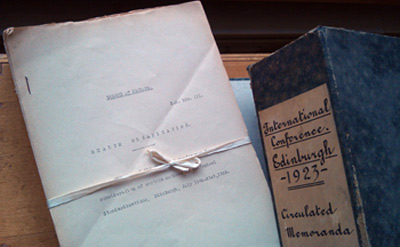
Biological standardisation was another strong interest of Dale’s (see here for a brief history of the field). He was one of the first to see the need for accurate assays of biological substances used therapeutically, and the Division of Biological Standards was established here in 1923. Years later it became a separate institute – NIBSC – but the archives of the first 50-odd years are still held in our collection. I displayed a box from those archives that contained papers relating to the First International Conference on Biological Standardisation, held in Edinburgh in 1923 under the auspices of the League of Nations Health Organisation.

Walter Morley Fletcher was the first Secretary of the Medical Research Committee and did as much as any other man to define the MRC (see my earlier post about him).  He was therefore also a key figure in creating NIMR.  His pamphlet Medical research: the tree and the fruit is the text of the Fifth annual Norman Lockyer lecture, given in 1929 under the auspices of the British Science Guild. Lockyer founded the Guild in 1905 and it merged with the British Association for the Advancement of Science in 1936. Fletcher’s lecture dealt with the history of medical research. He points out that in the three centuries between the accession of Henry VIII and the accession of Queen Victoria whereas great strides were made in anatomy and physiology, there was relatively little progress in practical medicine. It seems that “bridging the valley of death” is not a new problem! Fletcher goes on to describe the rapid progress of scientific knowledge since the accession of Queen Victoria. I fear he gets a little carried away here, saying “As to the art of surgery itself, it is difficult to imagine that it has any further advance to make”. But he later says, speaking of the fight against infectious diseases, “to rest satisfied with our present achievements would be …foolish” and “only the growth of scientific knowledge can bring success”.

After Fletcher’s death a substantial Memorial Fund was collected to be used for a memorial at the new Institute then being built at Mill Hill. In 1936 a memorial ceremony was held, with addresses by George Trevelyan and Frederick Gowland Hopkins. A memorial booklet reprinted these speeches, and included the names of the 500 subscribers to the Memorial Fund, so I included this booklet in my display.

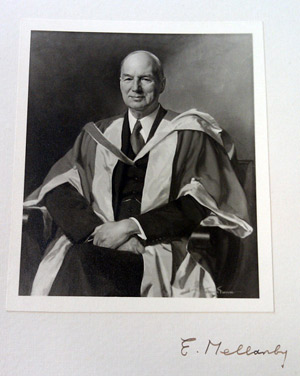
Edward Mellanby was Fletcher’s successor as head of the MRC, serving from 1933-1949. I have it in mind to write more about him one day as he seems like an interesting figure. In my display I included a print of his portrait, and his Royal Society biographical memoir. Photographs and portraits are so important as a way of connecting with figures from the past, making them seem more human than any assemblage of words can. The Royal Society memoirs do a pretty good job though.

I chose a small book by Charles Sherrington (1857-1952) thinking that it was an early popular book about neuroscience, since he was an eminent (Nobel prizewinning) neuroscientist. However, on closer inspection I discovered that Life’s unfolding (1943), part of the Thinker’s Library, is a work of philosophy. The book comprises three chapters of a slightly earlier work called Man on his nature and harks back to the writings of a 16th century physician-philosopher, Jean Fernel. See this editorial for a brief description of the book. I rather like the series title Thinker’s Library. The ever-reliable Wikipedia has a complete listing of titles in the series.

Still in philosophical vein I moved on to Peter Medawar – possibly NIMR’s most charismatic Director and one of the most influential. He was a brilliant thinker and writer about science and the philosophy of science. I selected his short book The Limits of Science (1984). In the preface he explains that he purposely made it a short book because “I have long thought that nearly all books are much too long” and “As a student … I was nearly put off philosophy altogether by the extreme length, leaden prose and general air of joyless learning”. This book is anything but joyless – as you read you feel that someone is talking to you, so straightforward and direct is his style (see review).

Another philosophical book fell into my hands as I prowled the shelves, this one by Harold Himsworth: Scientific knowledge and philosophic thought (1986). It is also a short book and, though it does not have the light touch of Medawar’s style, is quite readable (see review). Himsworth took over from Edward Mellanby as chief of the MRC, serving from 1949-1968, and steering it through a period when biomedical research began  a great expansion. The book has a foreword by James Watson, who was of course at the MRC Cambridge laboratory in 1953 when he and Crick published their famous paper on the structure of DNA.

As we are preparing for the centenary of the Medical Research Council in 2013, I was interested to find a special issue that the British Medical Journal put out in 1963 to celebrate the MRC silver jubilee. It included a brief history of the MRC by Landsborough Thomson, a look at the past 50 years of medical research by Henry Dale, a look at the future by George Pickering, and a lovely selection of photographs of some of the key figures in the MRC’s first 50 years. But the thing that most struck me about the issue is … the adverts! I don’t know why but they really convey a sense of 1963.

The MRC was born out of a desire to conquer tuberculosis. Infectious disease more broadly has been a major strand of research at the Institute since its earliest days. Influenza has a special association with the Institute – the WHO Influenza Centre is hosted here and the virus was first isolated here, using ferrets. We have a copy of a cartoon entitled Yoicks and tally ho! which portrays a rather fanciful depiction of a flu virus being hunted by ferrets hotly pursued by a collection of M.D.s on horseback.

Another big research effort was into the common cold. The Common Cold Unit was initially a part of the Institute, under David Tyrrell’s leadership. When it closed down most of their archive came to us.  There are boxes and boxes containing the results of different trials, but there are also scrapbooks that contain letters from trial volunteers, photographs and ephemera. I selected to display the scrapbook dated 1981-3.

Tropical diseases were important research subjects from the earliest years of the Institute. I picked out a copy of Ronald Ross’ classic book Malarial fever (1902) and a report on Malaria in the Andamans (1912), one of a series called Scientific Memoirs by Officers of the Medical and Sanitary Departments of the Government of India.

Historians of science start to salivate when they see our report collection. We have an impressive range of early 20th century medical research reports from around the world. I chose some suitably exotic reports:

  • Annual Report of the Medical laboratory, Dar es Salaam (1926)
  • Bulletins of the Institute for Medical research, Federated Malay States (1927-9)
  • Medical Research In The Colonies (1928-30)

We also have a set of the British Intelligence Objectives Sub-committee (BIOS) reports. These were essentially the result of a plunder by the Allies of intellectual property from German industry following World War 2.

The MRC was once a notable publisher in its own right. As well as its own Annual Reports, which contain wonderfully detailed summaries of biomedical research news and very informative overviews of particular fields, it published the Special Report Series. This series was commonly known as the ‘green reports’ due to the colour of the covers of the reports. Special Reports were issued when it was wanted to disseminate research results through an official distribution, e.g. during the First World War several Special Reports dealt with medical topics relating to the war effort. Later they were used for research results that were too long to fit into a journal article. Between 1915 and 1971, when they ceased to be published, 310 reports were issued. I displayed the first volume of our bound set, containing reports nos. 1-10 which were issued between 1915 and 1918. These covered topics including the incidence of Phthisis, meningitis, dysentery, heart disease, atropine, and infant mortality. A more grisly report series was MRC statistical reports on war wounds (1918-20). This emphasises again how much of the very early activity of the MRC was devoted to supporting the war effort. I hope to return to the subject of MRC as a publisher in a later post.

When weeding our books last year I noticed several titles from a monograph series published by the Rockefeller Institute.  NIMR was modelled on the Rockefeller, which had been founded just a few years before, and it was interesting to see this series in our collection.  I displayed a couple of early titles: Tumors of animals (1910) and Botulism (1918).

However interesting the reports and monographs are, though, they are not unique. Somebody, somewhere has probably got a copy of most of the published items that the Library holds. The archive holdings, on the other hand, are unique. The information about our past scientists is a bit variable, but can be fascinating. When you open a file that you know has not been looked at in 50 years, you really feel like an explorer and I can see why people get hooked on historical research.  I have previously written about parasitologist Frank Hawking so I displayed his file. He was at the Institute from 1940-1970. The other file I displayed was that of Major George Dunkin, who was here rather earlier. He was a veterinarian who worked with Patrick Laidlaw in the 1920s and 1930s on canine distemper virus.

This was not intended as a full guided tour to the collection, more of a drunken pubcrawl through it, to show something of its nature and take a few sips of history. I wish I had a better knowledge of the collection, but there just isn’t time. We hope to do some work on assessing the importance of the collection over the next couple of years.

Posted in History, Libraries and librarians | 2 Comments

PLOS shift

Camel case (the practice of writing words with some inner uppercase letters) is one of my pet hates, as it demands sufficient finger dexterity to make sure you hit the shift key at just the right point in the middle of the word. Prime offenders are brands such as EndNote, iPad and PowerPoint. A reverse example is the open access publisher PLoS (Public Library of Science).

Imagine my delight therefore to learn that PLoS will henceforth be know as PLOS. As part of a design refresh it has amended its logo, adopted a new colour scheme for the different journals, and abandoned that inner lower case ‘o’ –

to address community feedback regarding the difficulty with consistent pronunciation and writing our organization’s name.

I can’t help noticing that the name in the logo still looks more like “PLoS” than “PLOS”, but never mind. I am very grateful for the shift (geddit?).

Posted in Journal publishing | 11 Comments

Flying through the Crick

Quick update to my post about the Crick Institute building site.

The Crick has now released a fly-through video animation to show what the interior of the building will look like. It is just 4 minutes long, and includes some views from the exterior too.

Posted in Crick | 4 Comments

Another collection of essays

Last year I gave a shameless plug for the Mill Hill Essays that I produce each year.  Here is another plug, for the latest collection – Mill Hill Essays 2011-12. The printed booklets have been distributed (free to libraries and other deserving homes) and I have put all the essays online. Here is a quick summary of this year’s offering: six essays, seven mini-book reviews and two historical notes.

The sense of smell – A milestone to understanding the brain by Ed Bracey 

Ed is a postdoc in our Neurophysiology Division where he works on sensory processing and neuronal connectivity. He has written a very readable explanation of the mechanics of our olfactory system. This system is interesting in its own right (how can we recognise such an enormous range of different smells?) but is also interesting to neuroscientists as it has some features that mark it out from other sensory systems.

Vitamin D: a natural wonder drug we’re all avoiding? by Anna K Coussens

Anna is another postdoc, this time in the Division of Mycobacterial Research, where she worked the effect of vitamin D on tuberculosis.  Vitamin D has been much in the news recently. Her essay explains what vitamin D is, why it is important in several different systems, and how much of it we need.  As an addendum to this essay I wrote  “Vitamin D – historical note” which briefly tells the story of the race to characterise and isolate vitamin D about 80 years ago. A couple of years ago, while looking for information about chemistry at NIMR, I found a fascinating document in our archives that was a written account of the events leading to the isolation of vitamin D at NIMR, plus a collection of correspondence between the main protagonists at NIMR and in Germany. Someone should really write up this history in more detail.

Immune signatures in disease and visions for their future use – Anne O’Garra

This essay provides a grand overview of immune system functioning and an explanation of immune signatures and how they can be used as fingerprints of disease. The fingerprints, comprising records of the levels of hundreds of immune molecules, can also track diseases through different stages and the response to drug therapy.  Anne O’Garra is the head of our Division of Immunoregulation.  She is an immunologist working in the field of tuberculosis, and has championed the use of immune signatures in TB infection.

A key for every lock in the universe – the Blind Locksmith ? – Benedict Seddon

Immunology is a complex subject that can be difficult to explain and not many are brave enough to try – there are no popular science books written on immunology. Ben Seddon is an immunologist who works on mechanisms that control some of the key immune cells.  He has written an explanation of how antibodies work and where they come from. It is a remarkable story.

The mechanics of nanomedicine – Tania Saxl 

This year’s guest author comes from the London Centre for Nanotechnology. Tania catalogues a number of technologies and tools at he nano level that are useful in biomedicine and biomedical research.

To screen, or not to screen? Have we anything to fear from genetic screening? – Abida Gani

The NIMR Human Biology Essay Competition attracts around 100 entries each year from local schools. Year 12 students are invited to choose from a list of half a dozen preset topics and write a 1,000-word essay. The winning essay has the chance of being published in the Mill Hill Essays.  This year’s winner sums up the pros and cons of genetic screening.

And finally there is another historical note from me, this one about Griff Pugh, exercise physiology and the Olympics. Griff Pugh was an NIMR physiologist who was most famous for his involvement in the 1953 Everest expedition, but he also made a contribution to the 1968 British Olympic effort. The Olympics in that year were held in Mexico City, and there was some concern that the altitude might affect the the performance and health of the athletes. Pugh did some field work in advance of the Olympics and studied the performance and physiology of athletes at high altitude, making some recommendations for the GB team.

As last year the Essays conclude with a series of short book reviews by Institute staff. The selection covers quite a range, from prize-winning popular science books like The Emperor of all maladies and Bad science to books on epigenetics, Max Perutz, evolution, and DIY biology as well as a rather fine novel by a certain H.G. of this parish.  You will find a few reviews written by me in this section.


Posted in Books, Reading recommendations | Tagged | 3 Comments

A very large building site

Last week I went on a short tour of the Francis Crick Institute construction site. The Crick is a new research institute due to open in 2015, and will be formed out of two existing institutes in London plus three University partners.  The tours are available for staff at the two constituent institutes so that we can get an idea of the project’s progress and get some feeling for the new building. It is still early days but it is starting to look more like a building and less like a hole in the ground (thus far 375,000 tonnes of soil have been removed, so it was a big hole). The scale of construction is impressive.  The Wellcome Trust’s Gibbs Building is just down the road from the site of the Crick and is where the project is currently based.  The Gibbs is a large building but the Crick will be twice the length and twice the width of that building. The Crick is apparently the largest single-site construction underway in London, and also one of the most complex.

As we were shown round the site and told about the project I noted that construction is beset by the same problems as science when it comes to specialist jargon. I didn’t know what a “berm” was, nor the meaning of “rebar”, and the details of pilings and mole holes left me confused.  But the enthusiasm and pride shown by our guides left me in no doubt that this is a very special project.

Some images taken at different stages of construction are on the Crick website and the latest Crick newsletter has more construction news and views of what the labs will look like.

It struck me that each stage of the project is an enormous undertaking – first you must dig an enormous hole, then build an enormous building, then fit it out with a complex range of equipment.  And meanwhile, you have to design the organisation that is going to go into the building – this is a parallel project in its own right. On top of all that, you have to tell the world what is going on. That means telling the local community what is coming to their doorstep, telling the scientific world what the Crick’s plans are, telling people in the two component institutes what is going on, and telling the wider world how things are progressing. Actually, you have to do more than just ‘tell’ you need to ‘engage’ as well. That is harder to do, but I think it is starting to happen.

One brilliant example of such engagement at community level is a project the Crick did with a local school during science week earlier this year. They have published a short video about the project and I think it is the loveliest film about kids and science I have seen for a long time.

The Crick is going to feature large in my working life for the next few years, so I will probably return to this topic from time to time.

Posted in Communicating science, Crick | 7 Comments

Megajournals

The trend towards Open Access has catalysed the creation of many new journals and new publishers. BioMedCentral, established in 2000, was a pioneer of open access publishing, launching a large number of journals. Public Library of Science (PLoS) initially established a small number of high-level journals, then in 2006 it launched PLoS ONE. This was the first of a new kind of journal, later dubbed mega-journal. PLoS ONE aimed to publish any article that met the test of scientific rigour, and eschewed any measure of importance or impact in its editorial and peer review process. In 2010, PLoS ONE published 6,749 articles, making it the largest journal in the world (by volume). Its success helped to persuade the mainstream publishing industry that fee-paid open access was a viable business model.

Recently I invited representatives from a number of open access publishers to discuss megajournals. Five of them gave presentations to an audience of scientists here, and one visited me subsequently to inform me about their operations.

Nature Publishing Group (Scientific Reports)

NPG is a privately-owned business that publishes Nature and a range of other prestige titles: the Nature-branded titles such as Nature Genetics and Nature Medicine. Nature Communications was launched in 2010 as the first Nature-branded title with a paid-OA option. About 55% 43% of its articles are published as open access. It is not a mega-journal, but is aimed at a notch below the other Nature-branded titles.

Scientific Reports was launched in 2011 as a mega-journal. It publishes articles from all areas of natural science. It will publish any article that is technically sound in method and conclusions, with no need for conceptual advance, novelty or impact. Negative results are accepted and results with a narrow community of interest. There are strict submission guidelines for authors in terms of the article structure. An editorial board of 500, all practising scientists, and an advisory panel, manages the peer review process. Referees are sent a template for their responses, in order to achieve a faster review time. Some submissions are papers rejected by other NPG journals. Workflows are automated and thus scalable. The average time from submission to publication is 102 days. At present the acceptance rate is about 70% 55% – over 450 papers have been published since June 2011. The journal website promotes new papers on the home page and also uses download and social media metrics to show popular articles.  It is also possible to browse by broad topic. Press releases are issued for selected papers and they are promoted via Facebook and Twitter. The article processing charge (APC) is GBP £ 890 / US$ 1350.  Articles are published under the CC-BY-NC-ND or CC-BY-NC-SA licence, but authors can now choose CC-BY if they wish [added 11 Jul].

Public Library of Science (PLoS ONE)

PLoS is a not-for-profit publisher that was established by academics for academics. It publishes two highly-selective journals using internal editors, and four less selective journals with academic editors. PLoS ONE covers all fields of science, aiming to publish any paper that is ethical, has scientific rigour with conclusions supported by the data, and that is properly reported. The potential impact of the paper or the size of the audience are not important. Internal editors do some ethics checks on articles before sending for review. There is an academic editorial board with 3,200 members. The production process is streamlined with no copy editing or author proofing. The acceptance rate is 62% 65%. A proportion of papers rejected by PLoS ONE do get published elsewhere. Thus far i In 2012 the journal expects to publish about 25,000 papers. have been published. The journal website allows readers to add comments or notes to articles and also collates social media mentions, including Mendeley as well as citations from various sources. You can browse by subject and also see the most viewed articles by subject. The APC is US$ 1350.  Articles are published under the CC BY licence.

 BioMedCentral (BMC Series)

BioMedCentral is owned by Springer, one of the largest scientific publishers. BMC publish four flagship (more selective) journals, a data journal, the BMC series of about 60 journals, and a growing number of journals affiliated with other organisations. Strictly speaking BMC does not publish a megajournal, but it can be argued that the BMC series taken as a whole functions as a megajournal whilst retaining subject-specific identity. These journals aim to publish sound science and do not filter by interest. The series as a whole has well over 1000 2000 submissions per month, while the acceptance rate varies between individual titles from 45%-55%. There is an in-house executive editor but section editors and associate editors are all practising scientists. Interesting articles are highlighted on the BMC website and for some articles commentaries are commissioned and further promotion is carried out. Reader comments are also shown. The medical titles use open peer review, and the articles’ pre-publication history is shown. The biology titles do not have open peer review, though BMC Cancer does have some basic science articles with open peer review. Another peer-review innovation is the re-review opt-out. The APC for the BMC series is between GBP £675 (for Research Notes) and GBP £1445 (for the flagship journals). The standard article-processing charge for BMC subject journals is £1230.  Articles are published under the CC BY licence.

FEBS (FEBS Open Bio)

FEBS is a not-for-profit organisation: its affiliated societies have about 40,000 individual members across Europe. FEBS’ publishing profits help to support its other activities promoting the molecular life sciences. It publishes three selective journals and has just launched FEBS Open Bio, published on their behalf by Elsevier. The new journal is for papers in molecular and cellular life sciences in health and disease, covering basic, translational and clinical sciences. Currently most submissions are papers rejected by the other three FEBS journals, but direct submissions are also encouraged. The emphasis is on work that is technically sound and appropriately described. Though novelty is encouraged, sounds science is the key. The journal has a rapid review process and thus far an acceptance rate of 68%. There is minimal copy editing. The academic editorial board is currently just 16 but this is being expanded. The journal uses the Elsevier article of the future format and shows some article level metrics. The APC is Euros € 1200. FEBS currently holds the copyright of articles  but allows the equivalent of the CC-BY-NC-ND license.

 Company of Biologists (Biology Open)

CoB is a not for profit organisation. Income from publishing helps to support its other scientific programs. It publishes four selective journals and launched Biology Open in January this year. It covers all aspects of biological sciences. It publishes articles that are scientifically sound but reviewers are not asked to try to judge the impact of the work, which will be left to the community post-publication.. Thus far 75% of submissions have been cascaded from the other CoB titles. Out of 170 submissions it has published 62 articles. The review process is swift, with a first decision after nine days and from acceptance to publication is just four weeks. The editor-in-chief and editorial board members are senior academics. An editorial board of 30 is being formed. The APC is $1350. Articles are published under a CC-BY-NC-ND licence.

Frontiers 

Frontiers is a Swiss-based publisher that was established by scientists for scientists. It publishes 12 main journals, with two more on the way (actually it’s more complicated than that as, for historical reasons, neuroscience is broken down into a series of several separate journals). It is not a mega-journal and does not promote itself as such but taken as a whole the Frontiers in… series has some similarities to the other titles here. The review process emphasises accuracy and validity not significance. Strict guidelines for authors and a clear template for reviewers help to deliver a fast review time, three months from submission to acceptance. Reviewers first evaluate articles independently from each other, following a standardized review questionnaire. Then, authors and reviewers participate in an online discussion until a consensus is reached. Reviewers’ names are published on the accepted article. The editorial board is 25,000 strong and all editorial decisions are handled by scientific editors. About 450 articles per month are published currently. The website is quite complex, breaking down journals into specialist areas, and sometimes into research topics. This helps to give a community feel (each niche area has its own page) but can make it confusing at first. There is a system of tiers, which once again seems a good idea but in practice is a bit opaque. Tier 1 is research articles; tier 2 is review articles; and there are two further tiers not yet populated. The idea is that authors of important research articles, as judged post-publication, are invited to write commentaries or focused review articles. The site also has a research network where you can establish a profile.  This is integrated with the publishing workflow so you can readily see the status of articles you have submitted or are reviewing/editing. Frontiers seems to be attempting more than just creating another journal, but has re-engineered the whole publishing process. Articles on the website include a limited range of article level metrics and other links. The APC is Euros € 1600 but a system of discounts means that the average fee paid paid is substantially less than that. Articles are published under a CC-BY-NC licence.

General

It is instructive to compare these journals. They all share a number of features:

  • Sound science
  • Impact not required
  • Academic editors
  • Automated, scalable workflows
  • Fast turnaround time
  • APCs around GBP £ 1,000
  • Post-publication promotion
  • Article-level metrics

One or two still “encourage” novelty, but do not require it. How low is the bar on originality? If a previously-published finding seems to be in need of additional evidence then another paper that replicates it is worth publishing. Would a scientifically sound, but quite banal, replication of a long-established fact be published? Presumably not, which suggests that there must still be some subjective judgement being applied in these journals. In practice the publishers said that it has not been a problem – they have not had large numbers of banal submissions.

All emphasise the use of academic editors rather than internal editorial staff, though in most of them there is still a limited role for internal editors. All of them claim to have a fast turn-around time, and to have automated systems that are scalable. There is a question about the willingness of reviewers to comply with demands for rapid response. If asked to complete the process within 14 days, how many will just say “Sorry, too busy. Find another reviewer”?  Two of the journals are genuinely broad; two have multiple subject foci; two have a definite subject bias. I wonder whether the subject-focused and multiple subject-focused journals will have more success in the long run, if Cameron Neylon’s comment about the benefits of community focus in science publishing is correct:

Because PLoS ONE and other wide scope journals are covering wide areas of research, they necessarily need processes that can cover many data types and different disciplinary approaches, and these are still human, and therefore relatively expensive, processes. It is also fairly difficult at scale to place as much reliance as you might like on community peer pressure to contribute — and this may be a real advantage that society and independent journals have — a close knit community can effectively run shoestring budget journals.

The APCs charged are mostly similar, about GBP £900, though BMC and Frontiers are a little higher.  The fees are certainly well below the average figure mentioned by the Finch committee. All have waivers available in cases where funding is really not available.

Most of the publishers also publish more selective journals, and are ‘cascading’ papers rejected by those journals into the less selective megajournal. This seems to make good business sense.

Article-level metrics (ALM) and post-publication promotion are another common theme. ALM are still in their infancy and, to be honest, a bit underwhelming in most cases.  But when an article is heavily read/downloaded/mentioned then they come into their own.  Such articles will be promoted on the megajournal’s website, and/or elsewhere on the publisher’s website. Some of the megajournals also offer to issue press releases for key papers.  If this post-publication promotion turns out to be popular with authors it could become a key advantage for the journals that do it successfully. I am not sure whether size (big publisher, big website, high hit rate) or focus (dedicated user group, high levels of interest) will win out in that race for eyeballs.

The licence under which articles are published also varies. The two established OA publishers (BMC and PLoS) both offer pure CC-BY, which will soon be required for work funded by the Wellcome Trust and the UK Research Councils. The others offer only more restrictive licences.  I expect that conversations about this are taking place and it may change in future.

I should add that this post focuses on journals in biosciences broadly following the megajournal model.  There are a number of other new OA titles launched recently or about to launch that are following a more selective model – eLife, Open Biology, Cell ReportsmBio, G3. Basic facts and figures about these and other journals have been usefully collated by the library at UCB. Another new title that looks rather different has recently been announced by Peter Binfield, the founder of PLoS ONE.  Called PeerJ it will launch in the autumn and looks like it will drastically undercut all other OA journals. I wonder whether PeerJ will kickstart another series of imitators: just as we have got used to the idea of the megajournal so a new journal life form seems to be developing.

I expect that the list of pure OA journals will grow over the next couple of years and we won’t be asking “why are there so many new OA journals” but rather “why do we have all these old-style subscription journals?”.  An editorial last year in one of those old-style journals, pouring scorn on the OA journal model, suggests that some of them are getting scared.

Posted in Journal publishing, Open Access | Tagged | 11 Comments

M and S

I am back at work after a three-week break. I had a good holiday, visiting Manila and Singapore.  I really managed to switch off, totally ignoring the temptation to look at my email or Twitter. The part of my brain that is concerned with ‘work’ went right to sleep. But the holiday is finished now and as each day passes I am more focused – my work brain is slowly waking up, and the memories of my holiday are fading. This post is the holiday’s last gasp.

Part of the Manila skyline, plus freeway.

We stayed in Manila, the Philippines, for two weeks. On previous trips to Manila we have tried various hotels, but this time we rented a small apartment on the edge of town in a district called Marikina City. You may have seen pictures of the appalling flood in 2009 that devastated Marikina. Today the town seems to have recovered and one would hardly know it had suffered so much.

The carabao by the Marikina river.

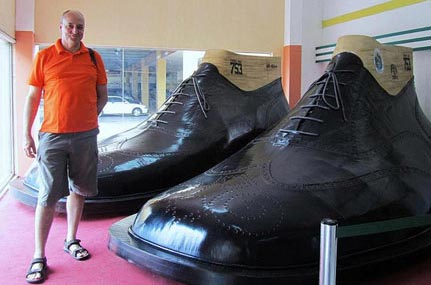
Marikina is also famous as the shoe capital of the Philippines, having had a shoe industry since 1887. In various locations – including some floating on the river – there are outsize shoes on show. The city boasts a Footwear Museum to boot.

Marikina has a reputation as one the country’s cleanest cities, and has strong green credentials: it has various recycling schemes and has introduced a ban on plastic bags, so stores give out paper bags for your shopping. The city does seem clean, though I think its claim to be a ‘little Singapore’ is a bit of a stretch. They are also building networks of bicycle lanes and I was assured there are many keen cyclists.

Cyclists in Marikina

Environmentally friendly policies seem to have really caught on in the Philippines. Several cities or districts proclaim their intention to be “green cities”, though sometimes the reality is quite a long way from the intention. Pollution from road vehicles is pretty bad throughout Metro Manila and built-up areas.  One town I passed through badges itself as an “organic town”. I am not really sure what that means.

A sign in Baras

I saw a number of signs that left me wondering. The English language is widely taught and used in the Philippines, but the idiom is sometimes subtly different.

A sign in a cafe.

A sign in a petrol station.

One sign I saw while walking along a road was a bit alarming. The Philippines is part of the Pacific ring of fire: there are several active volcanoes and earthquakes are not uncommon.but you don’t expect to be reminded of that fact quite so forcibly.

Beware - earthquakes.

I quite like Filipino food but it can sometimes be challenging. I had heard people talk about “Soup number 5”, usually accompanied by sniggers and broad grins. I wondered what it was – it seemed an odd name for a soup. One day we visited the famous Balaw Balaw restaurant in the town of Angono, about 20 miles from Manila, and my attention was drawn to its page of exotic dishes. There was this famous soup with a rather blunt, if gender-confused, description of the ingredients. Of course we sampled it. I found it to be tasty but a bit greasy.

Some tasty delicacies

Angono is an interesting town, renowned as the art capital of the Philippines. There are several artists studios, and indeed the above-mentioned restaurant has a gallery attached. Once a year the town holds a fiesta, the Giants Festival, with a procession of ten-foot high paper mâché dolls. Angono is also the home of the Angono petroglyphs. These are 5,000-year-old marks (drawings?) carved into soft volcanic rock. The marks are said to depict people and animals, but they looked like squiggles to me.

The petroglyphs of Angono

The Philippines is rich in natural beauty. Away from the cities and towns you can find mountains, rivers, waterfalls, islands, and beaches galore. Guidebooks tend to overlook most of this but you can find out information through the interwebz. My favourite excursion was one day we went into Rizal province to visit the Palo Alto falls.  UInfortunately the park was closed so we couldn’t visit them after all, but half an hour later we made it to the Daranak falls which were pretty good.  And the journey through the lush green countryside was a pleasure in itself.

The path to the Daranak falls

Daranak falls

The other thing that the country has in abundance is churches – it seems that every town has an old Spanish-era stone-built church, two or three hundred years old. This time I was determined to visit St Joseph’s church on the southern edge of Manila, in Las Piñas. It is famous as the home of the bamboo organ – an organ with pipes made from bamboo.

The bamboo organ in Las Pinas

Finally, from Manila, a photo of some kittens.

Who could resist?

The temperature in Manila was in the low to mid 30s.  Moving on to Singapore we found a similar temperature, but a more relaxed vibe.  The air was cleaner, the traffic was quieter, there seemed more space and less frenzy than in Manila. I had visited Singapore before but it was quite a few years ago in 1989. I remember having loved the skyscrapers, particularly this one that was for a short time the tallest building in the world.

One Raffles Place

Singapore’s river runs through the main business district and makes an attractive walk, giving space and air to the city. This sculpture reminded me of the carabao sculpture in Marikina (see above).

It's so hot you want to jump in to cool off!

I was surprised to find that the city has expanded quite a bit.  They have reclaimed some land from the sea to create a new quarter where they have built a number of eye-popping buildings in the last two or three years.  When I first caught a glimpse of the Marina Bay Sands Hotel I could not believe what I was seeing. Three 57-storey towers are linked at the top by “the world’s largest public cantilevered platform”. This is the Sky Park – it is 340m long and overhangs the north tower by 67m. It looks scary but you feel compelled to go up there.  For a modest charge you can go up and enjoy the view from that overhanging part and look over the edge.

Marina Bay Sands Hotel with its Sky Park on top, and the double helix bridge in the foreground.

The easiest way to reach Marina Bay on foot is via the Helix Bridge, which is about the closest I got to thinking about molecular biology the whole holiday, though I was intrigued by the name of one company whose offices we passed:

Curious name for a company

Also in the Marina Bay complex is the very striking ArtScience Museum. I thought it was a great title for a museum so I made a point of visiting but was a little underwhelmed by the contents.  The permanent exhibition is quite slight, taking you on a journey through “Curiosity, Inspiration and Expression” by looking at the history of human achievements such as flight. It was all interesting and thought-provoking, but not what I was expecting. There were two temporary exhibitions: one about Harry Potter (which I avoided) and one on Andy Warhol (which I visited).  Again, the Warhol exhibition was interesting but not what I was expecting.

The ArtScience Museum, like a giant lotus flower

One other thing I was not expecting was a visit to a theme park.  Universal Studios Singapore opened in 2010 and has become a must-see attraction. Being a grumpy old man I don’t think I am quite its target audience but I was prevailed upon to go along. It is not quite as bad as Disneyland – there are at least some semi-grown-up exhibits like Jurassic Park and Ancient Egypt.  And I do have a soft spot for Shrek. We went in to see a short film about Shrek that was billed as a 4D film. As well as 3D glasses, the seats all moved to shake you around when the screen showed Shrek travelling on a shaky carriage, and you were sprayed with water when someone on screen sneezed.  There was an unpleasant fluttering sensation around the ankles when a large number of spiders were shown scurrying across the screen. It was a laugh.

Jurassic Park at Universal Studios, Singapore

The kingdom of Far, Far Away

So that was Singapore.  I heartily recommend a visit if you enjoy cities and stunning architecture, not to mention good food.   We met and had dinner with an old colleague who took us to a branch of Din Tai Fung, which was exquisite. She also gave us a small gift which I was tickled to discover was a packet of tea and a box of biscuits, both from Marks & Spencers! On our last evening we went to True Blue – a restaurant serving Peranakan cuisine which is very delectable. Then we said farewell to the city, visiting the famous Merlion statue. Goodbye Singapore – I will be back!

The Merlion


Posted in Froth | Tagged | 5 Comments

Evidence of corruption?

Guilty.   Not guilty.

The moment in the courtroom when a verdict is delivered is a moment of high drama, potentially a life-changing decision for the accused.

Reading newspaper reports of court cases makes me feel uneasy. Is the verdict correct? How do we really know what happened? Can we be sure of the evidence? If it was a journal article under trial, would the reviewers be asking for more experiments?

In the UK we have seen plenty of drama this year in the Leveson Inquiry – an inquiry into the behaviour of and connections between the media, politicians and police. It is not a court case, but is under the control of a senior judge and features witnesses, evidence and cross-examination rather like a court case. It also features contradictory accounts and frankly unbelievable statements from various parties. The conclusions are expected to have a significant impact on the media in the UK, and possibly on some politicians. I find it quite impossible to know what to believe thus far, apart from a general feeling that “they’re all up to no good”. Luckily, I am not a judge.

Last week’s verdict on Hosni Mubarak, on trial for the murder of 850 unarmed protesters, was controversial. He was found guilty and given a life sentence but his assistants were all acquitted. In a second ruling Mubarak and his sons were acquitted of corruption charges. Commentators say that a life sentences for Mubarak had been expected “in order to placate a public hungry for justice”. He is expected to appeal the decision. Meanwhile, the public are not placated and are protesting against the acquittals.  What is the truth?  Is the public reaction justified or not?  I don’t know.

I have been following another trial – this one was an impeachment trial in Manila.  The Chief Justice of the Supreme Court of the Philippines, Renato Corona, was accused of failing to disclose his assets, liabilities, and net worth.  He was reported to have 82 different dollar accounts in five different banks, amounting to over US$ 2million.  Wikipedia reports that “according to a World Bank study in 2008, corruption in the Philippines is considered to be the worst among East Asia’s leading economies”. But, innocent until proven guilty.

As this was an impeachment trial the Chief Justice was tried not by a regular court but by the Philippine Senate, the upper house with 24 Senators, many of them trained as lawyers.  In a drama-laden and drawn-out scene each of them delivered their verdict, giving reasons for their decision. Some voted to acquit the Chief Justice. Now you might think that those who voted in his favour were all his cronies, or had nefarious reasons for protecting him, but you would be wrong.

Miriam Defensor-Santiago is one of the most respected figures in public life in the Philippines. She delivered a coruscating speech to her fellow Senators before voting to acquit the Chief Justice. Her 20 minute speech was quite extraordinary in its power and ferocity. You can watch the video here – it is well worth it, though it is in a mixture of English and Tagalog. You may not understand all the words, but you will for sure understand her intent. Essentially she says the law is the law, and argues that the whole case was wrongheaded. Chief Justice Corona had admitted his failure to disclose the Statement of Assets, but Miriam maintained that this does not constitute an impeachable offence so he must not be found guilty. She asked whether such a failure to disclose assets should belong in the same class of offence as treason and said “a line has to be drawn between the rule of law and the dystopian concept of freewheeling ethics”. She spoke passionately about the need to respect the law and pointed out that an improper conviction was actually a sign of corruption rather than the reverse. Her arguments are summarised here. Her view did not hold sway though and Corona was found guilty by 21 votes to 3. He maintains that the charges against him were politically motivated and plans to appeal.

The reason that you should be interested in this is that Miriam Santiago will soon become one of the judges at the International Court in The Hague. I think her courage, forcefulness and clarity of thought will serve that Court well. You may hear more of her in the next few years.

Posted in Peer review | 1 Comment