Err … ology

Publication bias is the tendency to report positive results differently from negative or inconclusive results, resulting in a bias in the overall literature (see Wikipedia article and this tutorial at the Cochrane Collaboration). Afficionados of evidence-based practice and meta-analysers of research worry that such bias makes it hard to accurately interpret the literature (though there is bias and bias).  In the clinical field it was hoped that registration of clinical trials would improve the situation, creating more pressure to publish results of all trials.  Nature reported in 2009 that

“Fewer than half of published trials are adequately registered, and, on the other hand, fewer than half of registered trials are ever published in peer-reviewed journals”.

In a letter to Nature last year Bob O’Hara pointed out that a number of journals do publish negative results, listing the following as titles devoted to or including negative results:

  • Journal of Negative Results in Biomedicine
  • Journal of Negative Results — Ecology and Evolutionary Biology
  • Journal of Articles in Support of the Null Hypothesis
  • Journal of Universal Computer Sciences
  • PLoS ONE

Incentives for publishing negative or inconclusive results are lacking though.

Now a new publication, the Journal of Errology aims to help change this. They say

“apart from sharing successful results and data, it is also important for researchers to share the experiences learned via their trials and tribulations. We can say with certainty that nothing till now has not been discovered or invented without its fair share of failures, mistakes, errors and problems.”

So far the journal seems to be empty.  Not just empty of articles but also empty of editors and reviewers. Even the FAQ page is empty. Still, it is an interesting idea and an arresting title –  Errology. I wonder how long it will be before we see a Professor of Errology?

Posted in Journal publishing | 12 Comments

Hawking history

It was good to hear the reports of Stephen Hawking’s speech at his 70th birthday celebrations at the weekend. The Independent ran the story under the headline “I owe it all to my father” and noted that

Hawking spoke movingly of the role his father played in picking him up from the devastating diagnosis when he was just beginning his PhD at Cambridge University

His father was Frank Hawking (1905-1986) who spent much of his working life at the MRC National Institute for Medical Research (NIMR) working on parasitology.  A quick glance at his thick  file in our archives reveals that he was an interesting character.  Conversations with one or two people who worked with him confirms that impression. He does seem to have got into one or two scrapes along the way.

Born the son of a farmer, Frank soon showed himself to be a bright child and was sent to the Leys School, in Cambridge.  He gained a first class degree at Oxford then took clinical studies at St Bart’s.  After finishing his clinical training he was awarded a research fellowship at the Liverpool School of Tropical Medicine where he worked under Warrington Yorke from 1930-33.  Frank then held a travelling fellowship at the Radcliffe Hospital in Oxford, spending some time at Columbia University, New York. In early 1934 he wrote to two senior staff at NIMR asking whether he might be accommodated there if he were successful in winning a Beit memorial fellowship. The Institute Director, Sir Henry Dale, replied encouragingly that there might be space available.  Unfortunately as it turned out Hawking was not successful in his application for the fellowship.  Over the next few years he continued to correspond with Dale about various possible scientific career moves.  Dale  was a fellow old Leysian and seemed well disposed to assisting Frank in his career.

Hawking spent some years lecturing in pharmacology at the Welsh National School of Medicine at Cardiff and then in 1937 he was awarded a research fellowship of the Medical Research Council to work in east Africa on trypanosomiasis.  It seems to have been a flexible fellowship as he made his way to Nigeria too, and he worked on other tropical diseases as the opportunity presented itself. Towards the end of 1939 he was offered a place at NIMR and in early 1940 returned to the UK to take up a temporary position in NIMR’s Division of Chemotherapy. Within a few months he was appointed to the  permanent staff at NIMR. When the Institute moved in 1950 from Hampstead to Mill Hill, Hawking became head of the Division, later renamed “Parasitology”, where he stayed until his retirement in 1970. After retirement he continued in research, first in the USA then for three years at the MRC’s Clinical Research Centre at Northwick Park and later at Brunel University.

On his retirement the MRC Annual Report (1970-71) said:

“Dr Hawking’s association with the Council goes back to 1937, when he was awarded an MRC senior travelling fellowship in tropical medicine. He joined the staff of the Institute in 1940 and built up his division into an important centre for the study of tropical infections. He will continue to pursue his interest in malaria and trypanosomiasis, with grant support from the Council, at the Clinical Research Centre.”

His obituary in the BMJ records that

His DM thesis in 1933 was nominally on induced drug resistance in trypanosomes but strayed into immunology, host specificity, and quantitative studies on the uptake of acriflavine by the parasites. This last subject was further developed until in 1938 he was able to estimate the intracellular concentrations of acriflavine in normal and resistant strains; he considered this to be his finest intellectual achievement.

As he joined NIMR just as the war was beginning, he then directed his efforts to the treatment of wounds, and determined the best methods for preventing gas gangrene by topical treatment with sulphonamides. He also worked on malaria and later on the tropical disease filariasis and the physiology of circadian rhythms.

As well as the BMJ obit, see his entry in Munk’s Roll,  VIII, pp. 215-6, for further information.

There does not seem to be a biography of Frank Hawking, but I think it would be an interesting read.

Posted in History | Tagged , , | 9 Comments

How are your tweetations?

A contentious paper came out towards the end of last year in the Journal of Medical Internet Research. That is a reasonably respectable title in its niche field and the author, Gunther Eysenbach, is a respected medical informaticist and e-health guru.

At first I loved the paper for its wonderfully silly and memorable neologisms. It talks of “tweetations” and “twimpact factors”:

  • a tweetation is “a citation in a tweet (mentioning a journal article URL)”
  • the twimpact factor is “the cumulative number of tweetations 7 days after publication of the article”

But disillusion quickly set in. The paper reports an analysis of the effect that tweeting about a research paper has on the subsequent number of citations to that paper. It concludes that:

Tweets can predict highly cited articles within the first 3 days of article publication. Social media activity either increases citations or reflects the underlying qualities of the article that also predict citations, but the true use of these metrics is to measure the distinct concept of social impact.

Phil Davis, at The Scholarly Kitchen blog, points out:

The main message of the paper is that highly tweeted articles were 11 times more likely to be highly cited, a result that makes a great 140 character headline but needs much more context for interpretation.

My main concern is that the group of articles being studied are articles published in the Journal of Medical Internet Research – 55 articles published in 2009 and 2010. Hence the results may not reflect the reality of broader biomedical research publishing. To be fair, Eysenbach acknowledges this:

as a journal about the Internet and social media [JMIR] has a sophisticated readership that is generally ahead of the curve in adopting Web 2.0 tools. However, this also limits the generalizability of these results: what works for this journal may not work for other journals, in particular journals that … do not have an active Twitter user base. …Journals that publish non-Internet-related articles have probably far lower tweetation rates per article, and it is also less likely that people tweet about articles that are not open access.

Davis has other reservations, noting that there is a highly-skewed distribution of tweets and citations and that many of the tweets studied were sent out automatically. The comments thread to his post has other trenchant criticism of the paper and a defence from Eysenbach.

Davis also questions the ethics of the inclusion in the reference list of citations to all the 55 papers studied. This has now changed – JMIR has issued a correction of the original article, removing the offending citations to dataset articles, and replacing them with a list of articles in an appendix..

The main point Eysenbach makes seem to be that “buzz in the blogosphere is measurable”, and his definitions of tweetation etc may be helpful to future studies of the broader literature, even if the actual numbers he has generated are not generalisable.

Posted in Bibliometrics etc, Journal publishing | 8 Comments

A fruitful New Year

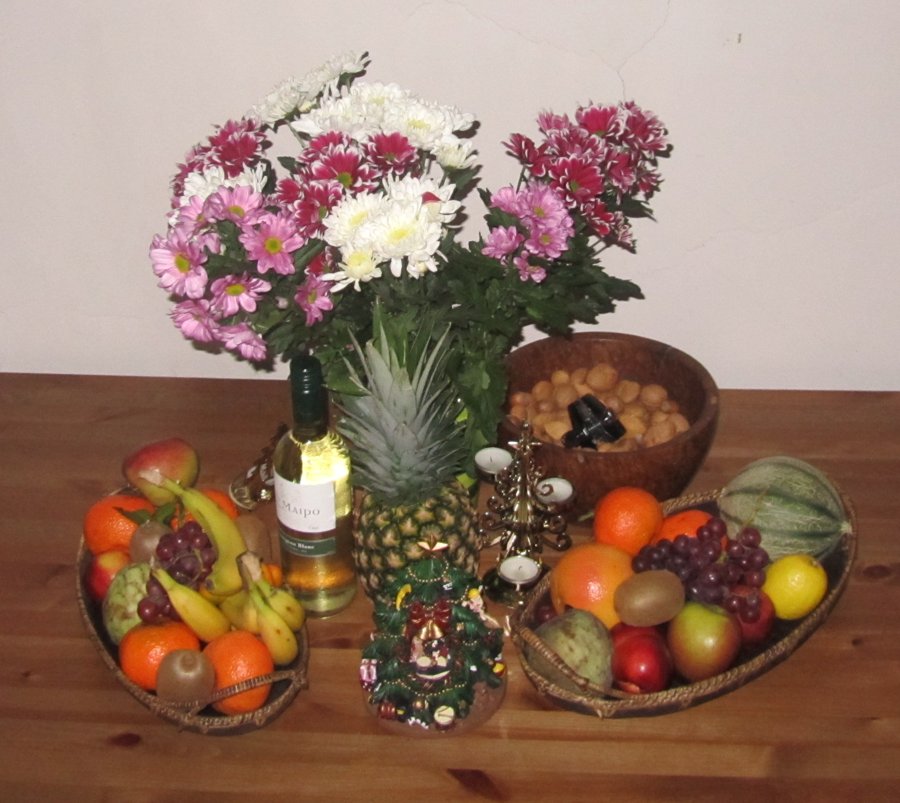
A display for New Year
In England we don’t have much in the way of colourful New Year traditions. The Scots famously make more of the season, which they call Hogmanay, but in England the traditional choices are:

  1. Go out to a pub and get roaring drunk
  2. Stay in at home and get roaring drunk, while watching inane rubbish on TV
  3. Ignore the whole thing and go to bed early with earplugs in

In London there is also a tradition of going to Trafalgar Square to get half-crushed to death along with thousands of other people. In recent years the firework display along the River Thames has also drawn big crowds to the riverside. This year’s display was rather good, judging by the TV coverage.

My household (all two of us!) is half-Filipino and half-English so I have been exposed to other ways of celebrating New Year.

In the Philippines there are several New Year’s Eve traditions. Typically families and friends will congregate at home and enjoy a late night meal, the Media Noche, with festive foods such as pancit (a rich and tasty noodle dish). There should also be a display of twelve round fruits, one for each month of the year. In the Philippines the price of round fruits usually goes up after Christmas due to the increased demand. It is difficult to find twelve perfectly round fruits: I cheated a bit with our display and included banana and pineapple. My version of the display was an orderly parade but my partner produced a more creative display, putting the fruits in a couple of traditional Filipino baskets and featuring flowers and a bowl of nuts plus some Christmas decorations.

An orderly display of not-quite-round fruits

An orderly display of not-quite-round fruits

Fruits and flowers for New Year

Flowers, fruits and nuts for New Year

Another tradition is to wear something red (I think this probably derives from the Chinese tradition where red is a lucky colour) and to wear polka dots. Apparently roundness signifies prosperity.

You must wear polka dots and something red.

You must wear polka dots and something red.

On the stroke of midnight everyone makes as much noise as they can, letting off firecrackers, banging on saucepans or tin boxes or anything else to hand, blowing whistles or torotots (not quite as bad as vuvuzuelas but not far off), or just shouting. It is a fearsome noise and spectacle, with fireworks and sparklers adding a goodly dose of choking smoke to the occasion.

Torotots

Torotots

Often people will throw a handful of coins in the air which their children scramble for as they land. The kids’ screams of excitement add to the general din. All in all, it is a wild few minutes with the festivity-level turned up to FULL-ON.

This year we were in London so had a more sedate time, sitting with some Filipino friends and foods and a few polka dots and just watching the London fireworks on the TV when the time came for the countdown.

I hope you all enjoyed 2011, had a festive time upon the transition to the New Year, and are looking forward to the next twelve months that will be 2012.

Posted in Froth, Uncategorized | Tagged , | 3 Comments

Righting authorship wrongs

I had never heard of Dalton Trumbo until today, and I daresay you haven’t heard of him either. He was a member of the “Hollywood Ten,” which was a group of writers and directors who were blacklisted after being deemed Communist sympathisers. Trumbo was sent to prison and later he moved to Mexico. He continued to write but had to use a writer friend as a frontman. Thus his script for the film “Roman Holiday” was credited to Ian McClellan Hunter. Hunter received payment from the studio and forwarded it on to Trumbo in Mexico. When the film won a screenplay Oscar, Hunter continued the pretence and picked up the award. IMDb mentions that:

In December 1992 the Academy decided to change the records and to credit Mr. Trumbo with the [Oscar]. Ian McLellan Hunter was removed from the Motion Picture Story category and the Oscar was posthumously presented to Trumbo’s widow on May 10th, 1993.

Now, according to an article at Reuters and various other papers, the Writers Guild of America has agreed to formally acknowledge Trumbo as the screenwriter of the film.

I wonder whether authorship corrections will take off in science? Nobel prizes always generate a bit of controversy about who was responsible for the prize-winning leap forward (think Rosalind Franklin, Douglas Prasher and this year’s immunology prizewinners), but I am sure there are many other squabbles about authorship that bubble under the surface. I am aware too that sometimes generous PIs omit their names from papers in order to give a boost to their up-and-coming proteges.

Just goes to show that you can never be sure who actually wrote something. And don’t even mention that Earl of Oxford.

Posted in Authorship, Froth | 4 Comments

They’re really not helping

Getting older and more forgetful is one of those things you just have to accept. Trying to remember where you left the keys, what day your niece’s birthday is, whether you need to catch the 143 bus or the 134 bus… all those things get harder.

Distinguishing between journals with similar names can be tricky too. Stem Cells seems straightforward until you encounter Cell Stem Cell, which looks like a typo the first time you see it. For some reason I always mix up Development and Developmental Biology too.

The rush to join in the mega-journals market has made things worse. As I noted a few months back we have Open Biology and Biology Open (I dare not put links in to these as I will probably get them the wrong way round), and now I see a new title has been launched by Elsever and FEBS. It will be called FEBS Open Bio. For a moment I thought it was just Open Bio, which would have been terrible, but at least there is the “FEBS” in there to differentiate it.

What is an ageing librarian with looming memory-loss to do? Oh well, if you can’t beat ’em, join ’em. I think I will start lobbying for a new journal to be called Bio Open.

Posted in Journal publishing | 13 Comments

Is this a post?

Today is a special day on Occams Typewriter. One year ago the site burst onto the blogosphere.

I had an idea to write a witty history of Occams Typewriter in the form of a Christmas carol, but I didn’t have enough wit. I couldn’t get past the first line:

O little town of Nature Ne-etwork, how still we see thy blogs.

So I scrapped that idea.

Then I thought of just writing a straight brief history. But I didn’t get much further:

We were a group of people thrown together by chance, a common interest in writing around science and a shared approach to discourse.

So I scrapped that idea.

Then I tried the last resort of the tired blogger – put up a word cloud from all my posts over the past 12 months, pretending that no-one’s ever thought of it before.

But that doesn’t seem to capture what I have been thinking about in the past 12 months. I thought the word cloud would have a stronger showing from ebooks, open access, journal publishing, and a few other things. I think the reason it doesn’t is because I haven’t been writing about everything I have been thinking about in the past 12 months.

So I gave up on that idea too.

There was a danger that this post would join that long list of half-finished posts – partly-realised ideas for posts that I never get round to polishing up enough to publish. But it’s not everyday that you can mark the anniversary of a blog platform so I really have to write something.

THe best I can do is to to express my gratitude to Occams Typewriter – to Richard for having the vision and setting it up, and to all the OT regulars and irregulars for making it what it is now.

Posted in Blogology | 20 Comments

It’s a book, but not as we know it

A series of 21 online books has been launched as part of an initiative to provide a bridge between the humanities and the sciences. The aim is to create:

a resource for researching and teaching relevant science issues across the humanities

The project is interesting in a number of ways. The range of topics covered is broad, from straightforward science topics such as pharmacology, veterinary science, and human genomics, through interdisciplinary topics like astrobiology, consciousness, and bioethics, to frankly imponderable titles such as “Digitize Me, Visualize Me, Search Me“, “Creative Evolution“, and “Partial Life“. The nature of the books is unusual too – the editor of each book has selected existing open access content and repackaged it as a book, with an introduction and maybe some introductory text for each article or section. Some video and other audio-visual material is also included. And finally the books are intended to be living documents:

These ‘books about life’ will themselves be ‘living’, i.e., they will be open to ongoing collaborative processes of editing, updating and commenting upon, by readers of all levels.

It’s not really clear to me at this stage how this will work. Only registered people can edit the pages and you have to apply for an account by telling the site something about yourself, so there is some level of screening. Since most of the content inside the books (at least those I looked at)  is external to the book itself, being links to PDFs or videos elsewhere on the web, so most of the book cannot be edited.

You can also download the whole of a book as a “frozen” pdf.

It is an interesting idea and I applaud the experiment. Whether the books have enough coherence to have the force of a traditional book remains to be seen. This is always a problem with multi-author works but even more so when the separate components are just stuck together rather than edited together.

I am intrigued to know how scientists will respond to the books. The editors seem to be drawn from the world of humanities so there may be some toes being trodden on and some boundaries being crossed. I think this is a good thing but I know that not everyone shares that view.

Posted in Books | Tagged , , , | 3 Comments

Trashy journals

A Chinese couple published a couple of dozen academic journals, collecting a reported $1.5 million in publication fees from thousands of contributors. But, provincial authorities allege, the journals were fake. Only a few copies of each issue were printed, and sent to the authors. The couple have been detained but charges not yet pressed.

A report in Science suggests that this episode is symptomatic of a wider malaise in Chinese scientific publishing, but that efforts are now under way to clean up China’s academic publishing industry.

the country’s 4700 scientific periodicals include a hefty number of what the Chinese press refers to as “trash journals.

China’s leading journals have made their mark by bringing on international editorial boards, wooing editors from top-shelf Western publications.

Others are experimenting with open-access platforms

Publications in China are regulated by the General Administration of Press and Publication (GAPP), which has started to reform the industry. GAPP has recently closed six obscure publications and reprimanded two others for violations.

I don’t expect such state intervention in the UK publishing industry – all we get is a feeble government response to reports on peer review. But, if there were such a thing, I wonder what journals you would like to see closed or reprimanded? Nothing libellous please!

Posted in Journal publishing | 3 Comments

The Royal Society Library

Librarians love to snoop round other libraries, looking for new ideas and taking inspiration from different institutions and their collections. I must confess that sometimes I find such visits a bit tedious but I really enjoyed my latest visit. Last week I went with a small group of fellow librarians to the Royal Society library, courtesy of Library Manager Rupert Baker. Sitting at the heart of the UK scientific establishment with a 350-year timeline behind it, the Royal Society library has an enviable position and a historical collection to die for.

Rupert explained a little about the history of the Royal Society and its building. I had not realised that it had only been at its present location since 1967. Before that it had been housed in Burlington House in Piccadilly. Now, at Carlton House Terrace , it occupies four houses. They were originally separate but are now joined together. One of them had previously been the German Embassy and residence of von Ribbentrop, another (or perhaps it was the same one – sorry, not paying enough attention) was the home of an American sheep farmer. He had made a fortune in sheep in Argentina and decided he wanted to live in an Italian Palazzo in London so he spent much of his fortune on very lavish decorations for this house. Some of the ceilings are really beautiful, but unfortunately the farmer bankrupted himself in the process of creating them.

Rupert also showed us part of the collection of portraits, mostly of past Royal Society Presidents. My favourite is the Salvador Dali painting of Brian Mercer. Rupert also pointed out the portrait by Meredith Frampton of F. Gowland Hopkins, the eminent biochemist. It is one of those paintings with very fine detail like a photograph, and yet not pretending to be a photograph.

Then we got down to the nitty gritty: the basement stacks. Any decent historical library must have a dark underbelly of closed access shelves stuffed full of old journals, books and papers. These stacks were a warren of small rooms and corridors, with low ceilings and a fusty smell of old paper. Just what you expect from an ancient library, though disappointingly they were not very dusty. The Royal Society published the world’s first scientific journal and they have been exchanging their journals with other national academies of science all over the world ever since, on the basis of “you send me yours and I’ll send you mine”. All kinds of scientific societies sent their journals in to the Society, and the Library has kept them all. The collection is particularly rich in 19th century natural history societies’ journals.

Archives are an important part of the collection too. I noted that the Library’s IT system is Axiell, which I understand is the system of choice for cataloguing archives. We didn’t spend time looking at the archives, but I can imagine there are some fascinating materials there, not least all the papers relating to the election of new fellows each year. After fifty years the Nobel Foundation release details of who was nominated for a prize, and it would be interesting, after a suitable interval, to see the corresponding details for Fellowship nominations.

Fellows are of course the key to the Society, and are important for the Library too. All Fellows are asked to donate to the Library a copy of any book they publish. Recently the Library started a collection of works of fiction that feature one of the fellows. The authors of these works often use the Library for their research.

Rupert mentioned that the recent One Culture weekend held at the Society had been a great success, bridging the worlds of science, literature and the arts. The building had also opened up for the Open House weekend, and there are regular talks held in the library that open to the public. Podcasts of these talks are available.

The tour finished by taking us to the main reading room, another fine room with a lovely ceiling. Rupert brought a few treasures up for us to admire: Newton’s death mask; the manuscript of Principia mathematica; and a couple of other very old books.

I was surprised to learn that the Library is open to the public. If you register and show some id then you can even borrow from the modern collections – biographies and books on the history of science. The reading room has wifi and a couple of computers (Macs) that you can use. If you ask nicely you can consult older materials, under supervision.

All in all, the Library was much more open and friendly than I had imagined. I will certainly be going back if I need to do any research in the history of science.

Posted in History, Libraries and librarians | 4 Comments