The Twelve Days of (a Lab) Christmas

On the first day of Christmas my true love sent to me

A postdoc with her own grant.

On the second day of Christmas my true love sent to me

Two PhDs,
and a postdoc with her own grant.

On the third day of Christmas my true love sent to me

Three Nature papers;
Two PhDs,
and a postdoc with her own grant.

On the fourth day of Christmas my true love sent to me

Four antibodies;
Three Nature papers;
Two PhDs,
and a postdoc with her own grant.

On the fifth day of Christmas my true love sent to me

FIVE CLONING RINGS;
Four antibodies;
Three Nature papers;
Two PhDs,
and a postdoc with her own grant.

On the sixth day of Christmas my true love sent to me

Six cultures shaking;
FIVE CLONING RINGS;
Four antibodies;
Three Nature papers;
Two PhDs,
and a postdoc with her own grant.

On the seventh day of Christmas my true love sent to me

Seven cells dividing;
Six cultures shaking;
FIVE CLONING RINGS;
Four antibodies;
Three Nature papers;
Two PhDs,
and a postdoc with her own grant.

On the eighth day of Christmas my true love sent to me

Eight gels a-running;
Seven cells dividing;
Six cultures shaking;
FIVE CLONING RINGS;
Four antibodies;
Three Nature papers;
Two PhDs,
and a postdoc with her own grant.

On the ninth day of Christmas my true love sent to me

Nine ‘scopes a-scanning;
Eight gels a-running;
Seven cells dividing;
Six cultures shaking;
FIVE CLONING RINGS;
Four antibodies;
Three Nature papers;
Two PhDs,
and a postdoc with her own grant.

On the tenth day of Christmas my true love sent to me

Ten enzymes chomping;
Nine ‘scopes a-scanning;
Eight gels a-running;
Seven cells dividing;
Six cultures shaking;
FIVE CLONING RINGS;
Four antibodies;
Three Nature papers;
Two PhDs,
and a postdoc with her own grant.

On the eleventh day of Christmas my true love sent to me

Eleven Westerns blotting;
Ten enzymes chomping;
Nine ‘scopes a-scanning;
Eight gels a-running;
Seven cells dividing;
Six cultures shaking;
FIVE CLONING RINGS;
Four antibodies;
Three Nature papers;
Two PhDs,
and a postdoc with her own grant.

On the second day of Christmas my true love sent to me…

Twelve thermals cycling;
Eleven Westerns blotting;
Ten enzymes chomping;
Nine ‘scopes a-scanning;
Eight gels a-running;
Seven cells dividing;
Six cultures shaking;
FIVE CLONING RINGS;
Four antibodies;
Three Nature papers;
Two PhDs,
and a postdoc with her own grant.


A merry Christmas to you all!

Posted in Nonsense | Tagged | 2 Comments

On site

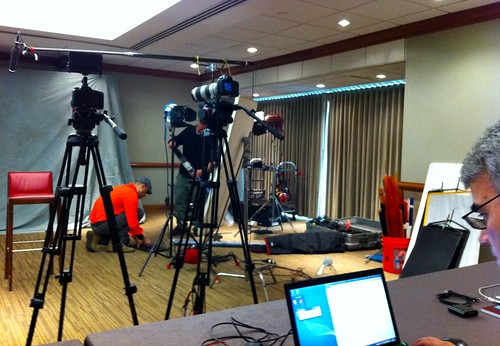
Just checking in. Unfortunately, I’m not staying at the US Grant in San Diego

US Grant

but I am involved in the output of what went on here:

Set

Back in London on Wednesday, I think.

Posted in Work | Tagged | 6 Comments

On cell porn and laser beams

As you might have gathered, I’ve got a bit of a thing going for lasers. Seeing as I’m a certified biologist—or biochemist, at least—what better way to celebrate Occam’s first birthday than by writing about a combination of the two?

On one of the many mailing lists to which I’m subscribed, there was a video of what’s possible when one shines coherent light through a droplet of common water. ‘Not much,’ you might think—but truth, as often in these cases, is much, much stranger than fiction.

IMG_1722

And a great deal more fun, too.

Antonie van Leeuwenhoek made microscopes by making tiny spheres of glass. Small but surprisingly powerful lenses, these spheres would have looked rather like water droplets. They would have had similar properties too: if you’ve ever accidentally spilled water on a document, you’ll be well aware of the magnifying properties of such a drop. The little drops act as powerful lenses—and how powerful is surprising, until you realize that this is more or less how van Leeuwenhoek discovered bacteria.

IMG_1721

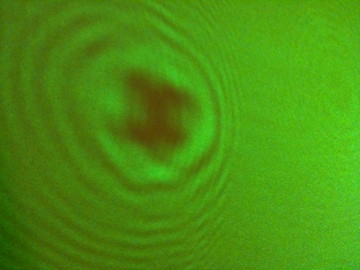
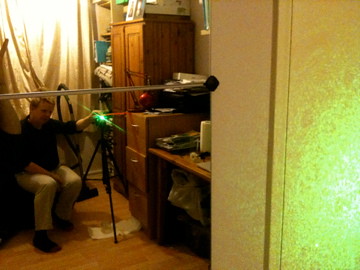
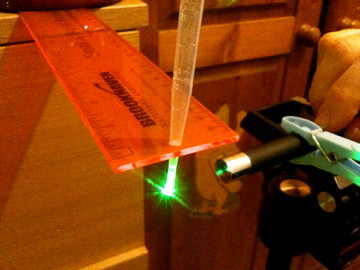
So: take a small glass sphere—or, in this case, a droplet of water—and shine some light through it. You can’t see much unless your light source is, say, a relatively ordinary 50 milliwatt laser. Then something quite remarkable happens.
IMG_1732

That thing, looking remarkably like a cell in anaphase projected onto the door, is about 10 cm in diameter. I’m going to assume that it has been diffracted from something that as far as I can measure is a point. The drop—my tiny lens—is a few millimetres across, but I can’t measure the diameter of the entire diffracted light spot very well; so let’s call that 10 cm the ‘opposite’. Or y, if you’re as old school as I am.

angels

I can measure the ‘adjacent’ (‘x‘); and it turns out to be near as damn 2 metres. Recalling my trigonometry I know that y/x = tan θ. So (where’s my calculator?) θ is 2.86°, or close enough.

Which, if I squint a bit at the set-up, doesn’t seem completely insane.

Right?
IMG_1719

Now, I know Bragg’s law says you get constructive interference when nλ = 2dsinθ, where d is the crystal lattice distance. But I’m not working with crystals—I’m working with what I want to consider point diffraction, and I’m ignoring interference and whatnot, so I’m going with λ = dsinθ. We shall see that this is not an appropriate approach, but at the time I couldn’t think of a better one. I’d had a couple of gins and tonic, which might explain that—and besides, it was fun. Kids, laser beams and gin don’t mix.

Anyway, if θ is 2.86° and the wavelength of my fricken laser beam is 532 nm (which it is—and I calculated it) then

532×10-9 = d sin(2.86°)

where d is the size of whatever it is that’s doing the diffracting. It’s trivial to solve for d:

d = sin(2.86°) / 532×10-9;

=>

d = 5.32 x 10⁻⁷ / 0.05

=>

d = 1.06 x 10⁻⁵

which is 10 µm.

Which is pretty darned close to the average size of an animal cell.

Hmm.

While I was working out the maths above I noticed a curious similarity in the sin and tan values. Then I dredged up from the murky recesses of my memory that for small angles, sinθ approximates tanθ.

λ = dsinθ (=> λ/d = sinθ)

and

y/x = tanθ

and sinθ = tanθ

Therefore, substituting for the angle term in son of Bragg,

λ/d = y/x

Solving for d:

d = λ x / y

And now we can easily see what’s wrong with this approach. The sharp-eyed among you will have realized that reciprocal space is, well, reciprocal. In other words, small distances in a lattice diffract to large distances in the real world, and vice versa. Which means, although my attempts at deriving some maths from my little experiment worked (to within an order of magnitude), I was too fixated on diffraction to think in terms of magnification. If you plug some numbers into that last equation you’ll soon see that small objects in the drop should appear extraordinarily large; while large ones shrink to nothingness. That’s diffraction, not magnification.

Which shows you the danger of taking something you’re familiar with and applying it to another system—especially when things coincidentally work out how you might expect them to.

Read on.

What I did, see, was take a scraping from the inside of my cheek, and spread it in some water on a microscope slide. I looked at this under my microscope—I can’t show you a picture of that, because I don’t have a camera attachment. But I did know that the size of the cells I could see was 10–20 µm. Then I took those cells up in my Pasteur pipette and suspended them, in their drop of water, in the path of my laser beam.

IMG_1738

And Lo! and behold! We saw cells floating on my spare room cupboard door, about 10 cm in diameter. Which, as derived above, is what you’d expect if you solved some misbegotten derivation of Bragg’s Law for a diffracting unit of 10 µm.

Although the maths is wrong, I’m pretty confident that my laser beam is helping my humble drop of water to a magnification factor of x10,000. The most powerful objective on my microscope is 100x. The objectives are 10x, which gives us x1,000. And, I’ve projected this on my wall.
IMG_1723

Now, the resolution of a microscope depends on the numerical aperture (NA) of the lens—the wavelength of the light over twice the NA, in fact. The numerical aperture is defined by n sinθ where n is the refractive index of the medium—1.33 for water—and, hey! There’s that sinθ term again. I’m a little bit stuck now: I want to generalize the magnification factor for this experiment—how the distance from the drop to the wall relates the image to the size of the real things in the drop—but how to determine the focal length is eluding me, and right now I have to get ready to fly to San Diego, so it’ll have to wait until I get back/have more time.

Either way, if one dark night I were to suspend a drop of water in my garden and shine a laser onto the house across the street I could get a magnification of x100,000. But I suspect that not only would my images suffer from some strange diffractive noise effects, I might come to the attention of the authorities for being totally too weird.

Which would be a shame.

Posted in Don't try this at home | Tagged , , , , | 12 Comments

The sun ain’t gonna shine any more

Giant Rabbit Eats Northern UK

Posted in Science-less Sunday | Tagged , | 8 Comments

On the up

Having a chat with Henricus croxii this morning, it suddenly struck me that I have been rather quiet of late. So quiet, in fact, that even H. croxii, with whom I normally share everything (except underpants and family members), wasn’t privy to my latest—albeit now three weeks old—piece of news. Statistically, therefore, the chances are that you’re similarly as unenlightened as he was this morning.

Permit me to explain.

Actually, permit me to digress.

Up until the first month of 2009 I was a research scientist. I had been thus since I emerged, anadyomène-like and yolk glistening, from the revivifying waters of the Biochemistry department of the University of Oxford in the balmy summer of 1991. Now, some might quibble over the ‘research scientist’ moniker being applied to someone working towards their doctor of philosophy qualification, but they can just bugger off. Either way, doing bench research had accounted for a major chunk of my adult life. The reasons why that should have changed at such an advanced stage are many and varied, but sadly not all that unusual.

And as you well know, since 2009 I’ve been working at the Faculty of 1000, doing various things as they came up, including contributing to The Scientist magazine; building a social media presence from scratch; and overseeing the launch of an opinion-based ranking system for scholarly journals. All those revels now—as of three weeks previously, actually—are ended, however. Faculty of 1000 was my first non-research science job, and while I’m very grateful for the opportunity to land on my feet in London and get to meet interesting people and figure out exactly what else a one-time lab rat can be good at, I always knew it wasn’t going to be long-term, and that once I was more in control of things I’d be looking to move on, and hopefully up.

I have now embarked on the next stage of my winding career path. Three weeks ago I joined a medical education and publishing agency called Remedica, as a Senior Writer. I’ve been thrown right into the thick of things (which is great—it’s the only way I know how) and although I haven’t really done any writing as such, I have done a great deal of editing, information architecture and, oddly enough, literature-based research. I’ve read more papers per day over the last three weeks than at any time since I was writing up my DPhil. I know more about a certain class of macromolecule than anybody has any right to know—and that information is going to be coming soon to a pharmaceutical booth near you. In beautifully rendered 3D, no less.

I can’t really say who are our clients, nor talk about the specifics of what’s in progress, but I can say there are some really hot animations in development, as well as some interesting iPad apps that I have my eyes on. And they want to send me to San Diego soon to produce a webcast.

Never a dull moment. I’ve been very busy in a very refreshing way, although I’ve not really had the energy for blogging. It is great fun, but my mother still wants to know when I’m going to “get a proper job.”

So now you, and H. croxii, know.

Posted in Me | Tagged , , , | 11 Comments

Poppy

It’s not about being patriotic or British—not that there’s necessarily anything wrong with either of those.

It’s about those who, when the time came, gave whatever they could for what they believed in. It’s about those who died; those who were captured in the Far East and returned to a world they didn’t recognize; those who manned AA emplacements or pulled bodies from bombed-out buildings or flew their crippled aeroplanes away from civilian areas; those who machined gun mounts in converted confectionary packaging factories; those who were ready to cover the withdrawal from Aden; those who spent Christmas in a flak jacket as rockets exploded close by.

Poppies

Posted in Personal, Politics | Tagged | 6 Comments

On nominations

There’s no way to read the full article without a multi-hundred pound subscription, but I see that Research Fortnight UK has announced its nominations for the Research Fortnight award:

Policy stars shortlisted for Research Fortnight award
02-11-2011
The chief executive of the Technology Strategy Board, Iain Gray, social scientist Teresa Rees, and UCL researcher and campaigner Jenny Rohn have been short-listed for the Research Fortnight Achiever of the Year Award.

Achiever of the year? Complete AwesomeDoc, more like.

Posted in People | Tagged , | 8 Comments

Three steps to Heaven

Back in August I finally got around to writing the ‘Corporate Twitter Guide’ they’d been on at me to produce. Being the sort of guy I am, I actually did it in twenty tweets.

Because I’ve just spent five minutes looking for it so I could point colleagues, who will be twittering in my absence, to it, I thought I should also post it somewhere more easily searchable.

So here you go. Please feel free to copy, re-use or remix as you see fit:

Richard’s Guide to Corporate Twitter Etiquette

  1. The point of tweeting—as with all social media—is to drive traffic to the site & bring it to the attention of potential new customers.
  2. We try to achieve this by building a community and a network around
    our social media activities.
  3. Communities are built on trust. People trust other people; it is important to maintain personal connections while remaining professional.
  4. People trust you to share interesting and relevant content; trust that you will respect other members of the community.
  5. Therefore, your tweets should be enticing and catchy, but never misleading. You are publishing: always factcheck; never libel.
  6. Your own voice is important—try to become a trustworthy voice of the company. We all have different voices and this is good.
  7. You are speaking on behalf of the company. Say ‘we’ when appropriate, and don’t write anything you wouldn’t repeat in the boardroom.
  8. Add value. Are you making the company look good? Are you interesting to other people? Are you putting the company before yourself?
  9. Through your tweets, your links and your conversations, give people a reason to follow our twitter account. See #1.
  10. Check what other company tweeters have just written. Duplicate tweets are good, if there’s at least few hours between them.
  11. Try to keep your tweets to about 100-120 characters, not 140. This gives people room to retweet and comment on your gems.
  12. Use hashtags responsibly, on keywords, e.g. #Ecology #RCT #Vaccination. Don’t overdo it: #This #is #silly. Examples follow:
  13. “Congratulations to F1000 Members @lauramenenti and Peter Hagoort on ‘Shared Language’ http://bit.ly/qIUcMu #psychology #fMRI”
  14. “Section Head Regina Fölster-Holst wins first prize in German science #communication competition http://bit.ly/qTE5z0”

  15. “Retweet for the other hemisphere: on the importance of good note-keeping http://t.co/jRMwLxI #retractions”
  16. Follow interesting people back, but don’t feel you have to follow everybody. Don’t set an autoresponse for new followers.
  17. Engage: take time to respond to people who ‘@’ you. Reply to and retweet interesting tweets from others.
  18. Together, @s and RTs should take up no more than 66% of your output; and you should send fewer RTs than @s.
  19. Be polite and courteous at all times; even when you’re arguing with a muppet. Again, see #1.
  20. Punctuate. Try not 2 use txt spk. Rephrase rather than mangle the English language. And don’t swear. Ever. Even in jest.
  21. Have fun.

(Original on Twitter and G+.)

Posted in you | Tagged | 3 Comments

Meet your density

Now witness the firepower of this fully ARMED and OPERATIONAL battle station!

Posted in Science-less Sunday | Tagged , | 11 Comments

Cell phone

Cell phone
Cell phone

Posted in wibbling | Tagged | 4 Comments