Latest posts

Launch

My latest book A (Very) Short History of Life on Earth has now come out in the US and Canada. Actually, it came out 17 days ago, and it’s available from St Martin’s Press and the proverbial All Good Bookstores, but I haven’t had a moment to carve a word on this until now. It was pipped at the post by versions in Dutch and German; a Spanish edition is now available for preorder; and of course the UK edition, from Picador, has been out for a while.

In thirty years of writing books, this is the first to have made any impact at all. For some years I have subscribed (through Amazon) to a service called NPD Bookscan. This gives me weekly sales of all my print books (so, excluding Kindle and audio) sold either by Amazon or in more than 10,000 US bookstores – some 85% of the bookstores in America. Most weeks I sell one or two. I have never sold more than six in any given week in the past two years. Last week, I sold 536 – this week it’s down to 284. Almost all were of the new book. And this is in the near absence of US print reviews of the book (so far … though the Wall Street Journal did recommend it as a gift book, which can’t have done any harm).

OK, so hardly Harry Potter, I know, but it means a lot to me. My UK publisher tells me that the UK editions has shifted 7,500 copies in all formats and it’s gone into a second printing. They say you have to toil in obscurity for years before you get to be an overnight sensation.

One reason for the visibility is that the book really is available in stores. My previous books have generally be confined to more academic outlets, and this tends to restrict availability. Another is that I have a whole team of people working for me. Not just my marvellous agent, but the publicity people at both US and UK publishers, and, crucially, a PR firm. Through them I’ve got excerpts of the book out in variously visible places, bookings on US radio shows, appearances by Zoom at various events and quite a few podcasts. I’ve been keeping a list here, if you’re interested … but it’s not over yet. There’ll be quite a few more things happening as we slide down towards the festive season. Suffice it to say that rectangular gifts are easiest to wrap. Although I’ve heard that although cylindrical gifts are easier to consume, one shouldn’t let the rectangularity of a gift put you off. Just start nibbling away at the corners.

Posted in a very short history of life on earth, Writing & Reading | Comments Off on Launch

Did Humphry Davy suffer from Impostor Syndrome?

When I think of Humphry Davy, I think of a scientist, someone who became a star attraction during the early days of the Royal Institution and inventor of the eponymous Davy Lamp (although at the time others accused him of plagiarising earlier designs). Of course, the word scientist did not exist in his day and, as Jan Golinski’s book The Experimental Self makes clear, Davy had a range of personae during his lifetime which reflected different aspects of himself and which he played up to different extents at different periods. (Undoubtedly he also thought of himself as a poet and someone who knew a thing or two about fishing.)

Don’t we all have such multiple personae? Golinski indicates how, in Davy’s lifetime, the concept of a ‘man of science’ was only just emerging. Part philosopher, part ‘enthusiast’ – which was verging on a term of abuse at that time, as overdoing things a bit and potentially dangerously radical – part discoverer (and also, part dandy and part traveller to complete Golinski’s list, although these are less relevant to a scientist). A fair degree of issues of class crept in too when people contemporaneously passed judgement on Davy: he came from a poor family in Cornwall but made a very advantageous marriage to a rich widow. (Incidentally, on Radio 3 a local Cornish group sang an amusing folksong about him as I was writing this post.)

The various epithets that might be tossed in the direction of a scientist these days might be different, although philosopher/philosophical might still be directed at some of us, but the fact that we exhibit different personae in different groupings is as true today as then. Take impostor and impostor syndrome. Many of us suffer from this, but many of us equally know how to cover it up and may come across as confident, even overly so by way of compensation, so that the underlying condition is hidden from view. I was amused to hear a mutual (scientific) male friend described to me by a woman as typically male-confident, when he was someone I knew perfectly well hid his own insecurities under an effective mask. Don’t we all? (Or nearly all.) This woman herself I’m sure would come across to the external world – and she is very much visible to the world through her writing and interviews – as confident, but she knew internally how different she was. The same mistaken belief, no doubt, could be applied to me.

When I wrote about impostor syndrome in the early days of this blog, implying women suffered from it more than men, one of the people who publicly responded over Twitter to my post, suggesting that men too, himself included, were very prone to it, was David Spiegelhalter. The pandemic has been full of his writings and pronouncements about the statistics of death, vaccination etc, all so beautifully clearly set out. He seems on the surface to be confident and willing to speak up in extremely public fora, despite his admission to feeling a fraud, an impostor. Equally he is willing to admit to his failures. I was amused by a recent tweet of his


indicating how he’d failed to unmute during a live interview – something else we are all liable to do in different situations. I did it very obviously in a meeting with the last Minister of Science, Amanda Solloway; it’s always the stress of a high-profile moment when these things go wrong. It would seem to be a natural tendency to feel a fraud, but then to put on a different external persona; those people you think are arrogant may indeed be quaking inside. I would suspect that Davy himself suffered from impostor syndrome, and hence he ‘invented’ these different personae to mask what he no doubt felt to be inadequacy, not least because of his humble roots.

David Spiegelhalter is a colleague of mine, on the Fellowship at Churchill College (not that I knew he’d become a colleague back in 2012 when I wrote that particular blogpost; I didn’t join until 2014).  But the College perhaps has surprisingly strong links to Davy himself, or at least to a current AHRC-funded project on the Davy Notebooks, on whose Advisory Board I sit. This is a fascinating project aimed at transcribing all his notebooks via Zooniverse, a crowd-sourcing platform (or citizen science if you’d prefer). They are, incidentally, always looking for new people to join in the transcription project, no previous experience required!

I learned a lot of what I know about Humphry Davy from the wonderful Age of Wonder by Richard Holmes, an alumnus and Honorary Fellow of Churchill (again long before I joined the College).  He too is on the Advisory Board. I have written previously about the past and present meanings of ‘impact’ in science as discussed in an earlier book by Jan Golinski, a Professor in the History Department at the University of New Hampshire who held a postdoctoral fellowship at the College; he is also on the Advisory Board. The fourth member of the Board associated with Churchill is Alice Jenkins, Professor of Victorian Literature and Culture at the University of Glasgow who is an alumna.  For a college so heavily associated with STEM subjects I find this grouping of the four of us on an AHRC-funded project fascinating. I hope it illustrates that, despite being also the College of CP Snow (he was a Founding Fellow) we absolutely don’t believe in the two cultures being distinct and never speaking to each other. I am proud of that.


Posted in Alice Jenkins, History of Science, Humphry Davy, Jan Golinski, Richard Holmes, Science Culture, Zooniverse | Comments Off on Did Humphry Davy suffer from Impostor Syndrome?

A Reckoning with Huxley’s Legacy

Recognition and Redistribution for Imperial College’s Community

This is a guest post by my former colleague, Dr Rahma (Red) Elmahdi, in which she lays our her reaction to the Imperial College History Report, and in particular the recommendation to rename the Huxley Building. I am grateful to Red for allowing me to share her perspective.  

Red-Full-Flow

Red in full flow

As a former student and member of teaching staff at Imperial College London, I was excited to finally read the Community Report from the College’s History Group, released earlier this month. Despite no longer studying at or working for the College, I consider myself a continuing member of its community, having spent over a decade (including some of my most formative years) learning, teaching and researching there, even spending five years living and working at the College as a subwarden in student halls of residence.

In the last few years of my time at Imperial, I became increasingly involved in ongoing efforts for progressive change for equity, diversity and inclusion, particularly working with Black and Minority Ethnic (BME) groups in the College to increase representation and foster a stronger sense of identity as members of the college community. Efforts such as these are usually uncontentious and considered a reflection of an institution’s commitment to improving the lot of the underrepresented groups who study and work there.

In keeping with these efforts, and following the lead of many international universities in exploring the roots of structural discrimination in their own institutions, Imperial commissioned the work to “report on the current understanding and reception of the College’s legacy and heritage in the context of its present-day mission”. Among the recommendations of the report, which was supported by two independent external Russell group advisors, was the removal of a bust of Thomas Henry Huxley (first Dean of the Royal College of Science, renowned 19th century naturalist and principal defender of Darwin’s theory of evolution) and the renaming of a building which currently bears his name. This recommendation was made because Huxley used racial divisions and hierarchical categorisation in his work that might now be called ‘racist’. Despite being only one of many recommendations put forward by the report, this stirred the most media attention and the strongest criticism of the History Group and the College as a whole. Headlines in online newspapers from across the political spectrum accused the College of giving in to wokery, erasing its history and effectively besmirching the name of one of the UK’s greatest scientists and educators who was even a known slavery abolitionist.

Making sense of the criticisms of recommendations such as this are never easy. Even for those of us who are genuinely trying to engage in our shared history with the intention of learning from the past for progressive future change, it often boils down to an issue of ‘recognition or redistribution’, to quote Nancy Fraser. After all, how can the renaming of a building or removal of a bust of a man (who most students and staff only have a vague notion of anyway) help with the challenges experienced by black and brown students today?

Speaking as a black woman, (and I think my identity matters here) I think that this has everything to do with these challenges. If Imperial does not honestly contend with its history of racism, it makes it easy for Black students and staff to continue to feel excluded, and othered in their own institution. I appreciate and value the work of the History group and take its recommendations seriously for this reason. Providing more opportunities for talented Black students to gain good degrees from a university with a history of racism, without acknowledging the deeply exclusive historic (and ongoing practices) of that university, does not allow us to move forward honestly. Therefore, I believe that between recognition and redistribution, a reckoning is necessary for reparation.

The challenge in the criticisms here can be surmised as two questions. 1) Is it morally correct for the College to continue to honour Thomas Henry Huxley (and by proxy his racist views)? 2) How do we contend with the fact that the bricks and mortar of the building (regardless of what it is called) is part of an intellectual legacy of dehumanising Black people at Imperial that cannot be undone?

I admit that the latter is far more important for both the education of all staff and students and for fostering an understanding of minority staff and students’ struggle in the correct context. We cannot change where the money to build our institution came from or what the product of the research undertaken in it has meant for the lives of countless people deemed scientifically inferior by the likes of Huxley. We can however attempt to highlight the legacy of the Huxley’s work and the role Imperial has had to play in creating ‘evidence’ for racialised exploitation under empire, through the lens of those affected.

The first of my two questions is an easier one for me. The purpose of naming a building after someone is to honour that person. It is paying homage to their work, what they contributed and what they stood for. Whether that is ever a good idea is another question, and I think Gary Younge has made a very persuasive case that it isn’t. There is no one person in history who has held perfect morals by modern (and changing) standards of acceptability and so perhaps there is no use in honouring anyone with a statue, bust or by naming a building after them. Racist views however are clearly not something we should want to honour at the College “in the context of its present-day mission” and I think it is an insult to the Black people who continue to work and study in a building named after a person who was so adamant in questioning their capabilities and equality.

We all understand why the Imperial College Business School was renamed from Tanaka, so why is it so different in the context of Huxley? No one accused the College of ‘Cancelling Tanaka’ but isn’t this the same thing? We are not obliged to preserve, in reverence, the names of slavers, oppressors or racists and if we do so in the name of ‘history’, we are doing a deep disservice to those who suffered because of Huxley’s views and the work he produced. What is worse, we are contending that, at one point in time at least, racism and sexism were fine. Just because some views and actions were historically commonplace, it does not mean they were correct and they were certainly never correct in the minds of those who suffered because of them at the time (or continue to suffer because of their legacy). This line of argumentation only serves to continue to normalise sexism and racism by insisting that they were once acceptable. Acceptable to whom? Certainly not to me or to those like me who Huxley deemed inferior.

One of the more interesting and surprising critiques of the report came from Kenan Malik in an Observer article where he likened Facebook’s recent rebranding to the recommendation for renaming the Huxley building. This parallel is unhelpful for many reasons, but particularly because the arguments for maintaining the building’s name and the place of the bust essentially boil down to ‘white supremacy was normal in Victorian England’. In itself this is unimportant for Black staff and students living with Huxley’s legacy at the College today. The interests of intellectual classes of Victorian Britain fall outside of the remit of the History Group. Malik also reasons that Huxley was not as big a racist as say, 18th century slave trader Edward Colston, and that by “damning both equally as racists who do not deserve commemoration is to abandon historical evaluation for a crude mode of moral judgment”. This argument in particular misinterprets the entire notion of racial equality. Just because Huxley’s work or views did not directly subject black people to violent degradation and exploitation in an utterly dehumanising system for economic gain, does this mean that they were not racist? It is the same argument that those who misunderstand calls for equality make when they equate bigotry and racism, disregarding systemic contributors to the discrimination experienced by Black people every day.

Huxley’s contribution to scientific racism has arguably had a far more profound and longer-lasting impact on racial discrimination than slavery alone. Although Huxley disagreed with the application of his work to Social Darwinism, and was no advocate of eugenics, his belief in the deterministic significance of his system of classification of the “higher and lower races” (which he states in his essay Emancipation: Black and White), were undoubtedly significant contributors to the formalisation and normalisation of scientific racism and its subsequent applications. It would have been much harder to create and maintain systems of racial domination without the validation of scientific racism that men such as Huxley helped create and perpetuate.

Ultimately, I am not only in support of the work undertaken by the History Group but also in agreement with their recommendations. Whether or not Huxley’s name remains attached to the mathematics and computing department building, the College must actually identify, disseminate and educate on Huxley’s legacy through the lens of those harmed by his work and that is the reckoning. Without this, there can be no recognition, and the value of redistributive efforts will not be fully realised. These efforts, which include increasing access to Black students from disadvantaged backgrounds to the opportunities that an education from an institution like Imperial can provide, as well as improving retention and career progression of the existing Black staff in the College, are absolutely essential. We need both to address historic legacies of injustice.

You can’t have a true attempt at reparation of institutional discrimination without doing the uncomfortable work of explaining why it was necessary to start with, who lost out, who was exploited and who continues to be excluded as a result of scientific racism. This means exposing Huxley’s contribution to racist injustice and acknowledging how Imperial benefited from this. It is one knot among many to disentangle in the complex web of historical injustice across British society that we all remain caught up in today. But it is at least one knot less.

Red is currently a postdoctoral researcher in the Department of Clinical Medicine at the University of Aalborg, Denmark. She can be found on Twitter as @RahmaElmahdi.


Posted in science | Comments Off on A Reckoning with Huxley’s Legacy

Why p-values should be interpreted as more than p-values

Last week some of us published a paper trying to improve the way p-values are interpreted by suggesting this be done on a more continuous scale (here’s another link to the paper: hopefully one will go to a readable version). This caused a lot of activity on twitter, and a response from Daniel Lakens, who is a 20% statistician (and is therefore not significant). His post is a strange beast: the main message is diluted by the way he contradicts himself.

Our paper was an attempt to make an improvement in one (small) part of scientific inference: how p-values are communicated. Our argument was that when we write our results sections, we shouldn’t use the dichotomy of “significant” or “not significant”, but instead communicate a continuum of interpretation of p-values as evidence, e.g. rather than writing “The effect of x on y was significant (P = 0.03)”, we suggest “There was (only) moderate evidence that x has a (positive/negative) effect on y [(give effect estimate), P = 0.03].” We though this would be a useful, if small, step to improve the interpretation an reporting of significance tests in practice.

There was a lot of reaction on twitter, most supportive, but not all. In particular, Daniel Lakens did not like this at all:
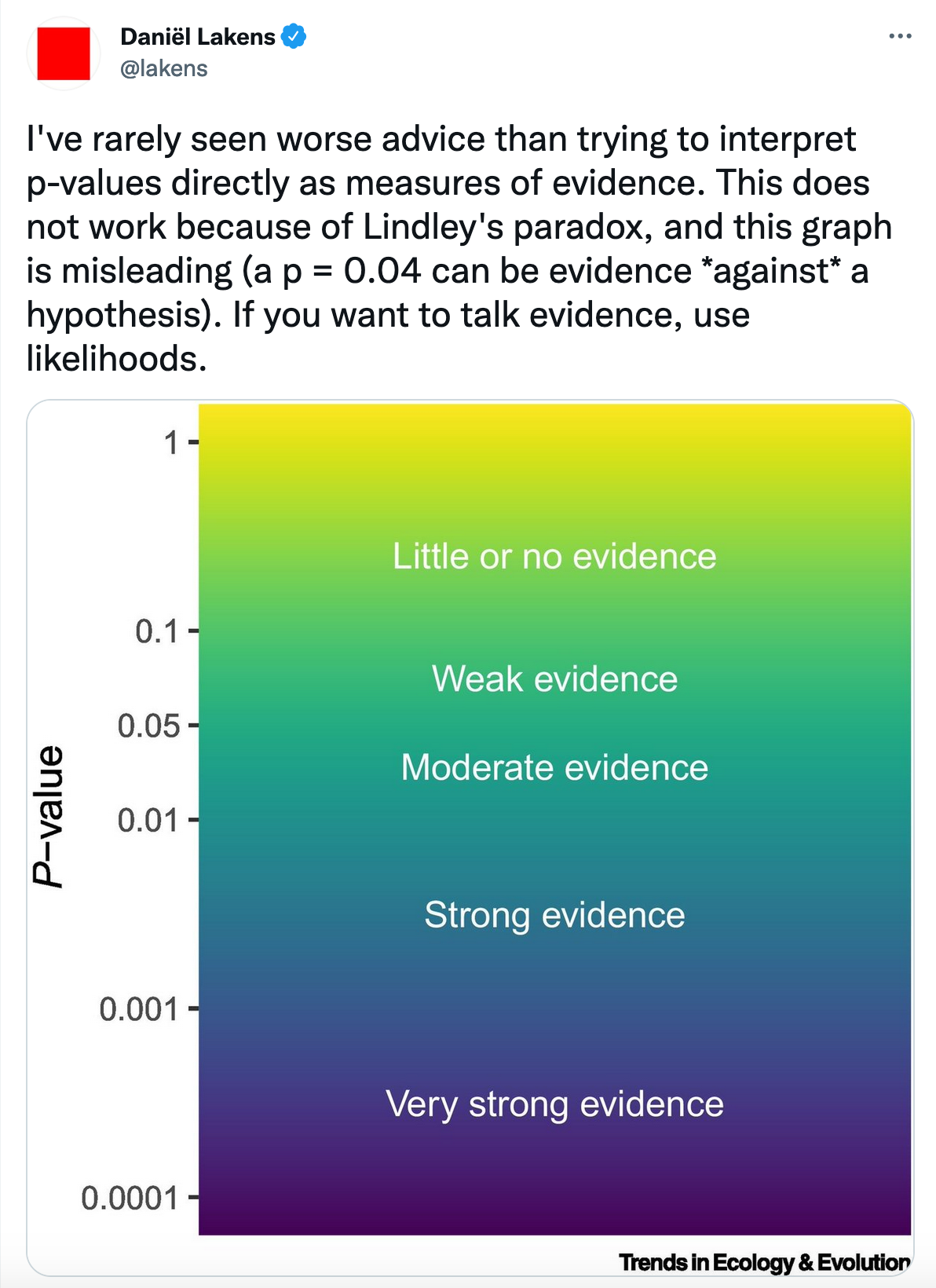
After some discussion (which went around a bit, as twitter discussions are wont to do), he wrote a blog post to clarify his views. I think we actually agree on the main point of disagreement, but if we get there by different routes.

Lakens’ argument goes roughly like this:

1. p-values only make sense when the null hypothesis is compared to the alternative hypothesis
2. p-values should be treated as p-values. But as p-values in the Neyman-Pearson null hypothesis statistical testing framework.
3. There are a variety of coherent statistical frameworks that are used, and people should be able to use them.

The incoherence between point 2 and 3 should be clear (not all coherent statistical frameworks use the Neyman-Pearson appraoch), especially as I have over-simplified it. But aside form the bit about Neyman-Pearson null hypothesis statistical, we more or less agree. Lakens sees disagreement because, I think, he is taking a narrow view of the inferential process, and so sees our way of looking as p-values as incoherent. Unfortunately for him, he can only make his argument by destroying the “p-values should be treated as p-values” slogan.

Let’s walk through this. First, what is a p-value mathematically? As we say (and I assume Lakens agrees), it is the probability of observing a specific data summary (e.g., an average) that is at least as extreme as the one observed, given that the null hypothesis (H0) is correct. I don’t think I’ve seen anyone argue that that is incorrect. The way it is used is (informally) is to say that if the p-value is low then we decide that the null hypothesis is wrong, and instead we accept the alternative hypothesis. This developed into the formal Neyman-Pearson approach:

1. specify the null hypothesis, H0
2. specify the alternative hypothesis, H1
3. Calculate your statistic, and thus p-value
4. If p<0.05, declare it significant, reject H0 and accept H1

Our argument maps nicely onto this, but rather than accept/reject, we are suggesting we move towards a more graded way of describing p-values, as summaries of evidence, e.g. “There was no evidence that x has an effect on y [(give effect estimate), P = 0.53].”, or “There was very strong evidence for a (positive/negative) effect of x on y [(give effect estimate), P < 0.001].” (both of these are from our Table 1). Note that the examples, indeed all our examples, are couched in terms of the evidence for/against the alternative hypothesis.

Lakens didn’t notice this, probably because we didn’t spell it out. In our Box 1 we presented p-values as being about rejecting H0 (a Fisherian approach). Which, strictly, is all they are. The alternative hypothesis does not (usually) appear in the calculation1, so if you want to interpret p-values as p-values, then you shouldn’t refer to H1 at all. At best they become goodness of fit tests: with a single test a low p-value suggests that the model for the null hypothesis is unlikely to have produced as extreme a value.

Even though he wants us to interpret p-values as p-values, Lakens doesn’t actually discuss what a p-value is. Instead he explains the Neyman-Pearson approach, which is a framework for hypothesis testing built around p-values. In other words, he is arguing not that one should interpret p-values p-values (i.e. a statement about the improbability of more extreme data given the null hypothedsis), but only as Neyman-Pearson p-values, i.e. as a formal comparison between two specified hypotheses. If one is using a Fisherian p-value, you can’t interpret your p-values, because… what? They are not p-values? And if you are actually carrying out a goodness of fit test, where the null hypothesis is what is of interest… what? In this case, the alternative hypothesis is that the null hypothesis is wrong.

So one has to be Pure of Heart and accept the Teachings of Egon and Jerzy (revised edition). Except:

I will go out on a limb and state some things I assume most statisticians agree on. First, there are multiple statistical tools one can use, and each tool has their own strengths and weaknesses. Second, there are different statistical philosophies, each with their own coherent logic, and researchers are free to analyze data from the perspective of one or multiple of these philosophies. Third, one should not misuse statistical tools, or apply them to attempt to answer questions the tool was not designed to answer.

All of which I would agree with: there are different approaches, and specifically I am not arguing that the Neyman-Pearson appraoch is wrong. But Lakens seems to be arguing that all ways are right, as long as we follow the Nayman-Pearson approach. Given that p-values don’t explicitly answer questions about H1 2, one could even be naughty and argue that one shouldn’t use them to answer questions about H1.

In reality, I actually think we are not so far apart from Lakens, and he missed the importance of what was in our tables (and we overlooked the importance of them in making a complete argument). We all agree on the mathematical definition of a p-value. We also agree that a small p-value should be interpreted in the context of support for the alternative hypothesis. The difference is that we didn’t explicitly state it. I think the excuse we’ll use in public is that we were only focusing on one part of the use of p-values, so didn’t go into details about the others. But our examples did, at least fairly explicitly, put them in the context of the alternative to H0. So we make the leap from rejection of H0 to evidence about H1 in the informal interpretation of p-values, rather than put it in a formal framework. That reflects the way we see p-values being used in practice: not with null and alternative hypothesis being explicitly stated, but with them often being implicit, but clear.

In summary, what we were doing was a reflection of how we saw p-values being used, for example, in Schools of Psychology, whereas Lakens is more interested in the sort of formal framework that emanates from Mathematics departments. In general neither is really wrong, I think, but when talking to one audience one has to sacrifice aspects that the other might think important.

1 OK, OK. First, some tests are set up so that H0 and H1 are directly compared: essentially, likelihood ratio tests do this. Also, the test statistic usually reflects H1, e.g. if H1 is that the means of two treatments are different, then the difference in the means makes a good test statistic.
2 See footnote 1.


Comments Off on Why p-values should be interpreted as more than p-values

It’s out! Today’s Curiosity is Tomorrow’s Cure

IMG_9114

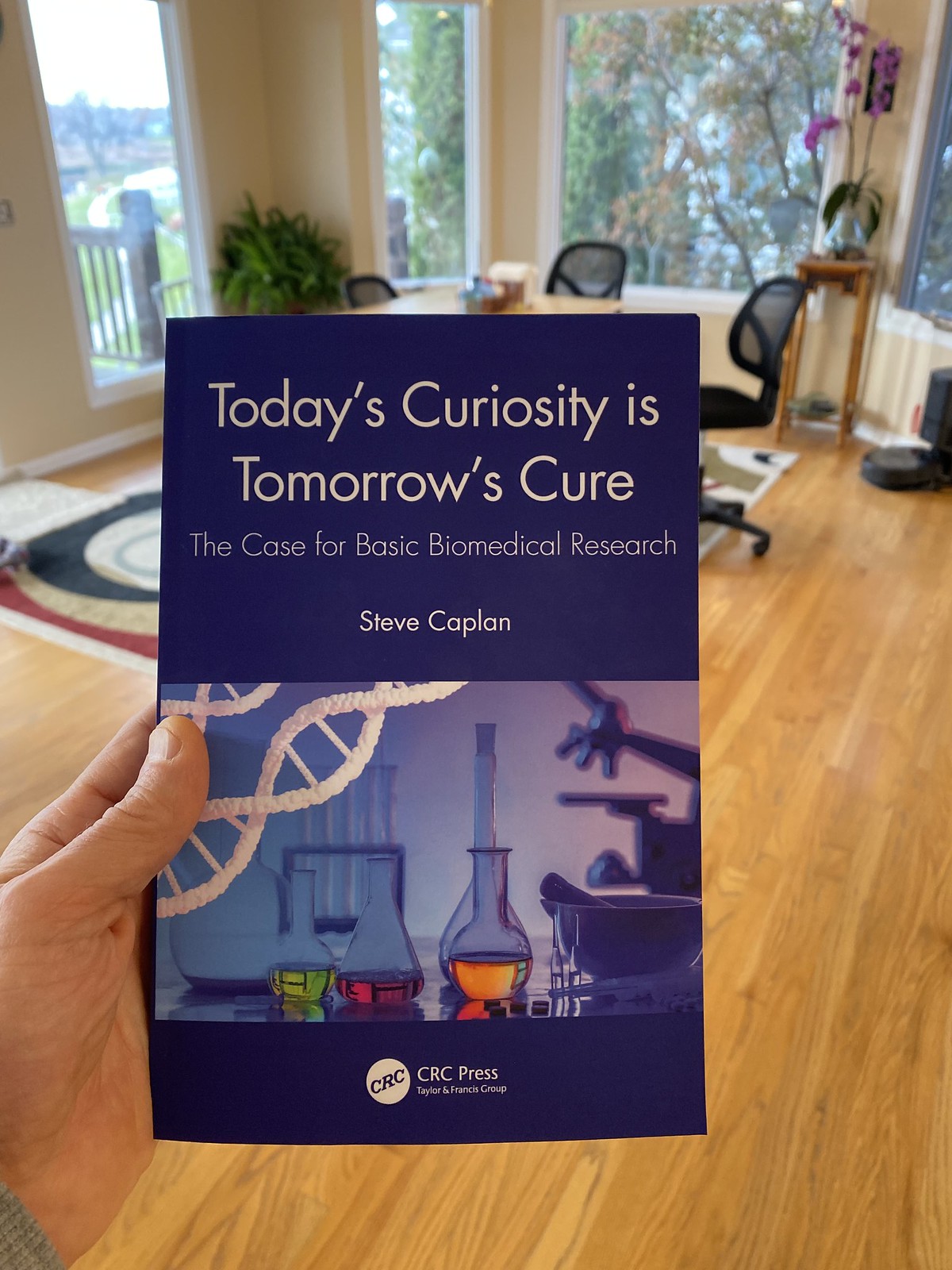
Today’s Curiosity is Tomorrow’s Cure: The Case for Basic Biomedical Research is now officially published and available from Routledge/Taylor & Francis/CRC Press on their website, from Amazon and all the regular book sellers, including Barnes & Nobles, Waterstones, etc. I’m not sure what this means, as this is an academic book, but it’s been a #1 hot new release on Amazon (the paperback version) alternately in “Biotechnology” and “Medical Research” as well as “Cell Biology” and “Biochemistry” these past 10 days since being published.

It’s been on my mind for the last 5 years, and in active writing since early 2020. For the last 12 months it’s taken up every free minute of my spare time, the writing, editing, tweaking, modifying, re-editing, figures, references, glossary, proof reading ad nauseam–so that now that the book is finally published, I feel a little lonely, a little lost, and not quite sure what to do with myself. Fortunately I have a new young dog to keep me busy…

Overall, it’s been a marathon of sorts–a marathon I started as a book to lobby for basic biomedical research, but in the course of writing became enamored with the history behind some of the greatest discoveries. I really loved the researching and writing of each of the 24 chapters in the book, and the biggest take-home message is that “it takes a village of scientists” and usually decades between the initiation of a great discovery until some clinical fruits might be gained from the research.

Another important point relates to perspective. Researchers are continually trying to “sell” the science and highlight the “significance” and “impact” of the research. But historically, it hasn’t been an easy task to always predict what impact a discovery might have in the future. For example, Chapter 24 addresses the discovery of the green fluorescent protein (GFP)–arguably one of the most impactful findings that has had a monumental influence on the course of research’s allowing scientists to study proteins, organelles and living organisms more readily. However, when the protein was first isolated from jellyfish in 1962 by Osamu Shimomura and his colleagues, the initial publication was a rather understated paper in a modestly-ranked journal–not really providing a hint of the massive impact the GFP protein would later make.

Indeed, what is “impact?” I once was asked to show a group of donors some microscopy studies on a confocal microscope, perhaps 15 years ago. After a lot of preparation and working to explain things to laypersons, I realized that the group was entirely fixated on—the notion that the microscope had two computer screen (at the time this was a relatively new thing) and they were amazed that I could drag images and icons from one screen to the next one seamlessly. The actual biology held no interest for them. And thus, “impact” can be a very subjective concept. Just ask any scientist whose paper has been rejected without review for “insufficient impact…”

In any case, for anyone interested in the stories leading up to the great discoveries, or in search of a holiday gift for a scientist, please check out this book. There’s even a discount for my friends…

KEA21SCI010


Posted in angiogenesis, antibodies, basic research, DNA, education, genetic code, genetic engineering, GFP, great discoveries, penicillin, proteins, Research, RNA, science, science history, stem cells, ubiquitin | Comments Off on It’s out! Today’s Curiosity is Tomorrow’s Cure

The Huxley Question

Writing in The Observer a couple of weeks ago, Kenan Malik cast a sceptical eye over a report published by the history group at Imperial College that had been asked to reflect on “the current understanding and reception of the College’s legacy and heritage in the context of its present-day mission.” Linking the report’s controversial recommendation that that the Huxley Building be renamed because of Thomas Henry Huxley’s views on race to the recent rebranding of the Facebook parent company, Malik wondered if Imperial’s historical self-examination was more of a PR front than a serious attempt to address race inequalities.

Huxley-bust

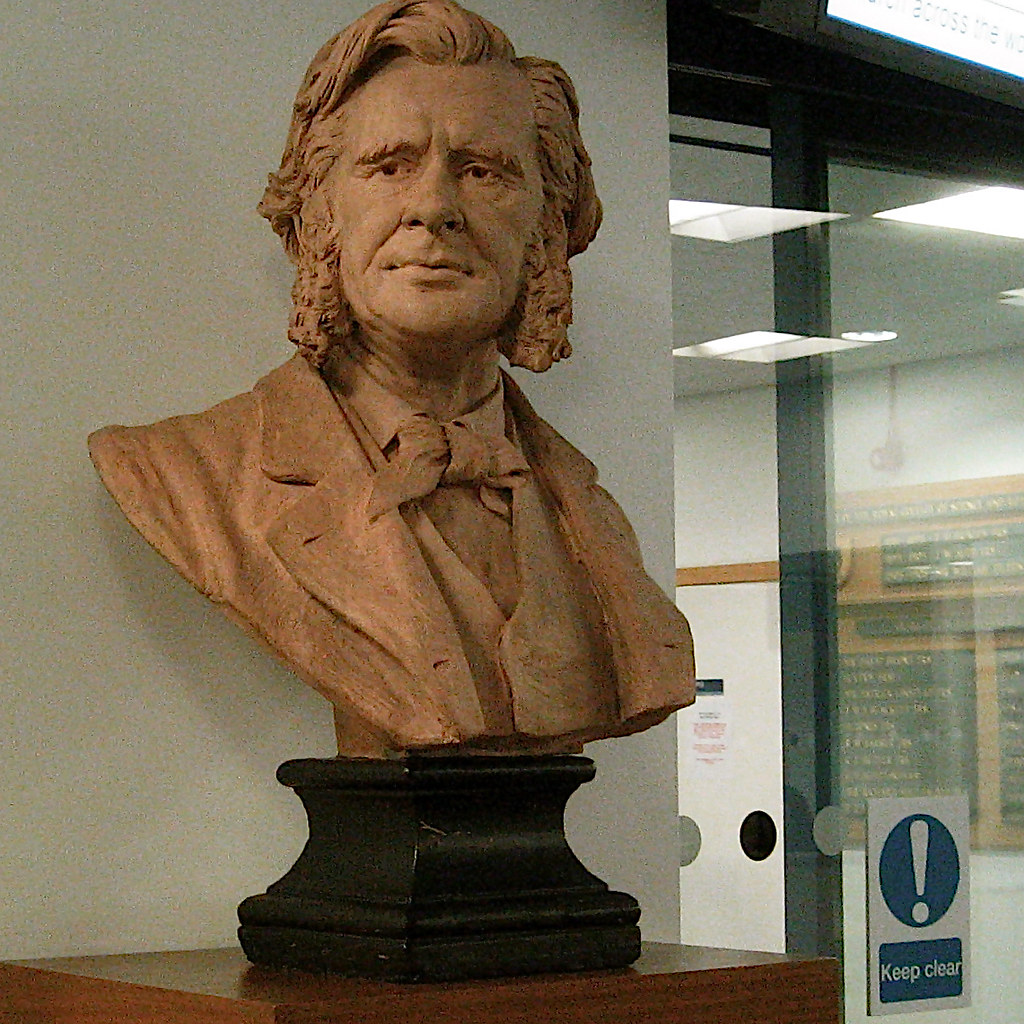
Thomas Henry Huxley – keep clear?

I have long been an admirer of Malik’s newspapers columns and books. His rigorous and thoughtful analyses of the questions thrown up by identity politics are almost unparalleled in the mainstream media and his superb book, The Quest for a Moral Compass, is one that I turn to regularly when thinking about equality. So, it is uncomfortable to find myself somewhat out of alignment with him on the Huxley question.

But I think I can illuminate the gulf between us and venture to suggest that is may not be as wide as it first appears. I should start by declaring my hand: although I am writing here in a personal capacity, I am presently the Assistant Provost for Equality, Diversity and Inclusion at Imperial College and served as an advisor to the history group alongside a diverse range of colleagues and a couple of historians who are external to the university. I have worked at Imperial College for over twenty-five years, several of which were spent in an office in the Huxley building without giving the great man a great deal of thought.

Malik raises important challenges for Imperial in his article. He cites Nancy Fraser’s warning that too often “cultural recognition displaces socio-economic redistribution as the remedy for injustice and the goal of political struggle” and goes on to ask “in what way would removing Huxley’s bust and renaming the hall improve the lives of minority students at Imperial College?”

That’s a fair question. The answer comes in part from Fraser herself. Addressing her own warning, she writes: “we should see ourselves as presented with a new intellectual and practical task: that of developing a critical theory of recognition, one which identifies and defends only those versions of the cultural politics of difference that can be coherently combined with the social politics of equality.” In essence, if I have understood correctly, Fraser is arguing that the cultural and practical impacts of inequality must be addressed together and this is the approach that, in my view, Imperial is striving to achieve. Malik has overlooked the fact that the history group report is part of a broader effort at the university to identify and dismantle barriers to race equality. This includes ambitious targets to address the under-representation of Black undergraduate students at Imperial, which supported by substantial financial investment, and serious commitments to a slew of practical and cultural actions in support for ethnic minority staff and students (e.g. on recruitment, career progression, curriculum development) that have been developed using the Race Equality Charter (REC) framework.

The REC action plan has been worked up through lengthy and wide-ranging discussions with our community and the leadership team. These will now continue as staff, students and alumni enter into a period of dialogue on the recommendations of the history report, which will inform the College’s final decision. Together these strands of work have given the university a clearer view than ever before of the race inequalities that persist at Imperial, but it has also helped to raise awareness of the issues of race and racism right across the organisation. Ultimately, the university should be judged on the success of the actions taken to build a truly inclusive environment for staff and students.

For now, much of the discussion remains centred on Huxley, whose case raises the thorny matter of how figures from the past should be judged by modern standards. Malik rightly highlights Huxley’s scientific standing and his progressivism on many issues: he was a proponent of women’s education and avowedly anti-slavery. He revelled in taunting the white supremacists of his day even if he clearly believed in their racial superiority: “no rational man, cognisant of the facts, believes that the average negro is the equal, still less the superior, of the average white man. […] The highest places in the hierarchy of civilisation will assuredly not be within the reach of our dusky cousins.”

In Malik’s view, the recommendation to rename the Huxley building because such views “fall far short of Imperial’s modern values” is to damn Huxley “primarily as a racist”, “to warp both the past and the present” and to “abandon historical evaluation for a crude mode of moral judgement.” Respectfully, I would like to challenge that assessment.

To remove a name from a building is not to damn someone. We will remember Huxley; he is an inextricable and ineradicable part of our history. It’s just that his part in our history is more complex and has troubling resonances with members of our minority communities than we had previously appreciated – and I think we must address that. For what it’s worth, I would favour keeping the bust of Huxley within the building but in a glass case as part of a display that discusses his history and a narrative accompanying the renamed building, should that be what the College eventually decides to do.

I agree with Malik on all the difficulties that attend the evaluation of figures from history by today’s standards. But we should not discount the power of their reach into the present. Huxley is a figure I have long admired – I have even described him in a public lecture as one of my scientific heroes. I came across his views on race years ago when I read Adrian Desmond’s magnificent biography, but what strikes me now, after listening to Black colleagues and students talking about how Imperial’s honouring of Huxley impacts their sense of belonging to the university, is how little I was struck by them at the time. My Black colleagues’ views on history are inflected with the power of experience and need to be heard. As one put it pithily in questioning the argument that Huxley’s views on race cannot be judged by 21st Century standards because they were commonplace in Victorian Britain, “it does not mean they were correct (and they were certainly never correct in the minds of those who suffered because of them at the time)”.  For white men like myself and for institutions like Imperial, an honest confrontation with history must entail a letting go of power, a greater responsiveness to the legacies of European racism, and a willingness to tackle its enduring cultural and economic effects.

The aim of the university must be to present a more complete picture of its history to everyone in our community. The controversy over the proposal to rename the building has had the happy effect – thanks in part to Kenan Malik – of raising the matter for discussion in the public domain and drawing attention to aspects of Huxley’s history that have been overlooked. But no one is being cancelled here, however difficult the ongoing process of grappling with the past. Our conversation with history has sprung to new, argumentative life and this is exactly the sort of free and critical enquiry that universities were created for.

Posted in History of Science | Comments Off on The Huxley Question

Skills, FE and Levelling Up

As we await various key Government papers – specifically the long-awaited response to the Augar Report and the Levelling Up White paper – the news is full of labour shortages. Whereas delivering some of Augar’s recommendations about funding for FE Colleges may not do much for the number of HGV drivers on the road, it may make a difference in the medium term to some of the smaller companies that sit somewhere on the low productivity tail. Much is frequently made of the contribution of high tech IT developments to the economy; the discussion of the future of ARM is not unimportant here. Nevertheless, the significance of employees in much lower tech companies who need to have the skills and confidence to use a spreadsheet to facilitate ‘just in time’ logistics, or to update costings if they have to raise pay for employees due to the loss of EU workers, is no small matter. This is where ensuring that FE Colleges are funded well enough to deliver that level of skill to a wider swathe of the population is so important. And, alongside that, that as the Lifelong Learning Loan Entitlement comes into play (unfortunately not till 2025), workers will have the financial means, if not security, necessary to return to education to gain the skills they need which either may not have been available to them when they were 16, or been obvious to them then that they would be useful.

The evidence that increased R+D intensity drives up economic prosperity and GDP seems broadly accepted now, as well as that that public sector funding crowds in private sector investment. Thus, the increase in money in the budget for research and innovation funding is a huge positive. Much of this money will provide a welcome fillip to the university sector, where there will be many people ready to take advantage of it. Backing up the researchers will be a team of technicians, whose input is often crucial in sustaining and delivering a project, particularly when they provide long-term stability and knowhow as research students and postdocs come and go. However, their own career progression is often forgotten, an issue the current TALENT Commission is examining in depth (a project I am pleased to be associated with), along with a survey of their experiences, with a report due to be published in the New Year.

But what about technical support in industry, broadly defined. By which I mean, industry not just in high tech areas, but other areas such as more basic manufacturing, logistics or public health-related, for instance? This is where upskilling the workforce comes into play as being a vital component. Here I would include IT skills as part of this technical support, not so much as a stand-alone component, but as a necessary contributor to overall skills. If you are entering data, let alone analysing it, these skills are vital.

A Royal Society report from earlier this year highlighted a worrying trend of this part of the workforce ageing and not being replaced by youngsters entering the pipeline. Choices children make at 14 or 16 probably play into this, and they are not necessarily getting access to good careers advice to help them make those choices. But, additionally, they may not find the courses they need to put their aspirations into action if the local FE College is unable to provide them. This comes right back to what is going to be delivered – not least in terms of funding – and to whom, when the Augar response is finally published.

The Skills for Jobs White Paper, published at the start of the year, suggests the Government is aware of the issues, with excellent overarching goals, of which three are particular pertinent to my arguments here:

  • Investing in higher-level technical qualifications that provide a valuable alternative to a university degree;
  • Making sure people can access training and learning flexibly throughout their lives and are well-informed about what is on offer through great careers support; and
  • Supporting excellent teaching in further education.

As the second of these bullet points shows, it is most certainly not just for school-leavers that thought must be given. The decline in opportunities for adults to upskill or reskill is an indictment of our society. The introduction of (initially) £9000 fees for university courses has had a massive impact on part-time adult learners at universities. The position over ELQs (Equivalent or Lower-level Qualifications), making it impossible to retrain if you already have a qualification at or above the level you are wanting to retrain at, has recently come back into sharp focus with recent comments by Chris Skidmore and Jo Johnson, both former HE Ministers, both calling for a rethink on this and associated entitlement to loans.

However, rhetoric and practice may be two very different things in this space and, despite the warm and encouraging noises, policy isn’t fixing the problems yet. The threat to defund BTECs, deferred but not removed, in favour of T Levels remains a concern when considering the education of those whose tastes may lie in less academic subjects. (BTECs have a good track record of facilitating entry to university for those who haven’t taken A Levels.) However good the concept of T Levels may be, it would seem that not enough thought has been put into how courses are going to provide the obligatory 45 days of placements in industry for each student. If this is the only route to qualifications post-16 other than A Levels, that’s a huge number of placements required and no guarantee of successfully finding them. By killing off BTECs, at speed, without resolving this issue, it is hard to see these vocational routes will succeed in their stated aims.

So we are in a position where there appears to be lots of good intent but without the wherewithal to achieve them. I would identify four issues in particular where words and action don’t completely align:

  1. Plans to offer loans to adults wanting to upskill, but who may have severe and utterly understandable reservations about taking on the requisite level of debt imposed by such loans;
  2. ‘Great career advice’ at every stage should be a no-brainer, but it is something that has not shown much sign of appearing and would need substantial additional funding;
  3. New vocational training routes, that require plenty of on-the-job training, but no guarantee the placements can be found;
  4. Nobody could object to the idea of ‘Excellent teaching in FE’, but without a response to Augar about funding this is unlikely to be able to materialise.

Levelling up touches all of this because, where the jobs are, where the people with the right skills are, and where the FE Colleges to deliver are may be non-intersecting sets and, without appropriate joining up of these key dots improved regional economies are unlikely to be transformed in the way that levelling up might be taken to mean by local populations. The stagnation of the UK’s productivity since the financial crash of 2008 is well-documented and undoubtedly has had a major impact on the reality of lives lived in ‘left behind’ regions. Investment in research and innovation is a crucial part of national recovery and regeneration, but money alone without people with the right skills is not sufficient. Current thinking about how lifelong learning will be delivered in ways that can actually make a difference still seems to be a bit foggy. One can only hope the Augar response and the Levelling Up White Paper finally part the clouds.


Posted in Augar Review, BTECs, careers, education, productivity, Science Funding, T Levels, technicians | Comments Off on Skills, FE and Levelling Up

Corner Office

64987420886__BCEEB7A9-270E-451E-8587-184756375535

As a child, one of the most humiliating punishments at (elementary) school was being banished “to the corner” for bad behavior. Something to be avoided at all costs. But as an adult, I have learned that there are advantages to being in “the corner.”

For nearly 18 years I have spent large portions of my working day toiling behind a screen (or two or three) in a “compact” (mind the euphemism) office. I had no complaints, being housed in a modern building that was completed in 2004, with a large, well-furnished lab, I was perfectly happy to retreat to my office-closet. I had my kettle, coffee and tea, emergency snack food, an oversized desk and a bookshelf, with little room for anything else. Given that I purchased a “convertible standing desk” (https://www.vari.com/standing-desk-converter-varidesk-tall-40/DC-TL40.html) a few years back, meetings with colleagues or visiting researchers (remember those?) were inevitably uncomfortable, and more than one visitor required the securing of a conference room for a meeting. Such meetings, including with my own students, were always complicated, with technical difficulties in looking at data, whether on my computer screen or on paper.

64987419360__0E42F13A-E897-4D2C-B773-1140FC620BE9

As if to compensate for the tiny size of my 7thfloor office, I was blessed with huge floor to ceiling glass windows. Nice? Sort of…. The windows faced full west, and even with the blinds permanently closed, the glare often necessitated wearing sunglasses while working at the computer in the afternoons. If that wasn’t bad enough, my view west (in the rare instances when the blinds were open) included: several parking lots, an electrical power station, a smelting factory from WWII that just recently closed, and a large cemetery on the other side of a very run-down industrial road known as “Saddle Creek.” However, we scientists don’t like to complain, and if we have a lab and research resources ($), then who cares about such trivial matters?

64987414911__37135D92-E095-429F-89BA-75B514A8E240

However, this summer I was offered the opportunity to move to a corner office at the other end of the hallway and I readily accepted. Unlike all the other offices, this one is different—it is much larger, with space for a nice desk for my co-investigator, as well as a round table for meetings with colleagues and students, and the ability to swivel my screen around to look at data from the table with students. No less significant than the extra room is the northern exposure—meaning that I get natural light all day from the many, large windows facing several angles, without having to close the blinds. Even better is the view, which looking north avoids the power plant, graveyard and factories (although there is a car wash), and I can even see two of Omaha’s iconic sites: the Joslyn Castle and St. Cecilia’s Cathedral.

50708629-4D4E-471A-8390-C1F0FEED3760

Whether the new corner office improves my productivity or leads to more exciting scientific advances, I am doubtful. But given that I spend so much time in the office, I am very appreciative of my new surroundings, and certainly no longer dread being banished to the corner. Although, I guess it does mean that I’m getting old…

Posted in Research, science | Comments Off on Corner Office

Week

What an ericacious exhausting sackbut amazing week.

It started last Saturday morning when I discovered that I was being followed by the Literary Editor of the Times.  Followed, in the sense of Twitter. At least, I don’t think the Literary Editor of the Times really was following me, you know, in person, with a raincoat and binoculars, notwithstanding inasmuch as which the Present Emergency and so on and so forth, though of course he might have been, but if he was, he’d very good at it, because I didn’t notice.

Perhaps, though, this was a signal. So alerted, Mrs Gee and I bought a copy of the Times on our regular weekend supermarket trip, just in case we were approached by a stranger who sat down next to us on a park bench and said something innocuous like ‘The tulips bloom early in Vienna this spring’. Actually, it’s only Mrs Gee who ventures into the supermarket. I sit in the car, in the car park. After all, someone has to do the stake-out.

Mrs Gee came out, with the usual groceries — atonal apples, amplified heat,  and so on — and a copy of the Times. When we got home we found that my latest book had attracted not just a book review, but the lead book review, noch, and a splendid one it was too. You can read it here.

The effect had a salutary effect on sales. The book had been published in the UK in September. Reviews were sparse but  generally good. There was a lovely one in the Literary Review, a magazine for which I have a particular fondness, though its appeal is, as you’d expect, limited to people like me who simply can’t get enough of books.  Following that, the Amazon UK ranking crept up to the low thousands. Although my publisher tells me that the algorithms Amazon uses are mysterious, this had to count for something.

The Times review gave sales a huge boost. Amazon rankings shot up well into the top 200 of all books – up with colouring books, celebrity autobiographies, books for children, and editions of novels by Sally Rooney in Hebrew. At one stage, I was told, the rank was above 120, though the highest I saw was 134.

In specific categories, such as ‘palaeontology’ and ‘dinosaurs’, it reached number one and stayed there for some days (see the picture). The hardcover edition was most popular, but the audiobook and kindle versions came up to approached got close.

And, quite unlike any other book I have ever written, it really was available in the canonical All Good Bookshops.

The Amazon rankings subsided over the following days, although very slowly, and as I write it’s still in the top 1000. By the end of the week normal service should be resumed and I shall return to the comforting obscurity to which I have long been accustomed.

People ask me about the paperback. (Well, one person did, take a bow, Mr. G. O. of Norfolk). There is what’s known as a ‘trade’ paperback, available from foreign markets that are less receptive to hardbacks. The UK ‘mass market’ paperback should be out in autumn 2022.

But, hey, things have hardly got started. Editions are already out in German and Dutch, and on 9 November it’ll be published in the US & Canada. …

In preparation I’ve been a guest on a lot of podcasts that’ll be broadcast nearer the time (I already have a podcast series of my own that you can hear now).

Posted in a very short history of life on earth, Literary Review, times, Writing & Reading | Comments Off on Week

Vaccines, Emotion and the Status of Women

I’ve been catching up with some reading this weekend: a year’s worth of (hard copy) THE issues, picked up now I’m finally able to get back into my department, and Vaxxers – sub-titled The Inside Story of the Oxford Astrazeneca vaccine and the Race against the Virus. These cover the same period, but from rather different viewpoints. Take the period April-June in the THE articles, so many focussing on Covid-related topics: the rapid adoption of online teaching, the ‘Zoomiverse’, the dawning appreciation of the potential damage to careers, particularly for early career researchers and those with caring responsibilities, plus the likelihood that a researcher’s productivity will plummet and the need to be kind to oneself and others when this happens.

With hindsight, perhaps we were too optimistic that this situation wouldn’t last long and that within a few weeks, which then stretched into months, all would return to normal. Of course, it hasn’t. To different degrees around the world, life is still strange, worrying and, for many, Covid-related health issues remain. Carers’ lives are still upended and the lasting impact on careers unclear (but unlikely to be positive). Although for a lot of us, by this point some meetings are now held in person, many are still not conducted remotely. What ‘normal’ will eventually look like is not yet clear.

But long before Covid hit the UK, the Oxford vaccine team were already moving into top gear, as soon as stories of a strange illness began to surface in Wuhan. Sarah Gilbert – the one who has a Barbie doll in her likeness – and Churchill College alumna Cath Green, had read the China tea leaves and realised it was time to direct their existing vaccine platform to target this specific virus to give themselves – and the world – a head start in developing tools to weaken (though not yet neutralise) the virus’ impact. While most of us were adapting to working from home, this pair and their teams were flat out in their labs, working out all the necessary steps to produce the vaccine in record time. As the recipient of two doses of the Astra Zeneca vaccine, I can only be immensely grateful for their dedication, intellectual prowess, a firm grip on logistics of an incredibly complex chain of steps plus their ultimate achievements.

Their book is a gripping account, not just of these steps in some detail, explained in simple terms for the non-experts in their field, but also the emotional roller coaster of their work, the sleepless nights and the nerve-wracking interactions with the media as well as funders (there was no guarantee of success; funders are risk-averse and not used to working at the speed this situation demanded, but the money did come through). This all had to be followed by the anxious wait to see if the vaccine succeeded in Phase 3 trials (which, as we now know, it did). Scientists rarely speak up about some of these issues that can lurk under the public face of their work or the written word of journal publications. Rarely do they have such an intense media spotlight shone on them, week after week, as this pair did. Nor are the stakes often quite so high. It will be interesting to see if the BioNTech scientists, with their alternative route for successful vaccine development, choose to write their own story to complement Vaxxers.

As two immensely successful female scientists, I am also interested in what they have to say about the subject of emotional content. Their family lives intrude to some extent (both Green and Gilbert are parents, the latter of triplets, although none of their children are toddlers constantly interrupting zoom calls or needing much help with home schooling), so the huge problems many mothers have had to face while working from home did not beset them. Nevertheless, making time for family in the midst of handling the massive task they faced was by no means trivial. But it is more the commentary on the simple fact that they are female that intrigues me, inserted in passing in their wider narrative. Most of what I learned came from Green referring to Gilbert (they each wrote their own chapters from their own perspectives, more or less alternately throughout the book) rather than a first-hand account by the latter. Maybe this was a deliberate strategy.

For instance, Green quotes Gilbert as saying ‘something like’

“This is 2020. Why are we discussing women scientists? I’m not a woman scientist, I’m a scientist and more than half my colleagues are women and we do the job.”

The frustration at being seen as a woman first and a scientist second is palpable. That feeling will resonate with many, myself included. I have written previously about how the media referred to Dorothy Hodgkin when she won the Nobel Prize (“Oxford housewife wins Nobel“, according to the Daily Mail of the day.) Similar sorts of out-of-date comments were, perhaps unsurprisingly and as quoted by Green, used in describing members of the team: serious redhead mother to triplets (describing Gilbert), not your stereotypical Oxford boffin (Green) and Irish mother of two for Teresa (Tess) Lambe, a third team member. As Green remarks wryly, one of the men on the team has ‘never been described as ‘male scientist Andy Pollard’ nor, presumably, has his parental status been laid bare in the media.

Nevertheless, the balancing act between being annoyed by the gender issue or motherhood constantly being raised and using the opportunity to excite and inspire future generations of young women by being a visible role model is a delicate one. Not many scientists get to feature in Vogue (nor is it likely to have been an aspiration to do so for many).  A decade ago an article in The Lancet stated that

‘It’s impossible to be 100% sure, but Molly Stevens is in all likelihood the only person ever to have graced the hallowed pages of both The Lancet and Vogue.’

Whether or not that was true in 2012, Sarah Gilbert has undoubtedly joined her in appearing in that rare pairing of journals. As Green writes in Vaxxers

‘One of the more surreal moments of this year was Sarah’s high fashion photoshoot in the basement of the Jenner Institute. Sarah had already been to a London studio for a shoot for Vogue’s ’25 Women Shaping 2020’ earlier in the year. She said she thought it would be fun [we don’t get told if it was!] and not something she was likely to be asked to do ever again. But not long after Vogue she was approached by Harper’s Bazaar…she describes their shoot…. as ‘all slightly ridiculous’.’

Nevertheless, as Green makes clear, her view is that this is important and not ridiculous. Again, this resonates with me. When I won the L’Oreal/UNESCO 2009 Laureate for Europe for Women in Science I endured numerous photoshoots and interviews. I never actually saw, I’m relieved to say, the huge blown-up photographs of me that were plastered both on the side of L’Oreal’s Hammersmith headquarters or in Charles de Gaulle Airport, though I have a copy of the issue of Le Monde which had a full page devoted to my photo. However disconcerting for the individual, these photos convey an important message for the casual passer-by. Women do do science. Everyone should feel confident encouraging their daughters and other young women of their acquaintance to pursue science if that is their passion. If girls don’t see the faces of women scientists in their textbooks (and they don’t, as a recent American Chemical Society report made clear), they need to see them elsewhere in their daily lives. However uncomfortable I felt then, as Molly Stevens may have felt appearing in the pages of Vogue and presumably Gilbert did this year in all the publicity, it isn’t a bad – let alone vain – thing to do. It is, unfortunately, still necessary.

2020 was a weird year, as both Vaxxers and all those back issues of the THE make clear. Women do science, they do it at the top of the game, and yet too many are held back by caring responsibilities, by attitudes and by unconscious bias still operating. 2021 is little better as a year, but the battles must continue to ensure both that excellent science gets done and that the opportunity to do so is open to all.

Posted in Cath Green, Communicating Science, families, Sarah Gilbert, vaccination, Vaxxers, Women in science | Comments Off on Vaccines, Emotion and the Status of Women