Latest posts

Have We Had Enough of Experts?

Recently, my Cambridge colleagues Diane Coyle and Michael Kenny from the Bennett School of Public Policy took to the pages of Nature to write a cautionary Comment about the role of science and scientists in public policy. They are critical of those scientists who don’t pay attention to how to interact with policy-makers effectively, as opposed to simply baldly stating their views, data and/or evidence. Scientists must recognize, they say,

‘that the importance of science is not self-evident, and that part of the blame for the erosion of trust in science lies with scientists themselves.’

They go on to say:

‘In public policy, solutions to the problems society faces are rarely, if ever, purely technical. People’s values and interests often conflict, and scientific studies do not always provide direct answers to the questions that politicians and officials must grapple with, such as how to reduce crime rates or respond to a disease outbreak.’

There is nothing like working with policy-makers to ram this message home. As the saying goes ‘scientists advise and policy-makers decide’. Chairing science advisory committees, previously for DCMS and now for the Department for Education, clearly demonstrates to me any evidence that a scientist can bring to the table, however useful, correct and possibly even self-evident, can only inform. Many other factors, from ministerial direction to electoral acceptance, not to mention the fundamental issue of money, will need to be taken into account before any decision is made. But if we want the community of scientists to appreciate this, what action – other than writing in Nature – should be taken? If you are a PhD student, you may well be led to believe your thesis, all those results and the paper(s) you submit (and even see published) are the end of the story. In policy terms, that is not so.

Diane and Mike write of ‘science’ in the broadest sense (covered much more effectively by the German word Wissenschaft, as opposed to Naturwissenschaft; English does not have such a neat distinction), and I can really only talk as a ‘hard’ scientist, a natural philosopher if you like, not a social scientist, or indeed an engineer. But, although the details may vary, the basic issue is the same. Where, in training the scientists of tomorrow, do we introduce the idea that pure fact will not be sufficient to drive a policy. As it happens, a conversation with the head of Cambridge’s Institute for Manufacturing, Tim Minshall (he of the wonderful book, Your Life  is Manufactured), made very much the same point in a different context: the need to ensure a PhD thesis (from his field) considers not just the evidence, but  what impact it can and will have on (e.g) supply chains, scale-up or necessary skills.

In my field, the last chapter of a thesis is, typically, ‘suggestions for further work’. That covers no more than all those things the student might have wanted to do had they had another year or two of funding or the equipment had worked better, or indeed they had access to some other equipment. It would not typically address why the results had any bearing on our lives, potential government policy or saving money in production of some material. In my field, we don’t usually teach that stuff, but perhaps we should.

Turning briefly to a younger age group, the recent schools’ Curriculum and Assessment Review, with its mantra of ‘evolution not revolution’ remains wedded to standard assessments that focus on disciplinary facts, but does acknowledge there are other topics that need to be addressed, if not examined, within schools. One of these is climate change and sustainability – which one hopes has to cross disciplinary boundaries in the teaching – but a lot of material is to be crammed into (non-examinable) lessons in Citizenship and RSHE (Relationships and Sex Education, where issues around misogyny and toxic masculinity are likely to be touched upon, although I’ve already heard from some this is unlikely to be particularly productive).

In other words, in schools, some social issues will be taught but outside the main examinable curriculum, unless subject teachers find a way to bring them in. Should our university science departments be doing more of the same? It is obvious many, if not all, universities are running around trying to work out how to handle AI education and AI in education and assessment. But does every student get formally exposed to discussions around sustainability, for instance? I’m not sure they do. We don’t expect our students to be au fait with the environmental  challenges of extracting enough lithium from under the earth’s surface (be it from the Atacama Desert or China, which provoke different ecological issues) for the batteries we want for the energy transition, or to worry about the supply of rare-earth metals needed for our phones coming from fragile African states. As a physical scientist, all that is likely to be taught is how these components work.

Too often, we only teach facts that can be examined, not the issues that underlie those facts. We are unlikely to teach students to think about how to weigh up the pros and cons of the environmental plusses of moving towards a green economy reducing carbon emissions compared with the damage mining may do to a region. I’m aware many people reading this may think, well my department does, or that there is a specific ‘green energy’ module, but I fear too few actually discuss this wider context. Yet this is the context in which policy makers live, in which they have to weigh up pros and cons of any decision. These specific examples obviously come from the physical sciences, but one could raise the same sorts of questions in the life sciences.

Diane and Mike consider the impact of the growing polarisation of our society due to increasing inequality, the crude distinction between the haves and have-nots. They question whether the decisions – indeed the evidence – that ‘elite’ scientists seek and produce is, in itself, influenced by their status and not relevant to the more disadvantaged and that they may not listen to their views. That what counts as ‘evidence’ may need to be broadened to factor in what people know but which cannot easily be measured and quantified as well as their ‘tacit knowledge’. This is not a new idea (for instance, to give an early example, Brian Wynne has written a lot about this in the context of sheep farmers and the after effects of the Chernobyl disaster), but it is sadly easy to forget in many situations, although it won’t apply in all.

If we, as scientists, want our work to have impact in the way our society operates – be it about the mass take-up of vaccinations or achieving a just green energy transition – we all have work to do to think harder about how we communicate and contextualise what we do, and indeed which questions we ask. Every field will have different challenges in achieving this and it is not to say ‘pure’ curiosity driven research has no place. In our teaching, in our communications to the public (as opposed to within our own communities) we should remember the plea from Coyle and Kenney. We can each do our own bit to remind the wider world they really haven’t had enough of experts.

Posted in Bennett Institute for Public Policy, Communicating Science, Diane Coyle, education, Michael Kenny, Policy, Science Culture, Tim Minshall | Comments Off on Have We Had Enough of Experts?

Practice and Experience

It seems appropriate in this 250th anniversary year of Jane Austen’s birth to use a quote from Pride and Prejudice to kickstart this post. ‘If I had ever learnt, I should have been a great proficient.’ says Lady Catherine de Bourgh. The idea that one is naturally talented and would have been brilliant if only one had put in the time is a very attractive one. The idea that, if one started learning something, great things would have transpired; yes we can all see the attraction of that. But nothing happens without effort and, although – in the case of music that Lady Catherine was referring to – some of us may have larger hands or longer fingers making certain chords easier than for the average member of the public – the reality is, one will never be proficient let alone brilliant without putting in the hours.

I am rediscovering the tedium of practice as I attempt to pick up my piano playing 50+ years after I last had a lesson. And, as I only had lessons for two or three years, I was never much good anyhow. However, it is part of trying to rediscover the things that used to give me joy before science completely took over my life. I’ve written before about the piano I originally learned on, which is now far away so my granddaughters can learn to play on it. Currently I’m renting an e-piano to see if my elderly limbs can cope with the stretches required to play octaves and so on, given I’ve had problems with one of my wrists since teenage years.

However, the point of this post, is not to wax lyrical about musical recreation, but to remember that nothing comes easily. I’ve never forgotten the moment I realised that, just because I had a first-class degree from Cambridge, it didn’t actually mean I knew very much about Physics at all. It is easy to think that passing an exam or ticking off some other milestone means you’re transformed from novice to expert in a moment. Life – and knowledge – sadly does not work like that. Nothing can be accomplished without putting in the hours, and you never know whether the challenge is one that you are mentally or physically capable of mastering until you try. Think of all the aspiring ballet dancers who, regardless of talent, were turned away from a career because they were too tall or heavy; they were not ‘suited’. But we all have brains or bodies that work better in some directions than others. Why I could never remember the basic facts, let alone the intricacies of NMR and MRI, I never fathomed. But despite reading the topic up multiple times (I seemed to be asked to examine an inordinate number of PhD theses involving the technique), the facts always failed to stick. No doubt something fundamental in my brain wiring, or perhaps merely a lack of real application.

However, being an expert takes multiple forms. I worry that, when it comes to our schools, we are still cramming our children with facts – because these are the easiest to test in, say, a GCSE – rather than teaching them how to use the facts in unfamiliar situations, which will largely be what the world of work for them requires. We know children will have easy access to ‘facts’ (as well as misinformation) on the web, and be likely to use LLMs, whether or not they have a good sense of how to get the most out of them and spot a hallucination when they see it. The Royal Society wants to see a very different emphasis on mathematical, digital and data education in our schools – for all, not just for those who wish to pursue a more formal route into computing or mathematics – and to help students with AI literacy, again for all students. The skills the next generation need are not simply about memorising facts, and both what is taught and how it is examined need to be kept up to date. The recent Curriculum and Assessment Review had surprisingly little to say about the actual assessments themselves, so we are likely to see little transformation from what strikes me as the Victorian ideal of knowing and testing facts, to using them wisely.

Knowing how to approach problems, where to go for the necessary facts – even knowing which are the necessary facts – are a crucial part of solving anything, but remembering their details may not be the important thing. Knowing which questions to ask, without necessarily being particularly expert in a field, is a great skill. I expect most of us have encountered the professor (I knew at least a couple) who would appear to snooze through a seminar and then ask the killer question. Often prefaced with the humble ‘I may have missed this’ or ‘perhaps I misunderstood’, but usually leaving the speaker looking a bit foolish. Maybe there was an implicit assumption lurking underneath the analysis that the professor has spotted. Maybe they see an analogy with another field where they are expert and feel that the speaker has missed a trick by not looking there for understanding. Knowing what questions to ask is a skill every bit as important as knowing the facts that can easily be tracked down. Do we teach our students – of whatever age – enough about this? Are we moving on from regurgitating facts to knowing how to use and manipulate data?

As a scientist I believe I am capable of critical thinking, which this is one aspect of, as well as be creative, both skills the arts and humanities folk sometimes seem to want to claim as if they are a race apart from scientists. We all need these skills, although obviously creativity may manifest itself in different ways across the disciplines. Memorising and reproducing the second law of thermodynamics (to replicate CP Snow’s arguments) or knowing how to use Excel can indeed be demonstrated by a simple and easily marked test. But mastering more subtle skills of expertise, for instance to carry out analysis in an unfamiliar situation, is more challenging. Like a musical instrument, it takes time, practice and experience.

Posted in critical thinking, Curriculum and Assessment Review, education, Jane Austen, Science Culture | Comments Off on Practice and Experience

Paranoid Android

I hate AI (or to be exact, LLMs).

There, I said it.

In the day job, that’s not really something I’m allowed to say. It’s supposed to be making our tasks quicker (it doesn’t), and our deliverables more accurate (it really doesn’t).

But even if it were to do those things, and to my satisfaction—and truth be told, in future it might—I’d still hate it.

A carpenter will use a hammer, or a saw, or a Hoffmann MU3 Manual Dovetail Routing Machine, but the carpenter will still be the creator. He (or she) will still be the artist, and you will pay him (or her) for their vision and execution.

Writing in general (or designing or concepting a booth or forming a strategy or translating an NEJM paper into understandable slides), and Medical Communication specifically, may, in time, be something that a machine might be able to do more quickly, more accurately and more compliantly than my colleagues could ever do.

But what would be the point?

What would be the point?

My day job is about human-to-human communication. So is my hobby. And if I don’t feel that I am making that human contact—even if it is to sell a drug—then I ask again, what is the point?

I may as well get a machine to read a book for me. Or write a poem for me. Or cook dinner for my family. Or drink a glass of wine for me.

Oh it’s just a tool, they say. Look how cars made horses redundant. Look at the Hoffmann MU3 Manual Dovetail Routing Machine.

Yes, a tool. But not one that takes away something at the core of your soul—your ability to create.

(And don’t even get me started on thinking.)

So I want to promise you that nothing I write on this blog, nor any of my poems, nor my books if I ever fucking finish writing one, and not even my professional output will be created by an LLM.

Fitter? Maybe. Happier? Maybe.

More productive?

Fuck that.


Posted in AI, Ethics, Ill-considered rants, LLM, Me, med comms, wibbling, work, Writing | Comments Off on Paranoid Android

What Voice?

It is more than 40 years since the American psychologist Carol Gilligan wrote her book, In a Different Voice, challenging the view that women were morally less developed than men, pointing out this difference arose because the schema had been developed from studies on (white) males. According to Gilligan’s analysis, women are more centred around caring whereas men prioritise justice. It has been criticised as reinforcing stereotypes and treating ‘women’ (and ‘men’) as homogeneous, regardless of other characteristics such as ethnicity, age or socio-economic status. It also begs the question – present in so many of these debates around gender issues – of whether there is an innate biological difference or simply the way we bring up our children that creates this difference. It is the nature versus nurture debate once more.

When I first read it, maybe 15 years ago, the book certainly resonated with me in terms of how I viewed my life and my place in it. It isn’t clear to me that, in a situation like this, the origin of any difference in the way men and women approach problems (one of Gilligan’s earliest studies was around attitudes to abortion) is relevant. What matters is that, in many situations, women and men may approach or envisage problems differently. In talks I give about women in STEM, I cite the word clouds Let Toys be Toys produced about toys for children. Those toys marketed at boys (specifically 4-8 year olds) stress words like ‘battle’ and ‘power’, whereas girls were directed towards ‘magic’ and ‘glitter’, with ‘beautiful’ being another oft-appearing word thrown in. It is hard to imagine children don’t receive messages from these words, at least at some subliminal level.

Historically, of course, women ‘knew their place’, and in the science community that meant that a rare woman had to tread carefully if she was to be heard and not shunned. Margaret Cavendish, Duchess of Newcastle, eschewed such actions, and therefore got tarred with labels such as Mad Madge, and more comments about her dress, when she visited the Royal Society in 1667, than her thinking (which Samuel Pepys swiftly dismissed: ’nor did I hear her say anything that was worth hearing’) . Caroline Herschel was much more careful, even – or perhaps particularly – when writing to the secretary of the Royal Society to inform him she had discovered a new comet (the first of seven she laid claim to). As she put it

‘In consequence of the Friendship I know to exist between you and my brother I venture to trouble you in his absence with the following imperfect account of a comet..’ ,

a suitably modest way of daring to break into what was then solely a male preserve, and invoking her famous, if absent, brother to demonstrate her credentials. It is a very self-effacing introduction, while equally being forthright about the claim she is making, even without her brother looking over her shoulder.

We may have got beyond the need for women to be quite so modest, but nevertheless most successful women know they always have a fine line to walk between being seen as assertive and aggressive, between bigging oneself up and being seen as a threat to the establishment, primarily male, or coming across as overtly ambitious (not a trait that is seen as attractive in most women). But this difference in approach manifests itself in many ways.

Take Nobel Prize winner Jennifer Doudna writing in the introduction to Venki Ramakrishnan’s 2018 book Gene Machine. This is a book in which he discusses his life and how he succeeded in unravelling the structure of the ribosome, the work for which he won the Nobel Prize, rushing along in order to beat others chasing the same prize. She says ‘the story is one of professional dilemmas, the serendipity of discovery and the deeply human nature of research, in which personalities play a central role.’ These sentences stress the interpersonal challenges everyone faces and the book discusses how they were tackled. In contrast, journalist Roger Highfield is quoted as saying of the book ‘this exhilarating account of the race to understand the molecular machine …..’ conjuring up an image of competition and individualism. Back to battle and power of the boy’s toy’s ads for Roger. Of course, both descriptions are right, but the emphasis is very different between them. Whether their different takes on identically the same book (and person) reflect nature or nurture isn’t the point. The fact is, what they see as the key takeaways are very different. An illustrative single data point to ponder.

I believe a key challenge for our (western) society, in science or other professions, is that the presumption remains that the male norm is the norm. Increasingly backwards-facing attitudes to DEI initiatives will not help this change.  How many young female scientists still feel a need to be understated, if not positively self-effacing, in case the males around them have their egos upset because the women are being ‘unwomanly’? How many of the men notice and try to encourage the women, rather than stamp on them? Clearly, stereotypes being the dangerous things they are, some women will be the ones doing the stamping and some men doing all they can to encourage the women. So, yes, ‘not all men’ believe in the importance of battle and power in our laboratories – or offices, or law chambers or wherever. But nevertheless, quite a few.

The question of ‘what voice’ should a woman use, however, to be most persuasive or most successful remains. Having had a supportive colleague once ask me if I’d thought of having voice coaching lessons to lower my voice (think Maggie Thatcher), in some senses I mean literally ‘what voice’ as well as what words to use. But there is also the of ‘what voice’ in terms of what sits centre stage: it could be a change from an  active to a  passive voice in the narrative, but it could also be a change in the dynamics of the narrative from – as the Doudna/Highfield example shows – one reflecting people to one reflecting power or control. Unfortunately, unless we change the subtle cues children receive from everything (including advertisements, but also all kinds of media) and everyone (parents, teachers and peers) around them, this delicate dance that women often feel obliged to execute will have to continue. It can be very exhausting.

Posted in Carol Gilligan, Caroline Herschel, Gene Machine, Jennifer Doudna, Let Toys be Toys, Roger Highfield, Women in science | Comments Off on What Voice?

What I Read In November

Mick Herron: Real Tigers, Spook Street, London Rules, Joe Country, Slough House, Bad Actors, Clown Town Following on from Slow Horses and Dead Lions (both reviewed last month) these novels — which should be read (or listened to) in that order — follow the misfortunes of the variously damaged and inept spies exiled from MI5 to the sin bin that is Slough House, in the hope that they’ll quit and so won’t be able to claim redundancy pay. The presiding genius is the intellectually brilliant if personally revolting Jackson Lamb who, despite everything, always looks after ‘his Joes’. Although the Slow Horses are meant to be confined to their desks where they are engaged in pointless and Sisyphean tasks, they inevitably get caught up in wider plots and intrigues often involving the opportunist politician Peter Judd and the scheming head girl spy Diana Taverner. The writing has its longueurs but the action makes up for it. The plots are clever but forgettable, but you’ll read this for the characters: the whole sequence (which might yet carry on) is less a series of stand-alone thrillers than a soap opera. People come and go. They die, and are occasionally resurrected. And so the world turns. I’m addicted.

Ron Chernow: Alexander Hamilton I’d read this before but turned to it again after seeing the eponymous stage show by Lin-Manuel Miranda, who read the book and turned it into a musical theatre performance. You might have heard of it. And what a subject! If Alexander Hamilton’s story weren’t true you’d never have believed it: born into penniless illegitimacy in the tropical hellhole that was the slave-worked British West Indies, his early life was so obscure that nobody really knows when he was born (though it was most likely 1757). Misfortune stacked upon misfortune until, impressed by his early literary skills, people passed the hat round to send him to New York for a proper education. Once there he hit the ground running, and if his origins were unpropitious, after landfall he seemed to be in all the right places at all the right times. He fought in the American Revolution, became George Washington’s aide-de-camp, and the first Secretary to the Treasury in the infant United States. A genius for organisational structure and a monumental capacity for work, he defended the US Constitution in The Federalist Papers; created the U. S. Treasury out of nothing, and with financial structures that were way ahead of their time, used debt-financing to turn thirteen bankrupt and fractious colonies into a united, prosperous and powerful nation. At the same time he fell prey to America’s first sex scandal (he was blackmailed after falling headfirst into a honey trap). He made enemies, too — the Civil War, and the polarisation in the United States today, can arguably be traced to the falling-out between the self-made and opinionated Hamilton, who favoured strong central government, and the aristocratic and more reserved Thomas Jefferson, who preferred a more devolved association of independent states. Hamilton was killed in his forties in a duel with longtime political rival Aaron Burr, which meant that, unlike all the other Founding Fathers, he wasn’t allowed to grow old and polish his legacy. But what a life he’d led before that. Chernow’s book is thoroughly researched but as stirring and juicily readable as Miranda’s musical has catchy tunes.

Posted in Writing & Reading | Comments Off on What I Read In November

Botanists in the Family

It is difficult to know where to begin with this post, since several strands have got intertwined. I guess the prompt for this is, as with my last post, the meeting at the Royal Society celebrating women from the past who, whether or not they would have identified themselves as scientists/natural philosophers, certainly got involved with the scientific endeavour and made significant contributions. I did intend to write about Margaret Cavendish, but that will have to wait, as I’ve disappeared down a genealogical rabbit hole. This was prompted by seeing the name Francis Boott on one of the slides, I think certifying some botanical specimen. Francis Boott (1792-1863) was American by birth, a secretary to the Linnean Society, a physician in whose London house the first recorded use of an anaesthetic for a dental procedure was recorded – and (if I’ve got my generations right), my great, great, great grandfather. His mother-in-law was Derby-based Lucy Hardcastle (1771-1834), a botanist of some distinction and acquaintance of Erasmus Darwin (one of my heroes, as a polymath) and, more particularly, his two illegitimate daughters. It is not for nothing that my grandmother’s middle name was the otherwise bizarre choice of Hardcastle.

Lucy Hardcastle befriended Francis Boott when he was on an extended stay in Britain and, after a family disagreement when he went back to the USA, he continued his interactions with her upon his permanent return to this country. In due course he married Lucy’s daughter Mary and they moved to London. Through his introduction, Hardcastle started a correspondence with Sir James Edward Smith, a leading botanist of the day and the founder of the Linnean Society. She did many delicate drawings of plants and in 1830 she published a book about Linnean classification. Whereas her acquaintance Erasmus Darwin wrote a long poem in rhyming couplets on the same theme entitled The Loves of the Plants (1789), when Hardcastle wrote her book she carefully avoided the use of the words male, female and sex, no doubt feeling such words were inappropriate for a woman (particularly one who ran a school for girls), although the sexual parts of the plants were clear in her illustrations. I learned all this and much more from a fairly recent pamphlet about her life, The Rediscovery of Lucy Hardcastle, written by Jonathan and Anne Powers, available through the Derby Museum.[1] This museum holds a number of her drawings and letters. All this I have picked up in the last couple of weeks since the Royal Society event.

Lucy Hardcastle, Capsula, An Introduction to the Elements of the Linnaean System of Botany, for Young Persons, London, 1830, p. 75.

Lucy Hardcastle, An Introduction to the Elements of the Linnaean System of Botany, for Young Persons (London: Thomas Richardson, 1830)., Public domain, via Wikimedia Commons

But then, in trying to work out quite how many generations I needed to go back to get to Lucy Hardcastle, I fell into another rabbit hole concerning another botanical relative, or perhaps more precisely, a well-known Victorian gardener: the Reverend Charles Wolley Dod (1826-1904), who was my great great grandfather and whose son Francis married Lucy Hardcastle’s great granddaughter, Annette Mary Clarke. The genealogy is a nightmare to disentangle because, in the way of Victorian families which ran out of male heirs, surnames got changed along the route, and often the same first names were recycled. My reading is that the Rev Charles was born Charles Hurt, married Mary Wolley who then became Wolley Dod upon the death of the relevant male heirs. The Rev Charles then changed his name formally to Wolley Dod in 1868 and in 1877 acceded to the family estate in Cheshire. Up till then he had been a Master at Eton, but thereafter he could use the gardens around the Hall to experiment and breed new varieties. He interacted with the eminent gardener Gertrude Jekyll who said of him:

‘of all these friendly gardeners, the one whom I felt to be the most valuable was Rev C.  Wolley Dod, scholar, botanist and great English gentleman; an enthusiast for plant life; an experienced gardener; and the kindest of instructors.’

(quoted in Huntia). He is depicted in one of the south nave aisle’s stained glass windows of Liverpool Cathedral.

Coming full circle to the Royal Society event, that same Huntia article says how Ellen Willmott, would stay with the Wolley Dod’s and use the Rev Charles as an advisor. Ellen Willmott (1858-1934) was one of the many women discussed at the Royal Society, covering her role in financing botanical explorations and the importance of the role she played in a widespread network of collectors. She was identified as a central node in such network analysis, with a huge circle of correspondents. She used her family money to employ over one hundred gardeners at her home as well as covering the costs of international teams seeking new plants. Wilmott was able to penetrate the scientific establishment, becoming one of the first women fellows of the Linnean Society.

None of this has any bearing on why I was enthusiastic about science at school. I vaguely knew about the Rev Charles Wolley Dod, because we had a rose in our small garden referred to as the Wolley Dod rose, but he was never described to me as a biologist (after all, he wasn’t one, although he carried out a lot of plant breeding). And, despite my ornithological inclinations I was put off biology at school anyhow by a formidable teacher as much as by the then curriculum. But it is interesting to see these different strands come together, all prompted by attending an event celebrating 80 years since the election of the first women to the Royal Society – and thereafter making extensive use of the web to track down relationships.

[1] For what it’s worth, this pamphlet debunks the story in Desmond King Hele’s life of Erasmus Darwin, where he suggests – based on correspondence between Charles Darwin and Francis Galton – that Lucy Hardcastle (née Swift) was actually a third illegitimate daughter of Erasmus. Sadly, therefore, I must conclude I am no descendant of his!

Posted in Ellen Wilmott, Erasmus Darwin, Francis Boott, Lucy Hardcastle, Women in science | Comments Off on Botanists in the Family

Where Were the Women?

I know that many people feel the Royal Society is a stuffy, white male institution, unwelcoming to women and other minorities, but I cannot agree. It may have had a long history of excluding women, but no more and, in my own personal experience, not over the past couple of decades at least. This year they are celebrating 80 years since the first women – Katherine Lonsdale and Marjory Stevenson – were elected with a series of events. Much more about these women and related events can be found out here. As part of that celebration, I attended a one-day meeting regarding historical perspectives. There will be further events in the coming months, including the unveiling of further portraits of women. For the current celebrations, they have acquired, on loan, the well-known painting of Caroline Herschel. There is no doubt the images around the building favour the male, but less so than when I was elected. Portraits take time to produce (not to mention are expensive), but in the short term there is also an excellent exhibition of photos of current women scientists that has been created for this year’s celebrations.

The meeting celebrated women active in science-related areas over the centuries, starting with Emilie du Châtelet, in a series of vignettes. In my own book Not Just for the Boys (now available in paperback too!), I included some brief accounts of some women from the past, including du Châtelet and Herschel, but I learned about a number of others whose names I’d not come across before this week. I’ve written in the past that, unlike female composers, where more and more from the past are receiving current attention, I didn’t expect many female scientists to emerge from history to claim a place in the scientific record, but perhaps I need to change my views, certainly as regards from the nineteenth century on. I believe in due course the recording of the meeting will be put online, so others can check who these women are.

Mary Wortley Montagu on the mystery of Lady Mary Wortley Montagu’sMy illustration is of Lady Mary Montagu Wortley, with her splendid turban/hat. She spent a decade in (what is now) Turkey when her husband was Ambassador to the Ottoman Empire, and there came across the local habit of inoculation against smallpox. In the harems and Turkish baths frequented only by women, she could see that, unlike herself and so many of her British compatriots, the skins of Turkish women were not scarred from the effects of smallpox. She became convinced of the power of the practice in providing good protection against the disease that killed so many back home (including her brother and nearly herself), and disfigured many more. When she returned to England, she was vocal in support of the practice, and had her own daughter inoculated (her son had been inoculated back in Turkey). For these actions she was much reviled, including by the medical profession.

Although not a scientist in the modern meaning of the word, she had studied how the practice had been carried out in Turkey, not by medics but by more lowly folk. She noted they were careful to introduce only tiny amounts into the patient and then isolate them from others as a mild form of the disease took hold. In contrast, the medical profession in England, even when carrying out an inoculation, believed purging and bleeding were what needed to accompany the incision, not isolation, with predictable results. However, the royal family in due course inoculated their own children, which conferred a degree of respectability on the practice.  By introducing the practice into Western Europe,  she undoubtedly will have saved many lives. It was another 75 years before Edward Jenner came up with the idea of vaccination using cowpox rather than smallpox itself.

Let me single out one other woman from the many discussed:  Eleanor Ormerod (1828-1901). She was a so-called ‘economic entomologist’, in other words someone who studied pests which attacked crops to economic disadvantage. She built up an enormous circle of correspondents, creating what we might these days call a group of citizen scientists. She was much more formally a scientist than Montagu, including being appointed consulting entomologist to the Royal Agricultural Society and lecturer at the Royal Agricultural College in Cirencester. She also had something of a global reputation, winning awards from, for instance, both Russia and France. She became the first woman to be elected to Fellowship of the Meteorological Society in 1878 and the first woman to be awarded an Honorary Degree from the University of Edinburgh (1900), shortly before her death.  Nevertheless, she was very conscious of being largely excluded from the male scientific establishment and hers is not a well-known name. Apparently, Edinburgh’s cloud computing network is known as Eleanor, and I’m wondering how many of their undergraduates – or staff – have any idea why.

The day ended with Stella Butler and myself talking about what has changed since the first women FRS’s were elected in 1945 (three years, as I have to remind myself ruefully, before my own university even got to the point of awarding full degrees to women). Stella has just published a book Breaking the Glass Ceiling of Science, which tells the story of the first eleven women elected. Again, many of their names will not be well known. Most people will have heard of Dorothy Hodgkin, and possibly Kathleen Lonsdale (both, incidentally, very committed to promoting world peace), but are less likely to have come across the names of some of the others (in order of election after the first two in 1945: Agnes Arber [1946]; Mary Cartwright [1947]; Dorothy Hodgkin {1947]; Muriel Robertson [1947]; Sidnie Manton [1948]; Dorothy Needham [1948]; Honor Fell [1952]; Marthe Vogt [1952]; and Rosalind Pitt-Rivers [1954]). A group of women, none of whom were professors at the time of election, and many of whom survived for at least substantial parts of their careers on short-term and precarious contracts.

It is interesting to note that, despite the early nomination in 1902 of Hertha Ayrton to be a fellow, a nomination that was rejected on the grounds of her being married (you can find out more about her in the film that Sarah-Jayne Blakemore and I were involved with as part of the Royal Society’s 350th celebrations), there was a long period after the time the Royal Society had had to accept the legal argument that women were eligible to be elected, when strangely not one was nominated (from 1922 to 1943). You can read the details of how the first women came to be nominated, and how the politics of making sure the existing (male) fellows would accept the election of women came to pass in Stella’s book.

Once women were elected, it wasn’t long before they were serving on the Royal Society’s Council, so it would seem after the momentous step had been taken, they were fully included in the fellowship. As I say, I always found the organisation welcoming. I was struck that after I had remarked on this at the meeting, and how it was noticeably different from my experiences in Cambridge at around the same time, another Fellow came up to me to say how that chimed with her own experience, albeit in another university and more recently. Interestingly, I’ve just been going through a transcript of an oral history I recorded for the AIP (the interview was actually conducted about 18 months ago) in which I talk about this experience. There I stated about this time and how I had found the Royal Society more welcoming and inclusive than Cambridge:

‘I think just because they always treated me as a person, not as a woman. I’m just one of them, as it were, instead of being othered.’

Probably quite a succinct way of expressing the feelings of the years around my election in 1999.

There is much more about the historical aspect of women in science, those connected with the Royal Society and more broadly, as well as the current situation and the work that is now being done by the Society on their website. They may still be way off parity in the fellowship (I think they’ve reached around a third of the fellowship being women), but the numbers have been rising steadily. That’s not to say there isn’t still some negativity towards women lurking in some corners – but that’s true everywhere in our world, and probably getting worse. It’s not time to give up the good work and the fights where needed.

Posted in Eleanor Ormerod, Lady Mary Wortley Montagu, Royal Society, Stella Butler, Women in science | Comments Off on Where Were the Women?

The Importance of Community

I mentioned the book by Jeffrey Abbott and Andrew Maynard, AI and the Science of Being Human, in a previous blogpost. I love its optimism about how all of us could work with AI without letting it take us over simply to make money for Silicon Valley folk, although I’m not sure I share it. The idea that groups of individuals, in their daily lives or at work, might ‘fight back’, as it were, take control of the messaging so that humanity not money wins, is wonderfully positive, but it is based around imagined ‘stories’ as much as current reality. Can we get there from here?

One thing that is very obvious about how the authors describe their new world, is that it works via a sense of community, of people coming together. As it happens Maynard was a PhD student in my own department, the Cavendish Laboratory. We must have overlapped in the department, but I’m not sure we interacted back then, and my infrequent exchanges with him since have purely been digital. Nevertheless, he describes something I well remember: the importance of the Cavendish canteen and the tea breaks we all enjoyed.

‘I remember tea breaks and seminars from when I was a grad student, where we’d get together in person and talk about everything and nothing; in the process sparking ideas and hashing out new possibilities. Now we’re all in our offices (or more likely at home), doors closed, “connecting” through email chains that nobody fully reads.’

Those tea breaks were fundamental to the rhythm of the day for condensed matter physicists, both when I was a student myself and also, later, as a young lecturer. Every research group had its own timing for turning up and its own table(s) to sit at. So, you had the opportunity to talk casually about politics, or football – or science – on a daily basis with everyone else in your group. Group sizes varied from a handful to dozens of students and postdocs, and sometimes group technicians joined in (although workshop technicians had their own space in the comfortable chairs by the window).

It built a strong sense of community, which was often extended to the pub in the evenings. Different groups had a reputation for being more or less friendly. Some academic staff were more likely to be seen in the tea room than others, but in principle you could meet and engage with anyone there. Indeed, it was in the tea room that I recall Brian Pippard (already retired from the Cavendish Chair, the senior chair in the department, but still much in evidence) questioning why I wanted to get a research grant, when I admitted my first application had been turned down. He was definitely in the ‘you can do it all with string and sealing wax’ school (although for him, this would have been along with fantastic workshops and technicians to help build the apparatus, which were properly funded by the department under the funding mechanisms of the day.)

I mention this was the case for condensed matter physicists because, as I recall, the astronomers and high energy physicists always stayed away, with their own tea room(s). In due course the theoreticians got their own fancy coffee machine and were no longer to be seen, and over time that whole habit was essentially lost, except possibly amongst the workshop technicians for whom the 30 (I believe) minute breaks were sacrosanct. I note the new Cavendish building, recently fully opened as the Ray Dolby Centre, has preserved the idea of a large tea room, open to anyone without the need to get through the security gates with a University card. It will be interesting to see how it is utilised. I was struck, on arranging a meeting with an active member of the department (as I clearly am no longer) that they chose the canteen as a place to meet, rather than their office.

That is all a long-winded way to say that personal interactions matter, access to people you might not otherwise see during the course of your day crouched over some apparatus or screen. That sense of a community where you can ask naïve questions over a cup of tea as well as discuss the latest gossip is important for science to progress. As Abbott and Maynard say ‘Digital spaces optimize for transaction, not relationships…’ I’ve not forgotten the last huge US conference I went to, now many years ago but already people were sitting in the corridors staring at phones/laptops/tablets rather than attending the talks themselves. I found it deeply dispiriting and have avoided all such conferences since. I didn’t travel across the Atlantic simply to read the emails I could have read more comfortably from my desk.

Abbott and Maynard stress the importance of working in close collaboration and discussions with others in the context of AI, neighbours as well as work colleagues, and the importance of social interactions form the backdrops to another book I’m currently reading: Pete Etchell’s Unlocked about screen time and whether or not it is bad for us, particularly for adolescents. There is mass media discussion of how bad staring at a screen can be for teenagers, but the evidence is far from clear. In part this is because looking at email is vastly different from TikTok, which is different again from gaming or watching a film, let alone doom-scrolling. Obvious though that point is, it isn’t usually possible to detect that level of nuance in headlines. Nevertheless, people matter to adolescents as to PhD students and indeed to (just about) all of us. I am very conscious of this as a retiree, where I no longer have a place of work to go to and could just spend my life staring at a screen, even if I’m reading books on my iPad rather than getting worked up by what I find on social media.

The pandemic upended all our lives, for the current generation of adolescents and those a bit older probably more than for us older folk. I appreciate that I can give webinars without stirring from my desk, or attend committees without suffering the vagaries of the trains (Cambridge to London trains seem to have been particularly unreliable recently), but if chairing I find hybrid meetings unsatisfactory however convenient. I hope we will not voluntarily return to never being in the same room as other people as the default setting which was forced on us during the Covid era; or let AI tell us what it wants us to do, without human intervention and discussion.

Posted in AI, Brian Pippard, Ray Dolby Centre, Research, Science Culture, screens, tea break | Comments Off on The Importance of Community

Being Practical (Or Not)

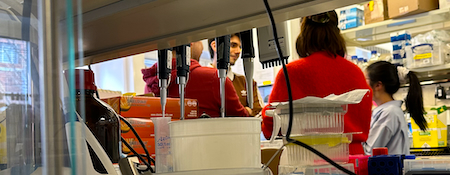
Last week I attended a workshop on the future of practical science in schools at the Royal Society.  Driven in part by the findings of the 2023 Science Education Tracker, that students at secondary school were frustrated they had little opportunity to do hands-on work themselves, as opposed to watching either the teacher do an experiment, or simply a video of that experiment, the meeting explored different aspects of the issue for both primary and secondary schools. The meeting was held, as it happened, the day before the publication of the Curriculum and Assessment Review. However, when the 197 pages of the report did land (metaphorically) on desks, its remarks about school practical science were somewhat bland. Recognizing that ‘practical work is not always effective’ it recommends that:

‘practical science activity – focused on high-quality teacher demonstration and hands on work by pupils – be underpinned by clearly defined purposes in the Programmes of Study and GCSE subject content.’

One can hardly disagree with such a statement, but it could be argued that is more about prescription for the teacher than feeding curiosity in the student.

When I think about my own school science days – as I was encouraged to do when talking about my personal experiences in the opening talk of the meeting – our lessons, as far as I recall, were largely based around ‘doing’ science. Right from the beginning of secondary school we were expected to do experiments, involving things such as dilute acids (no goggles provided) and open flames from Bunsen burners with tripods and asbestos mats. It was a different world, in which health and safety was not visibly considered, although I don’t remember any significant accidents. Lessons consisted of a teacher starting off with some explanations and then we were set loose. We had plenty of opportunity to explore and get used to apparatus.

In my talk, I discussed the A Level Physics course I had done, a new course just getting underway from the Nuffield Foundation at that time. It must have been very demanding on our teacher, since – as a pilot – she only got the material to teach a few weeks beforehand. There were no textbooks, everything came in a loose-leaf file. One of the innovative ways of working was to carry out an extended investigation. Having read The New Science of Strong Materials by JE Gordon (an inspiring book, then as now, and one I wrote about back in the days when the Guardian had science blogs, because it was so influential on me) to supplement the work on materials we did, I chose to attempt to replicate one of the key experiments described there. That was on glass fibres and related to fracture mechanics. The theoretical details don’t matter, but when preparing my talk I went back to look at those teenage diaries I referred to in my last post. Of this attempt at independent experimentation, I wrote:

This time I did some work on glass fibres – and I managed to burn myself while making one – not very badly, but inconveniently.

Nobody seemed too bothered about this accident.

Let’s face it, I was then – and throughout my career – not very dexterous. I broke things repeatedly during my PhD, and my experiences with chemistry were equally unfortunate. Again, my diary tells the tale:

‘Had our first chemistry practical. We did some titration and I swallowed some sodium hydroxide when trying to pipette it, but although nasty not serious.’

By the time I went to Cambridge as an undergraduate, and finding myself needing to continue with Chemistry to my annoyance, I hadn’t got much better with my hands.  This time quoting from a letter to my mother, I described my first undergraduate practical lab:

‘I got myself well and truly stained bright yellow by a salt of picric acid all over my hands (I should have been wearing gloves but took them off to wash up some apparatus). Also on my face, since I kept touching my face when adjusting safety goggles.’

I literally lived to tell the tale, and I don’t really want to know whether the salt was cancerous or explosive or any of the other things I’ve been told.

However, amusing and embarrassing though these anecdotes may be, the reality is science in my day was full of practical work at least from secondary school on (there was nothing that was described as science at my primary). It was striking how many people in the Royal Society audience last week had also done one or more of the Nuffield courses of the day. Courses that had practical work at their heart, in stark contrast to what schools can offer now. Everything from a packed curriculum, to teachers having to teach outside their specialism and therefore comfort zone; from lack of space to lack of cash; and from school accountability measures to absence of crucial equipment, practical science just doesn’t have the same focus in science lessons today as in my own, often as not. Yet, as the most recent Science Education Tracker shows, students miss being able to do their own practical work. It was a motivating factor for students wanting to do science for more than half of those in KS3. By making that a rare treat rather than something that they can routinely expect to engage in, we are turning students off pursuing science thereafter.

What many students get regularly as part of their lessons is watching a video demonstration. It may in principle have the same learning outcomes as doing the identical experiment themselves, but in practice almost certainly it will be less memorable and not give them ‘muscle memory’ of how to do things. Or, as in my case, how not to do things. The Curriculum and Assessment Review (CAR) had little to say about these matters. It explicitly states it won’t be discussing the teacher workforce. Yet, a science teacher who is teaching outside their own speciality, may not have the confidence to talk around a video to help the students understand what is going on, let alone have the resources or the confidence to do the experiment themselves. The evidence the conference was presented with showed that – in terms of student learning – a well-prepared and judiciously commented on video or, even better, teacher demonstration can be very effective for learning. But passively watching a demonstration with no additional elucidation from the teacher is not.

School practicals should feed curiosity as well as learning. Finding out what doesn’t work and why and how to use key apparatus ought to be central to the science curriculum. Unless schools are enabled – through adequate funding, curriculum time and supply of teachers in each of the sciences – to deliver effective practical work, we are short-changing our students, whether or not they are going to be the scientists of the future. It is disappointing that the CAR had so little to say about this.

Posted in Curriculum and Assessment Review, education, Science Education Tracker, teachers | Comments Off on Being Practical (Or Not)

Is That What Makes Me Human?

I have been reading the recently published book AI and the Art of Being Human by Jeffrey Abbott and Andrew Maynard. I found it a fascinating – and indeed optimistic – book, which prompted a lot of reflection, although not directly because I’ve been exploring AI myself. I haven’t (at least as yet), but the underlying theme of what it takes to be human resonated with me, even without the AI bit. I may have more to say about other aspects of the book another time, but for the moment I want to pause and think about one of the many questions the book poses:

What remains uniquely mine? – Name the experiences, feelings or qualities that can’t be captured by algorithms.

Thinking about what is ‘uniquely mine’ I would hazard a guess is not something many of us dwell on too often, at least if our primary focus is science. However, that sentiment certainly gave me pause for thought. I looked up and around the room I work in, and my eyes fell on the objects casually sitting on and around one of the (many) bookcases in the room in which I now ‘work’ (given I’m retired). It struck me how much these are symbols of the people and things that matter to me, or who have contributed to who I am. A strange collection they happen to be, but feeding into my being.

There is a conductor’s baton. This belonged to my grandmother who, in my teenage years, expended much effort every autumn on being part of running a conductors’ school; my grandparents lived with us. This was a weeklong course for those who lead things like WI choirs and other amateur bodies. My grandmother was undoubtedly musical, and right to the end would play Chopin mazurkas and polonaises with great panache but, in my lifetime, I never knew her conduct anything. Nevertheless, when we cleared my mother’s house after her death, this baton turned up and I couldn’t bear to throw it out.

Most of the other items on this bookshelf were also tied to that house-emptying, along with some of the books on the shelf itself. How can one throw out appalling Victorian tracts given to a great- or even great-grandmother as a Sunday school prize, for attendance or good behaviour? I can’t imagine reading the actual books, but inscribed books have sentiment attached it’s hard to dispose of.  Then there are a couple of pieces of damaged porcelain that were always part of my childhood. Perhaps they were valuable once, but they surely aren’t in their damaged state. I suspect anything actually valuable of this ilk was sold when we were on our beam-ends when I was around 10 and bankruptcy stalked the family.

Perhaps the item I treasure most is a print of brent geese by the naturalist, broadcaster and artist Peter Scott, dated 1939. I remember buying this – a scruffy somewhat crumpled print at the time, unframed – at a jumble sale (as I say, money was tight) for my mother’s birthday when I was a young teenager. She kept it by her bed all her life, and I treasure it because she treasured it. We brought it back to our house, and now that it is flattened and suitably framed it looks rather good. It reminds me of the days she and I used to go out birdwatching, including with the London Natural History Society’s coach trips to the Essex and Kent mudflats where we often saw brent geese. An atmospheric painting, bringing back memories of freezing cold days at the coast. But they were happy days out to places we’d never have got to without the LNHS (my mother never drove).
brent geeseHanging over the bookshelf is a penguin mobile that we must have given my daughter as a small child. It hung in her room till she left home. Indeed, it hung in her empty room gathering dust for many years and I rescued it before our house was gutted and refurbished, and now here it is.

The final item is a bronze (?) figurine of a woman standing tall and empowered. It’s about 30cm tall and very heavy. This was given to me by colleagues in the University when I stood down as the Gender Equality Champion as a vote of thanks. It meant a lot to me that they had clubbed together to give me this as a measure of appreciation for what I’d done, or at least tried to do, to support women across the university. It definitely symbolises empowerment and was created by a local artist.

So, in some ways that is a summary of significant parts of my life and the fact that I’ve kept these objects must say something about me. Is that what makes me human, because an algorithm probably wouldn’t have collected a random array like this? At least, I assume not.

Of course, that is by no means all of my past that I treasure and which I keep upstairs in nooks and crannies. There’s also my school attaché case, given to me when I was still at primary school and which – I suspect – I took in every day rather than the traditional satchel. It contains much of my past too, in the form of letters from my husband before we were married, the single letter from my father I still have with me, and my childish diaries. Curiously I had recourse to these this week: preparing a talk for the Royal Society’s meeting on practical science at school on Tuesday, I was amused to look back at what I wrote about my own days of school practicals. Suffice it to say, I was not good at them and safety issues were less on people’s minds then than now. I once nearly set fire to the chemistry lab and I had this to say about my first A Level chemistry lesson:

We did some titration and I swallowed some sodium hydroxide when trying to pipette it, but although nasty not serious.

I lived to tell the tale, and to gather all these memories – solid and ephemeral – around me. Is that what makes me human?


Posted in AI, Anthony Maynard, memories, Peter Scott, Science Culture | Comments Off on Is That What Makes Me Human?