On message

Back in September 2010, I’m not sure that any of us who answered Jenny’s call to action knew quite what to expect. Maybe not even pulling off a rally attended by over 2,000 scientists and supporters; perhaps not going to Downing Street with 35,000 names on a petition; probably not being called into a minister’s office at short notice for a very interesting chat—and I’m pretty certain that we didn’t consider if we’d still be going two years later.

But here we are. We’ve presented a report on science careers to that same minister; we have our first Annual General Meeting on 13th September (at Christopher Ingold XLG1 Chemistry Lecture Theatre, UCL, 20 Gordon Street, London, WC1H 0AJ); we have a bank account; we even have a Constitution (if only I can remember where I put it). In addition to all that, we’re subverting the Guardian Science Blogs to raise awareness of the cause.

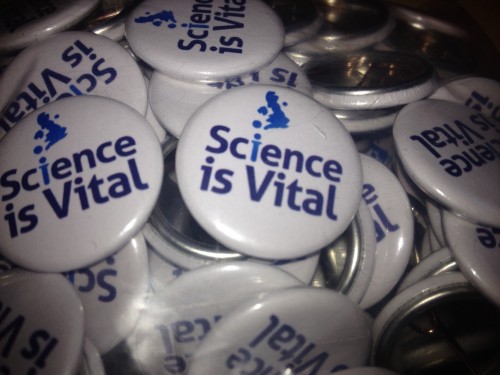
And perhaps even more importantly, thanks to the inestimable Della, we have pin badges!

Science is Vital pin badges!

One of these pretty, shiny things can be yours for the princely sum of one of your English pounds, and they’ll be available at the SiV AGM. And subsequently probably from any of the committee members—if we don’t sell them all on the 13th. All monies will go directly into the SiV coffers, thence to support our next campaign, whenever that might be.

Wear yours with pride!

Posted in Science is Vital | Tagged , , | 5 Comments

On target

I settle, relaxing all my muscles: feet to legs to bum to back to arms. I’m essentially slumped. A bit of pain in my left hand: that’s not quite right. Perhaps I just have to get used to it.

I look at the concentric circles; shuffle to the left, wriggle my hips. Relax again.

Close my eyes. Breathe in, out; in, out; and open my eyes again. Take stock. Shuffle infinitesimally to the left. Eyes closed; breathe once, twice, and open them.

Apparently, the French think our success in the Olympic track cycling events is something to do with the wheels on our bikes being somehow more ’round’ than theirs. A more precise determination of π perhaps? And again, the New Zealanders are wondering what is special about our equipment compared with theirs (stop sniggering at the back).

It is somewhat disheartening to think that two hundred years after the Enlightenment people are still thinking in terms of magic or trickery to explain what, to be fair, is a staggering record in a sport (Team GB won, for the record, seven out of a possible ten gold medals; a silver in one event and a bronze in a ninth. We were disqualified from one event).

The truth is of course, it’s down to bloody hard graft. And a tiny touch of science.

We normally think of science in terms of observation; hypothesis; experiment. But there are different types of science, aren’t there? There is basic science, there is translational science, and there is applied science. None of those is exactly technology (or medicine, come to that). And what we are seeing, described by British Cycling’s performance director Dave Brailsford, is some sort of applied science—with, perhaps, just the tiniest bit of basic science, of experiment, thrown in.

For example, the cyclists take their own pillows with them when they go away. They learn to wash their hands more effectively, so they come down with fractionally fewer colds and sniffles, which means they have fractionally better performance. And a percentage point here; half a percent there: it all adds up to those fractions of a second that make the difference between an Olympic medal and historical oblivion.

I’ve been doing a little bit of this myself recently, in an Olympic sport no less. I’m not likely to be winning any medals any time soon, but (like my missed chance at a backgammon quarter-blue when I was at Oxford), I do have a realistic chance of competing at high levels.

I am in my own little world. A gash piece of plastic—cut from a milk carton—is covering my left eye. My right eye is up against the sight; my hearing muffled by the ear defenders; the stock firmly against my shoulder.

I breathe in and out and in and out and just as the bull centres the second time I bend my forefinger and the rifle leaps up—a bang, the familiar, addictive smell of cordite—I count to three and mark where the rifle is now pointing. Finally I lift two fingers from the grip and pull back the bolt, sending the brass casing flying somewhere to my right, and reach for another round.

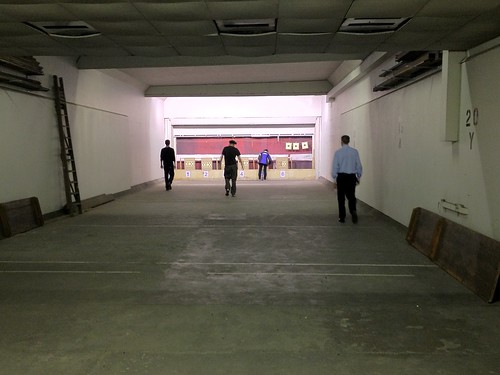
For the last three or four months, on most Wednesday evenings, I’ve been letting myself in through a metal doorway under Blackfriars Bridge and going to the Stock Exchange Rifle Club. There, I’ve been learning how to make little tiny holes in small pieces of paper with tiny pieces of lead.

Testing ground
Down the range

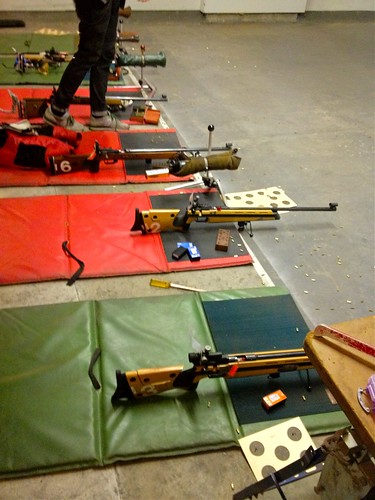
Now, target shooting is quite unlike shooting for food. I’ve done that, when when Mike shoved a Lee Enfield in my hand and told me to kill a pig that had just gone for cover in a bush. One shot, one pig curry. But what we do at the SERC is a little more refined. I started off with no equipment other than the rifle, a glove and a wooden support (‘block’) to rest my hand on. I was pretty rubbish at first (as you’ll know if you’ve been keeping track of my progress on Facebook). But after learning how to shoot five rounds that consistently hit a small area (a ‘grouping’), last week I got fitted up with a shooting jacket that incorporates a sling. The sling holds the rifle so that when you lie down you can take your right (or firing) arm and hand away, and the rifle should still be pointing at the centre of the target.

Tools
Tools of the trade

The idea, ultimately, is to be able to put a 0.22 round through a hole a centimeter across from 50 meters away. Ten times. Then, if you want to be an Olympic gold medallist, you have to repeat the feat a further five times.

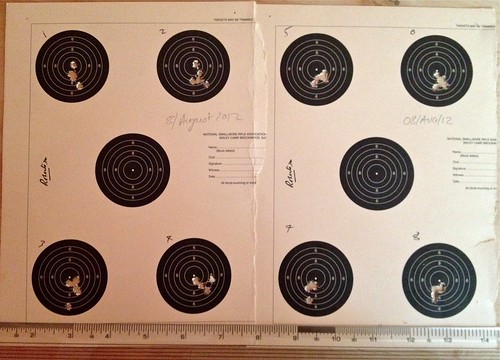
So this week, I got into my jacket, settled down, and fired ten rounds: five at each of two targets. Took a rest, repeated the exercise. And then shot two more details: eight targets in all, forty rounds of 0.22 ammunition.

And look:

Forty
Progress

As the night progressed, so my groupings got smaller. Follow the numbers, 1 through 8. This is all down to practice, yes, but also to those ‘marginals’ that Dave Brailsford talks about. Each time I shot, I was improving my position, my breathing, my settling on a natural point of aim. Each time each parameter is tightened, I do a little bit better.

Each week, I pick up another little tip. Each detail, I try to implement it. There is a science behind it: not just an applied science of what is known, but also a little experiment as I see how it applies to me. Exactly as the Team GB cyclists gather data and apply it to themselves, and see what a difference it makes.

At this stage, the grouping is the thing. Hitting the centre of the bull—each time, every time—is something I’ll start working on next week. And then I’ll be able to put some numbers on my performance.

Isn’t that science?

Posted in Personal | Tagged , , | 9 Comments

Bad cover version

Ever have one of those evenings?

In the midst of following the conversation about an event at the Royal Society tonight, in which Vince Cable, Sir Paul Nurse and other luminaries discuss the future of science in the UK* (twitter tag RSvince), I saw this tweet:

RT @ProfBrianCox: Busy writing the Wonders of Life book. Its a bit tricky this biology stuff 🙂

— Alok Jha (@alokjha) July 12, 2012

I hit reply, as you do, saying that perhaps a biologist should be writing it instead. Adam Rutherford responded,

“believe me, he’s on top of it, has some sound advice.”

Awesome. So he has some sound advice. The next obvious step is for Cox to write a book on women in science, and I suggested it.

@rpg7twit I had no idea there was propriety on subject areas.

— Adam Rutherford (@AdamRutherford) July 12, 2012

I’m sure that he’ll get “some sound advice” for that too, and the irony will similarly be lost.

You read it here first.


* Apparently Cable said he wanted to talk about maintaining the ‘supremacy’ of British science without talking about money. I couldn’t have been more surprise if he’d said “I want to talk about management of pneumonia without discussing antibiotics”.

Posted in Rants | Tagged , , , | 4 Comments

Little blue

In other news, this little guy deserves more exposure. We were sat there on Sunday afternoon, when suddenly there was a thud and a little tap on the wooden floor. We got up to see a rather startled baby blue tit sitting there by the back door.

Baby blue

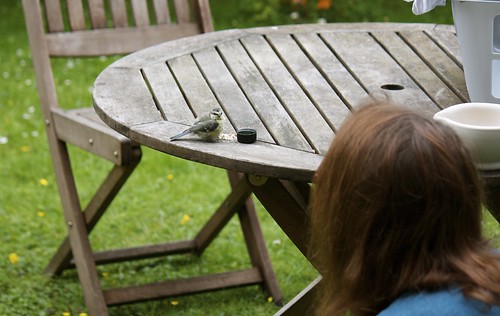
He wasn’t moving, so I picked him up and stroked his head (which, it has to be said, was missing a few feathers) and, because it appeared that there was no way he was going to let go of my forefinger, got Jenny to put some ground peanuts* and water on the garden table for him.

Jenny and the bluetit

Finally I got him off my finger and on to the table, and we hung around to scare away any cats that might be on the prowl for helpless birdlife. I got my camera and took a few photos, somewhat relieved when he startled at the shutter snap.

Eventually he decided he’d had enough of our hospitality and flew up into the trees, where he perched and twittered for a while before flying off again.

I think I saw him back on the peanut feeder this morning, so all’s well in the urban jungle.

Continue reading

Posted in Birds | Tagged | 2 Comments

Protected: On not being able to talk about it

This content is password-protected. To view it, please enter the password below.

Posted in Work | Tagged , , , , , | Enter your password to view comments.

Do you remember the first time?

It is a thing of beauty.

That should be enough.

For now.

I love the instructions.

PS. Does anybody want 2x2GB of PC3 RAM?

Posted in Nonsense | Tagged | 4 Comments

On a drop of water

One of these days, I’ll treat myself to a proper camera attachment for my microscope. In the meantime, here’s what we can achieve by pointing the iPhone at one of the oculars.

Flea

And a movie:

Here’s the little guy at a higher magnification:

Flea

Ain’t that just purty?

(Captured from a new pond in Russia Dock Woodlands. There was also lots of Spirogyra in the sample, although I was careful not to take any of the more macroscopic beasties, such as water boatmen.)

Posted in Don't try this at home, London, Photography | Tagged , , | 11 Comments

On the road

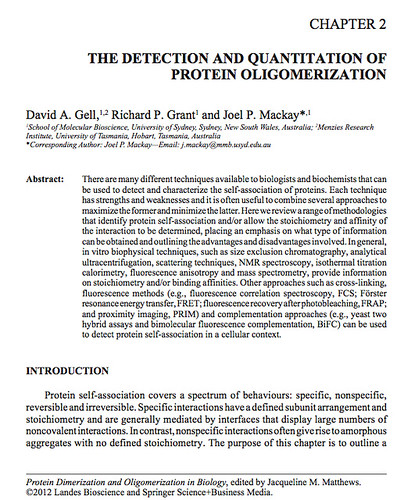
Protein Dimerization and Oligomerization in Biology is a textbook that can be yours for the princely sum of £126. I know this because last week I received an email from a cove in India wanting a copy of a chapter from that book, called “The Detection and Quantitation of Protein Oligomerization”. Why did they ask me, you might well wonder. So did I, until I retrieved from long-term storage the memory that I’d actually contributed to that chapter—over three and a half years ago. My Indian correspondent wanted a copy last week because it had only just been published (oddly enough it’s down in my CV as a 2009 publication).

Chapter

A brief email exchange with my old boss followed. He told me that although we were late submitting our chapter (and I do remember that rush, now), ours was actually the first one in. So the 3+ year delay wasn’t our fault.

They do things differently in the private sector, of course.

Stony road

This is a book we’ve just put together to accompany a continuing medical education (CME)-accredited event taking in place in a little under two weeks’ time. Back in about March, it didn’t exist.

Front matter

To be fair, there was a pre-existing German language book—which had to be translated and (heavily) edited—but over the last two or three months I’ve worked with Professor Sylvia Haas and the people at my company, to produce from effectively a standing start what’s turned out to be a rather lovely, illustrated history of anticoagulation in the treatment and prevention of anticoagulation. Katherine and myself hammered the translation that Sylvia provided into a coherent form, and Rachel made some lovely graphics to our specifications (and typeset the thing, too)—I even created some original artwork for it myself. James and Andrew supplied mad editing skills, making it into a real professional piece of work.

We are very pleased with it, and I hope we’re going to get round to selling it as a standalone coffee-table piece after the meeting next week. I doubt it’ll cost anywhere near £126.

Posted in Don't try this at home, War stories, Work | Tagged , | 2 Comments

Swimming lesson

Ever since I saw an editorial in last Tuesday’s Evening Standard, I’ve been meaning to write a serious blogpost. However, ever since last Tuesday I’ve been a bit under the weather, and not really up to it (before you jump to any conclusions, correlation doesn’t equal causation, remember).

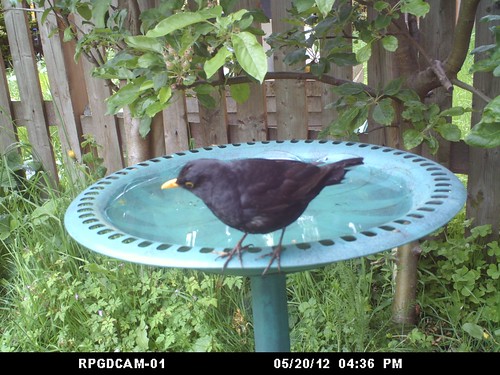
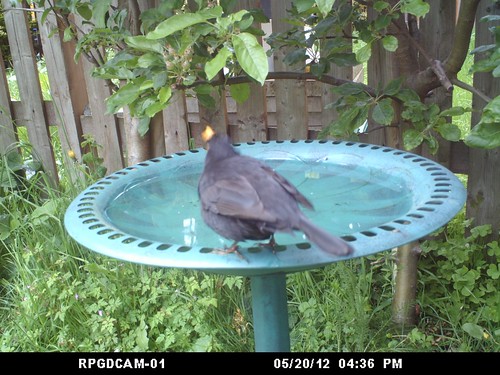
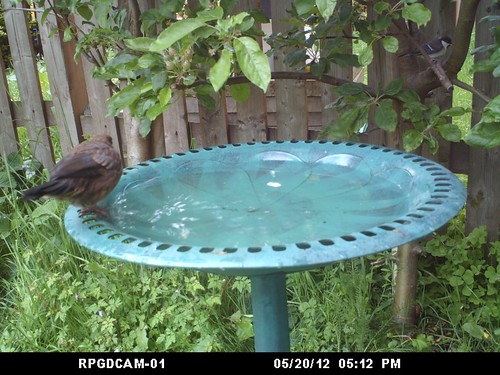
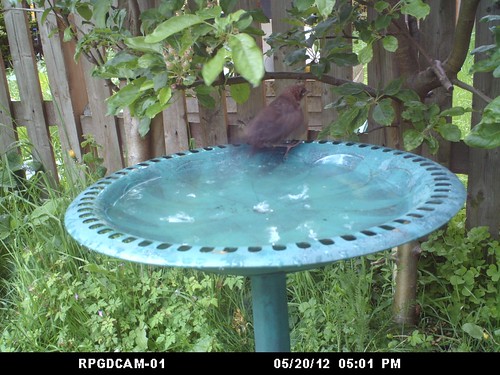
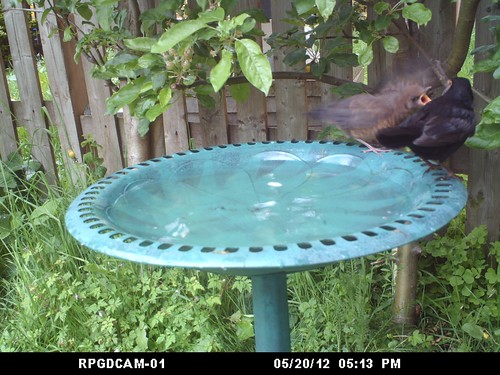
So in the meantime, to keep you entertained, here’s some hot bird action from my garden this afternoon.

Swimming tips for children

Checking out the pool
Always let an adult make sure it’s safe to bathe.

Having a drink
Sometimes they’ll take a sip to make sure it’s all right for you.

Bathtime
Allow an adult to check the depth.

Schwartzchild dips a toe.
Remember kids, until you have learned to swim well, stay in the shallow end.

Lifeguard
Always swim with an adult present.

Bbbrrrr
Make sure you dry off afterwards.

Snack time
And finally, eat after your swim, not before.

More.

Posted in Birds | Tagged , , , , , | 8 Comments

No fishing

No fishing

Posted in London, Nonsense, The stupid, it burns | Tagged , | 5 Comments