Latest posts

The (Damaging) Power of Silence

There are many strategies for dealing with an overfull inbox, not all of which are helpful to the person who sent the email. I have weeks where I feel more or less on top of things and other weeks where too many slip through the cracks. Then I find myself, weeks later, sending an email saying ‘I do apologise for not replying sooner but….’ After that beginning I can try to find some plausible excuse along the lines of the dog ate my homework. However, these days I tend just to say ‘I’m afraid it got lost in my inbox’, which is usually the truth. Along these lines, I was amused to read a decade-old post of mine about constantly living on the edge of chaos, along with all its comments, which was complemented by the next post about the importance of knowing when to say no.

However, there is another way to deal with an overfull inbox, particularly when some of the emails are tricky or embarrassing to answer. That is to do absolutely nothing. Silence. Ignore the email, either as a deliberate strategy or in the hopes that if you don’t reply the whole problem will go away. Although I can’t say I have never used this strategy occasionally (but I hope not often), when someone does this to me in reverse, I find it intensely annoying. There was the time when I wrote to a colleague in Cambridge pointing out that the way he kept patting me on the arm through a dinner wasn’t particularly a problem for me at my advanced age, but might be regarded as totally inappropriate by a student. When no response was received, I felt strongly enough to send it again, to which I eventually received the reply ‘Athene, I got your email the first time.’ That was all. A totally inadequate response, but of course my original email had fallen into the ‘tricky or embarrassing to answer’ category. At least I felt I’d tried, not been complicit in letting bad behaviour go unremarked.

However, there are persistent offenders who simply do not answer when a direct question is addressed to them. If a PhD student asks ‘can I have access to your equipment?’ and you choose not to reply, where does that leave the student (or indeed their supervisor, if it gets escalated to them)? If an administrator tries to convene a meeting to discuss space utilisation, and the key professorial (robber) baron doesn’t acknowledge the email, let alone confirm a possible time to meet, how can space be fairly allocated? In both these cases, there is a power imbalance implicit in the situation, and a senior professor can get a long way by ignoring emails they would prefer not to answer. It is a very difficult situation to resolve, particular when someone is a long-term offender who hogs equipment, space etc but is never prepared to engage in a dialogue. Sadly, I have seen this situation (appropriately modified to any particular departmental situation) more times than I care to recall.

It is, of course, a form of bullying. Bullying by default. In my experience this passive sort of bullying is just as damaging to the local culture as anything else. If someone lower in the food chain tries similar behaviour, there tends to be recourse. If a PhD student silently but implicitly refuses to let another student use equipment, in principle (although in my experience most reluctantly) escalation through their supervisor may resolve the issue. It may not, however, lead to any sort of sanction being applied to the student in question, who then learns they can get away with being obstructive. They may anyhow have learnt this bad behavioural trait from their supervisor.  There is no doubt that students learn ‘acceptable’ behaviour from those around them; badly behaved supervisors can perpetuate a pattern of poor behaviour indefinitely.

To me, silence in these sorts of situation, including email, is a form of passive-aggressive behaviour that can be hugely damaging to an individual and a community. The one-off ‘oops’ moment, the email that slipped through the net inadvertently, the one put off and off because a reply is tricky until ultimately it vanishes from consciousness, that’s one type of failure. (Sadly, I would guess most of us have sometimes fallen into that trap; most certainly I have and usually with deep embarrassment when I realise this has occurred.) But, the repeat offender who thinks this is a good way to get on in the world is destructive to those around them, even if sadly it appears to be a constructive way to get on for the guilty party. It is , however, just one of the multitude of ways that enables a toxic culture to be built up, and one that is extremely difficult to unpick.

Posted in bullying, complicit, email, power imbalance, Science Culture | Comments Off on The (Damaging) Power of Silence

Opportunities

It’s a horrible word, redundant. ‘No longer needed or useful; superfluous’.

I don’t feel superfluous, but have to admit to feeling a little less than useful.

Some people have been very kind, noting my efforts to continue to support my little team and make sure they’ve got what they need to navigate these tricky waters, while others sail on, seemingly oblivious.

Can’t really blame them—those of us who are being shepherded out probably feel like an embarrassment; best not to say anything, or even look in our direction.

Titanic in color

It’s all a bit shit, really.

On the other hand, I’ve had an outpouring of support and interest on LinkedIn. Nothing firmed up yet, but despite the industry being in a bit of a patch at the moment, especially for people at my level, it’s not looking so bad.

I’m trying to see this as an opportunity to refocus, and think about things, and do some gardening and reading and shooting and I really really really hope to do a substantial amount of writing. It’s my last day tomorrow, and I can’t wait.

I do need to find a new job at some point, but one step at a time.

I’ve got the brains…

Posted in gizza job, personal, work, Writing | Comments Off on Opportunities

What I Read In February

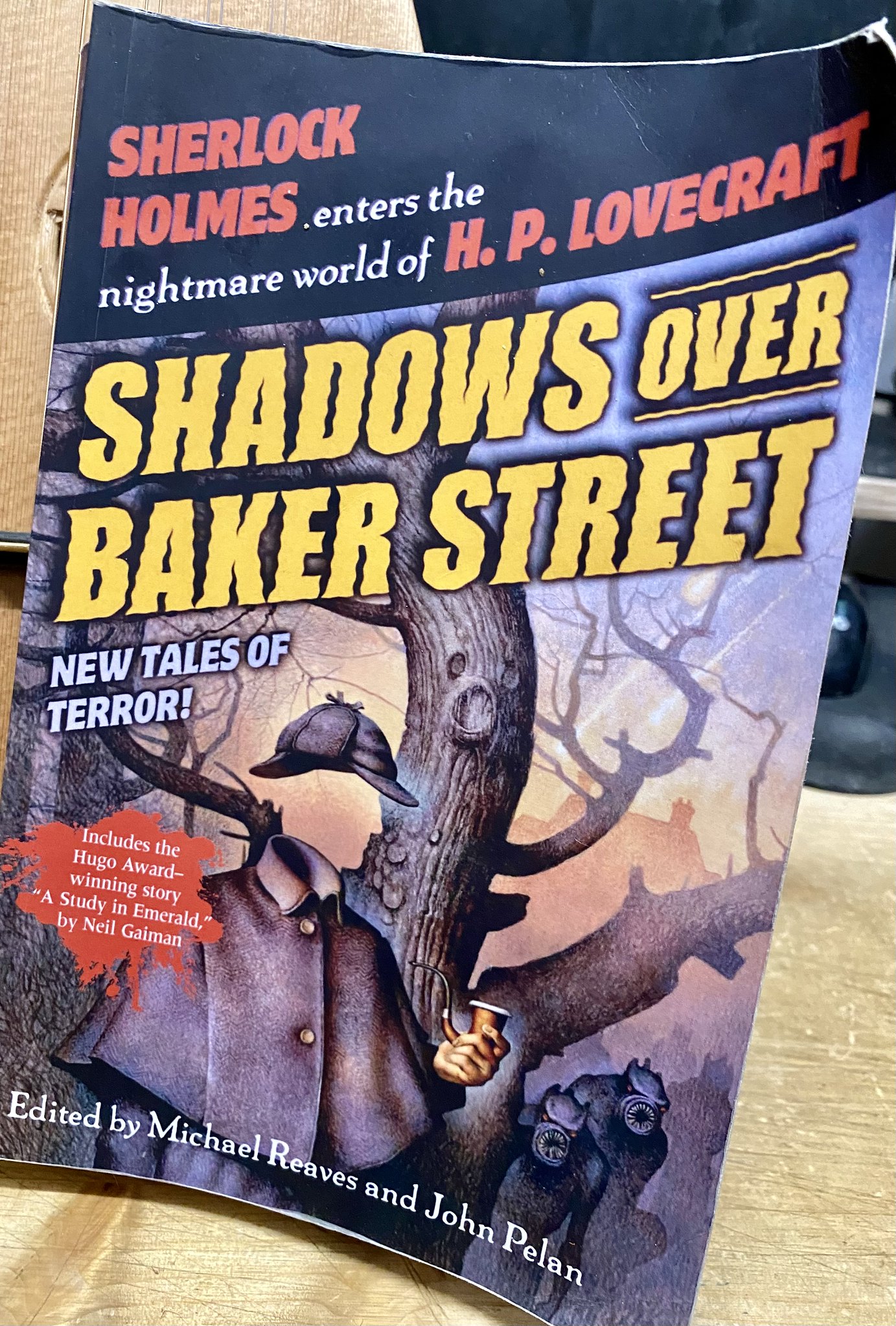
Screenshot 2024-02-03 at 11.50.58Barbra Streisand: My Name Is Barbra I first came across Barbra Streisand with a fluffy comic song in my parents’ record collection. It was ‘Second-Hand Rose’, which I now know was written in 1921 and originally performed by the music-hall comedienne and singer Fanny Brice. It was in a Broadway musical about Brice that Streisand made her name and shot to stardom. That was Funny Girl. Streisand was just 21. As a child she was practically feral. Her father died when she was an infant. Plainly an inconvenience to her cold stepfather and uncaring mother, she left home in her mid teens and hustled for acting and singing jobs, eventually scoring a residency at a well-known Manhattan night spot as well as stealing the show, aged just nineteen, with a supporting role in a Broadway production, I Can Get It For You Wholesale.  Her talents as singer and actor were spotted and she was cast as the lead in Funny Girl. That was made into a movie in which Streisand starred opposite Omar Sharif, and she never looked back. Dozens and dozens of albums followed, along with films, in which she played an ever more active part behind as well as in front of the camera. This culminated in Yentl, the story of an Orthodox Jewish girl who impersonates a man so she can acquire learning, in which Streisand not only starred, but wrote the screenplay, produced and directed — a first for a woman.  There are parallels with Streisand’s life and that of rock star Geddy Lee, whose memoir My Effin’ Life I reviewed last month. At first glance, it’s hard to imagine musicians as different as Lee and Streisand. But look closer: they are both Jewish; their fathers died when they were very young; neither went to college (which perhaps explains the ferocious curiosity of the autodidact); both are entirely self-taught as musicians, and have enjoyed lifelong and lauded careers. This mammoth memoir goes into immense detail about every project Streisand was involved in, her loves, and her hates. She settles old scores, talks about food (a lot), and recalls every outfit she’s every worn, anywhere. At almost 1,000 pages, it was (unusually for a celeb autobiography) written without literary assistance. Perhaps Streisand’s greatest coup was that she had written into her contracts, from a very early age, that she would have total creative control of any recording project she would be involved in. I suspect that this applied to this book, too. My Name Is Barbra is an enjoyable if over-long read, but somewhere there’s a place for us in Manhattan is a book editor sobbing into her skinny latte in frustration.

UPDATE: Since reading this I’ve started to listen to the audiobook. This makes more sense than the dead-tree version. It’s narrated by Barbra herself, naturally, and also has clips of the music she mentions along the way. It’s amazingly long — about 48 hours — so is likely to keep me out off mischief on dog walks for some time.


UntitledIain Banks: Espedair Street Danny Weir is a gangly bug-eyed kid from a sink estate in Paisley, Scotland, who goes by the name of ‘Weird’ (a school joke: he was ‘Weir, D.’ in the school roll). He has just one talent – writing songs. In the early 70’s he linked up with a promising rock band, became their bass player and main songwriter, and enjoyed (if that’s the word) the life of 1970s rock excess. Years later, he lives in a converted folly in Glasgow, fabulously rich but somehow aimless. A concatenation of events leads him to contemplate suicide. That’s when his rockstar past collides with an uncertain future. But which will he choose? Espedair Street comes from the literary-novel side of Banks’ personality. With his middle initial ‘M’ he wrote brilliantly realised and influential space operas. I’ve read all of those, some of them many times, but haven’t read so many of his M-free works. Those I have read are varied in character and tone, from the ghoulishly gruesome Complicity to the affectionately dotty Whit to the readable but strangely heartless The Business to the fantastical Transitions to his gleefully revolting debut The Wasp Factory. Okay, perhaps I have read more of them than I first thought. Espedair Street tends to the darkly comic, with some amazing sitcom-style set pieces (always involving a great deal of alcohol and drugs), but is on the more affectionate side of his writing. I once met Banks in the coffee queue at a SF conference, and considering that many of his works are very dark, sometimes violent, he was the nicest, kindest, sweetest person imaginable. Perhaps he exorcised his demons in his writing. He died of cancer aged just 59: even with his prodigious literary output, he left us far too early.

UntitledMartin Popoff: Queen: Album By Album I rarely read, still less buy, books about rock musicians written by fans or journalists, even books about Queen, a band I’ve been fond of since I was eleven. I confess that I bought it by mistake, on eBay. I thought I was bidding on a book of Queen sheet music, as I have just joined a Queen tribute band as piano player and need to sort my Galileos from my Bismillahs (I bought that too, in the end). Still, it didn’t cost much, and when it arrived, I read it. It’s a series of transcribed interviews with various Queen fans, musicians and journalists conducted by rock journalist Popoff, each chapter analysing one of their many albums in chronological order from the self-titled debut in 1973 to their final record, Made In Heaven in 1995, released four years after Freddie Mercury’s death. I was pleased to see that not everyone agreed with one another, nor did they have universal praise for everything Queen did. Hot Space came in for a critical panning, which one would expect, but to my surprise A Kind Of Magic came off worse. Reading this did make me realise that no Queen album can be seen as a coherent whole. This is perhaps a function of the band having four strong-minded songwriters with very different tastes. That they worked so long together and produced (in my opinion) some fantastic and enduring music is all the more mysterious.

UntitledHarry Sidebottom: The Mad Emperor Until recently perhaps the only time anyone heard the name of the Roman Emperor Marcus Aurelius Antoninus, better known as Elagabalus or Heliogabalus (reigned 218-222CE) was in the Gilbert and Sullivan song sung by the Modern Major General:

I know our mythic history, King Arthur’s and Sir Caradoc’s/ I answer hard acrostics, I’ve a pretty taste for Paradox/ I quote in elegiacs all the crimes of Heliogabalus/ In conics I can floor peculiarities parabolous.

But who was Heliogabalus, and what exactly were the crimes, so proverbially well-known in Victorian times that Gilbert and Sullivan’s audience would immediately have understood? History has painted Heliogabalus as the most depraved and dissolute of all the Roman Emperors (something that takes some doing). He was perhaps most notorious for his many extravagant banquets, which were not only decadent but dangerous. This idea was cemented in the 1888 painting The Roses of Heliogabalus by Sir Lawrence Alma-Tadema, a fine example of High Victoriana, showing guests at one of his soirees suffocating in a blizzard of rose petals. Lately, Heliogabalus has become a minor icon in parts of the LGBTQ+ movement, as a man who wanted to be regarded as a woman, and even (legend has it) that he inquired about having surgery to create a vagina. Wherefore the modern gender-fluid ideation?  Historian Harry Sidebottom tries to separate the man from the myth in this excellent book which — be warned — is much drier than you’d expect from the subject matter. The problem is that almost all we know of Heliogabalus comes from three sauces tzores sources, all variously unreliable, only two of which were written by contemporaries, and only one by someone who ever stood in the same room as Heliogabalus. What is certain is that Heliogabalus was a spectacularly incompetent Emperor. His lavish spending depleted the Imperial coffers; his habits alienated the Senate, the Army, the Plebs and the Imperial Household — the four constituencies that any competent Emperor would have to mollify; and, worst of all, he tried to introduce a new religion to Rome. Heliogabalus, although born in Rome, was raised in his family’s ancestral home of Emesa (modern-day Homs) in Syria, where the local god was Elagabal, a solar deity manifested as a large conical black stone. Heliogabalus was a High Priest of Elagabal and brought the god to Rome, where he insisted that it assume primacy over Jupiter, father of the Roman pantheon. Romans didn’t mind adding another God to their pantheon (they did it all the time) but objected to the demotion of Jupiter. That, along with the fact that Heliogabalus often wore priestly robes rather than a toga (a habit that the Romans found effeminate); was circumcised and didn’t eat pork (A similarity to Judaism — antisemitism, then as now, lurked close to the surface); and tended to promote people to high office on the basis of penis size — all contributed to his downfall. What Sidebottom doesn’t explain is how, a century or so later, Jupiter and the entire Roman pantheon were not only demoted but completely swept away by another obscure Oriental cult, an offshoot of the despised Judaism, that venerated a man nailed to a cross. But perhaps Constantine had better PR.

UntitledRichard Shepherd: Unnatural Causes When I was an undergraduate I went to a talk given by a forensic pathologist who recounted some grimly hilarious episodes from his casebook, many of which have stuck in the memory but which are probably unrepeatable nowadays. Imagine my anticipation when I was recommended this book by a colleague who, like me, enjoys a televisual emission called Silent Witness, which follows the lives of forensic pathologists as they solve mysterious deaths from the many clues that silent corpses can reveal — if you know where to look. Unlike Silent Witness, Unnatural Causes is the memoir of the real-life work of a forensic pathologist, one Richard Shepherd, who was switched on to cutting up dead bodies in his earliest youth, and ended up involved, directly or indirectly, in many celebrated cases, including the Marchioness river boat disaster, the Clapham rail crash, the 9/11 outrage, and the inquiry into the deaths of Princess Diana and Dodi Fayed.  The personal cost of such work proved to be enormous. His first marriage was sacrificed to his devotion to slicing and dicing, along with his mental health (in later life he suffered from PTSD) and — very nearly — his reputation, when he was referred to the General Medical Council over a trivial error (the case was dismissed). Shepherd clearly prefers the company of the dead, who, unlike the living, are unlikely to overload one with emotional demands (his young baby, his frustrated wife, the grieving relatives of the dead) or indulge in personal character assassinations (attack-dog barristers in court-room cross examinations). His only solace seems to have come from flying, an occupation that took him far away from the cares of the everyday. I have to say I found this a grim read, though I stuck it out doggedly to the end.

Posted in Music, Writing & Reading | Comments Off on What I Read In February

Notes from Open Research London, 12 February 2024

Earlier this month Open Research London held a half day event at the Francis Crick Institute to mark Love Your Data week, comprising six half-hour talks. The very engaging and interesting talks were focused on research data discovery, with detours into publishing, preprints and AI. Attendees were well-supplied with coffee and pastries during registration and the halftime break, so there was plenty of time for chatting with fellow attendees. There was also an option to move on to a local pub afterwards to continue conversations and catch-ups. All in all, it was a great chance to learn from and discuss with knowledgeable people.

Here are some notes about each talk. I’ve put them in a different order from the actual programme.

  1. Dan Crane, from the Open Research team at King’s College

Dan started by describing the setup at King’s and outlining what FAIR data is (Findable, Accessible, Interoperable, Reusable). Then he outlined how his team capture datasets into the King’s Open Research Data System (KORDS) – a repository that uses FigShare.

The team at King’s have developed a metadata template to guide and encourage researchers to add descriptive metadata. There’s a balance to be struck between encouraging them to be as thorough as possible, whilst not nagging them so much that they are put off depositing their dataset. There’s also a balance between getting the researcher to do the work versus the Open Research Team taking on the work. I really recognise that dichotomy. Depositors in KORDS are encouraged to include a readme file and to add their ORCIDs. The system can also capture relationships between datasets. There is a good range of guidance and training material to help users to get their head around FAIR and open data sharing. Researchers are shown how they should reference the dataset deposited in KORDS when creating their data access/availability statement in the paper.

The King’s team also encourages researchers to create metadata-only records for datasets that cannot be shared openly, to give some exposure to this data.

Finally, Dan talked about how they create DOIs for grey literature in their PURE repository. Currently this is done manually. Guidance on ‘how to cite this’ is put on the page of each grey literature document that is posted in the repository.

I wonder how easy it is to get the message out to researchers that creating a DOI for any grey literature that they create is a Really Good Idea? I found that researchers (in life sciences at any rate) have a tendency to stick documents on general web pages without considering that there might be a better way to make them discoverable and accessible.

  1. Jonathan Green and Julie Baldwin from Univ Nottingham libraries

Jonathan and Julie described the process they use to find research datasets that have been deposited on external platforms by Univ Nottingham researchers, and then to import metadata from Scholix into the Nottingham repository. The aim is to create metadata-only records in the Nottingham data repository. Often research data is deposited into specialist domain repositories and thus is not easily visible or knowable via the university where the authors work. The Nottingham service is based on code shared by Durham/Manchester and uses the Scholix service as a data source.
Jonathan and Julie explained that initially they kept the project small-scale, due to resourcing constraints. The project started as an exploration – running some code to find what datasets existed ‘out there’ and then checking them manually before converting the metadata so it could be imported into the DSpace repository. The process has now been streamlined and further automated.

They had an interesting slide reflecting on some of the challenges and learning points. These boiled down to observing that the world of research data is messy, unpredictable and complex, hence human intervention is needed.

I found it very interesting to see this idea in practice as it’s something I’ve long thought could be useful. You can also import metadata from the EBI’s Biostudies database and I’ve seen this done, but for the purpose of research evaluation rather than for increasing the visibility of the datasets.

  1. Holly Ranger, from University of Westminster

Holly talked about capturing research outputs from practice research. This kind of research is often non-tangible, and collaborative, affected by its relations with other practice research. Holly noted that existing standards aren’t always suitable for arts research outputs. To improve the representation of practice research in the repository, Westminster has made various changes to the schemas for these. A particular feature is the ‘overlays narrative and context’. Holly said that contextualised data is really important for practice research. Holly mentioned persistent identifiers; RAiD, DataCite DOIs and CReDit. RAiD has proved to be a good fit for these outputs.

Westminster has embedded guidance to making practice research open within the practice PhD research handbook – explaining how to document the practice and research journey.

The second aspect of Westminster’s steps to embedding OA into practice research was implementing ‘Theory of change for research design’. I missed the details of this part of the talk. Holly mentioned the Practice Research Voices project, funded by the AHRC, and its final report and recommendations that have been published.

  1. Maria Levchenko, from the Europe PMC team at EBI

Maria talked about preprint discovery and preprint review/feedback, focusing on preprints in life sciences. She started with a definition of what a preprint is, and showed the growth in adoption of preprints and of preprint evaluations being posted. She mentioned that there are up to 60 preprint servers that have some biomedical content, and there are more than 35 initiatives reviewing life science preprints. This means that discovering preprints in life sciences can be challenging.

Europe PMC has been indexing preprints since 2018 and now has 735k preprints from more than 30 servers. Of those, 260k have been published in peer-reviewed journals and 10k have some kind of feedback.

Europe PMC also indexes preprint feedback and links them to the original preprint, to help readers assess the preprint. The feedback can be any kind of comment on the pre-published work. Though still small, the numbers of preprint peer reviews are now increasing. Researchers can gain exposure and credit through providing feedback on preprints. ePMC also links into funder and grant information about the research in the preprint, and citations to the preprint. These are all indicators of trust. Maria mentioned eLife’s Sciety website and EMBO’s Early Evidence Base website. Both of these categorise preprint feedback, but their categories are not the same. It would be helpful to harmonise types of preprint feedback.

Maria highlighted the issue of licences for reviews to whether and how the reviews can be reused. For example, can they be translated, text-mined, used by AI tools to provide summaries? Free to read does not mean free to re-use. Hence there is a growing need for pre-print licenses. Subsequently on Twitter EuropePMC posted:

If you want to be part of the conversations to define best practices and community standards sign up here: buff.ly/3uyZC3V

You can check for preprint updates using the Europe PMC Article Status Monitor tool to check if a preprint is:

  • Published in a journal
  • Withdrawn
  • Removed
  • Available as a newer version
  1. Mark Hahnel, Digital Science

Mark’s talk was titled “Global Academic Publishing: Where will experimentation lead?” He enumerated some of the qualities we look for in effective academic publishing: speed, openness, cost-effectiveness, trust. It’s hard to combine all four of these. Mark suggested that trust is the most important.

Mark sketched out some of the current problems in scholarly publishing: paper mills, research integrity failures, the volume of research that needs peer review. He pointed out that over the last 20 or so years the amount of academic research published has tripled, but there aren’t three times as many academics. Hence the peer review burden on each academic is increasing, and this is not sustainable. He asked whether/how we can limit the number of papers and datasets that need to be reviewed?

Mark said he doesn’t have answers to these problems, but emphasised that we need innovation in publishing in order to find the answers. He added that innovation can add complexity to the whole system, so it is not always welcomed by researchers/authors.

  1. Andrea Chiarelli, Research Consulting

Andrew talked about AI’s influence on open research discoverability and impact. He stated that there are many AI tools today and it’s hard to keep up. There’s even a website called ‘There’s an AI for that‘.

AI tools for enhancing search/discovery/review are getting better. Some tools can recommend what to read. Others can enhance research objects with machine-generated metadata, to improve discovery. Other AI tools can help to translate academic language into language that speaks to the policy and practitioner communities that can benefit from research findings. AI tools can also help with trend discovery and analysis.

Andrea highlighted three tools that are worth a look:

He acknowledged that there are drawbacks to AI. It’s a black box – leading to limitations in transparency and reproducibility. It’s difficult to understand the tools and language of AI. There is potential for bias and ‘hallucinations’ with generative AI. There are also data security and privacy concerns.
Finally, Andrea posed the question whether AI is a research partner or a research predator?

He presented the pros (research partner) thus:

  • AI becomes a powerful ally for researchers, enabling them to deliver more
    efficient, comprehensive and rigorous work.
  • AI tools help researchers with literature review, data analysis, hypothesis generation, experiment
    design and paper writing.
  • Researchers leverage AI to enhance their creativity, curiosity and critical thinking.
  • AI helps democratise research, making it more accessible, inclusive and diverse.

and the cons (research predator) thus:

  • Researchers lose their autonomy, agency and identity as AI takes over several facets of their roles.
  • AI enables a competitive and metric-driven culture, where researchers are pressured to publish even more and faster, sacrificing quality and integrity.
  • AI widens the gap between disciplines, institutions and countries, creating a monopoly of research by a
    few powerful actors.
  • AI tools are used to manipulate, plagiarise, and fabricate research results at scale by paper mills and toxic actors.

A question from the audience highlighted sustainability concerns with using free AI tools: who owns the infrastructure that we become depend on when we use these tools? What “hidden costs” are associated with this? This is an aspect that needs further thought by anyone building services that rely on these tools.

Posted in AI, Journal publishing, Open Science, Preprints | Comments Off on Notes from Open Research London, 12 February 2024

Games Without Frontiers

My enthusiasm for sport has always surpassed my ability. Except for soccer. At school, me and John Grant would always play in defence and hope the ball never came our way. I still don’t see the point of that one.

But I enjoyed cricket and tug-of-war (I wasn’t very heavy but I had brains and understood the importance of rhythm), and hockey and swimming, and above all, rugby.

We’re fortunate now to live right next door to not one but two rugby grounds, and a year and a half ago I got around to signing away our Sunday mornings to take Joshua to rugby training.

It’s been a ‘journey’, but the squad is finally coming together, and in their little matches Joshua is showing flashes of genius, not to mention grit and determination—and kittens for his mother.

He had 2 days with Saracens coaches at half term, along with four of his squad-mates, and it might have made a difference.

He’ll also happily sit and watch the 6 Nations, cheering along whoever is playing (let’s not mention the Calcutta Cup though), and even though he was cheering for France at the outset was quite devastated when Paolo Garbisi’s rushed penalty bounced off the posts.

He’s also discovered that he can swim. He’s been having lessons since he was 5 or 6, but something has suddenly clicked, to the extent that when his primary school trust organized (I use the term loosely) a gala at the Olympic Park in Stratford, and his school only had four swimmers for a 5-lap relay, he was chosen to swim twice and helped the team to a silver medal—the only podium slot his school managed that day.

So he’s not just smart and handsome, but athletic too. Probably all due to his mum, again.

Posted in 15MinutePost, Joshua, offspring, proud dad, rugby, swimming | Comments Off on Games Without Frontiers

What (and How) Should We Teach our Children?

In the world of social media and ChatGPT, a post-Covid world and a world where climate change and war put everything and everyone under new strains and worse, what should our students – at school or university – be taught and (not necessarily quite the same thing) learn? Two recent papers raise these issues, with a looking-to-the-future slant.

“In the past 14 years of Conservative government, the focus of the education system has been on the narrow task of getting children through exams, with little thought as to whether it will adequately prepare children to navigate this transformed world.”…. Half (50%) of Britons think that schools are not preparing students for the world of work. 50% think that schools are failing to prepare children for life in general.”

So says a Labour Together newsletter reporting on a recent polling of parents carried out in December, designed to go along with their new report Broad and Bold: Building a Modern Curriculum. The argument of this report comes firmly down on the side of “learning a broader range of knowledge and skills in different contexts is a better bet for the future. More, in this case, does indeed mean more. Breadth matters…”.

This is very much the line the Royal Society has been taking for a number of years, with its push for a ‘broad and balanced curriculum’. This philosophy, if not this phrase, certainly dates back to their Vision for Science and Mathematics Education project report from 2014 (a report I was associated with), when the overarching vision was described as ‘All young people study mathematics and science up to the age of 18’. The Government has indeed recently made a push for everyone to study maths to 18 although, as has been frequently pointed out, there aren’t the teachers to provide this. However, their concept of the Advanced British Standard, currently out for consultation, doesn’t really amount to significant broadening of education post-16, nor does it address anything that happens before that age. It really isn’t possible to introduce a meaningful post-16 baccalaureate style education without thinking about a child’s learning and progression throughout their school days from first entry. Sadly, that doesn’t seem to be on the agenda. For any Government, let alone one shortly to face a General Election, rethinking the entire education system is a big ask.

Simon Margison, in his lecture this month to the Centre for Global Education, highlighted a different problem within our education, specifically higher education, saying:

“education focused solely on productivity and employability, now dominates policy and public debate in many countries concerned about graduate under-employment…governments more confidently press for the remaking of higher education by pushing the sphere of work back into education and measuring education in vocational economic terms, installing extrinsic job preparation inside the intrinsic core of higher education….The bottom line is that neo-liberal policy does not see higher education as personal formation in knowledge as optimal for productivity and growth.”

So, we face a problem both at school and university, a tension between knowledge and skills, which the appearance of AI on the map, hallucinating or not, brings into sharp focus. Do we teach deep disciplinary knowledge, the memorising and regurgitating of facts in exams that have been standard for decades? Do we assume that is unnecessary because Google and ChatGPT have all the answers and simply teach life-skills such as team working and project management? Clearly that would be unwise. I am reminded of an exchange I had with Michael Gove, Secretary of State for Education at the time, regarding careers advice at school, in which he told me that ‘any self-respecting 16 year old can find all they need to know on the web.’ I would have liked to dispute that then (but was swiftly shut up) and I would still dispute it now: the web is great if you know exactly what question to ask and can spot ‘fake news’ when it provides garbage. Otherwise, human intervention – about careers or so much else – is really necessary.

However, it is undoubtedly the case that we need to think harder about the content of our curricula, at school and university, to rebalance how we teach fact versus understanding, all coupled with a good dose of life-skills. Sadly, this debate is too often mired in political dogma as well as the genuinely massive challenge that a rethink would bring. England is a real outlier in terms of the breadth (or more accurately, narrowness) of its post-16 curriculum. The changes to Scotland’s Curriculum for Excellence were intended to provide breadth (the Scottish system was anyhow broader than England’s) and, according to the Scottish Government at the time of introduction, ‘provide a holistic, competency-based curriculum for those aged 3-18 years aims to prepare children and young people for the workplace and citizenship in the 21st Century’. Instead, it seems to have led to a decline in standards and a narrowing not broadening of subject-study at the later years. According to a 2023 Nuffield Foundation report there is

“Significant evidence of the existence of a culture of performativity in many schools, encouraging the instrumental selection of content and/or organisation of curriculum provision to maximise attainment in the Senior Phase.”

English politicians can point to this as demonstrating the unwisdom of changing the ‘Gold Standard’ A-level system.

Nevertheless, perverse incentives imposed by any government, as in English league tables of schools, constant harping on about ‘mickey-mouse’ degrees and using salary post-degree as a measure of success, may all be defeating the purpose of educating, as opposed to training, students at both school and university. I have no confidence we are providing the education our future citizens need in science – or languages or even literacy and numeracy – to face the 21st century, but feel the debate is hardly started. It is to be hoped the next Government will take on this challenge. Starting with early years, as Bridget Philipson has made clear would be her own priority if she becomes the next Secretary of State for Education, is no bad thing. If children (many still badly affected by the pandemic) don’t learn the basics at primary school, it is all but impossible for them to thrive thereafter. The more so if they come from a less-than-privileged background. There is a lot of work to be done.

Posted in broad and balanced, curriculum, Curriculum for Excellence, education, Simon Margison | Comments Off on What (and How) Should We Teach our Children?

Family Tree

We’re blessed to have a larger-than-usual garden (for these parts). Legend has it that when they built this development at the arse-end of the 1980s, what-was-to-become our plot was down for 2 (or even 3) houses, but they didn’t get planning permission for that, so we ended up with double the regulation size garden.

It’s not some manicured mansionly acre, but a rising jumble of joyousness and birdsong and weeds and flowers and  trees. Definitely trees. You can’t have too many trees, we say to ourselves, more frequently than is perhaps healthy.

And we can always find space for one more, although I’ve been saying “But we don’t have room” for at least the past 6 saplings we’ve put in.

We planted a walnut tree about five years ago, and we’ve had one nut off it (and the squirrels [fuckersfluffy-tailed tree rats] have had two). It’s somewhat shaded by the vast and mighty laurel out the front of the property, which we don’t want to do anything with because the robins and sparrows and blackbirds live there. But that’s not conducive to walnuts growing quickly.

Jenny says “Maybe we should have another one, in the back garden where it’s sunny.” So she bought me one for Valentine’s day, and now we have another tree.

Squeezed between the less-good cherry, one of the magnolias, and the path.

I’m sure it’ll like it here.

Posted in 15MinutePost, nature, Silliness, walnut | Comments Off on Family Tree

No News Is Good News

During a group discussion at work (as you both know, by day I’m with the Submerged Log Company) a colleague noted that among the various things one wouldn’t be allowed do with human subjects, one would be to deprive them of access to the news for five years.

Five years without the news, I thought. Bliss! Sign me up!

That was when I decided to  make myself nayesrein (I’ve just made that word up), so since 15 February I have stayed away from all sauces tzores sources of news, whether broadcast, print or online. I can choose not to watch TV news, or look at news websites, and when the aggressively inoffensive burble of BBC Radio 2 that’s usually on at home is interrupted by a news bulletin, Mrs Gee either switches it off, or I fire up Queen’s Greatest Hits from my iPhone into my bluetooth-equipped hearing aids. If in the supermarket, I avert my eyes from the come-on headlines on the news stand.

Earlier experiments with abstention from news (for a day or two, such as over a weekend) show that lack of exposure to news does improve my mood.

Consider: most of what news editors choose to report of world events is dreadful, and what makes it worse is that there is very little you can do about it. That doesn’t stop one being personally affected by the news. Ever since Recent Events in the Middle East, there has been a sharp rise in anti-semitism, evidenced with such strength of feeling and in such a large swath of the population that Jews like me feel, to say the least, intimidated. In short, it’s a downer.

How long will I abstain from news?

I don’t know yet. Some news has already leaked through (the death of a Russian opposition politician) but perhaps some crosstalk is inevitable. It reminds me of Anathem, a fine novel by Neal Stephenson, of a secluded order of monks whose members can choose to shield themselves from the outside world for a day, a year, ten years, a hundred years … even ten thousand years. I’m not sure I’ll be able to keep it up for that long.

I have a feeling that the world would be a far better place if we went back to a kind of world in which news came to us once a day, via a radiogram, at 9pm, and read by Alvar Liddell. Failing that one could get it from The Times, two days later.

Perhaps, you might argue, constant exposure to news should make for a more informed electorate. On the other hand, I am not at all sure that exposure to the news on demand, at any hour – any minute – of the day or night, is really healthy. And that’s aside from the invariable spin that news editors choose to put on the news, at times simply by choosing to include one item rather than another. It’s no wonder that fake news and conspiracy theorists have thrived in such a news-soaked atmosphere.

Hey, I have an idea. Wouldn’t it be great if the whole country, or even the whole world, simply refused to access any news site, or buy any newspaper, or listen to or watch news broadcasts, for a short while, such as a week, and do something more useful instead such as go for a walk? It would do wonders for our mental health.

Comments Off on No News Is Good News

In which we fast-forward

A grassy lawn with spring flowers

Once more, with feeling

The phrase bleak midwinter was first coined by the English poet Christina Rossetti in 1872 and went viral when composer Gustav Holst incorporated her text into a carol a few decades later. Although the words are clearly meant to evoke the “hard as iron” feel of Christmas, I have always associated bleak midwinterism with January and February, the period after the festivities have ended but before the first spring bulbs begin to bloom. In this dormant, liminal period, the world is gripped in darkness and all hope seems very far away.

I used to struggle quite a bit during the bleak midwinter, but it’s been increasingly less problematic; this year, the period has lost its bite altogether. In fact, it doesn’t seem to have happened at all. Maybe it’s because of the mild winters we’ve been having, which keep the roses blooming into late December, coaxing up freakishly early snowdrops at the same time. The cow parsley sent up green fronds in January, alongside the rusty-red quince blossoms and lemon-yellow false oxlips; February has brought the crocuses and daffodils, hyacinths and hellebores, all compressed into one wave and heedless of the proper unfolding order of things. We may yet get a cold snap or even a dusting of snow, but to all intents and purposes, some celestial force has zapped us straight from New Year’s Day to spring.

I am not complaining. But at the same time I am hardly sure what to do with this sense of peace and contentment which normally needs to be awaited, longed for, somehow earned.

Posted in Domestic bliss, Gardening | Comments Off on In which we fast-forward

2023 – Top Ten, plus one

In a surprising twist, here are my top 10 photographs from 2023… only a couple of months into 2024! As usual, they also live in a Flickr set that you can explore here.

Craig McRae, Royal Agricultural Winter Fair (November)
RAWF 2023
One of a number of performers to appear on the OLG Entertainment Stage during the ten days of The Royal. The foreground blur is courtesy of a display case of award-winning foodstuffs – specifically, maple syrup bottles.

Avalon Stone, Maxwell’s, Waterloo, Ontario (February)
Avalon Stone, Maxwell's, Waterloo Ontario
Avalon is a singer I first met in 2022, as one of the artists participating in the Canadian Musicians Co-Op. This show was from a large club about an hour away from where I live, with Avalon on a bill with three other local bands. If it looks like she’s ripping the roof off the club with her voice – she is. Blues-rock at its best.

Roo the Rooster (May)
His Name is Roo
Another local vocalist. Legend has it that this brave fellow chased off a coyote. I certainly wouldn’t mess with him.

Newgarden vs. Rahal, Honda Indy Toronto (July)
Honda Indy Toronto 2023
Team Penske’s Josef Newgarden gets past Graham Rahal of Rahal Letterman (yes, that Letterman) Lanigan Racing at turn 5 of the Streets of Toronto IndyCar circuit. The race was won, in a bit of a surprise, by first-time-winner Christian Lundgaard, also driving for RLL.

Bull Riding, Royal Rodeo (November)
RAWF 2023
One of the highlights of the Royal Agricultural Winter Fair is the Royal Rodeo on the last day – and one of the highlights of the rodeo is the bull riding. The riders are equal parts brave, athletic, and completely unhinged – but undeniably fun to watch.

The Petras, backstage, Horseshoe Tavern, Toronto (September)
The Petras, Horseshoe Tavern, Toronto
It may be an indication that you’ve reached a certain age, when your best friend from high school’s daughter finds herself in her band’s big-city debut. In this case, at the legendary Horseshoe Tavern on Toronto’s trendy Queen Street West. Close your eyes backstage and you might imagine being back in the days when The Rolling Stones, The Police, The Pixies, or a host of other bands played here. Open them again and you’d see The Petras, kicking back before headlining the evening. Read more about the Horseshoe’s storied history here.

Daniella Kistemaker, Orillia Opera House (August)
Canadian Musicians Co-Op - Orillia 2023
Another co-op performer – isolated in this photograph but actually on stage with a full-on rock band. Yes, there is such a thing as rock-and-roll harp, and Daniella is one of its ambassadors.

“Don’t Call Me At A Party” single release – Liam Benayon, Cameron House back room, Toronto (April)
Liam and fans
Another independent musician at another storied Queen Street West venue. Liam packed out the back room (possibly slightly exceeding its allowable capacity) to debut his new single. I’ve photographed Liam on a few occasions, and he always brings a ton of energy to the stage, as well as some truly impressive hooky pop songwriting. And when you know the artist, you can sometimes hop up on stage for this kind of post-performance photo.

Farriers, Royal Horseshoeing Classic, Toronto (November)
RAWF 2023
For the first time, this horseshoeing competition made its way to The Royal, and I hope it comes back. The challenge is to fabricate a horseshoe to exacting specifications, starting with a steel bar, in only an hour. It’s great fun to watch and visually very striking – even if my clothes and all my camera gear smelled like forge smoke by the end of it.

Feura, Queens Hotel, Barrie, Ontario (October)
Feura - Queens Hotel, Barrie
Yet another co-op musician, although in this case I met Feura initially through another favourite co-op performer (and, because everything must be connected, Liam Benayon was also at that show). Fast forward 16 months or so and here’s Feura again, bringing their high-energy, politicized, pop-punk music to the stage, opening for two other bands (one screamo metal, the other ska-punk). Feura has rapidly become my favourite act to photograph live, because of the amazing energy of their live show.

Bonus – Northern watersnake (Nerodia sipedon sipedon) (August)
Northern watersnake (Nerodia sipedon sipedon)
Common in this part of the world, these snakes get to be about a metre long, and are well known for their curiosity about people. It’s not unusual to find one swimming up to you while you’re taking a dip in a lake, just to take a look and see what you’re made of. This particular one was sunning itself on the dock at the cottage, and very obligingly posed for a photo or two. You can read a little more about these snakes here, if you like.

And that’s it! Heavily biased towards live music and The Royal, with a taste of motorsport in there (because why wouldn’t there be?). And a rooster and a snake, because I like them. 2024’s photographic journey is off to a very slow start, unfortunately… with only some from the very earliest few minutes of the year so far. Time to pick up some cameras and get out shooting again!

MTAV NYE 2023

Posted in concert photography, Hobbies, Music, nature, Photography, racing | Comments Off on 2023 – Top Ten, plus one