Say again?

I saw an advert on local TV last night for an upcoming street festival. It was described as a fun-free event for all the family.

I guess the announcer didn’t realise that a comma translates to a pause…

Posted in English language, silliness, Vancouver | Comments Off on Say again?

Field dispatches from the war on viruses

I have yet to be formally challenged, so I will take the initiative to venture ever so slightly away from the very centre of my usual comfort zone…

I have written before about the ongoing arms race between viruses and the host species they infect. This week’s Journal Club will cover one story from each side of the struggle. The first paper, by Andreas Ackermann and colleagues from the University of Freiburg, concerns the evolution of the Borna disease virus (BDV) to enable infection of a new host species.

BDV infects many bird and mammal species, causing a severe neurological disorder, but does not usually infect mice. However, virus extracted from monkey cells grown in the lab can be injected into rat brain, where it will cause disease symptoms within a few weeks. Extracts from the rat’s brain can then be injected into mice, which will display some signs of neuronal infection, but no symptoms. Extracts from the mouse brains are then injected into new mice, and so on until the virus eventually evolves to become infectious and pathogenic in the mouse host.

To determine how this process happens, Ackermann et al. sequenced the genomes of viruses that had successfully adapted to mouse hosts. They found three point mutations (single-letter typos) that were each present in around 80 – 100% of evolved viruses. The mutations mapped to proteins within the polymerase complex that is responsible for transcribing the viral genes into RNA. Two of the mutations arose twice independently, indicating that they confer a strong selective advantage to viruses that are in the process of adaptation to mouse cells.

The researchers engineered viruses that contained either a single mutation, or a combination of two or three of the original mutations. The mutated viruses were then put through their paces in a series of tests for replication in cultured cells and in living mouse brains. While each mutation individually improved the ability of BDV to infect mouse cells, the viruses that combined two or three different mutations grew the most aggressively. Not surprisingly, the viruses that multiplied the fastest caused the most severe symptoms in infected mice.

So how do polymerase mutations enable BDV to infect mice? One possible mechanism is interference with the normal interactions between different members of the polymerase protein complex. Indeed, one of the evolved changes essentially blocked the mutated protein subunit from binding to a partner that usually inhibits polymerase activity. The result is increased transcription of the viral RNA, which appears to be enough to overcome the mouse cell’s normal barriers to BDV infection. This is not the only route by which viruses can evolve new host specificities, but it is certainly an effective one.

The second paper is from the same issue of the Journal of Virology, and involves host resistance to HIV. Lokesh Agrawal, from the Indiana University School of Medicine, worked with colleagues in China and France to study why some Caucasians are resistant to HIV infection, and how that resistance can sometimes fail.

The first thing that HIV needs to do before infecting a cell is to bind to its surface. This requires the presence of two proteins on the cell’s surface membrane – CD4, and usually CCR5 or CXCR4. In other words, the virus needs to fit keys into two different locks in order to enter the cell. Some Caucasians carry a mutation in CCR5 that prevents the protein from reaching the cell surface and contacting the virus; one of the two locks closes, and the virus can not enter. Around 1% of the Caucasian population have two copies of the mutated CCR5 protein, and therefore have no CCR5 protein on the surface of their cells. HIV infection is very rare in these individuals, but a few cases are known. Agrawal and colleagues wanted to know how these patients’ usual defenses had failed.

The first phase of the study examined the amount of CCR5 and CXCR4 protein expression on the surface of cells from various individuals. HIV negative subjects with 2 mutated copies of CCR5 (known as CCR5-/-) did not express CCR5 on the surface of their cells, as expected. They also expressed CXCR4 less strongly than normal, presumably because the mutated CCR5 protein is known to bind CXCR4 and hold it captive inside the cell, preventing it from reaching the surface. This represents a double line of defense against both CCR5- and CXCR4-specific viral strains. However, HIV positive CCR5-/- patients expressed normal levels of CXCR4 on their cell surfaces, suggesting that HIV infection somehow prevents the mutated CCR5 protein from retaining the CXCR4 protein inside the cell. The researchers showed that the increased level of surface CXCR4 protein made HIV positive CCR5-/- cells more susceptible to viral cell penetration.

As expected, cells that contained more copies of the mutated CCR5 protein were generally the most resistant to HIV infection. However, the stability of the mutant protein also played an important role. Some HIV positive CCR5-/- patients’ cells remained susceptible to viral entry despite artificially increasing their level of mutated CCR5 protein expression, as the protein was too short-lived to perform its usual protective function. The paper’s discussion section speculates on several potential mechanisms by which HIV infection could destabilise the mutated CCR5 protein, and hence reopen the CXCR4 lock to allow viral cell entry. One such mechanism is targeted destruction of the mutated CCR5 protein by Tat, a viral protein that is known to increase the expression of CXCR4. The authors look to have a lot of painstaking work ahead of them in order to identify exactly how CCR5-/- individuals’ usual HIV resistance sometimes breaks down.

Meanwhile, the arms race will continue. Viruses such as BDV, SARS and avian influenza will evolve ways to target new species. Hosts will evolve novel defense mechanisms that will in turn be breached by mutated viruses. However, understanding the underlying processes gives us a slight advantage that we can potentially leverage in the form of new anti-viral drugs and targeted treatments for people with different genetic profiles. We may never win the war, but tactical advances might just win us a few battles.

Posted in evolution, journal club, original research, science, virology | 2 Comments

Challenge me!

I’ve been actively soliciting feedback from scientists whose papers I have summarised on this blog. A critique I received from one respondent is that my posts are very technical, and might be difficult for the lay person to follow.

I tend to agree. I think the reason is that I’ve been choosing the papers that interest me the most, and these are usually the ones that I know most about. I then get excited by the nitty gritty details and end up writing summaries that are targeted mostly at fellow molecular biologists.

So now it’s your turn…

Do you have a paper that you’ve read (or written!) recently, or maybe a general topic, that you would like to see described on this blog? I’m happy to consider any paper that falls within the biological sciences. I’ll do my best to summarise it, and you get to tell me how I did. Leave me a link in the comments, or email me. Open Access papers preferred!

Posted in communication, publishing, science | 6 Comments

The singing cyclist

It’s a beautiful day for bicycle commuting, you’ve crested the hill, and it’s downhill all the way to work. Traffic is light, the sun is shining, and the birds are singing.

So what are some really unfortunate songs to get stuck in your head if you’re prone to singing out loud while you coast down the hill?

1) Gold digger, Kanye West
2) Anything from South Park

I got a couple of very strange looks yesterday.

Posted in cycling, music, personal, silliness | Comments Off on The singing cyclist

Evolving regulation

For the latest installment of my Sunday Journal Club, I had initially thought of summarising this paper, but half of the internet seems to have been there before me. All I will contribute to the debate is to say that a Canadian male of my acquaintance thinks the study can not be extrapolated outside of the United States as American males are such well-known girly men.

Luckily, my weekly reading also included two other papers that complement each other very well and are unlikely to provoke a cross-border incident. The first is “Fast-evolving non-coding sequences in the human genome”, by Christine Bird and colleagues from the Sanger Institute, the University of California Santa Cruz, and Penn State University. Open access at Genome Biology.

The vast majority of the human genome does not code for proteins. While large stretches of this non-coding DNA have no known function, certain non-coding sequences have been shown to contribute to processes such as the regulation of gene expression. As I have mentioned before (see post and comments), altering the patterns of gene expression can have dramatic effects on embryonic development and other essential processes. Not surprisingly, therefore, mutations within some specialised non-coding DNA sequences are thought to have made major contributions to human evolution.

Bird and colleagues looked at non-coding regions that were previously found to be very similar in many vertebrate species. These conserved non-coding (CNC) sequences are found throughout the human genome, and their sequences can be compared in human, chimpanzee and macaque. This technique allows you to identify species-specific changes; a sequence that is identical in macaque and chimpanzee, but different in human, must have mutated within the human population, after the split from the chimpanzee lineage. The research group looked specifically for CNC sequences that have mutated in the human lineage. Around 10% of the qualifying sequences displayed evidence of a human-specific accelerated rate of mutation.

So why might a CNC sequence suddenly start to change in humans? One possible explanation is that a region that was once important for normal function, and therefore not allowed to mutate without disastrous consequences (this is known as negative selection), is freed from negative selective constraint when the function it serves becomes non-essential. The other possibility is that the human-specific mutation was beneficial, increased the reproductive success of individuals that carried the mutation, and started to spread in the population (this is known as positive selection and is much rarer). Bird et al. distinguished between these possibilities by looking at the general rate of change between human and chimpanzee Accelerated CNC (ANC) sequences. Regions that are under positive selective pressure will tend to mutate faster than regions that have merely lost their negative selective constraint. Around 15 – 19% of the observed ANCs were found to have mutation rates consistent with positive selection.

As I mentioned in a previous post, gene duplication is an important driver of evolutionary change. The genome essentially acquires a back-up copy of the gene, freeing the other copy from negative selective constraint and allowing it to evolve new functions. More of the putative positively-selected ANC sequences were mapped to recently duplicated regions than would be expected by chance. ANC sequences also frequently overlapped with regions of the human genome that are thought to be evolving under positive selection.

For me, the most interesting result was the correlation between ANC regions and gene expression. Mutations within ANC sequences were more likely to correlate with changes in gene expression levels than were mutations in other regions. The three genes that were affected the most by ANC sequence mutations will no doubt be the subject of future studies on the importance of gene expression regulation to human evolution. The paper concludes by suggesting that the likelihood of a particular gene’s expression being affected by changes within an ANC sequence depends on the type of function the gene performs.

The second paper of the day starts where Bird’s paper leaves off. “Genetic Properties Influencing the Evolvability of Gene Expression”, by Christian Landry and colleagues from Harvard and the University of Utah, is another example of the kind of study that is possible when you work with yeast. The study set out to determine whether certain kinds of gene are more likely than others to be affected by mutations within their regulatory regions. I’m afraid a subscription to Science is needed to view this paper in its entirety.

The group took a population of genetically identical yeast, and developed from it four independent lineages. Four randomly chosen offspring of the original yeast population were separated from each other, and each one was grown for 4,000 generations, enough time for the four parallel lineage to accumulate multiple independent mutations. The four resulting populations were then screened for differences in gene expression levels; 2,031 affected genes were identified and studied further.

As also suggested by the results of Bird’s study, genes with certain cellular functions were less likely than average to have evolved differences in gene expression. Genes with an essential role, in processes such as cell growth, display negative selective constraint and are less likely to tolerate mutations that affect gene expression.

Landry and colleagues also investigated other factors that might contribute to the evolvability of gene expression. Genetic regulation is a very complex process, with multiple genes often contributing to the control of another. The more genes it takes to regulate the expression of a particular gene, the more likely it is that that gene’s expression will evolve. This is expected, as a more complex network presents a larger target for mutation, with changes to the expression level of one gene having a knock-on effect on other members of the network. Possession of a certain type of regulatory sequence, common in genes that are known to be more diverged between different species, also makes a gene more susceptible to evolutionary change.

These two papers contribute to the growing body of evidence that changes to gene expression are important drivers of evolutionary change. As every good study should, both papers identify interesting candidates for further study. The availability of whole-genome sequences and information about the regulatory interactions between different genes is enabling many similar studies. The post-genome era really is a golden age of evolutionary biology.

Posted in evolution, journal club, original research, science | 2 Comments

Tonight’s entertainment provided by…

A very entertaining 64th Skeptics’ Circle is now up at the skeptical alchemist – and I get to make my first contribution! I must be going up in the world.

Here’s something else that is enormous fun to read, and must have been even more fun to write – Richard Dawkins’ review of Michael Behe’s latest book in the New York Times. My favourite line:

Notwithstanding the inconvenient existence of dogs, cabbages and pouter pigeons, the entire corpus of mathematical genetics, from 1930 to today, is flat wrong. Michael Behe, the disowned biochemist of Lehigh University, is the only one who has done his sums right. You think?


I have no idea what a pouter pigeon is, but it’s good stuff. HT to Paul Begley for this one.

And finally for today, Ricky Gervais talks about the book of Genesis. If anyone out there hasn’t seen Gervais’ original British version of The Office yet, I can’t recommend it strongly enough*. The American version is great, but the British version is just something else.

Enjoy!

*I do seem to go on about the BBC a lot, don’t I? It really is very good indeed.

Posted in Carnivals, creationism, embarrassing fan girl, evolution, science, silliness | Comments Off on Tonight’s entertainment provided by…

So-called Science

What message did you infer from my choice of title? Perhaps that I am going to talk about something that is posing as science – pretending to be the real deal – but that is actually some kind of quackery that is not deserving of the magnificent and imposing label Science?

I’m actually going to talk about one of my pet peeves – the use of the words “so-called” in the reporting of scientific discoveries.

Take this press release from Science Daily as an example. The article was “adapted from a news release issued by Broad Institute of MIT and Harvard” and explains a genuinely interesting development in the field of stem cell research. It generally reads very well indeed, containing enough information to satisfy my scientific curiosity, but with a pace and use of language that should keep a lay reader interested.

But there’s my pet peeve, right in the first paragraph:

a new study unveils a special code — not within DNA, but within the so-called “chromatin” proteins surrounding it — that could unlock these mysterious choices underlying cell identity.

They’re not so-called “chromatin” proteins, they’re just chromatin proteins. I see this kind of thing crop up again and again in scientific reporting – on the internet, in newspapers, even on the BBC News (Gasp! Surely not!). Whether it’s “so-called shot gun cloning” or “so-called regulatory regions [of the gene]” (both examples that I found in a two-minute Google search just now), this phrase in this context just really grates on me for some reason. Maybe it’s just me, but the words “so-called” seem to effectively cast doubt on the honesty and motives of the person or study being quoted.

Scientists are not making these names up just to confuse journalists! Genes, proteins and methods have actual names that we all use, just like any other object or process. We’re not trying to pull a fast one on you and laugh at you behind your back. Honest. So how about using (and defining) the real name in a way that doesn’t make us look so dodgy?

It’s not all bad. Here’s an example of what I would consider to be the correct usage of the phrase, in a description of the genetics of red hair:

Scotland… has the highest proportion of redheads (13 per cent of the population have red hair; 40 per cent carry the recessive so-called “ginger gene”), with Ireland coming a strong second.

Hooray! This sentence successfully conveys the fact that the gene involved in human hair pigmentation is not actually called the ginger gene, that it has another, real scientific name. I guess the MC1R gene just wasn’t as much fun to write about.

Well, time to go now. I have to make a so-called curry for dinner.

Posted in communication, English language, rants, science | 2 Comments

Spot the Difference

Apologies for the shockingly unsophisticated use of images below. I will try and find someone to help me fix it…

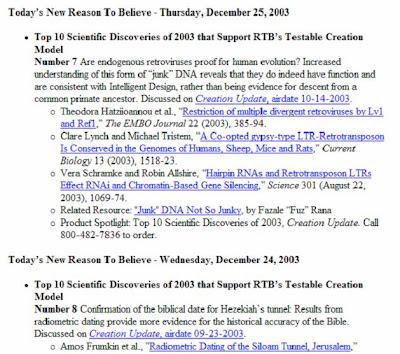
Here is the Reasons to Believe 2003 archives page, as printed on 19th April 2004, kept in a folder for a few years, and scanned in this afternoon:

And here is a screenshot of the same page, taken today:

It’s gone! They removed my paper from their site. It’s still visible in the webcast archives (#7), but it’s gone from their main page.

Thank you, Reasons to Believe, for updating your website after I pointed out that the paper you had cited as evidence for creationism actually supports evolution.

Thank you, everyone who helped drive more than 3000 people to my original blog post last Friday, by linking to my blog or submitting it to reddit (made the top 30!). No doubt this helped get RTB’s attention, and brought this blog up to result #14 (at the time of writing) when you google Reasons to Believe.

Now that we know RTB will respond to this kind of pressure, the onus is on anyone else who has had a paper erroneously cited on their website. I’ll do everything I can to spread the word and any assistance would be greatly appreciated! Contact me via this blog…

Posted in creationism, evolution, Reasons not to believe in lies | 6 Comments

Tagged! I’m It.

Well, I’ve heard of transposon tagging, but I’ve never personally been tagged by an ERV before. Yes, the ‘8 Random Things About You’ game has arrived! I feel so validated.

Here are the rules:

  • We have to post these rules before we give you the facts.
  • Players start with eight random facts/habits about themselves.
  • People who are tagged need to write their own blog about their eight things and post these rules.
  • At the end of your blog, you need to choose eight people to get tagged and list their names.
  • Don’t forget to leave them a comment telling them they’re tagged, and to read your blog.
  1. I am almost embarrassingly excited about the new Harry Potter book. I have it pre-ordered from Amazon and it’s due to arrive on my doorstep on the day it’s released.
  2. My house is full of unread New Scientist magazines. I got a subscription when I left the lab 2 years ago, and it helped inspire me to start writing my own articles on this blog. But now that I’m spending all this time writing and reading blogs, I don’t have time to read New Scientist.
  3. I hate melon. Every kind of melon. Yes, even water melon. I wish I could like it – it looks yummy – and I occasionally try a piece to see if I still hate it. I always do. I don’t even like eating other food that’s been stored in the fridge with a cut-up melon. My Grandma was the same way with cucumber and I think the two species are quite closely related.
  4. I was extremely, painfully, shy at school. I was bullied quite a bit for being a “swot” (like the British for geek/nerd, but with slightly different connotations). Once, when I was about 14, I purposely got some questions wrong on a minor German test. When the scores were read out, I was relieved not to be at the top of the class where I would attract attention and verbal abuse. Instead, I attracted lots of cat calling and “you’re not so clever now, are you? Think you’re so great mumble mumble mumble” comments. Realising I was screwed either way, I never pulled that trick again. I kept my head down, studied hard, and got the hell out of there. At university I discovered beer, and a class full of people who thought being smart was a good thing, and I stopped being so shy. I think I’ve had the last laugh.
  5. My favourite film should be Amelie. That’s what I tell people when I’m trying to sound intelligent. It really is a fantastic movie. But my actual favourite is Indiana Jones and the Last Crusade. Whoever cast Sean Connery as Indy’s father is a genius. I also enjoyed The Prestige, mostly because I think cloning Hugh Jackman is a really really good idea.
  6. My fiance is one of the (probably) very small number of people in the world who have their name in the acknowledgements of a scientific paper as well as in the credits of a movie. I can take partial credit for the scientific paper, but the movie was all his own work.
  7. I used to be really quite decent at the classical guitar. I once did a very short solo in the middle of a group piece in front of around 1000 people (other students’ parents) and didn’t screw up. I would probably still be quite good if I wasn’t so lazy about practising.
  8. One of my biggest regrets is that I never got to see Alan Shearer play for Newcastle United (yes, really). Every time I managed to get tickets (not often, due to price and the necessity of queuing at 5 am), he was injured. I had tickets for a game last Christmas when he was one or two goals away from breaking the all-time club scoring record. The game was cancelled 25 minutes before kick-off due to snow. We were already in the ground, and I got to see Big Al throw a snowball. I would have given anything to be there when he broke that record. Instead, I was back in Canada. I’m depressed now just thinking about it.

OK, who should I tag? Probably people who’ve linked to me in the past. That ought to teach them. I have to run off to work now, but I’ll be adding names to this post soon!

Here we go: Genomicron, Begley Web Log, Science Notes, The Divine Afflatus, Planet Atheism, A Blog Around the Clock, Everything and More, and Monkey Trials (the latter hasn’t linked to me, but I really like the blog) – you’re it!

Posted in meme, personal, silliness | 4 Comments

Fun with yeasty beasties

I’ve always been quite envious of researchers who work with yeast; there are some amazing tools available for microbial genetic analysis that just don’t exist for mammalian systems. You do have to put up with some unpleasant odours in your lab, but it can’t be worse than the smell of baboon colon and it’s usually worth it for the extra publications. I’ve heard that the conferences rock as well.

Trends in Genetics recently published a short paper from the University of Toronto that demonstrates the potential of yeast research. Gabriel Musso, Zhaolei Zhang and Andrew Emili analysed pairs of genes that arose when the entire genome of the Saccharomyces cerevisiae (budding yeast) species was duplicated some 100-200 million years ago. 450 pairs of duplicated genes (known as paralogs, or paralogues if you’re British) still exist in the modern yeast genome.

Gene duplication is a major driver of evolutionary change. A single gene usually encodes for one specific protein that plays a particular role in the cell. Mutate that gene too drastically and the resulting protein will not be able to perform its function, which can be disastrous for the cell. Mutations in essential genes are therefore strongly discouraged, and the gene sequence is conserved by negative selective pressure. However, if a gene is duplicated and gains a paralogous “twin”, then one of the two copies is free to change and experiment with new functions, while the other is conserved and continues to perform its original function. The cell effectively acquires a back-up copy.

100 million years is obviously an extremely long time*, especially for a species that reproduces so quickly. Previous studies had suggested that paralogous yeast gene pairs have evolved for so long that they now produce proteins with quite different functions, as evidenced by their distinct interactions with different protein partners. These protein-protein interactions are incredibly important; most processes in the cell are performed not by single proteins, but rather by multiple-subunit complexes that bring together many different types of protein. Finding two paralogues in distinct protein complexes strongly implies that the two copies perform quite different functions.

Musso et al. decided to re-examine the evolutionary divergence of yeast gene paralogues using updated protein-protein interaction maps. They had at their disposal two recent Nature papers that report the most accurate and comprehensive survey yet of the repertoire of protein complexes found in budding yeast. (This is where my microbe-envy comes in). The Toronto group compared the protein-protein interactions of 158 paralogous yeast gene pairs, and also of 10,000 randomly assigned unrelated gene pairs. Contrary to previous reports, around half of all paralogue pairs were found to map to the same protein complex – a correlation more than 50 times greater than that found between the unrelated gene pairs.

Paralogous gene pairs that mapped to the same protein complex were more similar to each other in sequence than were paralogous pairs that interacted with distinct protein partners. This is a classic example of a correlation that tells us nothing about cause and effect. Does participating in the same protein complex tend to introduce selective pressures that keep the two paralogous copies more similar to one another, or do gene pairs that diverge less through evolution tend to produce proteins that interact with similar partners? The current study can not differentiate between the two possibilities, but I would intuitively favour the latter explanation. The duplicated proteins that have changed the most from the original copy are probably the ones that are out experimenting with new partners and functions, and contributing the most to evolutionary change. I’m sure that these intrepid non-identical twins will have more to tell us about evolution than will those boring old clones that still hang around with the same friends as their brothers.

*as a reference point, the last common ancestor of humans and mice is thought to have lived around 75 million years ago.

Posted in evolution, journal club, original research, science | 6 Comments