A very retro seminar

(now that Big Complicated Grant has progressed to the next stage and I can draw breath again, let’s see if I can remember how to write about anything other than hockey!)

I believe I’ve mentioned in the past that I work in the same building as my postdoc supervisor; this proximity means that I often run into her and other old friends from my old lab. It’s always great to catch up and find out what everyone’s up to, both socially and scientifically, but these chance encounters are never quite long enough to learn many of the details of the latter. I read all the group’s papers when they show up in my automatic PubMed search RSS feeds, of course – just like I still read everything my PhD supervisor publishes, and even have a Google Alert RSS feed set up for news items that mention the company I worked for between my postdoc and my current job – but I very rarely get to hear about their new research directions and work in progress. This is a shame, because they do some really cool work on human endogenous retroviruses (HERVs), virally-derived pieces of our chromosomes that I described in one of my first ever (and still most Google-searched) blogposts – see also two of my favourite papers (published under my maiden name) from my time in that lab. So, when I saw my postdoc supervisor’s name show up on the weekly building-wide seminar list, I transferred the notification email straight into my calendar and was sitting in my customary seat like the eager beaver I am when the talk began.

I found myself surrounded by members of my old lab: a couple had overlapped with me; I’d met some of the others since leaving the lab, through the first two people; and I also got to meet some completely new people, including my former student’s new student! I felt like I’d gone seven years back in time, especially when photos of former lab members who’ve moved on to other cities and countries showed up on some of the data slides. It was a very nicely structured overview talk; the first part stimulated some lovely self-indulgent nostalgia (and even contained a brief mention of some of my own work), while the second brought me up to speed on what the lab’s doing now.

The really interesting part is how much overlap is developing between the HERV field and the main research focus of my main boss in my current job, i.e. using next-generation sequencing (NGS) techniques to characterise the genomic evolution of human cancer (cool paper #1 (2009), cool paper #2 (2012)) both before and during treatment. I’d been interested in this field, which itself represents an area of overlap between my PhD and postdoctoral fields, for a while (and blogged about it here), but didn’t know a huge amount about the nitty gritty technical details before starting this job. When I first joined my current department I asked my new boss whether the dataset described in his 2009 paper could be used to assess changes in HERV mobility and expression as cancer progresses, and he said that it depended on the length of the sequence reads – he thought it might be possible to get a feel for large-scale changes in the activity of families of HERVs and other repetitive elements, but probably not to look at individual HERVs.

Well, sequencing technology has progressed scarily quickly since then, and NGS-based HERV studies are now a reality, despite the technical challenges posed by the sequencing of highly repetitive elements. There had already been a couple of very intriguing studies about the role of HERVs in cancer that used more traditional molecular techniques (yes, I’m classing RNA interference as traditional – deal with it): for example, expression of HERV genes was shown to be required for melanoma growth in mice and in human melanoma cell lines grown in culture and as xenografts. As with multiple sclerosis (blogged here and here), these studies began to question the prevailing belief from my own time in the lab that the activation of HERVs that is often seen in human disease is a symptom, rather than a cause, of cellular disruption. As with so many other fields, NGS technology will really open up the data floodgates – and once all those data have been processed and analysed, we’re going to learn a LOT more about what those awesome-but-dangerous HERVS are up to in our genome. The first such results from my old lab – using some of the same datasets and collaborators as do the PIs with whom I work now – are very preliminary, and I’m obviously not going to blog about them until they’re published. But things look very, very interesting – watch this space!

I’m also hoping that this new research direction will make other groups in my old department take the HERV group’s work a bit more seriously. We were always the only group doing work not directly related to cancer in a department that focused mostly on leukemia and lymphoma, and our trainees’ talks were always noticeably underattended compared to those of the other labs – people just didn’t seem to care much about research so very different to their own*. Judging by the turnout at my former supervisor’s talk, however, that attitude looks to be changing, as people wake up to the scary awesomeness of the virus inside.

~~~~~~~~~~~~~~~~

*I was once chatting to a grad student from another group just before his labmate’s talk began, and he said, as if realising it for the first time, “are ALL the talks in this department as out of your field as your lab’s talks are for the rest of us?” I said “yes, and look at how we always attend!” But it didn’t seem to help much.

Posted in cancer research, career, evolution, genomics, original research, science, technology | 5 Comments

Somewhere there’s a village…

Just in time for the playoffs, a song from CBC’s The Irrelevant Show for all the Canadian hockey fans out there – or indeed anyone whose team, in any sport, has lost any final game in any competition.

Awesome.

Posted in Canada, music, silliness, sport, videos | 9 Comments

Final hockey pool results UPDATED WITH BRACKET INFO

Well, last weekend, this photo somehow got posted on Twitter:

Picture 4

Were the 40% correct? Let’s see!

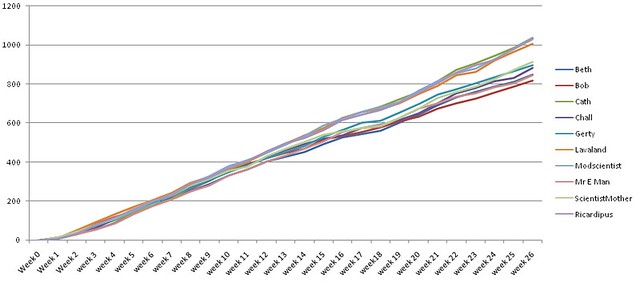
Here’s the graph of everyone’s points from the start of the season until the end of last week, i.e. not including the final week’s points:

Picture 2

The pool separated into two main groups quite early on, with Modscientist, Lavaland, Ricardipus and me fighting it out for the top spot. Having more players this year definitely made things more exciting, as the lead changed hands many times and it was any of the top three’s game right until the final week.

Gerty spent a good few weeks well clear in fifth place, but a strong challenge from ScientistMother in the last few weeks sent her down into sixth. Chall had an excellent week 25, but could she catch Gerty and SM?

Meanwhile, at the bottom, Bob, Beth and Mr E Man stopped changing their picks. At least one of them had excellent reasons for this failure of pool maintenance; at least one of them said “it’s just too much work!”. I don’t know about Bob 🙂

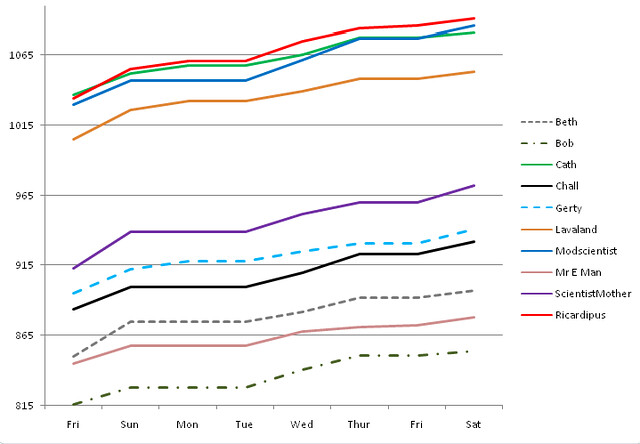
I decided two days into the final week to record everyone’s points daily, but then promptly forgot the next day, which is why there’s a day on the graph below where it looks like no-one got any points. I pulled it together for the last few days though, even as I despaired at my picks and spent a lot of time swearing quietly under my breath as I refreshed the nhl.com scores page (especially last night). I’d taken some variables into account – the number of games each team was playing, which goalies were facing which other goalies, who was still fighting for a playoff spot and who was just trying to get through the last few games without anyone getting injured – but forgot about others, such as teams resting their star players (or at least giving them reduced ice time) ahead of the playoffs. And, unfortunately, it showed:

Picture 3

40% of #vwxpool members clearly had no idea what they were talking about!

Many congratulations to Ricardipus, who was at or near the top of the pool almost all the way through. Well played, sir, and enjoy those bragging rights! Modscientist also played a stormer, as my Dad would say, and her last minute surge into second place spot is well deserved.

THANK YOU to everyone who played, trash talked on blogs and/or on twitter, and especially those who have their own blogs and helped with the hosting duties. It’s been a blast, and we will definitely be doing this again next year!

BUT FIRST, there’s the small matter of the playoffs! I’ll be cheering on the Canucks – President’s Trophy winners AGAIN, doncha know (not that it did us any good last year) – as they take on the LA Kings (hooray for opponents in the same time zone! I hate weekday 4pm starts against allegedly “Western” teams who play in the Eastern time zone).

Thanks to Lavaland, we also have a playoff pool! It’s on the same platform as the regular season pool we’ve just wrapped up, and all players should have already received an email from the CBC with details of how to join the pool – the private group is called vwxpool, password vwxpool.

GO CANUCKS GO!

UPDATE: as well as joining the Hockey Night in Canada Playoff Pool mentioned above, a few of us are also playing in the NHL Bracket Challenge in a league set up by Modscientist. Instead of picking players you just pick the winner of each series and guess the number of games they’ll play. Join up here – group name and password are both hockeysci. 

Thanks Mod!

Posted in hockey pool | 15 Comments

For whom the NHL polls

From the NHL website* today:

NHLpoll

Well I don’t know about you, but I’m convinced!

Looking forward to watching the Canucks-Flames game dahn the pub with Modscientist, Lavaland and Beth on Saturday… 40% of hockey pool contestants agree that it will be AWESOME! (50% are geographically disadvantaged, and 10% can’t make it 🙁 )

Best photo from the last time I watched a game with Mod and Lava:

photo(36)

I’m the one on the right

Second best photo:

photo(37)

Our buddy J stealing Mr E Man’s soul

~~~~~~~~~

*nhl.com is about hockey, but nhl.ca isn’t. This clearly makes no sense at all.

Posted in blog buddies, hockey pool, photos, screenshots, silliness, sport | 4 Comments

CATH GRUMPY

  • Our home internet’s down. It went down on Saturday, and came back on for a few hours on Sunday before the blessed “online” light on the modem went off again. It’s done this a few times before, and always switched itself on and off every two or three hours for a couple of days before sorting itself out – but this time it’s stayed off since Sunday. I called Shaw yesterday, and the earliest they can send anyone out on a weekend is April 21st. They said the tech will probably just replace the modem when they come. Well, can they just send me a new modem immediately for me to try, which the tech can take back if they manage to fix the old one when they eventually show up? No, they can’t. So we’re without internet for almost four weeks.
  • I tethered my iPhone to my laptop yesterday morning to check my work email. However, I’d forgotten that I’d hit “refresh” on my iTunes podcast list just before realising that the internet was still down, and as soon as the phone connected a bunch of huge files started to download in the background, unseen by me. While I was checking my email, my iTunes downloads ate up 92% of my cellular data allowance for the month. My billing period just started, so I essentially can’t use cellular data until April 23rd – I’m keeping the remainder of my allowance for picking up voicemails and any emergency use. So without WiFi OR cellular data access at home, there will be no more Words With Friends, Drawsome, or other fun internet-based games while I drink my morning tea. This makes me sad.
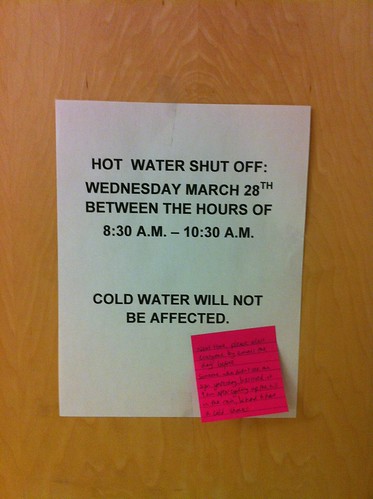
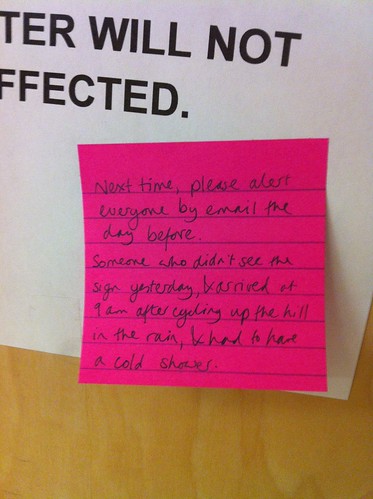
  • This just happened (and yes, I’m the one who left the post-it):

photo(34)

photo(35)

BRRRRRRRRR, BOOOOOOOOOOO, and BAH HUMBUG!

Posted in cycling, first world problems, personal, photos, rants, technology, whining | 14 Comments

Radical reform of peer review and research support, or rearranging the deckchairs on the Titanic?

OR More on the proposed reforms at the CIHR, which I first blogged about last month after taking my first look at the discussion document they published. I’ve since read the document in much greater detail, and also attended an informational / feedback forum held by CIHR at UBC, the university with which my research organisation is affiliated. I took notes at the forum (posted below) for the benefit of the PIs in my department – these notes should obviously be of interest to all CIHR-funded / fundable researchers, but I think there’s also lots of food for thought in there for non-Canadian readers, especially in the section relating to peer review rather than to the specific grant programmes that are being proposed.

Overall, my initial assessment stands that the changes to the peer review system sound very positive IF implemented as described; however, I think they’re going to have to work hard to convince the more sceptical PIs (of whom there were MANY at the forum). I also think that they’re going to need to put more thought into the specific eligibility and review criteria of the actual grant programmes, and a LOT more thought into how to handle the transition – either they haven’t spent enough time on this, or they’re being deliberately vague.

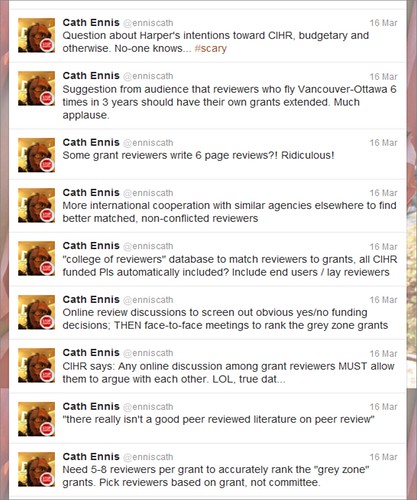
If you don’t want to read the whole thing, here are my tweets from the event – read from the very bottom up to the very top to get them in the right order!
CIHRforumtweets2

cihrforumtweets1

And here are the notes! Fingers crossed for Thursday’s federal budget…

Background: current situation

The changes are apparently not written in stone yet – they’re still gathering feedback. Several members of the audience seemed rather sceptical about this, claiming that the feedback process was just for show…

In the transition from the old MRC (biomedical research only) to the current CIHR the mandate was broadened, but the CIHR does not currently meet that entire mandate. The system is stretched and needs to be made sustainable.

The system is too complex: there are 53 standing peer review committees, whose mandates keep changing. 30-40% of all applications received by the CIHR don’t truly fit into any of the existing committees and have to be “force-fit”; this often results in grants being reviewed by two non-specialists.

The CIHR used to fund high risk-high reward projects, but now funds mostly incremental science (there was some discussion about whether “incremental science” is a pejorative term: the CIHR claim that it isn’t and that much of the science in question is of the highest standard).

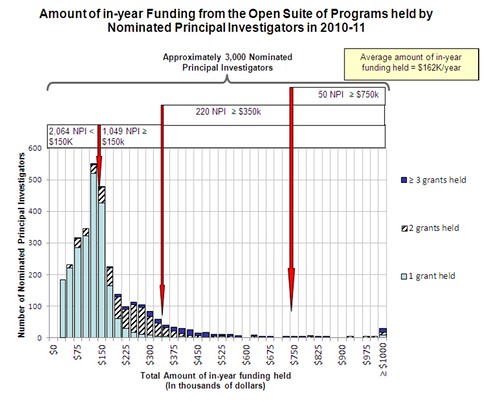
There is a continuum of funding levels among the ~3,000 PIs currently in the system (figure from the discussion document):
CIHR funding specturm


The average grant is around $162,000 per annum, but the range is huge and there is a long tail. Some PIs receive a single grant of $40,000 a year and do very well, whereas one particular PI has 12 grants totalling around $1 million per year.

The CIHR aims to maintain the number of PIs supported through its open grants (~3,000), and maintain this range of funding as appropriate for the different types of research that fall into its mandate.

Changes to peer review

The ultimate aim of the changes is to more quickly identify obvious yes / no funding decisions, thus allowing reviewers to spend more time on ranking the “grey zone” grants in between.

The biggest change would be that instead of standing committees, there would be a “college of reviewers”. All current CIHR-funded PIs, as well as all current reviewers, would be automatically included in a database with very detailed research, expertise, technology and patient population classification keywords. The best reviewers for each grant would be identified through this database by matching reviewers’ keywords with those identified by the grant’s PI. The CIHR Common CV and the keywords sections of the grant application forms are currently being revised to permit more robust self-identification of PIs and of individual grants based on these keywords.

Since other countries with relatively small populations (e.g. Australia, NZ, France) have the same problems as Canada in terms of the difficulty of finding specialised reviewers who don’t have a COI with the grant’s PIs, the CIHR is in talks with its counterpart agencies in those countries to share its reviewer databases and allow any country to use any listed reviewer.

Apparently “there really isn’t a good peer reviewed literature on peer review”, but based on the studies that have been done they would aim to assign 5-8 reviews per grant in order to more accurately rank the “grey zone” grants. Each reviewer should get around 12 grants per round, but these would be shorter than the current Operating Grants – reviewers have been complaining about increasing levels of “bloat” in the number of figures, manuscripts, and other appendices that don’t currently count towards the page limit.

They aim to reduce reviewer burden by moving to multi-stage reviews. The actual number, review criteria, and timeline of these stages would be different for programme vs. project grants, but both streams would involve some form of online discussion before moving to face-to-face meetings for the final stage of discussion and funding decisions. NB ~800/2300 application to the last round scored worse than 3.5 – they’d like to remove such “no-hoper” grants from both streams at the 2-3 page proposal stage. They’ve had lots of complaints about reviewers’ current travel burdens, and therefore plan to have fewer face-to-face meetings than under the current system. They also explicitly stated that any online system would absolutely have to permit reviewers to argue with each other as well as just upload their own reviews J They may also allow reviewers to ask applicants for clarification of specific aspects of the grant.

A grant could have different reviewers assigned at each stage of the multi-stage process, and at resubmission / renewal compared to the original submission. They acknowledged that the latter scenario in particular is not ideal and that all funding agencies struggle with this, but emphasised that funding decisions are always about rankings within each round. They claim that at the NIH, where resubmissions are supposed to go to the same reviewers as the original application, “everyone knows that they usually ignore the original reviews anyway”.

They said they would like to find a way of rewarding reviewers. This generated much discussion. One suggestion that reviewers, perhaps especially those who fly from Vancouver to Ottawa and back every six months, should be given automatic extensions to their own grants. This caused a round of applause (almost a standing ovation, actually), but apparently the CIHR can’t afford it.

Reviews will be more structured than they are now. Apparently some people write 6 page reviews of every grant assigned to them, but the average is 2 pages.

They would like to implement specific training in peer review for new reviewers – online courses, mock review sessions with real grant applications, etc. Some individual departments / faculties already do this, but the CIHR is not currently a partner and would like to adopt best practices from around the world.

There was a suggestion from the audience that there should be an arms-length budgetary committee that meets after the rankings are finalised, to assess the impact of grant budget cuts on each team’s ability to carry out the proposed research –budgets are currently cut by at least 20% across the board, but for some projects (e.g. clinical trials and associated translational studies) this would mean that the project could essentially not go ahead. The CIHR promised to include this suggestion in their internal discussions.

The new programmes

General

Much scepticism was expressed at the notion that the CIHR is not implementing a two-tier system.

NB the amounts listed in the document published on the CIHR website (Programme: $300k per year for 7 years; Project: $125k per year for 3-5 years) are NOT going to be hard caps. There will not be any career limits on the number of grants in either stream for which a single PI can be awarded.

In both streams, a certain percentage of the available funds will be set aside for new investigators, whose applications will compete against each other rather than in the general pool. The definition of “new investigator” in the document they published is “an applicant who has either never applied before to CIHR, or whose last degree ended five years or less before the original competition date”, but this is still being discussed and the definition may well change.

Teams of PIs, as well as individuals, will be able to apply for both types of grants.

The CIHR is in discussions with major institutions about how to structure the “institutional support” aspect of the review criteria, but emphasise that this new section will absolutely not result in any loss of academic freedom. They also stated that this section is not about matching funds, but rather ensuring that all funded investigators have the required facilities / support / capacity to carry out the programme or project.

Programme grants (7 years)

There will probably be one competition per year.

They see this stream as being for people who are “consistently successful” under the current system and want longer term support and less frequent grant applications / renewals. Track record would be a major component of the review. However, there are no “current CIHR support” eligibility criteria for this stream – i.e. you don’t have to have held CIHR funding before to apply to this stream, and there is no upper number of grants currently held that would prohibit you from applying.

You can only hold one programme grant at a time. PIs who are awarded programme grants will not be able to apply for regular project grants as nominated PI, but might be able to be co-applicants on other PIs’ project grants (to be decided), and will definitely be able to apply to selected special / strategic initiatives.

They have been talking about a target renewal rate of 50% for these grants, but have heard LOTS of complaints about the impact of such sudden and massive cut-offs for the unlucky half of applicants, and are therefore giving more thought to this target.

Project grants (analogous to the current Operating Grants)

There will probably be two competitions per year. However, they may have to change this as they would anticipate a massive spike in project grant applications in the first round after the programme grant decisions are handed out.

Transition

There will be at least one full year’s notice of the implementation of the new programmes; they expect to provide the first funds under the new system in 2014-2015.

They haven’t made any firm decisions yet about how the transitional period will work. They will run pilot schemes before making the full switch, and make sure that the needs of people at all stages of the career pipeline are being met – most expressions of concern via the feedback form have been from mid-career researchers (however, most complaints on the day were made by the older members of the audience, from what I saw). They say they will closely monitor the impact of the changes, and tweak the system as needed during the first few years of the new structure.

People with multiple funded current grants might be offered a “smooth transition” to the programme scheme, whatever that means (it was left very vague).

Overall CIHR Budget

The atmosphere got gradually tenser throughout the session – you could sense the frustration by the end. Someone stood up and loudly proclaimed that the CIHR are “re-arranging deck chairs on the Titanic” and that the only solution to the current problems is more money. Several people yelled “hear hear” and things became rather heated.

The CIHR do not know how they’ll be affected by Thursday’s federal budget, and a question from the audience about “whether Mr. Harper’s intentions toward the CIHR – budgetary and otherwise – are honourable” was side-stepped…

Stay tuned!

Posted in Canada, career, grant wrangling, politics, science | 6 Comments

Hockey Pool, Week 25

Well, with two weeks remaining, it just got very interesting! My goalie-fu deserted me last week, and ditching Malkin after his disappointing week 24 proved to be a big mistake as his points contributed to excellent week 25 scores for Ricardipus and Modscientist:

week25points

At the end of week 25 I was just clinging onto the lead by the skin of my teeth, but things have changed since and anyone in the top three (four???) can still take those coveted bragging rights!

week24-25

Lavaland and ScientistMother also had excellent weeks, with the latter leapfrogging Gerty to take fifth spot. There were no changes as the efficient end of the pool; the order of the bottom four looks unlikely to change in the next couple of weeks.

Many thanks to Ricardipus, Gerty, and Beth for the last few updates! ScientistMother will post the next one, then I’ll bring it home with the final regular season update in two weeks time (if I’m not sobbing too much at coming in fourth after leading for so long and/or the Canucks going out in the first round of the playoffs…)

Who’s up for a playoff pool?!

Posted in hockey pool | 12 Comments

“What’s the difference between Mick Jagger and a Scottish farmer?”

Thus begins the last really good joke I heard, several years ago now; answer at the bottom!

I recently realised that I never hear new jokes any more.

I had an actual joke book as a small kid, and my family would share cheesy jokes around the dinner table. My Dad’s thing was always to mix up the punch lines to some of his favourite terrible puns, leading to the following gems:

“My wife’s gone to the Caribbean”

“Jamaica?”

“No, it’s terrible!”

or

“My dog’s got no nose”

“How does he smell?”

“He does it of his own accord!”

etc. We’re used to this behaviour, but outsiders find it most confusing.

Jokes (mostly the immature kind) were ten a penny during high school. Going to university in a different town resulted in the merging of everyone’s local jokes into one big shared melting pot of guffaws and groans. The same thing happened to a lesser extent when I moved again for a PhD, and any major event in those days seemed to spawn a crop of excellent new jokes seemingly overnight; I heard several very dark (but funny) jokes about Princess Diana within days of her death, for instance. And then of course I acquired a whole set of jokes-in-law from Mr E Man and his family.

But now? It just doesn’t seem to happen.

There does seem to have been an explosion of visual jokes recently – Facebook has gone crazy for them in the last few months for some reason, and of course there’s always Chemistry Cat. (This one’s my favourite, but I’ve literally LOLed at a few of them):

funny science news experiments memes - Which Are You?
see more Dropping The Science

But the actual telling of jokes in person seems to be a lost art.

Is it due to the competition from Facebook et al.? (Is it just easier to hit “share” on a funny captioned photo than to come up with, memorise, and pass on a more traditional joke?)

Is it my age or career stage? (The people with whom I interact the most at work are the PIs, who do have a sense of humour (my main boss has quoted several bits of The Hitchhiker’s Guide to the Universe at me over the years, for example) but are highly, highly unlikely to tell me a good joke).

Is it just that I’ve been in the same place for ten years and have heard all my friends’ jokes already? (I don’t think so, because my main core group of friends is always in flux, with some people moving on to a new job in a new town, and others arriving to take their place).

Is a UK / Canada cultural difference to blame? (The timing of my move does correlate with the reduced joke frequency, and my Dad is still the most likely person to tell me a new joke he’s heard, usually from his golf buddies. Unfortunately, most of his jokes are about golf).

Or has Stephen Harper just sucked all the joy, fun and laughter out of Canadians?

I asked Mr E Man what he thought, and he replied that I must just work with boring people; he hears lots of jokes. Why doesn’t he share them when he gets home? Well, they’re mostly filthy and often sexist – two examples (admittedly funny, but definitely unbloggable) sufficed to prove his point (NB there are an increasing number of women in his industry, but none in his particular crew, which explains rather than excuses this behaviour). There was one exception to the rule: a joke about a hippy volunteering to clear the troublesome flock of seagulls from an airport runway using his stash of drugs, seemingly successfully – only for the first plane to take off that day to be brought down by the only bird that was still able to fly. Punch line? (all together now, say it with me): leave no tern unstoned.

What’s your experience? Do you still hear new jokes, in person? If not, why not?

Please preface all comments with your favourite joke.

~~~~~~~~~~~~

So. What is the difference between Mick Jagger and a Scottish farmer?

Mick Jagger says “Hey, you, get offa my cloud”, but the Scottish farmer says “Hey, McLeod, get offa my ewe!”

(Mr E Man told me this joke. He got it from his uncle, who played rugby for Scotland, so please don’t hate me, Scottish friends!)

Posted in Canada, communication, family, fun with language, furry friends, personal, silliness, UK | 33 Comments

That’s a new one

500 uL

Also seen: “five hundred thousand cells”; “fifty micrograms”; “forty eight hours”.

Amazingly enough, I was able to cut the length of the Materials and Methods section by more than twenty one percent >21%.

Posted in career, English language, science, screenshots, silliness | 25 Comments

If George R.R. Martin was a scientist

SPOILER ALERT!

I’ve tried to be as general as possible, but there may be some very minor spoilers in this post for people who aren’t as far through the A Song of Ice and Fire series as I am (I’m about a third of the way through A Feast For Crows). So be careful.

Please feel free to add your own contributions to the list – but please, NO SPECIFIC AND/OR MAJOR SPOILERS!

Right.

IF GEORGE R.R. MARTIN WAS A SCIENTIST:

  • All lab members would bear the sigil of their PI on their lab coats
  • The exact style of each author’s lab coat and gloves would be described in great detail in published manuscripts
  • Any tenured Professor could grant Assistant Professor status to students and postdocs who perform well in gruelling presentations and conferences
  • Plagiarism, data fabrication and other forms of scientific misconduct would be punishable by DEATH, with the sentence to be carried out by the first person to fail to replicate the original findings
  • Your favourite cell lines would be trypsinised just when you thought they were going to start yielding solid data; however, it would be possible to revive some lines from frozen stocks
  • The identity of all clonal lineages would be inferred from empirical observation, rather than via rigorous genetic testing
  • Some scientists who work with model organisms would be able to describe some of their findings from the model’s point of view, giving them an unfair advantage over other labs. This would be especially true of Canadian and Northern European labs, who would gain a further advantage by using transgenic diremice.
  • The shortcomings of the top glamour-mag lab in the sub-field would be described to you in great detail upon joining a new lab, making you hate them with all your heart and hope that someone else manages to scoop them. However, a few months into your project you would start to read some of their papers and learn that they actually have some really nice data, leaving you conflicted as to which lab you would like to see publish in Nature
  • There would be so many gene, protein, organism, method, and cited author names in each manuscript and grant that you would have to constantly refer to an Appendix in order to keep things straight
  • Each successive Aim in grant and fellowship proposals would become gradually more complex, dependent on the successful recall of the previous Aims, and reliant on magical thinking

(N.B. Two or three of the above scenarios may already be in play)

BONUS GEEKAGE: IF J.R.R. TOLKIEN WAS A SCIENTIST:

  • Approximately 5% of every manuscript and grant would be in the form of lengthy and (let’s face it) deathly boring verse or song lyrics. Most reviewers would simply skip these parts and move on to the meat of the text instead, but a significant proportion would just give up and go and read something else instead.

This may well be the geekiest thing I’ve ever written, by the way.

Posted in book review, career, communication, embarrassing fan girl, furry friends, publishing, science, silliness, snow | 37 Comments