A Degree of Betrayal

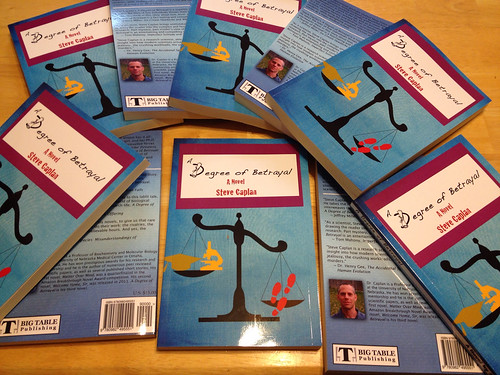
What a week it’s been! My book launch for “A Degree of Betrayal” in now finally underway!

image

I am delighted to report that “A Degree of Betrayal is now officially on sale! This story, part mystery, part literary fiction and part “LabLit” features a strong female protagonist graduate student who appears to ‘have it all.’ Maya Golan is a stellar biomedical science student, with a promising career, supportive husband and even a beautiful new baby in tow. When friction with her graduate mentor, Dr. Alberto Tartulo, threatens to derail her career and that of her partner, an unexpected murder plunges her into desperate straits.

Published by small-but up-and-coming Big Table Publishing, I am certain that “A Degree of Betrayal” is my best novel to date. I have a lot in the course of writing my 3 novels. As a scientist and like a scientist, I believe that I can keep learning and keep improving–and this applies to my fiction writing as well as my science. Standing still and treading water is the equivalent of failure to me, and I am confident that those of you who have read my earlier novels–as much as I think they are great stories–will find that the new novel is on a different plane. At least as for as the actual writing is concerned. I suspect my colleague and friend Dr. H. G. of Cromer may agree with that statement, having read electronic versions of my 3 volumes.

Although the story is, obviously, fiction, my inspiration came in part from the experience of someone very close to me–my spouse. The total control that a graduate mentor has on a student–the enormous influence coupled with the power to make or break a student’s career–leaves huge potential for abuse. Either willful abuse, or simply abuse by negligence or mismanagement. Such abuse could result from anything: pure chauvinism, sexual harassment, a midlife crisis for the mentor, lack of interest in the student’s fate. In any case, I suspect that most students will have encountered such complex relationships–if not with their own mentors, at least through the eyes of fellow students. Part of my goal was to portray this type of highly complicated relationship, between mentor and student.

I would highly recommended “A Degree of Betrayal” for anyone interested in an insiders look at academia and today’s biomedical science. I also recommend it for those who love mysteries and courtroom dramas, and for those of us who are concerned about the treatment of women in science—and in society as a whole.

A Degree of Betrayal” makes a great holiday gift for your students, professors, instructors, technicians, mystery lovers and feminists.

And just for good measure, here’s what a few authors have said about “A Degree of Betrayal:”

“Steve Caplan’s A Degree of Betrayal is a superbly written and crafted story. He takes the lives of five individuals throws them together and then, interweaves them in this story about love, trust, and ultimately betrayal. A Degree of Betrayal is a fascinating and compelling read.”
~ Jeffrey Miller, Ice Cream Headache and When A Hard Rain Falls

“As a scientist, Steve Caplan brings unmistakable authority to this lablit tale, drawing the reader into the complex and fascinating world of biological research. Part mystery, part insider’s view of the research life, A Degree of Betrayal is an entertaining and compelling read.”
~ Tom Mahony, Imperfect Solitude and Pacific Offering

A Degree of Betrayal” is available from the author at: www.stevecaplan.net or

as an e-book on Kindle:

As for me, I already have plans and an outline for the next one, although I suspect it will take me a couple years to see it in print.


Posted in research, science | Tagged , , , , , , , , , , , , , | 1 Comment

Has a career in science become a dog’s life?

A dog's life

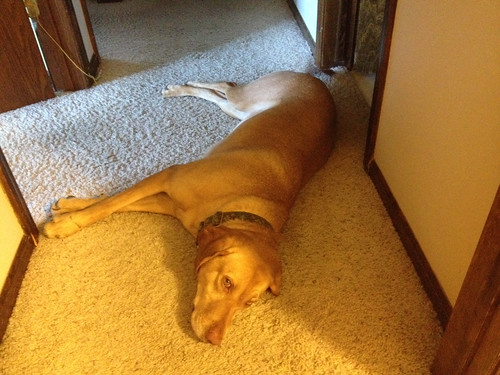
Ginger, after retrieving a gazillion tennis balls on a beautiful Sunday morning.

“A dog’s life?” Certainly a misnomer if I’ve ever heard one; at least for this dog, life is good. Adopted by a loving family, huge walks walks and car rides, tennis balls galore, good food and lots of treats. I only wish a career in science were more like a dog’s life.

Scientists (and I speak of the US, although the trend is fairly global), on the other hand, can only aspire to a dog’s life. Scientifically speaking, most of us are going from “meal to meal,” hoping someone will throw us a bone. Morale is at an all time low–at least since I’ve been in this profession.

Most active scientists today are either losing personnel, or in the process of trimming down. To be blunt, this means letting go of post-docs who are not yet trained to go to the next stage, or valued technologists who are essential for maintaining continuity in the lab. The pressures on the grant system are immense. The so-called sequester in the US, coupled with flat budgets for NIH have led to a situation where researchers are being squeezed from every angle. Salaries of employees continue to increase with inflation, at approximately 2-3% year. There is a concomitant increase in the cost of reagents, equipment, service contracts, etc. And yet the size of the typical government awards has not increased in many years–if anything, budgets are continually being adjusted and decreased. In order to keep the number of awards from dropping.

Personally, I have been fortunate, so far. But the wolves are howling at the door of my lab, too. I recently submitted a renewal proposal to continue a very successful collaborative project with a structural biology colleague–but I succumb to doubts and worries that continually work their way into my brain. Without being able to renew this project, not only will we be forced to part with a very exciting collaborative project, but I will be forced to make difficult personnel decisions for the coming year. It’s nice to maintain an optimistic face, but with real-life people involved–who have families and their own financial obligations–I can’t help thinking that “I didn’t sign up for this.” Well I did, but this is the sad and dark underbelly of being a scientist.

My pessimism comes from my duties on the other side of the coin: grant review. Truth be told, reviewers seem to be doing an extraordinary job in maintaining sanity and struggling to support the very best of science. There is so much good science, but having to rank grants with one another, and knowing that often only the top 10% will be funded (or fewer!)–this means that each reviewer identified her/his top grant, and the others, as great as they may be, will just not make it.

The problem is that the review process demands “high impact” from the proposals, so that the taxpayers are getting their “bang for the buck.” But high impact is often subjective, if not outright impossible to measure. It’s often the dilemma of comparing apples to oranges: can one really compare 2 proposals on different topics–especially if both are written by strong researchers?

To compound things, my perception is that university departments and institutes continue to hire new investigators even though the system is jammed up. And why shouldn’t they? A department’s ranking is measured exclusively by the number of grant dollars obtained. 50 faculty members bringing in $20,000,000 beats 20 faculty members bringing in $19,000,000. In analogy, many researchers’ scientific output is measured by their total publications (however one categorizes impact) and findings, with no accounting for the number of personnel or dollars used for that output. So, hiring more faculty, even with the limited success rate of proposals being funded, makes sense from the standpoint of a university or institute. After all, those who do not bring home grant dollars can always be denied tenure and replaced in a few years with a new crop of eager investigators.

Meanwhile, statistics show that 3 groups of investigators are being especially hit hard by the economic reality of today’s science: 1) New investigators, of whom many simply don’t reach tenure goals, 2) mid-career investigators, particularly those who received national funding and are finding it difficult to renew their first grant, and 3) established investigators who have been funded for many years for solid research, and whose science is no longer considered avant-garde enough to compete.

And if these issues are not enough to depress the average scientific researcher these days (and believe me, they are), it seems as though the past couple of years have seen a huge increase in the demands on researchers’ time. By this, I don’t mean our bread and butter, like serving on review panels, editorial boards, teaching, and so on. I mean pure bureaucracy. Reports, surveys, forms, authorizations, compliance, etc. all seem to have proliferated exponentially. Like adding salt to the wounds. Some days, I’m afraid of opening my email…

What is to be done? The scientific community needs to continue to reach out to the public and advocate the incredible importance of science and biomedical science. To better educate the public and its leaders of the need to support science as a national/global priority. To inform the public of the huge economic boom that science brings, in addition to the obvious and less obvious advances in science itself. But it may also be time for big science to take a close look at its own system, and determine how we can make science careers sustainable and, well, at least metaphorically less like a dog’s life.


Posted in research, science | Tagged , , , , , , , , , , | Comments Off on Has a career in science become a dog’s life?

When the sh*te hits the asphalt

It’s a beautiful day in Omaha, Nebraska. Autumn foliage is spectacular this year, likely due to decent rains and very gradual temperature drops. So I took my favorite dog, and headed off to my favorite nearby lake.

I am a conscientious dog-partner (never “owner”), and I always take a big bottle of water, a dog-dish, and plastic bags–just in case Ginger feels a need to do a dump, as they say in the vernacular. She rarely does–in fact she’s so well trained, that she prefers to hang on for ages and do her business in the allotted area on top of our retaining wall in the back yard. Fortunately, the neighbors have a huge pine tree that “sheds” over this area, nicely blanketing the area every few days in a huge pile of needles.

Ginger after walk
Ginger after our 90 min. (~6.5 mile) walk; if you can tire a Vizsla, you must be in decent shape…

In the course of our walk, however, I became very angry. Well, perhaps this isn’t so unusual–I’ve been known in some circles to have a rather short fuse. Here is what happened. As we rounded Lake Zorinsky, I noticed a narrow asphalt path angling up away from the lake-one that I had never tried before. I knew that it would probably not go very far before merging into a neighborhood, but what the hell–beautiful day, let’s do a little extra walking. Ginger and I made our way up the quiet path, and no bikes or people passed us in either direction. As we neared the neighborhood, two women (mother and daughter, most likely), passed in the direction of the lake with their dog.

When Ginger and I hit the neighborhood, we did an abrupt about-face and headed back down towards the lake–only to encounter midway along this quiet trail, piles of dog stool smack in the middle of the path. Since no one except the two women had passed us in either direction, ergo their canine must have been responsible for the mess. Or more accurately, the two women were responsible. Unusual in Omaha, with so many responsible dog-partners.

Vizsla’s like to move fast, and after ~15 min., I could see the couple about 100 yards down the lake trail. We caught up and slowed, and I removed my headphones. The heavyset woman began to smile up at me, but I wiped it off her face very quickly.

“You know, you really should clean up the mess you dog made on the path up there,” I said as I pointed up the hill to the neighborhood. Truthfully, I was curious to see her reaction, and rather expected a great denial coupled with the pretense of anger at my insinuations.

“I’m sorry, I didn’t see,” she said, avoiding eye contact religiously.

“Well, it’s pretty hard to miss–right in the very middle of the path. Even kicking it to the side of the path would have been better.”

“The dog was behind me; I didn’t notice.”

“That’s odd,” I said. “My dog typically has to stop and squat to do her business. I find it remarkable that your dog could do a dump while you continue walking and don’t even feel a pull on the leash.”

Then I moved towards her with the clincher. “You know, it’s people like you who gave a bad name to the rest of us who have dogs. Shame on you!” And we sped off…

What does this have to do with science? This is my answer to the Graduian trolls: it reminds me very much of microscopy (confocal microscopy). The garbage that some researchers have published (in the name of science) gives the rest of us cell biologists a bad name.

As Henry Baker wrote in 1742 in his book “The Microscope Made Easy:”

When you employ the microscope, shake off all prejudice, nor harbor any favorite opinions; for, if you do, ‘tis not unlikely fancy will betray you into error, and make you see what you wish to see’.

Posted in humor, research, science | Tagged , , , , , , | Comments Off on When the sh*te hits the asphalt

Call for Papers?

A few days ago I received an email from “The American International Journal of Contemporary Research“–now there’s an oxymoronic journal title: American International. Make up your minds!

Apparently, this journal is not good at ‘making up its mind,’ as the call for papers went as follows:

“American International Journal of Contemporary Research (AIJCR) is an open access, peer-reviewed and refereed multidisciplinary journal published by Center for Promoting Ideas (CPI), USA. The main objective of AIJCR is to provide an intellectual platform for the research community. AIJCR aims to promote contemporary research in business, humanities, social science, science and technology and become the leading journal in the world.

The journal publishes research papers in three broad specific fields as follows: [3 BROAD SPECIFIC fields–haha–more oxymorons: perhaps this should be called the Journal of Oxymorons. note by SC]

Business and Economics
Management, marketing, finance, economics, banking, accounting, human resources management, international business, hotel and tourism, entrepreneurship development, business ethics, development studies and so on.

Humanities and Social science
Anthropology, communication studies, corporate governance, criminology, cross-cultural studies, demography, education, ethics, geography, history, industrial relations, information science, international relations, law, linguistics, library science, media studies, methodology, philosophy, political science, population Studies, psychology, public administration, sociology, social welfare, linguistics, literature, paralegal, performing arts (music, theatre & dance), religious studies, visual arts, women studies.

Science and Technology
Astronomy and astrophysics, Chemistry, Earth and atmospheric sciences, Physics, Biology in general, Agriculture, Biophysics and biochemistry, Botany, Environmental Science, Forestry, Genetics, Horticulture, Husbandry, Neuroscience, Zoology, Computer science, Engineering, Robotics and Automation, Materials science, Mathematics, Mechanics, Statistics, Health Care & Public Health, Nutrition and Food Science, Pharmaceutical Sciences, and so on.”

Among other issues, what bothers me are the last 3 words: “and so on.”

In other words, there are no limitations to the actual scope of this journal: everything and anything goes!

Just out of curiosity, I glanced at the editorial board, and of course did not recognize any names from the Science and Technology and so on world. I also poked around to see what kind of papers are actually being published in this “Mother of all Journals.” And yes, I do have BETTER ways to spend my time, but inherent curiosity (and especially the scent of a rat) keeps my adrenaline high.

While I didn’t find any papers on vesicular trafficking–my own field of interest and that of the 2013 Nobel prize winners Schekman, Rothman and Sudhof, I did find this paper on “vehicular traffic:”

Application of Queuing Theory to Vehicular Traffic at Signalized Intersection in Kumasi-Ashanti Region, Ghana
Martin Anokye, A.R. Abdul-Aziz, Kwame Annin, Francis T. Oduro

Well, perhaps that’s why I was invited to submit papers. Some other day. or perhaps I’ll just leave it to John Bohannon

Posted in humor, research, science | Tagged , , , , , , , , , , | 10 Comments

Noble/Nobel Validation

For the past 10 years–my career as an independent investigator–I feel as though I have been swimming against the tide. The science that I was trained to do, the critical thinking and desire to understand the fundamental basis of how cells function at the molecular and even atomic level, has increasingly been attacked as unnecessary. Science on the fringe. Playing around with proteins and molecules for sheer curiosity. Should we expect the taxpayers to foot the bill for grown-ups to play with expensive toys for no real purpose?

This type of thinking, perhaps best illustrated by some of the comments made by former vice presidential candidate Sarah Palin, poses a great risk to the advance of science.

Nobel Prize winner Arthur Kornberg famously wrote:

“No matter how counterintuitive it may seem, basic research has    proven over and over to be the lifeline of practical advances in medicine. Without advances, medicine regresses and reverts to witchcraft.”

By the way, both Kornberg’s son, Roger, and former student Randy Schekman (I’ll be coming to that) also are Nobel Laureates.

But the Kornberg quote remains as true as ever. Despite this, there is ever-increasing pressure on scientists to move to “translational realms.” Well what is there to “translate” if no one structures the language in the first place? I mean, sure it is important to bring drugs along down the pipeline and test them. But if no one is there to understand how things work, then the number of new drugs to test will dwindle and there will no longer be anything to test.

Validation, however, comes in the form of a Nobel prize this year to be awarded to 3 researchers who have contributed greatly to my very own field: that of understanding how vesicles, membranes and proteins are shuttled around within cells–or released from cells. The complex machinery controlling these processes has been studied by a large number of researchers over the past several decades, and advances have been phenomenal. I heartily congratulate each of the 3 researchers, Jim Rothman, Randy Schekman and Thomas Sudhof for their outstanding contributions to the field. Much of their work has driven the field forward for everyone else. At the same token, I could easily find another 10-15 researchers whose achievements in the field could arguably rival those of the awardees.

For me, though, that is not the point. The real value of the award is the validation of this area of basic research–my area. There is a new spring in my step (not because of my orthotics), knowing that after all, progress in my field is appreciated. At least by some.

Posted in Uncategorized | Comments Off on Noble/Nobel Validation

Mass disgruntlement among scientists is growing

This popped into my inbox today, and probably into those of every other American Society for Biochemistry and Molecular Biology member. Life made easy–no need to blog my disgruntlement–it’s all been done for me (see standard letter below). But I have to admit, they did a good job…

Dr. Caplan,

As rumors swirl around Washington that a deal to re-open the government may be imminent, the ASBMB public affairs staff has identified that the remainder of the calendar year is likely to be consumed by debates on federal funding levels and sequester. ASBMB has been a leading voice in the scientific community discussing the damage inflicted by cuts to science funding that began in 2011, and were deepened with implementation of mandatory budget cuts – known as sequester – in March of this year. The sequester of science funding has critically damaged the ability of researchers to advance their areas of study.

As was shown in a survey conducted by ASBMB of non-defense discretionary funded scientists titled “Unlimited Potential, Vanishing Opportunity,” deep cuts to federal investments in research are tearing at the fabric of the nation’s scientific enterprise and have a minimal impact on overcoming our national debt and deficit problems. I hope leaders from both parties in Washington review these findings and join with scientists to say “enough is enough.”

ASBMB offers a tool to members to make reaching out as simple as a few clicks of your mouse. Today’s call to action is different from others, in that instead of simpy writing letters to be sent to officials in Washington, we have created a system that allows you to submit letters to the editors of your local newspapers. This allows your message to be read not only by your local Representative and Senators, but also your friends, neighbors, colleagues and local officials. It is our hope this method will help spread the message supporting growing investments in science research wider than just your local Congressional office.

Click here to get started.

Thank you for your continued support and activity on this critically important issue.

Best,

Jeremy Berg

President, ASBMB

Congress’ reckless inaction on budgetary issues threatens to derail the American scientific research enterprise. Over the past seven decades, this enterprise has made revolutionary advances including sending Americans to the moon, launching the Internet and sequencing the human genome. These and many other advances were due in large part to a strong, sustained federal investment in American scientists and the groundbreaking research they conduct. However, the political infighting that has characterized our government of late is limiting our scientific progress.
The technological and medical innovations that we depend on daily were derived in the labs of federally funded laboratories at universities throughout the nation. From the invention of vaccines to the most recent advances in molecular medicine, federally funded research has resulted in a steadily increasing life expectancy for Americans. Furthermore, smartphones, lasers, global positioning systems and satellite television, for example, were derived from research funded by the federal government.

However, with inflation, the federal investment in American science since 2010 has fallen nearly 20 percent, affecting scientists and engineers in every field of research. Unlimited Potential, Vanishing Opportunity, the analysis of a survey carried out by the American Society for Biochemistry and Molecular Biology and 15 other scientific societies, begins to shed light on just how damaging this faltering investment is for scientists.

This survey catalogs the beginning of a downward spiral that the American scientific research enterprise will struggle to recover from. Of the 3,700 scientists responding to the survey, budget cuts since 2010 have caused nearly half to lay off young scientists or they expect to soon. Nearly one in five respondents are considering pursing their scientific career in countries that are increasing their investment in scientific research, such as Singapore, Japan, Germany and China.

Even now, members of Congress are showing little motivation to reverse these trends. The current continuing resolution being debated represents another cut to federal science funding agencies, as inflation continues to eat away at their budgets. Enough is enough. Congress is free to squabble over specific issues, but it should do so without holding the rest of the federal budget hostage. If we want to understand how the brain functions so that we can improve mental health and head off an impending Alzheimer’s epidemic, then the federal government must overturn sequestration and return to a strong, sustained investment in scientific research. If we want to improve our current fuel sources as well as discover and utilize the alternative forms of energy that will power our society into the future, then the federal government must overturn sequestration and return to a strong, sustained investment in scientific research. If we are open to technologies that revolutionize our society and how we interact with one another, then the federal government must overturn sequestration and return to a strong, sustained investment in scientific research. And it must do so now.

Posted in research, science | Tagged , , , , , | Comments Off on Mass disgruntlement among scientists is growing

Hey, you guys in DC, I’m trying to work here!

Screen Shot 2013-10-01 at 12.18.07 PM

Posted in research, science, Uncategorized | Tagged | 7 Comments

Will the real Edinburgh please stand up?

In continuation of my recent blog about travels to Scandinavia, I will stay with the theme of northern Europe because I have recently listened to several audiobooks whose locale is firmly rooted in Edinburgh, Scotland.

The books to which I refer, each belong to a wider series. There is the Isabelle Dalhousie series of fiction/philosophy/mystery by Allistair McCall Smith, and the John Rebus detective series by Ian Rankin.

I have been to Edinburgh just once, about 20 years ago as a tourist–so I have a vague impression of Edinburgh. But the depiction of Edinburgh by these two excellent author could not be more different!

Rebus is depicted as a stubborn, aging detective inspector, oft passed over for promotion due to his valiant and sometimes self-damaging attempts to get at the truth, mixed in with a little insubordination and inability to curb his tongue. Rebus’ Edinburgh is portrayed as a grim place, infested with corruption at every level, rife with poverty in the ‘estates’ and teeming with unpleasant people. Not everyone, but enough to give pause to the reader. Rankin extends the grim reflection of Edinburgh further to Scotland in general, and in one scene notes through his characters that Scottish drinking and eating habits have combined to give the country the lowest mean lifespan in Europe (perhaps even the western world–I don’t recall). From bar to bar, cigarette to cigarette, there appears to be a general tendency in public institutions to ignore recent smoking bylaws–if one is to believe Rankin.

In Isabelle Dalhousie’s world, Edinburgh is a charming city–more like a town, where everyone knows everyone else. Isabelle owns and edits a philosophical journal that focuses on morality, and McCall Smith manages to bring a wealth of fascinating issues of morality to the table in each book. Isabelle’s boyfriend is a young bassoonist for the Edinburgh Philharmonic, and she is a patron of the visual and performing arts. The city is beautiful, quiet, civilized and polite, with a wealth of culture  for its residents and many tourists.

I greatly enjoy the Dalhousie series, for although Isabelle is not a ‘scientist,’ she is definitely an academic, and issues of authorship, review and publication issues crop up frequently. The series is charming and uplifting, sophisticated and well worth reading for anyone who wants some light but not trivial fiction.

I also enjoy the Rebus series (which those of you in the UK will certainly know that it’s also been made into a TV series), because the character of Rebus is compelling–sometimes overwhelming in the way he can be irritating–but never boring. This is worthwhile reading for those who enjoy detective/crime fiction. Only in recent years is this a genre I’ve come to appreciate (although I read about 50 Agatha Christie books one after another at the age of 8 when I tired of children’s books). I think my draw to detective stories stems from an occasional desire for something ‘light;’ books that won’t zap me of too much emotional matter at the end of a long day.

But I come back to my main question, in which I solicit information from my colleagues across the pond (and Cath!): what is Edinburgh really like? Which author is right, or who is farther off base?

Will the real Edinburgh please stand up?

Posted in science, Uncategorized | Tagged , , , , , , , | 8 Comments

From Omaha to Umea: Adventures and misadventures

Some time ago I was contacted and asked whether I would be willing to fly to Umea, Sweden, and deliver a seminar. Rhetorical question for someone who loves to travel to new places, and had not yet had the opportunity to visit Scandinavia or Northern Europe. In fact, my infrequent visits to Europe (especially compared to S. America, Central America and Israel) are mostly due to economic reasons—the fact that it is so expensive.

umea airport
Umea airport, recently. In fact, a long morning ago.

Let’s see: I have been to London a number times, having considered doing a Ph.D. years ago at the Imperial Cancer Research Center, and later hiking and backpacking through England and Scotland. So cheap that we bussed it from London to the Lake District and then on to Scotland to “bag some Munros” including Ben Nevis. Everything by bus, buying food in supermarkets and carrying it for miles to the, youth hostels to cook it. But great fun.

Later, in my capacity as a scientist, I was invited to several meetings in Italy and Portugal. But unfortunately, that is about the extent of my European travels. Except perhaps a night in Madrid.

So being asked the rhetorical question about traveling to Umea, my answer was obvious—so when do I want to come? Well, they were giving me dates between Sept. through Dec. Consulting the map, I realized that Umea was even farther north than that coldest of cities in which I spent my childhood, Winnipeg. In fact, much farther north. In fact, arctic circle north. I then found out that although I had no fear of visiting Umea in its natural, snow enveloped element, if I flew out in Dec., I might not see anything. The daylight hours, apparently, are about from 10:30 am to 1 pm, more or less. To me that was a lot of ‘less,’ and I opted for September. Temperatures mildly in the mid-teens Celcius with decently long days.

I managed to work in a 24 h whirlwind visit to Stockholm, found a reasonably priced and decent hotel with rather interesting translations in the room, and had a fantastic time walking through beautifully warm and bright Sept. weather.

hotel sign
Good thing I’m a wash-n-wear guy, and don’t have much use for squeezing pieces of rags and ironing boards.

I walked close to 40 km in my lone day in Stockholm, managed to see the famous Swedish Academy of Science where Nobel prizes are awarded, and enjoyed the Old Town (Gamla stan) and the famous Vasa Museum at Djurgarden, where the unbelievably well preserved Vasa ship pulled from the river (after sinking on its maiden voyage) now stands. All in all, a great start.

swedish acad
Visiting purely as a tourist.

Stockholm old city
Gamla Stan, the old city.

The next morning, I took a bus back to the airport, scheduled to fly out of Stockholm to Umea (about an hour’s flight north) at 7:30 am. Thus began the start of my flight troubles. We sat on the runway for 3 hours, along with 15 other domestic planes, because apparently a large poodle had wandered onto the runway and they were unable to catch him. Or her. I don’t want to be biased. I say apparently, because on such a domestic Scandinavian Airlines flight, the crew most likely presumes that it’s unlikely to have non-Swedish speaking foreigners on board, and the play-by-play announcements of the dog’s escapades were kindly translated by a fellow passenger. I emailed my gracious hosts that due to dog troubles, I would be arriving late, and my first meetings would have to be rescheduled.

When the flight finally began to descend towards Umea, I sucked in my breath at the beautiful landscape. Strips of forested land, green at summer’s end, surrounded by blue coastal waters and often sprouting a few isolated wood cabins, sometimes a bridge linking to the next strip of land. For an introvert like me, I thought this could be paradise.

Umea University, perhaps the northernmost university in Europe—or anywhere on the globe (?) is set in a heavily wooded area along a gentle, wide and picturesque river.

umea river

umea flower
Walking from my hotel in town along the beautiful river to the campus.

An unusual but extremely attractive setting, and Umea is apparently a haven for lovers of winter sports, especially cross-country skiing, skating, hockey and so on. And even more surprising, not particularly cold, at least by Winnipeg standards. Apparently both gulf stream and coast significantly influence the temperatures in winter, and the -40 days (same in Fahrenheit and Celcius, don’t ask) of my childhood are atypical in Umea. Snow, yes, but a dry and not severe cold. Hmmm, not a bad combination, and it must be fantastically pretty in winter. I’m told that the snow does not at all deter the thousands who ride their bicycles to the university everyday. I know this isn’t statistical, but I didn’t see an overweight person anywhere in Umea during my entire visit. I’d be willing to bet diabetes and heart disease are well below N. American rates.

clothes pin umea
Umeans have a sense of humor. What is it with laundry and ironing in Sweden, anyway?

In summary, I had a terrific time with wonderful scientist-hosts. I even had the opportunity to sample baked reindeer for dinner, a local specialty. I would love to return to Umea, especially in the winter. But I would not love to encounter the same flight issues I had heading home!

Now for the misadventures part; poodle on the runway was only a warm up…

I left my hotel in the town of Umea for the airport by taxi at 6:30 am for a 7:20 am flight. I was told that even with the 8 min. ride, that was ample time. And it was. I boarded the plane for Stockholm, with a connection to Chicago and later Omaha (all the same long day due to a 7 h time difference) and then waited as the plane sat on the runway for 3 hours with no air-conditioning. Despite the proximity to the arctic circle, it was HOT on the plane.

Relying again on translations from fellow passengers, it turns out that the engine would not ignite. 3 hours of attempts until it was announced that it would be necessary to bring in an expert maintenance crew from Stockholm. By then, about 30% of the passengers had already got off the plane and went back home. My nearest neighbor told me that she already missed her meeting in Stockholm, so there was no point for her to wait for some kind of solution. My own watch showed that—unless my Stockholm-Chicago flight was significantly delayed, I had already missed my flight. Bugger.

broken plane umea
Anyone have a Swedish wrench? My engine is broken…

In the meantime, all the remaining passengers hung out on the runway as one of the agents came back and forth calling passenger names to board the few remaining slots on the next (10:30 am) flight. I guess my status as an international traveler gave me that privilege, and eventually I walked down the runway and climbed up the stairs of the neighboring plane and found a seat.

Arriving, finally in Stockholm way after my flight to Chicago had departed, I was told to talk to someone in the service area. I waited in line for some time, and finally a very pleasant and efficient gentleman arranged new flights from Stockholm to Copenhagen, then to Chicago, and finally to Omaha still in the same day. Just my arrival would be at midnight instead of 4:30 pm. I was pleased, though, as I want to get back to my family.

My next station was to get the newly printed ticket. I walked several km to the place that I was told, only to find a long line. It was necessary to hit a computer screen and get a number. Nothing was moving. Even when occasionally a new number was called, I had B137, and the numbers were all K-series. A local gentleman also in line took a new number and suggested I do the same. I did. I received a K-number, and 15-20 min. later, my number came up. Still no B-series, so it seemed like good advice. However, the agent didn’t think so.

She looked at my number and told me that’s only for excess baggage, and that I had lots of time until my flight and could wait. I patiently explained to her that I had already waited nearly 45 minutes for the agent earlier who had sent me here, and that nowhere in English did it say which button to click on the screen, and that unfortunately my Swedish was not up to speed. She made a few snarky remarks that reminded me of the ‘trolls’ who anonymously frequent Occam’s Corner. And I began to lose patience.

This was the first time in Sweden that I had met someone unpleasant, and I had the distinct feeling that she viewed me as some American cowboy who licks George W. Bush’s boots. I mentioned to her that I am not looking for special treatment, but have needed the toilet for the past 2 hours and hadn’t eaten since 5:45 am. Then I pulled the “S” word—supervisor. If SAS had trouble taking care of its passengers, perhaps I could speak with her supervisor. I got my ticket.

I have to say, for you Europeans, that in a continent so technologically advanced and so considerate of the welfare of its citizens, the lack of restrooms in Arlanda (Stockholm) airport—and Copenhagen too, is pretty mind-boggling. Lines everywhere. There airports are beautiful, wide, architecturally modern, but it’s as though no one intended for passengers to void during their voyages…

By then, I thought I was out of the woods, but no! I made it to Copenhagen more or less on time, but all the passengers were waiting to disembark when the captain informed us (this time in English, too) that the sky-way to connect to the aircraft was broken, and they needed a maintenance team to fix it. I had about 45 min. to make my international connection. 10 min. went by. 20 min. 30 min. Finally we disembarked by manual stairs at the back of the plane (I wanted to suggest the plastic inflatable rafts at that point). Down and up. No elevators, escalators. I was fine with my back pack and carry-on, but how do elderly people fly? I finally got to the terminal and realized I need to get from A to B in 20 min., otherwise I miss my flight. Rather from B to C. I got into speed-walking mode and took off, zipping around strollers and dodging employees on scooters.

It seemed like a long way, and was in retrospect at least 2 km. Just as I was gaining in intensity and could see the C’s coming up, a major and unexpected roadblock. Smack in the middle was a line to passport control. 10-15 people ahead of me, and 1 person working. I snapped a photo of the depressing site.

passport control
Passport control. In the middle of nowhere.

Uggghh. While standing in line, I heard the second “final boarding call” for the flight to Chicago. I had my passport stamped and took off again, with fresh energy. As I approached gates C32-33 (I needed C39), an attendant approached me and said “Hurry up, you’ll miss the flight.” I said, between gritted teeth, “This is as fast as I can go.” She then said. “It’s inconsiderate—you’re keeping all the other passengers waiting.” If I had had a bowling ball, I might have dropped it on her head. The only two unpleasant Scandinavians that I met…

Well, I am firmly entrenched in my seat on route to Chicago, and although we were delayed 45 minutes in take off (so my “lack of consideration” of the other passengers was really meaningless), I should have ample time in Chicago to make my connection. But given the luck I’ve had so far on my return travels, as they say, it’s not over until the fat lady sings.

Final note: It’s almost 9 pm US CST, and I am waiting to soon board my flight to Omaha. Goodnight!

Posted in humor, research, science | Tagged , , , , , , , , , | 10 Comments

Jumpin’ Ginger Therapy!

Ever had a day where you almost wished you hadn’t got up in the morning? Where your computer crashes, your email doesn’t work, you get dumped with 100 different irrelevant bureaucratic busy-tasks, and you wonder why you didn’t become a post-office clerk? If this sounds familiar, you need Ginger Therapy!

What could possibly lift one’s mood more than such a welcome at the end of a lousy day?

Posted in humor | Tagged , , , , , , | 1 Comment