My fair book

steve OPL book fair

Yesterday afternoon I participated in the Omaha Public Library’s annual author fair, featuring (mostly) local authors and their books. The highlight, of course, was my own table featuring the “new genre of Lab Lit” and my 3 modest contributions to the burgeoning field. But there were books on everything from a young man’s escape from south Sudan, to a book about service dogs (featuring two very photogenic and amiable greyhounds who graced the library with an appearance) and non-fiction about the women executives in Omaha’s own Warren Buffet’s organization, and much, much more.

I sold several books, particularly hot was “A Degree of Betrayal,” which takes place in an undisclosed medical center in Omaha. And a great time was had by all…

Posted in research, science | Tagged , , , , , , | 4 Comments

Can’t have it both ways

Over the past 8 months, I have watched with detached interest as the spectacle of the Snowden/NSA scandal unfolded and developed. As with many government-related

r-WHISTLEBLOWER-TEACHERS-large570
A whistleblower, recently. 

scandals,  who is ‘scandalized’ often depends on which side of the political spectrum one sides. Often, but not always.

Since coming to the US nearly 15 years ago, I have learned that there are a lot of what I would define as “strange attitudes” to many issues. The tremendous value placed on human life and its preservation (including the debate on when life actually begins) coupled with the relative ease in people are sentenced to death. And mistakenly sentenced to death in some cases. Somewhat irreversibly.

Privacy is another issue that’s constantly receiving attention in the media. The same media who lust after every last detail of a politician or celebrity’s sex life often raise the flag of awareness about the common citizen’s privacy. It’s not that I think celebrities or politicians necessarily deserve a media blackout surrounding their personal lives – in fact they often flaunt their personal lives in public. When it suits their goals. I’m more interested in what a visitor from another planet might describe as “hypocrisy” with regards to the issue of privacy.

In the case of Snowden, and his famous release of details about the US National Security Agency’s (NSA) surveillance programs, I am not particularly sympathetic to his cause. Certainly I do fear an “Orwellian over-reach” that impinges on my rights as a private citizen. But I also fear terrorism. For anyone who’s witnessed first-hand the horror of mass casualties, privacy becomes a relative thing.

Prior to 9-11, would anyone in the US ever have imagined that passengers would have to remove their shoes before being allowed into the gate area for flights? That machines – apparently capable of detectable our genitals underneath our clothing – would routinely be employed at airports? I suspect not.

Privacy is a relative thing. Closed-circuit TV cameras are ubiquitous across the US – and I hear rumors that they are employed even more ubiquitously in the UK. IP addresses are recorded with every mouse click and opened website. And now we are told that the NSA is listening in to some of our phone calls, reading some of our emails. Do I care? Should I care?

First, I suspect that any NSA agent listening in to my minimal phone calls, or reading my never-ending piles of emails will likely be bored to death. I can barely keep up with the emails myself – so I doubt that the NSA could really monitor very carefully the emails of 300,000,000 Americans (not to mention leaders of foreign nations – whoops, now that is a mistake!). Unless there are a hidden 300,000,000 NSA workers. Clones, perhaps, with one assigned for each US citizen. The math just doesn’t work. So this of course leads to the conclusion that there is a great deal of selectivity in who is being monitored.

Do I trust that the selection is accurate? No. Because such selection is always statistical, based on the likelihood of a person being involved in terror, etc. So yes, certain cultures, religions and ethnic make-ups will obviously be targeted. But if I were/am on such a list, I would shrug it off and say – “I prefer that the NSA targets me so that they can see I have no evil intentions, and that they do their job conscientiously.” And that I understand (if this were the case) that they make this decision to monitor me based on the fact that others of a similar ethnic/religious background have done damage in the past. What else is there to go on?

The key issue is not the invasion of privacy per se; rather, whether the NSA is diligent enough to seek out and process information gained to prevent terror, while at the same time able to ignore and rapidly dismiss irrelevant information on honest people, and thus hone their selection process.

This is a new game – and it’s regretful that democratic countries have had to resort to to these measures. But it’s a necessary evil, and the jury is still out on how the government will strike the right balance with these measures.

Posted in Uncategorized | Tagged , , , , , , , , , , | 10 Comments

Next to (Ab)normal

I’ve had a rough time this week; not just the stress at work, the snow storm here in Omaha, a bit of illness and a young inexperienced driver smacking into the back of our car. It’s more than that. Part of it has to do with a play that I watched this week.

iconsquare34115_0003.jpg.pagespeed.ce.KACV0Z0GyQ

Next to Normal” cast at the Omaha Community Playhouse.

The University of Nebraska Medical Center sponsored the Pulitzer Prize-winning musical “Next to Normal” at the Omaha Community Playhouse, and my wife and daughter and I attended the preview night. While I am an avid patron of the theater, normally (to use that word) I only attend musicals under one condition – when my daughter is in the cast. Otherwise, I tend to yawn and lose interest as soon as the actors open their mouths to sing.

Well, although my daughter recently appeared in another terrific play directed by Omaha Community Playhouse Resident Director Amy Lane  (“Recommended Reading for Girls“), and she acted together with the immensely talented star of “Next to Normal” (Angela Jenson-Frey) in “The Sound of Music” at the Papillion-LaVista Community Theater a few years ago, she was not in this cast. And yet there I was, in the audience, spellbound by the fantastic performances of the 6 actors in the play. Why? What made me give up an evening of reading and writing to go to this musical?

Next to Normal” addresses a topic that is close to my heart – too close, in fact. So close that although the story differs greatly from my first novel, “Matter Over Mind,” the essence and message of the story is similar. The play is about the life of a suburban mother who has been suffering from a psychotic mental illness (loosely diagnosed as bipolar disorder) for the last 16 years, the struggles of her loving husband to help her, and the terrible price paid by her daughter who feels abandoned and angry. As in “Matter Over Mind,” the focus is not just on the patient himself/herself, but also on the impact that mental illness has for other family members – an issue that’s been largely ignored until recent years.

From my perspective, as an affected family member – despite the tears that the show brought to the eyes of many in the audience – I felt that the real-life impact on the surrounding family is even greater than that portrayed in the musical. Yes, the actors and director put on a superb show. The teenage daughter (played by Grace Bydalek) who turned to anger and drugs did an exemplary job venting her pent up frustration with her mother. And of course every patient is afflicted differently; no two cases are the same. Nonetheless, my own experiences with a bipolar disorder parent were far harsher. However, as noted by Omaha World Herald play critic Bob Fischbach:

“The acid test for any cast of “Next to Normal,” a musical about a family coping with mental illness, is how much they make you feel — and how deeply you feel it.”

And the musical dredged up a lot of emotions and difficult memories for me, and even a new revelation or two. I had always been proud that as a child and youth, from 1st grade on through 12th grade I didn’t miss a single day of school due to illness. Well, that’s not strictly true, but it would have been if I hadn’t had my appendix removed. In any case, the reason is not that I am a superman of the type that Cath wrote about recently in The Guardian, immune to all disease (I wish!). No. It’s because I couldn’t bear the thought of being alone with a parent who was so unstable. So much so, that I was able to bear colds and fevers and flus, nausea and pain – just to be out of the house. Anything to be away from an unpredictable parent: the instability of slamming doors and anger one minute, depressed and never coming out of the bedroom for weeks on end, or sky-high mile-a-minute gibberish at other times. At an early age I lost a parent. Not to cancer, or heart disease. But my trust in the parent had dissipated.

Some of this comes across in the dark humor of Matter Over Mind. But every new exposure to mental disorder and the suffering of those close to the patient further unravels the onion peel that has surrounded my soul. Apparently, “Next to Normal” achieved its goal for the audience. It did so for me as well.

If you have a chance to see this musical, don’t miss it.

Posted in science, Uncategorized | Tagged , , , , , , , , , , , | 2 Comments

Lab Lit on the map!

A couple weeks ago I traveled to Purdue University to deliver 2 seminars. The first one, the “original invitation” was from the Dept. of Biology and was entitled “Lessons on the Biogenesis of Tubular Recycling Endosomes.” The second one, if I am not mistaken, was sponsored by the Dept. of History with involvement of the Departments of Literature, Communications and Jewish Studies, and was entitled “Lab Lit- the new genre of Laboratory Literature: do scientists and art mix like oil and water?”

scientist-n

My spouse’s paper mache version of a scientist.scientist-n-back
Scientist-from the back. And YES, in case you were wondering, she takes personalized commissions for any event/gift, and can ship them without breaking! Tell ’em you saw it on Occam’s Typewriter…

In any event, it’s certainly not my notoriety as an author that led to this exciting opportunity; my friend and colleague, aware of my writing hobby, lent some of my books to a friend and colleague of his in the History Dept., and the rest is–as they say– (beware of another bad pun) History…

My arrival in Indianapolis (for transport out to West Lafayette, IN, where Purdue is located) did not bode well. When I turned on my iPhone as the plane landed, I was met with a ton of emails, text messages and phone messages asking about my safety–as an active shooter had just killed a student/teaching assistant on campus, and there was a lock-down. My host, being locked-down, had also called to warn about the likelihood of being late to pick me up. I have already spoken my mind on the issue of gun violence, so I won’t repeat myself in this blog.

It was cold in West Lafayette, but despite the tragic circumstances, my hosts were wonderful and I had a great time, scientifically, culturally and socially.

The Lab Lit forum was tremendous fun, and despite the university being officially closed for classes, was well attended with a full room of scientists, humanists, history, literature and communications experts. I presented a little Power Point feature on Lab Lit, emphasizing that science and art can be symbiotic, and there was an avid discussion that went on for about 1.5 h–until I needed to get over to another building for my science talk.

Here at the end, I will post a few of the slides that I used (as I promised to Jenny)–without, of course, my well orchestrated animations. But before I do so, I would like to bring up a really nice perspective that was articulated by my host from the Dept. of History, Dr. Ariel de la Fuente. In the course of the Q & A, there was a lot of talk about how one can manage to simultaneously deal with such apparently disparate enterprises such as science and art.

I admitted that the emotional involvement in running a research lab in today’s competitive environment does make it tough to take on longer term commitments, such as writing novels, but that at the same time, it’s often a breath of fresh air for me. I also noted that occasionally fellow scientists had raised eyebrows and gone so far as to query “Well if you can write cogently late at night, shouldn’t you be writing more grants and doing more science?”

Obviously, that misses the point, if one wants to consider that despite our absolute dedication to science, we are not scientific machines. And that to be really creative and do top-notch science, one needs to step back and look at the big picture–to view science from a fresh perspective. One of my tricks in writing science (and literature) is to write a grant proposal, and put it away for 10 days without reading it. It’s remarkable how much insight can be found as opposed to reading and rereading it twice a day.

Which brings me to the comment of Dr. de la Fuente, who in his wisdom pointed out the process of writing fiction–especially Lab Lit (as well as blogs about science and society) has additional value: it has an impact on me as a human being, as a leader of my lab, as a motivator and pseudo-psychologist. For which, of course, I have never had any formal training.

The point was well taken: science is not merely writing grants and papers. It is successfully motivating a group of students, post-docs, technologists, etc. It’s a lot more than that really, but in any case, the main idea is that the process of writing leads to self-reflection – a process which enriches me and therefore improves my suitability, credibility and viability as an effective principal investigator. I couldn’t agree more.

Slide01
This was the first “scientist” that my spouse created, and I won’t let her sell him!

Slide02
A superb example of the ingenious creativity of a scientist!

Slide03

Slide04

Slide05

Slide06

Slide07
Of course, the old self-plug…

Posted in research, science | Tagged , , , , , , , , | 2 Comments

Shulamit Aloni (1928-2014): The Death of a Giant

With great sadness I submit this short post on the recent death of one of my heroes: Shulamit Aloni. As an Israeli politician and winner of the Israel Prize for her life’s work, she is perhaps best known as a fighter for human rights, civil rights, women’s rights, the rights of minorities, the promotion of pluralism and anti-religious coercion, and of course her goal of obtaining a just and lasting peace with her Palestinian and Arab neighbors.

Unique to Aloni was her ability to fight for so many goals simultaneously, without ever losing sight of her other commitments and aims. She was remarkable in the energy she brought to Meretz, the political party that she founded (and that I consistently voted for) and actually won ~10% of the popular vote in 1992.

Aloni stood up to the religious parties and fought hard for a more democratic Israel, an Israel that would give women and minorities equal rights under the law. She never backed away from threats and was a beacon of humanitarianism. She fought for the weak, the oppressed and the underdog. She was attacked, threatened and cursed, and nothing deterred her.

When Aloni took over as Minister of Education in 1992, I was a Masters student in Immunology and Biochemistry. There was an immediate change, like a breath of fresh air that permeated the universities at the time. It smelled like hope, and Aloni did not wait long to begin promoting education (and its funding) from preschool on through graduate school. Unfortunately, within a year the religious parties banded together and forced her resignation for…being Shulamit Aloni and standing up against religious coercion in Israel.

Despite its reputation as a country with strong science–especially for its size–Israeli governments have typically underfunded basic science in Israel. In a 1999 article in Science, Richard Stone examined then Prime Minister Netanyahu’s outlook on basic science:

“Israel’s strength is applied research,” Netanyahu [then and now Prime Minister] told Science. “The country is too small [to devote more resources to basic research].”


Aloni disagreed, and her vision of enhancing support for basic research–perhaps at the expense of supporting Yeshiva students (orthodox religious students who are to this day heavily subsidized in their studies as long as they remain students and stay out of the workforce)–is still very much in the public debate.

Aloni was a giant; a product of another generation that held education–broad and general education–above all else. She fought for the country first as a soldier, and later as a politician. She was a scholar and a woman of many talents. Above all, she represented ME, and I regret to say that the world will not be the same without her.

Posted in Education, research, science | Tagged , , , , , , | 2 Comments

Critical Mass–a massive mystery and modicum of Lab Lit

Now that I have published “A Degree of Betrayal” and am officially a writer of a mystery novel–even if it is not purely a genre novel–I am actively devouring all types of mystery novels. So please, I welcome suggestions!

I began to read adult books at an early age; too early perhaps, because my family finds that I have serious gaps in the realm of young adult books and children’s classics. That’s hard to overcome, because I don’t anticipate returning to fill in those gaps any time soon.

In about 3rd grade (8-9 years old) I began reading my first adult books. I read an Agatha Christie Poirot mystery, and then bulldozed through the next ~50 Agatha Christie novels in a short span. I moved on to historical fiction of the Michener type, and from there it’s been almost exclusively literary fiction for the past ~40 years. So until the last few years, I have led a sheltered literary existence with regards to mystery novels. However, of recent I have found a number of outstanding authors who write mysteries that are truly literary fiction–the mystery may enhance the story, but the writing is so good that I can hardly call them ‘genre books.’

One such author is Sara Paretsky, whose PI (private investigator as opposed to principal investigator in the Lab Lit world) creation is V.I. Warshawski, a determined feminist detective whose loyalty to her clients and the truth–and unwillingness to yield to the privileged and corrupt–sets her apart from other detectives.

I have enjoyed reading through most of Ms. Paretsky’s novels and am continually amazed at the wealth of characters she brings to life, and their stories. She does not shy away from any topic, and at least two of her novels return to World War II and the Holocaust. In her most recent novel, Critical Mass, she again returns to aspects of Holocaust as a central theme in her book. But from a very unique angle.

I do not intend to do a book review of Critical Mass, because: 1) I haven’t completed the novel, and 2) It is simply outstanding and no review will do it justice. In fact, one of the reasons I am getting through it so slowly is because there are so many threaded bits of interesting information on the nuclear physicists of the time, fictional as well as real ones, such as the great Fermi and others, that I find myself continually putting the book down–reluctantly–and searching online for more background information.

An important part of the novel deals with Uranverein, the German program to develop nuclear weapons during WWII. Jews may have been inferior beings that needed to be gassed to death en masse to prevent their contamination of Europe, but a number of them were apparently kept alive–just barely, being starved and beaten–explicitly to advance the German goal of obtaining nuclear weapons.

The history of the Uranverein, and why the Germans–with such a head start and brilliant theoretical physicists (led by Heisenberg)–made such little progress (fortunately) is fascinating. Although it has been claimed that Heisenberg perhaps did not want the Nazis to obtain a nuclear weapon, some scientists and science historians such as Jeremy Bernstein–who wrote “Hitler’s Uranium Club-The Secret Recordings at Farm Hall,” were not convinced. Bernstein’s take on the matter was apparently more in line with the idea that although Heisenberg claimed he did try to use his position to find out about the fate of a number of Jewish scientists, the main reason for lack of progress was that he was primarily a theoretician who lacked experience leading a big project. I guess the Uncertainty Principle applies here…

It is clear that there was a tremendous race at the war’s end by the western allies to round up the top German scientists–engineers and rocket scientists, as well as nuclear scientists–before the Russians got to them. It is also clear that some of these scientists and engineers–as much as they have have pretended–were more complicit with the Nazis and Nazi crimes than they may have needed to be. In other words–and I have no doubt of Ms. Paretsky’s accuracy on this issue–they may have identified with and relished Nazi treatment of Jews far more than was needed strictly to stay alive and out of trouble in the course of the war.

As always, and as a central theme in Paretsky novels: those with advantaged backgrounds, money and power are often adept at twisting the truth to resist responsibility. As an underdog myself, I identify with Ms. Paretsky 100%.


Posted in research, science | Tagged , , , , , , , , , , | 22 Comments

Open Access and the self-forming journal hierarchy

I recently posted a piece on Occam’ Corner explaining why I think instituting radical changes in science publishing should not be a major focus of scientists at this juncture. As those who have read the post will realize, my point is that we scientists need to band together to impress the public – and the politicians – that we are losing a generation of young scientists right now due to inadequate funding. And we may be on the verge of losing a mass of researchers from middle and senior levels as well.

But let’s be optimistic; suppose funding improves greatly over the next few years. What would I then propose?

I do support the idea that a scientist’s career should be judged by one’s contributions to science – and definitely not arbitrarily calculated by something as irrelevant as an  “impact factor.” It does not make sense to credit someone merely by their publishing in a big name journal – a “super-journal” – as the trio of Cell, Science and Nature are frequently known. Credit should be given for publishing quality science – I agree with that altogether.

However, I sense that there is a level of naivete surrounding the desire to “level the playing field.” I’d like to raise some of my concerns with certain aspects of open access publishing that worry me.

First, in the interest of full disclosure, I serve as an editor or editorial board member for 4 journals: 2 are open access (PLoS ONE since 2009 and Scientific Reports), 1 is a ‘society journal’ that belongs to the American Society for Biochemistry and Molecular Biology (Journal of Biological Chemistry) and the 4th is a new journal called Frontiers in Cell and Developmental Biology. I have every interest in seeing open access journals thrive, and I spend long hours supporting these journals.

Having made my disclosures, I will now say that the open access journals are currently in the process of setting their own hierarchies. I don’t see this as wrong or bad; it’s natural. Science is competitive, and everything science-related will ultimately be drawn into a cycle of competition. So for those who believe that their careers have been ruined or impaired by not publishing in top tier journals – news flash – open access will not change the attrition in the tenure system. Researchers may not be weeded out for not publishing in Cell/Science/Nature (and that’s a good thing), but other hierarchies will likely take their place. Perhaps more emphasis will be placed on research merit. Perhaps. One would like to hope. But a new hierarchy will ensue. It is already happening.

Every other day I receive requests to serve on editorial boards; mostly for new open access journals. Some journals – e-Life for example, have assembled editorials boards comprised of well-known scientists. These journals will attract submissions and be considered “high impact journals” – even if no ‘impact factor’ is ever calculated. Other journals will slide to the bottom of the totem pole – or already inhabit the bottom of the pond. I have seen one such journal that has a message from its editor-in-chief on its website. The message is replete with typographical mistakes, spelling errors, bad grammar and awkward language. Would anyone take a paper published in such a journal seriously? I’m sorry, but I would not.

Another fine example that highlights the complexities in the publishing world is illustrated in an e-mail request that I received yesterday to review a paper for an open access journal. With my expertise in membrane trafficking and endocytosis – the cell biology of how proteins get from point A to point B within the cell – I was shocked to find a request to review a cardiology paper dealing with electrical pulses in the mouse heart. Just to make it absolutely clear: I don’t and never have done any mouse physiology/cardiology work, and certainly have no expertise (or even much knowledge) in that area. How desperate can a journal be? How bad can the editorial process and peer review be? Pretty bad, I surmise. Unfortunately, this was not the first – or the second – such odd request to review a paper that I’ve received.

I’d also like to delve a little deeper into the issue of hierarchy – but this time examining why hierarchies tend to form, even within the “good” journals (leaving out the super-journals). Here is my personal perspective, which although true in my field, may well not reflect all others in science.

A quality science publication typically consists of one or more novel finding that advances the field. A mere collection of data – while it may well merit publication for its usefulness to others – is typically not considered the strongest form of publication. Of course if the method is new, or a huge amount of data has been compiled, such a publication may be considered more meritorious. However, generally publications that follow a ‘story’ – that develop and address a hypothesis or series of hypotheses and strive – as much as possible – to make sense of our universe – are those that are most appreciated.

In my field a simple example would be the following: if a researcher identifies (by one method or another) a new interaction between proteins – and then carefully ‘maps’ the interaction to discover how this binding occurs – that could merit a ‘no-frills’ publication. However, if the researchers are able to take the next step, and figure out the significance of that interaction – what the physiological ramifications of this interaction are – that would clearly enhance the merit of the study.

In the field of my wise and respected colleague, Dr. Stephen Curry, solving the crystal structure of a protein is often the standard for a basic publication. A study that reports solution of a complex of several proteins together, or has perhaps made predictions based on a solved structure and tested them – in the realm of structural biology such a paper would have enhanced scientific merit.

Now certainly from the examples above, if both such types of papers are published in the same journal – the more ‘basic’ and ‘deeper’ types of papers – discerning readers will realize that the latter studies (for each example) have more merit. But if there are journals with more established scientists on their editorial boards, they will be more likely to draw submissions (and accept submissions) of the latter type. Inevitably, like a self-forming gradient, journal hierarchies will arise – whether the journals are open access or not.

I don’t have a perfect solution; in fact, I’m sure there isn’t one. Those who know me understand that I am anything but a procrastinator, so my indecision on how to settle this debate is both atypical and symptomatic of the inherent complexities. I need more time to think – but during that time, I am committed to preventing the loss of another generation of scientists from our ranks. So please, let’s fight for the funding first – that’s where the consensus lies.


Posted in research, science | Tagged , , , , , , , , , , | 5 Comments

Gunning for a better life

It’s been over a year since the massacre at Sandy Hook Elementary School in Newtown, Connecticut, and little remains of the resolve that seemed to develop within the American public to “do something.”

guns

I was taking advantage of glorious weather today, 60 deg. F, to take Ginger the dog for a great big 2 hour walk when we happened on this remarkable billboard sign.

For those whose eyes are not what they once were, the sign reads: “GUNS SAVE LIVES” and the Nebraska coalition for gun owners apparently paid for it.

Cynical? You bet. Doctors save lives. Nurses save lives. Antibiotics and medicine. Polio and tetanus vaccines. Biomedical research. Seat belts. Reduced smoking. But guns? Seriously?

Let’s examine this statement. Do guns save lives? If you are a police officer and being threatened by a criminal – then I suppose your weapon could save your life. If you are in the military and in a combat role – yes, I’ve experienced that. Possession of a working rifle can definitely help keep one alive. But these are extreme situations and reserved for those in uniform. How about your average run-of-the-mill citizen?

The answer, resoundingly, is that guns take many more lives than they save. No amount of cynical billboard announcements can change that fact. In Sept. 2013, Michael Luo and Mike McIntire of the New York Times published an article examining the under-reporting of gun-related deaths among children. This horrific report, detailing the massive numbers of accidental deaths and their causes (lack of parental supervision and improper storage of weapons) do not jive with the motto that “Guns Save Lives.”

Sure, one could envision an isolated scenario where a burglar or home invader is repelled by a responsible gun owner – but these instances are few and far between – and dwarfed by the massive numbers of gun accidents, not to mention intentional gun violence. But all these issues, as true as they may be, are beside the point.

As an advocate of gun control in the US, I know that there is no chance in my lifetime to make the US a gun-free society. I give up. I don’t even want to try. But it’s the simple, sensible measures that one would expect even gun owners to support that defy logic. Automatic military-style rifles? Are they required for self-protection or hunting? Anyone who says yes would probably also support the freedom to own hand grenades and rocket-propelled grenades (RPGs).

And what about sensible legislation? Should owners not be responsible for locking up their weapons? If a child gets his (and in 90% of the cases it’s really boys) hands on such a weapon, should the adult not be held accountable? Shouldn’t there be background checks to ensure that gun purchasers are not felons and don’t have acute schizophrenia? Shouldn’t gun owners support these very minimal modifications to the law that would make their own children and families safer? That would reduce the likelihood of accidental deaths or deaths caused by imbalanced persons? Wouldn’t fewer gun deaths reduce the pressure from those who would like to abolish guns altogether (as futile as that is)?

It’s high time that sensible leadership surfaced from the side of those who believe in their intrinsic right to bear arms. All that’s needed is a modicum of sensitivity to a problem that continues to take lives. But the posting of billboard signs that claim “Guns Save Lives” shows an intransigence that is both cynical and unreasonable.


Posted in Uncategorized | Tagged , , , , , , , | 1 Comment

A study of Ginger using live-image analysis

I have recently added a new title to my signature: that of director of our institute’s microscopy facility. One of my goals is to upgrade our capabilities and acquire a microscope capable of super-resolution; that is the ability to differentiate between particles that are as close as ~20 nm to one another–about 10 fold better than traditional light microscopy methods. I am very excited!

But here I’d like to demonstrate a classic live-image experiment carried out by my kids. Ginger is allowed on their beds, but not on the sofa in the living room.

Feel free to jump to 1 min 23 secs, to see when the action starts…

Hypothesis: Ginger naps on the sofa as well as the beds.

Methods: Live image analysis was used to monitor Ginger’s behavior.

Results: See for yourselves!

Conclusions: Dogs are smarter than humans.

Posted in humor, research, science | Tagged , , , , , , | Comments Off on A study of Ginger using live-image analysis

A week of betrayal

Winter has finally arrived here in Nebraska; from mid-50 degree F weather just a few days ago, we hit a chilly low of 1 degree F early this morning. Even some of the local youth actually abandoned their gym shorts for jeans, surprising as that may seem. Trying to make it up to Ginger-the-dog for not having gone on an outdoor walk these past few days, I took her out for a 15 minute walk and we both returned nearly frostbitten.
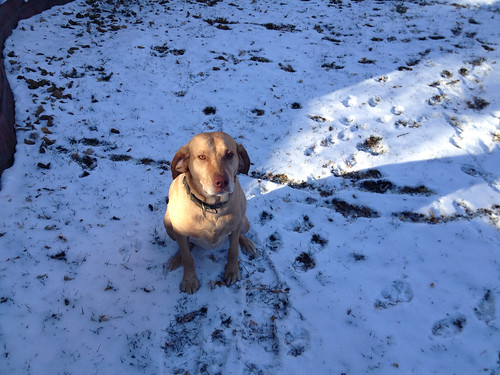
Ginger in snow
Cold as a witch’s…

In the lab and my office, however, things are heating up. Preparations for the annual American Society for Cell Biology meeting which I will attend with 2 of my students, this year for the first time in New Orleans. Posters. Student fellowship applications. Teaching. Writing exams. Grading exams. Reviewing papers. Writing papers. Reviewing grants. Writing grants. Committees. Meetings. More committee meetings. And so on. But the science is exciting, and despite the dismal odds at getting grants funded these days, the adrenalin of novel discovery spurs me on.

These are also exciting times for me, as I’ve blogged recently about the launch of my new Lab Lit novel, A Degree of Betrayal. Subsequent to my Occam’s Corner promotional blog last week, I found myself in the rare and somewhat surreal position of being sold-out and having to put potential paperback sales on ‘back order.’ For those interested in aspects of publishing, especially with a small publishing company, it is interesting how this situation arose.

To start with, some statistics: I launched an upgraded personal website in conjunction with publishing the novel. I previously had an antiquated system with a counter (to measure traffic) that might have been designed in the middle ages. So when I was offered a system that uses WordPress, just like our own Occam’s Typewriter–with proper statistics and a host of other advantages–I grabbed it.

I found that preceding the book launch, I was averaging ~50 visitors and 75-100 visits per day. However, as surprising as it may seem (and despite the usual droll troll comments), at least several people must have actually read my post–and then, actually taken time to click onto my website–and even–yes even–purchase copies of the novel. Paperbacks and Kindle.

In fact, one week after my Guardian post, statistics show that I racked up well over 150 referrals that indicated visits directed from The Guardian post. More spectacularly was the huge boost in daily visitors and visits at my site, which climbed to about 200 visitors and 250 visits by the end of the day.

Screen shot 2013-11-29 at 3.08.16 PM
Graph demonstrating an increase in visits on the day of the Guardian post; at the time I did this screen-save, we were only 3/4 of the way to the peak.

Although I didn’t take another screen shot since last Friday, this effect has continued to stimulate swelling all week (about 2-fold above the ~50 visitors/day), although things are gradually decreasing back to pre-Guardian post levels.

Now, unlike the situation with my previous novels, my publisher strongly encouraged me to sell autographed copies from home (in addition to Amazon sales, of course), because this is the most profitable method of sales. Indeed, the royalty for me on a self-sold novel reaches $8, in the absence of any discount. (Which reminds me, I offer paperback versions of A Degree of Betrayal for $12 for any of my Occam’s Typewriter friends or readers–just use “OT” as your code…).

But back to the narrative: I found myself very quickly, and unexpectedly without any stock to provide for customers. So I hurriedly had my publisher order another 4 boxes (about 100 books), and I waited with growing anxiety for the United Parcel Service (UPS) to deliver my books. The last thing I wanted was for readers to cancel orders because they were afraid they wouldn’t arrive on time to be given as holiday gifts.

I carefully tracked the books as they shipped from Charleston, South Carolina and moved west toward the great plains. And everything moved smoothly, on schedule. But then–I suddenly noticed that the address listed for delivery was inaccurate–it was missing my street number. Oh no! But that should be easy to fix–with such an organized, digitized and efficient system such as UPS. Just call in and correct the address–or even do the online chat thing, right? Wrong!

It turns out that the incorrect address cannot be changed until it is actually out on a truck for delivery (don’t ask me why-it doesn’t make any sense). And if one misses that special and narrow window–oops, the package may end up getting shipped back to Charleston. Many phone calls and many online chats later, I finally managed to get them to HOLD the shipment at the UPS facility way out at the south eastern tip of Omaha, so that it would NOT go out for delivery (to the wrong address). My plan, brilliant as it was, was only met with partial success.

I showed up at the facility in the morning, anxious to collect 4 boxes of my novels and head off to the lab. Inside, I showed my ID and received a single box. “Where are the other 3?” I asked. “On the truck” was the answer. Why, when I put a hold on it? Would that mean I’d have to keep showing up at the facility to try and track my other boxes every day lest they be returned to Charleston?

I hauled the heavy box to my car and then realized that I needed some stock in my office at the lab. Using one of my keys, I ripped open the box, and to my horror (no pun intended), I found this:

forsaken

Forsaken, God-forsaken, whatever. This did not help my blood pressure…

Not knowing what to do with a box full of young adult romance novels, I shoved it into the trunk of my car and resignedly got into the driver’s seat. “Steve,” someone called. I looked up, and a UPS man held another box. “We found another box for you. The others are on the truck.”

With little hope remaining, I opened this one, too, only to find:
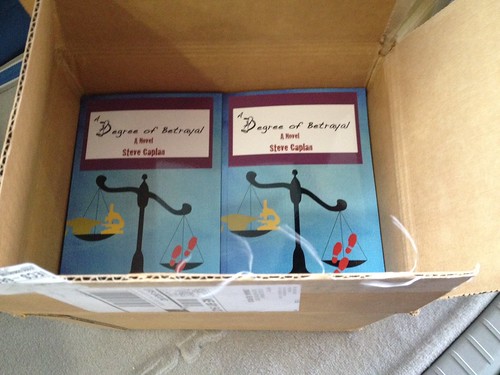
adob
YAY! At least enough to keep the masses at bay…

When I arrived home later that day, wondering if there would be: a) no delivery, b) delivery of 3 boxes of A Degree of Betrayal, c) delivery of 3 boxes of “Forsaken,” I found that the correct answer was none of the above. On my porch sat no less than 6 boxes: YES, my other 3 boxes of A Degree of Betrayal had arrived! But along with them, so had 3 more boxes of books by the YA author.

So how does one return these boxes so that they can be shipped to their author? Not so simple. Let me replay a little online chat conversation with UPS after the publisher sent me prepaid labels to affix:

Jasmine O.: Hi, this is Jasmine O.. I’ll be happy to assist you.
steve: hi, yesterday i received 4 boxes that arent mine, the company sent me labels for return. can i schedule someone to pick them up from my porch tomorrow
Jasmine O.: Thank you for bringing this to our attention. May I please have the tracking numbers?
steve: Of the return labels?
Jasmine O.: Yes, may I have one of the tracking numbers from the return label?
steve: XXXYYY
steve: AAABBB
steve: CCCDDD
steve: YYYZZZ
Jasmine O.: Thank you. Just a moment while I look into that for you.
Jasmine O.: I have checked and it seems the company CREATESPACE  has pre paid the shipping charges for the packages, however the pickup charge has not been covered. A pickup can be scheduled for a fee. The pickup charges can actually range between $5.00 to $14.00, depending on the location for pickup and the pickup date. Also the packages can be dropped off at a UPS location or if you happen to see a UPS driver you can hand him or her the packages at no cost.
Jasmine O.: Have you had enough time to review the information?
steve: Well, I did not make the error. It’s not my package, so I don’t intend to pay anything, and the boxes are heavy, so I am not going to lift them.
Jasmine O.: I completely understand that. In this case, I can suggest contacting the company CREATESPACE, to see what other options they can offer you.


One must understand that my publishing company, Big Table Publishing Company, has the books physically printed by another company called CreateSpace, which is owned by Amazon. And my publisher was the one who brokered the deal to get the UPS labels for me to return the books.

At this point, the boxes of the YA book are clogging up my front hallway. Being Steve, I penned an email directly to CreateSpace, hoping that this might spur them on to pay UPS to come and pick up their books.

Dear CreateSpace Customer Service,

Thank you for sending me the UPS labels to return the 4 boxes of books that don’t belong to me. However, when I called UPS to ask if they could come tomorrow to pick up these boxes, they wanted to charge me between $5-14 for this service, and noted that CreateSpace had not paid for this and I would be responsible for this cost.

Allow me to remind CreateSpace that I notified you of the mistaken delivery of these boxes out of my desire to be a good citizen. They do not belong to me, are in no way connected to me, and are not a result of any error that I have made. Accordingly, I have no intention of paying UPS to pick them up. Furthermore, these boxes are heavy, and I have back problems and do not intend to carry them to a UPS pickup point or to the Omaha UPS facility.

I have already spent over 25 minutes today of my own valuable time trying to reach UPS on the phone to confirm a pickup that they will not do. Please decide quickly what you would like to do, as I will be leaving town in a few days and will not be back until after the new year. If you would like to arrange a UPS pickup, I will be happy to affix the labels on the boxes and drag them out to my porch for pickup. But at this point, I leave the coordination in your hands with UPS, as I do not have time to spare to make these arrangements over the phone. Email me and let me know what day to put the boxes outside. If I don’t hear back, I will assume that you are not interested in their return.

Sincerely,

Steve Caplan

And the reply I received? You guessed it…

Hello Steve,

Thank you for contacting us with regards to returning an incorrect shipment.

I was unable to find any recent orders placed on your account. Please provide us with the order number so we can better assist you with this. I sincerely apologize for the inconvenience.

As always, please do not hesitate to contact us if you have any additional questions or concerns; our Member Services team would be happy to assist you.

Best regards,

Lauren
CreateSpace Member Services


Well of course I don’t have a bloody order number, I didn’t order 100 YA books, did I? I feel sorry for that author, but what can I do? I await instructions from the mother of all publishing bureaucracies.

In the meantime, I can only remind everyone that A Degree of Betrayal is now in stock, and a 20% discount in place for anyone who asks…

Posted in Education, research, science | Tagged , , , , , , , , , , | 2 Comments