Are you speaking?

Another hectic month of academic juggling, teaching, grant reviews, grant writing, manuscript reviews and handling, manuscript writing and submission, handling the affairs of the departmental graduate committee and concerns of incoming students, college wide graduate council (in which I was tagged to head a subcommittee looking into enhancing student recruitment) and on and on and on. But in addition to this hefty mission, I find myself delivering a lot of seminars. In short, speaking a lot.

Perhaps I should talk less and listen more? My all-time favorite singer/songwriter/poet, Joni Mitchell, put it aptly in her song “Talk To Me,” with the following poetic lyrics:

There was a moon and a street lamp
I didn’t know I drank such a lot
‘Till I pissed a tequila-anaconda
The full length of the parking lot!
Oh, I talk too loose
Again I talk too open and free
I pay a high price for my open talking
Like you do for your silent mystery…

Do I talk too much? Probably. But this idea of a lot of speaking brought back a rather vivid and funny repressed memory from the first week of my arrival in the US almost 14 years ago.

My partner, my 3-month old daughter and 12 year old dog arrived at Washington’s National Airport with 6 huge suitcases/duffel bags–little did we know that we would essentially never bring the rest of our (un)worldly possessions from Israel. More than most refugees, renegades or immigrants, we were fortunate enough to be met by a welcoming committee: my father and his wife, who came specifically to help us get settled in our new environs.

Fast forward. Apartment rented, car purchased. My father, coming from Canada had a medical meeting lined up in Washington. He often attends such meetings to keep up in his field, and in some cases may benefit from small tax breaks. Where was the meeting? Gallaudet University, which happens to be a world leader in liberal education and career development for deaf and hard of hearing students in eastern DC. Not a particularly pretty area of the city, and we were followed for several blocks by some mean-looking guys who eventually caught up with us, but left us alone when they realized we weren’t who they were looking for. Now that was a relief!

Eventually we made it to the campus, and navigated our way over to the registration area so my father could sign in and get the exact meeting schedule. As he was beginning to fill out some forms, the woman behind the desk said to him, “Are you speaking?”

My father, somewhat taken aback at the thought of presenting, said “No!”

The woman smiled at him and proceeded to give him the rest of the information about registration in a flurry of hand motions that, of course, were sign language!

So next time I complain about speaking too much, I need to recall that it’s better than not at all. After all, my signing is more than just a little rusty.

Posted in humor, research, science | Tagged , , , , | Comments Off on Are you speaking?

On common denominators between scientists and journalists: integrity in dealing with complex matters

Since my recent experience in posting a first blog entitled Academic Boycotts, Science and Hypocrisy on Occam’s Corner at The Guardian’s science blogsite, I have spent a good deal of time thinking about the parallels between good scientists and good journalists. The reason for this is that although I am certainly not trained as a journalist, and the views I express are my own and not necessarily an objective worldview (if such a thing truly exists), as a scientist I frequently find myself having to deal with complex issues. And yet to my astonishment, I found comments from some bloggers, who ostensibly call themselves journalists, refusing to admit that most issues are complex and not merely ‘clear-cut black-and-white’ ones that can be resolved into “the good side and the bad side.”

As scientists, most of us adhere to Occam’s principle, and do our best to sketch the simplest model that will fit our observations. Sometimes the model holds up to many experiments–even a lifetime of experiments. More frequently, however, we scientists need to factor in new data, variables and points, and to expand our model. As the information at our fingertips grows, inevitably our model grows more complex.

In journalism, many of these same principles hold true. The ability to reject simple models as one accumulates more knowledge is crucial in both science and journalism. A scientist who has decided that his/her own model is correct is neither humble nor realistic, and is in danger of making interpretations to fit his model. This can spiral into poor science, or in worse cases, even ethical breaches.

A journalist who ignores the complexities in focusing on a story or issue is in danger or sliding away from journalism to the desperate realm of propaganda.

The issue of boycotting Israeli academics serves as a backdrop for one of the most complex territorial disputes known. While I don’t want to rehash the entire argument against the boycott in my Occam’s Corner piece, I do feel the necessity of pointing out how taking an entirely one-sided approach to such a complex issue is really just espousing propaganda.

As any of you who will have read my blogs over the past year and a half can attest, having frequently rather criticized a variety of Israeli policies including human rights issues on this very site, you will realize that I am not a mouthpiece for the Israeli government. I have always been part of the movement in Israel that supports removal of settlement from Gaza and the West Bank, and I support a fair negotiated solution for a two-state solution. One can lump all Israelis into a single “colonizing entity” of vicious and heartless barbarians–as pseudo-journalists may do–but this is a wholly unrealistic depiction of a hugely complex situation.

The view held by the current Israeli government is wrong. The government  does not seem interested in relinquishing territories, and continues to support the presence of Israelis in the territories–which is not only wrong, but bad for Israel in many ways. As for the rest of the Israeli population- the views vary greatly. Terror attacks on Israel and Israelis push people to stances that oppose territorial concessions. How? When Israel pulled out of Gaza, the takeover of that strip of land by Hamas and their insistence on attempts to eradicate Israel’s existence and continuous firing of indiscriminate rockets on Israeli civilian towns is fodder for Israeli right wingers who can then maintain that this will happen in central Israel too if more territories are conceded. But then, groups like Hamas don’t really want a peaceful two-state solution; their goal is the obliteration of Israel. Perhaps journalistic-propagandists have similar goals? Send the Jews, all 7 million of them, back to Europe and N. Africa, where they have been harassed for centuries, and their existence in Europe nearly wiped out by the Holocaust. This is also wholly unrealistic, and perpetuating this type of mythical future event, the dispersal of Jews from Israel, will not help the Palestinian cause.

In examining how one-sided and simplistic propagandists try to make the scenario: the big bad Israelis vs the hapless helpless victims (and yes there is some truth in that), the key technique used by such propagandists is ignoring anything that doesn’t fit the model. Just as bad scientists do.

For example, regardless of how the Middle East got to its miserable situation today, propagandists will have you believe that Israel is entirely at fault. That the conquering of the West Bank and it’s colonization (wrong and bad for Israel, I fully admit) is the ONLY cause of the trouble. This is simply not backed up by facts. At the very least, one needs to remember that these territories were conquered because Israel’s neighboring Arab states never accepted the 1947 UN mandate for the creation of two states, and incessantly shelled and attacked Israel. Shelled and attacked Israel that had not yet conquered the West Bank. So attempts to convince Israelis that it’s only the West Bank that is a barrier to peace clearly ignores facts and data.

I could go on with tens or hundreds of examples of how the situation in the Middle East is a complex and complicated affair–but I won’t. World events such as attacks on embassies, riots, and the recent violence spreading across countries in the Middle East further depict a complex and difficult scenario.

Israel is no different in its complexity. There are huge disparities in wealth, and education within the country. The citizens are polarized between “right and left,” and between secular and religious. And everything in between. There is no typical Israeli. To arrive at a conclusion that Israeli universities are “complicit with occupation” is truly a ridiculous comment. Yes, there are isolated instances where Israeli scientists have developed equipment used by Israel’s military– as propagandists will likely point out. But Israel’s military defends the country against existential threats from a dozen surrounding countries, some of which vow even today to wipe Israel off the map. Can one deny any country the opportunity to prepare itself against such existential threats?

Any scientist worth his or her NaCl will admit that in vitro experiments carried out in test tubes, essentially in a vacuum, can be informative. But the same scientist will also agree that in order to see if the model fits overall, one needs to to look at the greater context. Typically this will involve experiments done in cells, or even living organisms. Ignoring the context makes for bad science. And in journalism it makes for bad propaganda.

Posted in research, science | Tagged , , , , , , , , , , | 3 Comments

In defense of journal hierarchy

Plagued with an unbelievably busy schedule, I have been a mostly passive follower of the excellent dialog that has resulted from several outstanding blogs on the peer review system, many of them “high impact blogs” by my esteemed colleague, Dr. Stephen Curry.

Just this week, after an extremely concerted and exciting process, my laboratory has submitted a manuscript spearheaded by a senior graduate student to one of those “high impact journals.” Now, granted, we are currently in limbo, and the manuscript may or may not even be sent out for review, but this of course raises the question as to why we chose to do so. Why not merely submit the work to an open-access journal that accepts solid and controlled science?

One might argue that it’s all vanity; the fame and the glory of having one’s name affiliated with high tier/highly respected journals is a major motivator. I won’t deny that this isn’t a part of it–there is an element of competition that clearly serves as part of the driving force. But is it more than that?

I would argue that it is. As I have briefly alluded in the comments to one of Stephen Curry’s recent blogs, it’s not the impact factor per se. In my field, there truly is a major difference in papers that are published in journals of differing tiers. For example, at the bottom of the scale, in some of the lowest ranking (unheard of) journals, the quality of the science is suspect, and its not always clear whether a researcher can see an abstract on the PubMed and actually believe the conclusion(s) or repeat them in her/his own lab. Occasionally outstanding papers can be found in such journals. Frequently the papers are a mixture of controlled and uncontrolled experiments, making it difficult to sort the wheat from the chaff.

A cut above these journals are ones where papers are published that contain absolutely rock-solid experiments. There is no concern as to the ‘repeatability’ or accuracy of the work done. On the other hand, the researchers who have done the experiments have not necessarily chosen a sequence of experiments that sheds a lot of information or new light on a problem. Sometimes the researchers are skirting the difficult questions, which are harder to answer. Other times, they are propelled in a certain (and not necessarily beneficial) direction out of inertia, or their ability to technically carry out certain experiments. For these reasons, the papers in such journals (generally speaking, of course), while depicting scientific experiments that are accurate, don’t necessarily provide a lot of helpful information to scientists in the field. They should be published, because that information may be useful to other researchers, but their publication in a journal of less repute than the higher-end journals marks them as reading that might be less essential. This is especially true in an age where scientists find it difficult to keep up, even within the narrow confines of their own fields.

At the other end of the spectrum are the most respected journals–those that showcase rock-solid experiments, but usually in the context of a model that sheds new light on a process or mechanism. Such papers are a must for those in the field to read, and allow other researchers to leapfrog forward and move beyond our current understanding of the science.

To be fair, I think that there are actually two levels of such journals: 1) journals that will accept such papers irrespective of their perceived ‘impact;’ and 2) journals that accept such papers only if convinced that they have potentially ‘high impact for a broad reading audience.

In my laboratory, I insist that my co-workers aim for these latter two journals, whose names are familiar to all of us in the field. I freely admit that acceptance into the latter style of journal can be extremely arbitrary, and in many cases can depend on ‘professional editors’ and whether they deem the findings of broad enough significance for their reader audiences. This, of course, is laughable; just look at some of the titles in these top-tier journals: “The dephosphorylation of serine 653 and 497 of protein XXX leads to its nuclear retention and deactivation of transcription factor YYY in a GTP-dependent manner.” Now that’s a made up title, merely intended to illustrate that with today’s level of scientific speciality, nobody outside the field will read it. They may read a “News and Views” style explanation, but certainly will not have the time to read the paper itself.

So why do we even bother aiming for these very high caliber journals? That’s a better question: distinguishing between the high and very high journals, as opposed to open access vs high tier. Here the answer lies in the system–one that it’s not possible to fight alone. As much as I have staked my career on excellent journals (but not the ultra-high tier ones) for the most part, the ultimate respect–translated practically into grant funding, etc.–comes from also having a few of the “type-2” high tier journal publications. This is despite my personal view that the average paper published in these journals is not necessarily any better than those in the journals we more frequently publish in.

So we await judgment in limbo, for now.

Posted in research, science | Tagged , , , , , | 32 Comments

Educating children: balancing the need for instilling security with knowledge of evil

As I’ve probably noted too many times in these pages, I am an addicted bookworm, and always have been. The pages of my books have always been escape (albeit often to realities more difficult than my own), and in modern days I find myself super-stimulated. Audiobooks in the car, downloaded library audiobooks in the gym and on the treadmill, and usually 3-4 paper books on my nightstand being read simultaneously. And then I discovered than one of the treadmills in the gym has a connection to my iPhone, essentially allowing me to watch films on my Netflix “instant” queue.

This brings me, albeit in a roundabout way, to the film I am still watching called Sarah’s Key, based on the book by Tatiana de Rosnay and some thoughts that have cropped up.

For any of you who have not seen the film or read the novel, I will only say that it depicts the French roundup of Jews in 1942 Paris and temporary incarceration at the Velodrome d’hiver (winter bicycle velodrome) before being sent off to the Nazi murder camps out east—detailing the degree of French collaboration and ease with which property was stolen from Jews sent to their deaths. Highly recommended, although I haven’t finished watching the film and I feel deflated and as though I’ve swallowed a lemon. Whole.

One of the things that parents have to struggle with is the balance between keeping our children safe, secure, happy and confident—yet at the same time projecting the dangers and terror of mankind’s horrific deeds. Shooting miners in S. Africa. Genocide in Rwanda. Atrocities in Africa between warring tribes and religions. Random murders in schools and movie theaters in the US. 9-11. The murder of Israeli athletes at the Munich Olympics. The holocaust. And tragically, the list goes on and on.

Unlike some of my learned and erudite colleagues here on Occam’s Typewriter, who write phenomenally well and often put together forceful cases for their contentions with citations, references and links—and perhaps eschew those of us less gifted (or perhaps simply lazier who have not taken the time to do their homework)—I neither have supportive literature nor do I have any concrete thoughts on the matter.

What I do know, is that at least until a certain age, providing a child with love and stability is key to his or her emotional development. I’m sure that large bodies of research support that, as modern child psychology seems to be based on this. So taking this as a “given,” how do we parents introduce the concept of evil—not in an abstract or fairy tale manner, but in relation to our lives at present?

It’s no secret that children of holocaust survivors have been plagued by tremendous emotional and psychological difficulties. Such is the case in Sarah’s Key, and such is the case in my own life. When I was about 12 years old, my 15 year old neighbor and fellow back-garage basketball player took his own life for reasons unknown. He was the son of Hungarian holocaust survivors, and one can only imagine what influence this must have had.

So how do we inform, yet protect and shield our children from the horrors of the world? Is there a magic age where children will be able to put things into perspective, to balance good with evil and not become demoralized? Is there any measure of the maturity and emotional stability needed in a child before one breaches pure evil in conversations? Or does the information filter in from school and the environment before parents can even begin?

I don’t have any answers. Sometimes the evil is so rampant that it’s the purity of my own children that keep me sane.

Posted in Education | Tagged , , , , , , | 3 Comments

Deja vu

Science is all about repetition, but this kind of repetition, ad nauseum, I can do without. My name is Steve Caplan, I work on protein trafficking and ENDOCYTIC recycling. I have NOTHING to do with environmental recycling of waste, at least in my professional capacity, and I’m tired of these scam-spam e-mails that keep ending up in my inbox. Now go away, before I taunt you a second time…

Dear Dr. Caplan,

We have learned of your published research on recycling. We would like to invite you to participate in our publishing program. In particular, we have in mind a new research or review article for a hardcover edited collection (by selected invitation only) tentatively entitled:

Recycling: Technological Systems, Management Practices and Environmental Impact

Related Nova publication:
Municipal Solid Waste: Recycling and Cost Effectiveness
Mohamed Alwaeli (The Silesian University of Technology, Gliwice, Poland)
https://www.novapublishers.com/catalog/product_info.php?products_id=27653

The deadline for the abstract is September 15, 2012 and for the completed chapter December 15, 2012. Please send the abstract and the chapter to [email protected].

Posted in humor, research, science | Tagged , , , , | 5 Comments

Roots

It’s back to work for me, with new students to orient, grants to review, papers to write, seminars to deliver–in short, back to what I enjoy doing. But “back from what?”

My family and I have been living in Omaha, Nebraska, smack in the geographical center of the US for the last 9 years-and we all agree that we’re happy living here. But I wasn’t always so happy living in the geographical center of a country.

I passed my childhood in the tundra of Winnipeg, Canada, a city for which I have preciously few fond memories. And many of those are recent ones from the visit we just undertook–the first one in 8 years.

Being the rather unhappy place where I resided between the ages of 3-18, with a year in the middle (15-16) when I was in Israel, I have been avoiding returns to the city despite the fact that I still have a lot of family, close and more distant, living in this intimidating climate. So close family have come often to visit us in Omaha, rather than the other way around.

Well, it was time for a visit. We got in our Toyota Prius and were amazed to find that it can get almost to Winnipeg from Omaha on a single 10-gallon tank of gas. In fact, we found that following an 18-wheeler semi-trailer for several hours on the road boosted our miles per gallon to an amazing 84 MPG. Awesome science lesson in wind friction and its effects.

In any case, on route we stopped overnight in the town of Fargo, North Dakota, famous for the film by the same name. I should mention that 8 years ago, on a similar trip, I had called my father in Winnipeg from Fargo and of course kidded him with my usual, “Oh no, we forgot the passports, guess we’ll have to go back.” Of course the joke was on me: I actually DID forget them at home–I realized it as I was rambling through my practical joke. Despite a 4th of July holiday weekend, friends of ours in Omaha were able to locate the passports at midnight and ship them to us in Fargo via FedEX, thus saving the day. Was that an unconscious desire of mine not to get to Winnipeg?

This time I did not forget the passports, and the visit was nice–and 20 degrees Fahrenheit cooler than Omaha’s triple digits. I met my nieces and nephews that I had not seen in many years, we had a nice visit to the town of Wasagaming in Riding Mountain National Park,

IMGP5334

and we visited the remarkable building site of the up and coming Canadian Museum for Human Rights.

IMGP5163

One of the things that occurred on this visit was my 10 year old son’s fascination with our family history. While knowing some general details, this has not been a topic that I’ve spent much time thinking about recently. So he set out to obtain all the genealogical information that he could to reconstruct the family tree.

This is still a work in progress, but coming along very well with the aid of many family members, most particularly my father–and I would just like to post 2 photos that are of great interest to me. The first is one of our most ancient traceable ancestors, who apparently went by the name of Dov Caplan in an area that today would be considered Lithuania. Dov would be my father’s great grandfather, or my great-great grandfather, or my son’s great-great-great grandfather–6 generations removed. We are not sure of his age in the photo, but it was likely taken in the late 1850s or early 1860s.

IMGP5173

Dov Caplan- circa 1960? Family resemblance?

The second photo features me, as a baby in 1965, with 4 generations on my mother’s side. Unfortunately, I am the only generation still alive in that photo.

4 gens

So the trip was beneficial as well. Just to round things out, we listened again to Bill Bryson’s wonderful audiobook book (read by the author) “A Short History of Nearly Everything” where he notes that each and every one of us alive today probably shares a million or more atoms with Shakespeare. I wonder how many of my atoms are from Dov Caplan?

Posted in science, Uncategorized | Tagged , , , , | 11 Comments

The cairn as a symbol of mentorship

In the spirit of my previous blog on self-promotion, I forge on.

Cairn

Sometime this spring, I was nominated for a national award known as the Thomas Maciag Award, a National Institutes of Health sponsored award for a scientist who embodies the spirit of the late Thomas Maciag, an outstanding scientist, mentor and also a renowned artist.

Nominees for this award were selected from 23 states and Puerto Rico–states considered to be under-represented in NIH-supported funding–not because the research is under par, but mostly due to demographics. For example, Nebraska has a population of under 2 million, a smaller community to serve in health and welfare, and therefore a smaller than average medical school by US standards.

In any case, I was honored to be nominated, and delighted to receive an e-mail one morning from the awards committee notifying me that I had made it to the final 5, and that the final selection would be done following an hour-long tele-interview with the committee, probing my ability to impart my philosophy of mentoring and my eloquence in public speaking in addition to my scientific achievements.

As I tend to be generally an organized and curious person, I read all about the life of Thomas Maciag, and was especially pleased to learn that on top of his scientific achievements, he was also a first rate painter, whose images graced galleries, museums, and even the cover of EMBO Journal. I prepared as best as I could for the phone conference, but I much prefer in-person meetings (or e-mails), as I hate talking on the phone, and sometimes fear that my artillery-career-impacted hearing puts me at a disadvantage. I am beginning to realize how much I lip read while listening to someone speak.

Needless to say, I was delighted to hear back from the committee several weeks later that I had actually been selected as the winner, and would have to fly out to DC to present a seminar and receive the award. And so I did.

Of course, being an informal guy who doesn’t didn’t own a suit, I had to drag my 14 year old daughter out to a clothing store to help me through this painful period. My greatest fear at the award ceremony was that I wouldn’t be able to tie that noose properly around my neck. But I did.

suit

The beautiful piece of modern art that I was awarded (and arrived recently in the post) is called Cairns, and was created by glass artist named Melanie Guernsey-Leppla. Why would a cairn be given to a mentor-scientist?

First, I should mention that although in the UK the word cairn is probably widely known, there was a good deal of surprise that I knew the meaning of the word. But after all, I spent a good month or so “bagging munros” in the Scottish highlands (including ole Ben Nevis), and hiking in the Lake District almost 20 years ago, so it’s hard not to know and appreciate cairns.

For those who might not be familiar with the word, it literally means a pile of stones that serves as a marker for travelers. In both the UK and India and Tibet, these are used to mark summits and guide hikers. In the little note that I received with the award it is written: “These cairns, born in heat and light, represent accomplishments, knowledge and experience gained, difficulties overcome, sanctuary and guidance for pathways yet to be traveled.”

I am humbled and honored by this description.

Posted in research, science | Tagged , , | 14 Comments

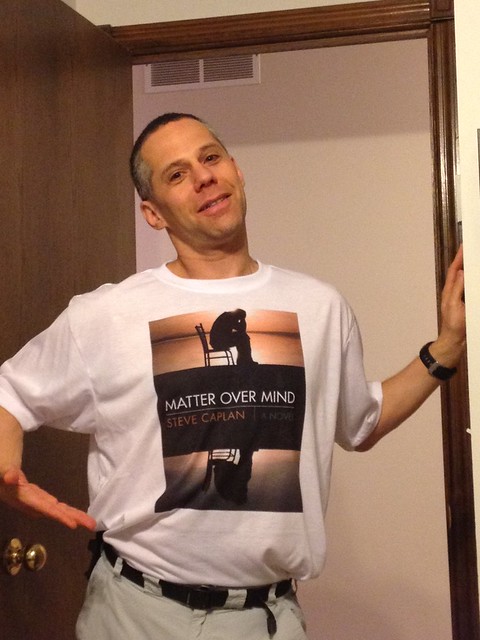
How far will you go to self-promote?

At the risk of going overboard…

MOM steve shirt

WHS steve shirt

At least it’s clear to me that I wasn’t going to be a supermodel…

Posted in humor, science | Tagged , , , , | 7 Comments

Should I buy a lottery ticket?

I’m not a gambler, but every once in a while a weird coincidence strikes–sometimes so weird that I wonder about my “luck,” and with such a rare and unusual event unfolding, whether it would be more likely for me to win the lottery. Of course, it helps if you buy a ticket.

At the beginning of the week, I was minding my own business, working on the discussion of a manuscript when an e-mail came through. Now that’s not unusual; even 50-100 of them in a very busy day isn’t out of order. This particular e-mail happened to be an invitation to travel some time in the fall to deliver a seminar and meet faculty at another institution. As this is something I enjoy doing–particularly meeting and talking with fellow cell biologists (who are not plentiful in Nebraska), I gladly accepted and we set about the “waggle dance” of finding a suitable date.

I was informed that the seminars are on Thursdays at noon, with the speaker coming in a day earlier, to meet with several faculty from the department for dinner. We ended up settling for one of two potential dates in Oct., to be decided soon. So far, so good.

On Thursday, I received another e-mail from the same institute, from someone who had introduced himself as the Chair of the department, asking me again about my willingness to come out for a Thursday seminar in the fall. No big deal, I supposed that my previous contact, Dr. So-and-So, had asked his chair to contact me directly. It did seem a bit odd that the chair provided me with several dates to choose from, although none were in Oct.

As it happens, one of the new dates was actually a lot simpler for me. So I wrote and thanked the chair again for the invitation, and noted that although Dr. So-and-So had set a couple of tentative dates in Oct., I’m actually pleased that he now contacted me and gave me a different date altogether that works better for me. All’s well than ends well.

A few minutes later I was rewarded with a big thank you from the chair, who was happy that I accepted one of the proposed dates he put forth, and that he and the department were looking forward to my visit. He also pointed out that he had absolutely no idea who Dr. So-and-So was, and what I was talking about regarding an Oct. visit!

As it turns out, I had received two separate seminar invitations from entirely distinct departments at the very same institution in the space of 4 days! Now how likely is that?! How embarrassing was that, too–of me to simply assume that since it was the same institute, that it was the same department! It’s a good thing I’m a lot more careful about the experiments we do in the lab than about scrutinizing invitations to deliver seminars!

Posted in humor, research, science | Tagged , , , , | 3 Comments

Semantics

On my way to pick up some sushi and maki rolls from a nearby restaurant, I encountered this intriguing sign:

lose 21 lbs

So, as a scientist, I first thought “Why 21 pounds?” Why not 12, or 15, or 17 and 3/4? But in looking more carefully at the sign, I realized that the important question–scientifically–is… for how long will I need to fast to lose 21 pounds?

Posted in humor | Tagged , , , | 2 Comments