OMICS, in your face…

Before you can say “endocytic recycling,” there it is, OMICS strikes again with its ridiculous ‘in-your-face‘ attempts to hoodwink researchers into submitting manuscripts (and money). I am glad to be an “eminent, efficient and supportive adept,” but: 1) I don’t work in the field of Molecular Biomarkers & Diagnosis, and 2) May 15 is 10 days away!

What kind of journal asks researchers to submit a manuscript within 10 days?

No, no, don’t answer. I know….

Dear Dr. Caplan,

You have been invited to submit a manuscript for Journal of Molecular Biomarkers & Diagnosis

We are truly obliged to introduce our Journal of Molecular Biomarkers & Diagnosis with Index Copernicus Value of 4.39.

We are pleased to invite eminent, efficient and supportive adepts like you to contribute a manuscript for our journal which strongly supports the Open Access initiative and publishes all kinds of research, review, case reports, short commentaries , short communications or mini reviews etc.

If possible, I would appreciate receiving your manuscript by May 15, 2014.  You may submit your paper online at:  http://www.editorialmanager.com/pharma/.

Please respond to this invitation by May 11, 2014.

Best wishes!!

With regards,
Joita
Editorial Assistant
Journal of Molecular Biomarkers & Diagnosis
731 Gull Ave, Foster City
CA 94404, USA
Phone: +1-650-268-9744
Fax: +1-650-618-1414

Posted in research, science | Tagged , , , , , , , , | 5 Comments

What makes a dog tick? No pun intended…

Having adopted Ginger as a 4 year old Vizsla-Labrador retriever mix less than a year ago from an animal rescue organization in Nebraska, I cannot even remember what life used to be like pre-arrival of my loyal retriever-pointer-and all around shadow. This is the second dog I’ve lived with, and while I loved her predecessor, he had a nasty temper and had to be kept away from kids.

image
Ginger in classic pose

Ginger, on the other hand, is the sweetest most even-keeled, friendly and affectionate canine that I have ever had the pleasure of meeting, not to mention living with.

I have long been interested in animal behavior, and particularly (after my former dog’s tempestuous behavior) in understanding why dogs behave as they do. I had heard some theories – such as why dogs sometimes swivel 360 degrees prior to lying down (or having a bowel movement) – supposedly an instinct that protected them from unwanted attackers in the wild – but very little about what makes dogs tick.

For this reason, when I spotted the audio book “Dog Sense” by Prof. John Bradshaw of Bristol University at my local library, I grabbed it. This blog has been long in the making, since I’ve been listening with my kids in the car on the way to school each morning – and it’s only a 10 minute ride to the first drop-off.

Now, having arrived at the end of the audio book, I first found that I have already been “scooped” with a nice piece written by Kate Kellaway for The Guardian. Oh well, lower the impact factor and shoot for Occam’s Typewriter – we scientists are used to this…

Bradshaw’s main point, and a good one at that, is that there are many misconceptions of dog behavior (and subsequently, how dogs should be trained) that have no real scientific basis. For example, Bradshaw notes time and time again how wrong the “dominance model” is for dog behavior. In this model, many trainers (among them celebrity dog trainers) continually push the notion that dogs seek to show dominance over their humans, and that any perceived weakness by the human is thus exploited by the dog to achieve a more prominent position in the hierarchy of the family (i.e., wolf pack).

Just as one of a multitude of examples, there is a common myth that a human needs to teach his dog that he should always enter a door or passageway before the dog. That it is a question of essential leadership and dominance. Now, while it’s fine to use this as a method of training the dog, Bradshaw maintains that the issue is essentially rubbish. Laying out his argument (albeit somewhat repetitively, particularly at the beginning), I certainly agree with his synopsis.

Bradshaw explains the process of domestication of dogs, and how this has radically altered their behavior from that of the wolf – despite the nearly identical DNA that they share. This makes sense; after all, our own DNA is nearly identical to simian DNA. He also points out that today’s domesticated dogs are continuously and mistakenly compared to the American Timber Wolf (Gray Wolf), when essentially dogs evolved from the European wolf, which is now practically extinct. Finally, Bradshaw points out that the many studies on wolf packs – in which hierarchy and dominance are perceived as playing such crucial roles – are all based on artificially created wolf packs in zoos and enclosures. The reason that these studies are flawed (at least as a microcosm for real wolf behavior), claims Bradshaw, is that the wolves in these packs are seldom related – and therefore they are far more aggressive to one another and this does not reflect the more harmonious relationships that occur within wolf packs in the wild.

Bradshaw points out that humans often mistakenly anthropomorphize dog behavior. Anger, for example, is an emotion that dogs are unlikely to be capable of feeling. Dogs are more likely anxious or fearful – and in both cases can show aggression that humans often interpret as anger. But Bradshaw notes that dogs are not really equipped to feel anger.

On the other hand, dogs do “love.” This is based on experiments that show the release of oxytocin, a hormone that in humans has been related to feelings of “love.”

Bradshaw details a variety of very interesting experiments that explain how dogs use their senses (primarily smell and hearing) to great advantage compared to humans, and describes the scientific basis for dogs keener sense of smell (the relative number of neurons and receptors allocated to this sense in the dog brain). He also explains the differences in dog and human eyesight – that dogs do not differentiate well between red/brown/orange, but see better at night (four times better than humans) and sense motion better than humans.

One of the fascinating studies done shows that dogs like to play with humans as much or more than they do with other dogs. In fact, dogs will always try to win a tug-of-war (for a rope) with another dog, but if they sense a human will stop playing with them during the same game, they will sometimes allow the human to win! Dogs know humans can be poor sports…

For the most part, I agree intuitively with Bradshaw’s conclusions, but there are a few of them that – at least based on my close personal interactions with my two dogs – I disagree with. Anecdotally, but nonetheless.

For example, Bradshaw discusses at length the idea that dogs have a poor sense of time. He explains, therefore, that upon coming home and finding that the dog overturned the rubbish bin, there would be no point in punishing or berating the dog. The dog would not be able to connect his action to the punishment that occurred hours, or even minutes after the deed. Bradshaw notes that cases where dog owners claim that their dogs roll over and become submissive when berated are not evidence of understanding; that the dogs are merely doing this to please their owners, without connecting their submission to what they did earlier. This may be so, but I don’t altogether agree .

Ginger, whose single weakness is for forbidden chocolate (toxic to dogs) and other such human treats, occasionally riffles through unlocked trash cans, dumping them in search of such treasures. She greets me happily and excitedly as usual when I come home and will follow me around the house as I take off my jacket and put down my back-pack. But when I enter the specific room where the naughty deed was done, she will not enter, and instead roll onto her back submissively.

Now, to me, this indicates that Ginger knows that what she did was wrong (perhaps not “why,” but she knows it’s forbidden). She knows and remembers full well what she has done – not my expression or posture or any other human giveaway, because she often won’t even come to the door of the room as I’m heading down the hall, and I haven’t yet seen the damage. And Ginger’s predecessor (Rodrigo) did the same thing, although he made more of a mess, and it seems that he did it to spite me, rather than search for remaining food tidbits. Yes, he was a piece of work!

The other concept that I disagree with is Bradshaw’s claim that dogs do not feel a complex emotion such as jealousy. He maintains that in order to be jealous, a dog would need to have a more developed sense of self. Anecdotally, again, but Rodrigo was an intensely jealous dog. If I patted the coffee table and said “Good dog,” he would become jealous. If family members hugged or patted each other – he would push in between. And if anyone – *shudders at the thought* – ever touched his tennis ball? Let’s just say I hope the person can count to ten without requiring all of his fingers to do so… Ginger, however, is not a jealous dog, and has a more noble, altruistic spirit.

All in all, for those interested in learning more about canine behavior, I would warmly recommend “Dog Sense.”


Posted in Education, research, science | Tagged , , , , , , , , , , , , , | 5 Comments

The ease of publishing does not reflect the realities of science

Almost every day I am besieged through email to either join editorial boards of new ‘up-and-coming’ journals or submit manuscripts to them. Neither is a trivial matter for me. A submitted manuscript often comes after several years of research by one or even several students, and by the time we are convinced of the merit of publishing, we have no intention of settling on one of the many “fly-by-night” enterprises that seem to crop up like mushrooms in the forest after rain.

No, our research energies deserve more than that – a serious consideration and fair review process by recognized scientists and reviewers: in short, a respectable journal.

So when I receive an email such as the one depicted below, I can only vent my frustration at the lack of professionalism displayed by this enterprising ‘journal,’ that is aware of my ’eminence’ in cell biology, and can’t string two sentences together without half a dozen grammos (grammatical typos). Shame on them!

Dear Dr. Steve Caplan,

Warm Wishes from SciTechnol!!

Being aware of your eminence in the field of Cell Biology, we with an immense pleasure, invites you for a valuable contribution for our upcoming issue and welcomes submission of original and significant contributions.

Cell Biology: Research & Therapy (ISSN: 2324-9293), a peer-reviewed and hybrid journal, encourages ongoing international research and information exchange through publication of latest advances, research reports/ breakthroughs. The Journal aspires to provide International scientific/ scholarly communication, platform for dissemination of research through our journal publications.

Posted in humor, research, science | Tagged , , , , , , , , | 6 Comments

Why this night is no different than any other – vile anti-semitism persists

Tonight, I know, is the first night of Pesach-Passover, the Jewish festive celebration of the historic/mythical tale of escape from slavery in Egypt. Being an atheist with a complete lack of interest in any religious or pseudo-religious customs, Passover has never been a holiday that I’ve really celebrated. In fact, I don’t celebrate much on any Jewish holiday (although I am interested in the history and culture of the Jewish people); but that doesn’t make me any less Jewish.

It was the Nazis who proved that Jews can’t convert, intermarry or recant their Jewishness. A Jewish grandparent on either side of the family was sufficient to merit being sent to the gas chambers, despite one’s belonging to a church.

One of the key passages in the Passover Haggadah (the guide to the evening Passover service) is a song about “what makes this night different from all the others.” Unfortunately, the answer is “nothing.” This time it was demonstrated by a vile white supremacist and antisemite who murdered 3 completely innocent and defenseless people by cowardly shooting them in cold-blood – just because he (mistakenly) believed they were Jewish. No other reason. Just because they were supposed to be Jews.

It happened only 180 miles from Omaha, at the Jewish Community Center in Kansas City. One 14 year old boy with a passion and talent for singing. His grandfather, a respected family doctor. And an occupational therapist who worked with children who have impaired vision. Cut down by bullets fired by a cowardly loser, whose own life was dedicated to spouting absurd lies, hatred and violence toward others. It’s sickening to think that this coward should have been permanently jailed for incitement to murder, based on his many criminally revolting statements. He should also be tried for treason; praising Hitler, who was the enemy of the US (and many other countries) in World War II, should be grounds for treason.

Unfortunately, as the bereaved families mourn their incomprehensible losses, the Jews mourn with them. But we also mourn for centuries of this type of antisemitism. The Spanish Inquisition. The Cossacks in the Pale of Settlement in eastern Europe who gave my grandmother nightmares. The murder of ~11 million people, among them 6 million Jews. And the knowledge that, no matter who we might want to be,  even if we cast our Jewishness aside – we will always need to look over our shoulders for the antisemitic white supremacists – who will cowardly murder any innocent unarmed person, as long as they can justify that their target was killing Jews.


Posted in Uncategorized | Tagged , , , , , , , , , , | 4 Comments

On the connection between (April) fools and trolls

Trolls seldom have anything worthwhile to say. They twist, bully, rant and rave and insult, putting forth their worst drivel to provoke a response. All behind a cloak of anonymity. That is the nature of a troll; inevitably a loser who dares not show his face. So when such a troll spouts outright lies that can easily be refuted, there is seldom any value in refuting the hateful comments, because the troll already knows they are lies, and is only seeking validation.

In other words, response to a troll allows him to think that he is on the same level as the writer/blogger/journalist, in his perverted mind at least. By ignoring any troll comments, this leaves the troll with the uncertainty as to whether the author has even bothered to read his lowly words – something that I envision is probably the most frustrating thing for a troll: not to be placed at the same “level” as the author.

But for once, glancing at a troll’s comments actually served a useful – if somewhat disparate –  purpose: the relationship between troll and fool reminded me that I need to blog about my most recent April Fool’s joke.

Recently, in my capacity of chair of our departmental graduate and admissions committee, one of my many tasks was to provide a detailed orientation and explanation of the “Comprehensive Exam” that our second year graduate students are required to take. This exam is essentially a very well-structured exercise in grant-writing, in which the students learn to research a topic distinct from their own, write an NIH (National Institutes of Health) style ‘specific aims’ page, receive feedback and input from their examination committee, and ultimately write a full 12 page proposal and defend it in an oral exam. The whole process occurs in a structured manner in the course of about 5 months. I should also point out that the issue of ‘how distinct the proposal needs to be’ from the student’s own research is always a bone of contention…

I want to take this opportunity to point out that I am immensely proud of my department’s graduate program, the overall level of the students in it, and particularly my own students. Furthermore, it is also important for me to note that my general comments about professional amongst graduate students (or lack thereof), in NO WAY reflects my view of the students in my own graduate program. My Guardian article was a very general reflection based on some students in some institutions, and the non-professional examples and attitudes cited had nothing to do with students in my program or lab.

In fact, I feel it necessary to point out that students from our program do very, very well, on average, in scientific careers. Students from my own laboratory have done exceptionally well. I have already produced an exceptional tenure-track assistant professor at an outstanding and highly competitive institute in India (IISER Mohali), and have 4 graduates at top-grade laboratories in prestigious institutions here in the US doing and thriving in post-doctoral positions. Certainly potential independent investigators and PIs, in a few years time. I have also been told explicitly, on several occasions by colleagues who encountered my former students that they are exceptionally well-trained, especially in comparison with graduate students from those high-tier ivy league institutions.

Okay, enough self-congratulatory back-patting, and now to the point!

Those who know me are familiar with my penchant for little practical jokes, and although I have had less time and energy to pursue this passion in recent years, I still enjoy pulling someone’s leg once in awhile. An example was when I announced to the lab members that I accepted a position in Anchorage, Alaska, and we were moving the lab in 3 months time. Anyone want to join me? Of course that was an April Fool’s joke, but no one caught on until I reassured them that we were not going to be Sarah Palin’s neighbors…

This April Fool’s I prepared a Power Point to orient the students on how to go through the process of their Comprehensive Examination. I began with a slide highlighting the differences between this year and the previous year. I put up an animated slide that said:

1) This year, to allow students more room to develop their proposals, we are moving from 12 pages to 25 pages, as the NIH grants used to be.

2) This year, due to the continuing conflict on how close the proposal can be to the students’ research, the graduate committee has decided that each student prepare TWO 25 page proposals: one on his/her own research, and one distinct from his/her research.

I wish I had had a camera to photograph the gaping mouths, the disbelief, the “how could this be happening to us?” A shocked silence hit the room. I was in my element, perfectly serious, explaining how these changes would benefit the students and the examination process. But I am merciful. I waited a few seconds, savoring the exprssions, before the next animation kicked in.

3) HAPPY APRIL FOOLS!

It’s a good thing the students were so relieved. Otherwise they might have roasted me over a spitfire. One thing for sure: it was certainly an icebreaker for the rest of the orientation!

Until April Fools, 2015.

Yours,

SC


Posted in Education, humor, research, science | Tagged , , , , , , , , | Comments Off on On the connection between (April) fools and trolls

Volcanoes

Many geologists and climatologists believe that global warming aside, the next major global climate issues are most likely to come from the explosion of a super-volcano; after all, just look at what an isolated Icelandic volcano did to air traffic across the globe recently.

IMGP6750

The Arenal stratovolcano in Costa Rica. Dormant since 2009, it has a frightening history.

On this visit to Costa Rica, we spent the majority of our time somewhere in the vicinity of the now dormant (but still emitting smoke) Arenal volcano. When last in Costa Rica, we were in the area for 3 days and never even had the opportunity to see the mountain, with rain and clouds throughout our stay.

We did a variety of activities around the Arenal, including birding, zip lining, tubing and hiking, and there was one specific  hike with a guide who gave us a perspective on the geology and history of the Arenal. We learned that in 1968, the volcano gave disturbing signs of activity, but that the people in the surrounding villages (whose ancestors lived there for centuries not knowing this was a volcano) did not evacuate their homes to seek shelter elsewhere. After all, the volcano crater was miles away. What could possibly happen?

What did happen was that the volcano virtually exploded, creating secondary craters, expelling a huge flow of lava, and heaving boulders that weighed several tons as far as several miles from the crater – in fact, within an area of about 15 square kilometers. Two towns were entirely obliterated, and ~80 people lost their lives. Including a rescue team that got caught in the lava several days after the initial explosion.

The town on the west side of the volcano, which was spared altogether, was thus renamed La Fortuna, for having the good fortune of being outside the range of the Arenal – at least on this occasion.

So while we do need to take care of our environment, I think the lessons of volcanoes (even when confused with myths of animals fleeing the Yellowstone caldera in the wake of movies and internet stirring up fear among the masses) are that life is fragile; and as many of us know to be true – evolution on this planet has been shaped far more by geological events than people typically give credit.

Posted in science | Tagged , , , , , , , | 4 Comments

Costa Rica: Part 2- river adventures (“Don’t cross the river, if you can’t swim the tide…”)

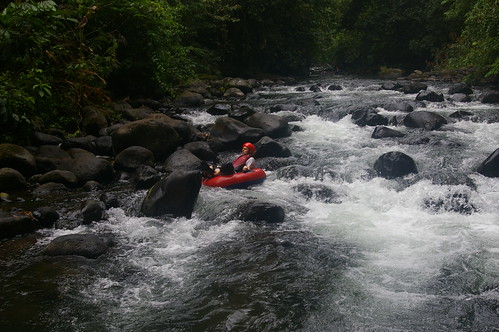
No visit to Costa Rica would be complete without visiting the fascinating rivers than run through the luscious rain forests. However, there are a wide variety of river adventures, some of which I would warmly endorse, whereas others – well I will let you judge…
IMGP6719
Me, on the rocks

ontherocks inset
If anyone thought I was having fun, think again. RPG, I go with a helmet, thin as a pancake, or not!

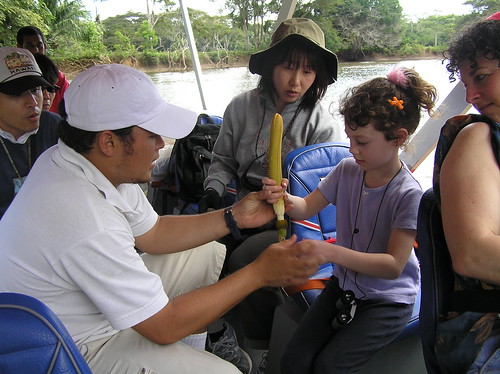
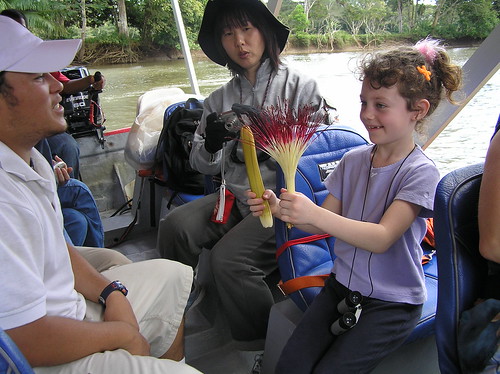
The real river experiences are achieved by “safari floats” or quiet and slow moving dinghies or boats that move down the river with a guide and allow time to enjoy and view the wildlife. On our previous trip to Costa Rica 8 years ago, when our daughter was about 7 years old, on the Cano Negro River near the border with Nicaragua, the guide showed her this cute little trick:

PC260187

and then, presto!
PC260188

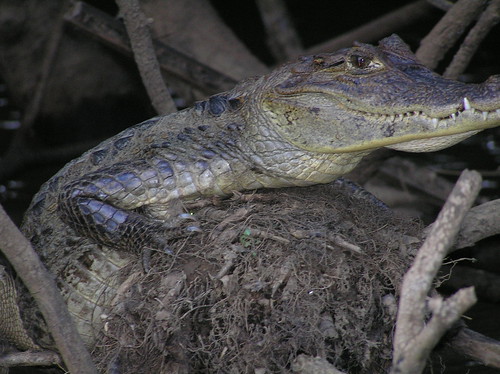
This time, we floated down a different river. As demonstrated, this activity was more to my liking than the tubing…
IMGP6356

PC260191
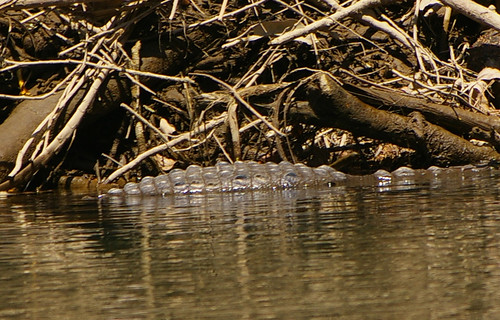
Cute cayman

crocodile
Quirky crocodile

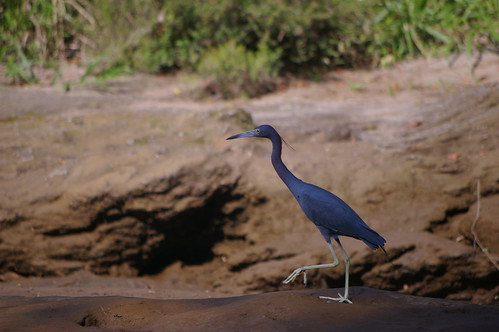
Blue heron
Harried (blue) heron

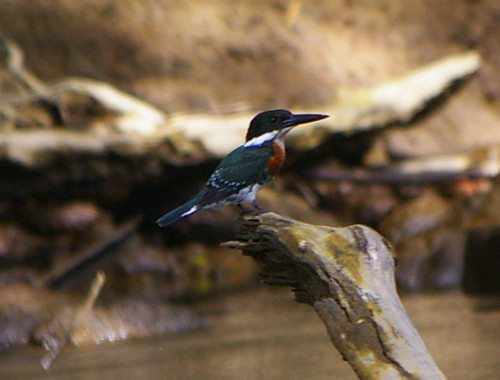
amazon-kingfisher(crop)
attractive Amazon Kingfisher

These were but a few of the delightful inhabitants of the river.

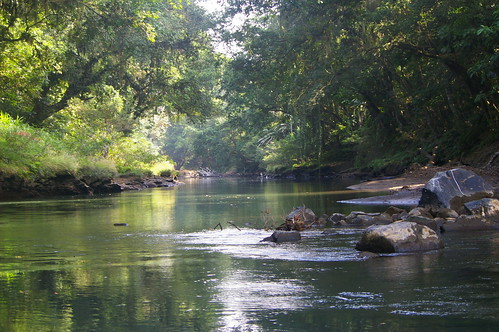
river view
Remarkable river

Howler monkeys (too far away for good photos), beautiful flowers:
IMGP6338

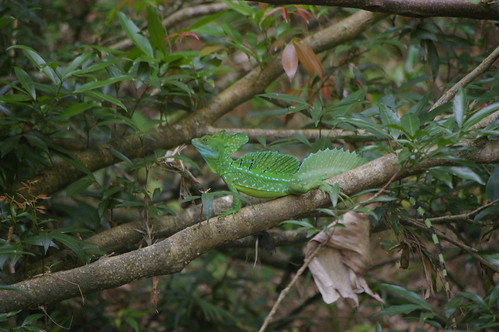
And miracles of miracles, we also saw the famous Jesus Christ Lizard (common basilisk), so named for his ability to scoot across the water, running rather than walking.
IMGP6308

Posted in science | Tagged , , , , , | Comments Off on Costa Rica: Part 2- river adventures (“Don’t cross the river, if you can’t swim the tide…”)

Costa Rica – Part 1: The Tree House

IMGP6383
Our Casa de Rana (frog) Tree House, recently

Costa Rica is an incredible country, often described as the “Switzerland of Central America” (apologies to my UK friends, but Ben Nevis and the Munroes don’t quite compare with the Alps…). A country of about 5 million people, with no army and no enemies. 99% literacy rate. Lowest crime rates in Central America. Universal healthcare. A recycling program that would put most “1st world countries” to shame – even in the most remote reaches of the country. 30% of the land conserved as nature reserves.

One of the most amazing things about Costa Rica is the deep understanding that the people have of the relationship between conservation, ecotourism, natural treasures and the economy. Indeed, tourism is the #1 Costa Rican source of income, dwarfing pineapples, coffee and all else in recent years. It seems that every one of the highly professional nature guides that we’ve had the pleasure of talking to strongly feels that it is a national mission to show off the wonders of the country, and they will proudly go to every effort to spot that Quetzal bird, or sloth, or howler monkey, with the same excitement and enthusiasm as the tourist – despite the fact that they see the same (or similar) wonders on a daily basis.

In keeping with nature and ecotourism, our first adventure this visit was to a lodge known as the Tree House Lodge (6 tree houses only) in the general vicinity of the town of Fortuna, near the famous Arenal Volcano. As indicated in the photo above and below, the room was essentially an entirely wooden structure built at the height of the rain forest trees (almost canopy level), giving one a feeling of living in the jungle. Isolated for a couple days, we stayed in this almost-no-frills but fascinating habitat for a couple nights, doing a night walk with the local guide – who caught an armadillo to show us, along with frogs, sleeping birds, spiders (tarantulas) and many other ‘treats.’

image
The armadillo was released unharmed back to the rain forest after several minutes

There were also quiet relaxing times.
IMGP6462
Yours truly at 6 am, listening to the sounds of the rain forest with a flask of local Costa Rican coffee.

Each day, we had activities (the subject of upcoming blogs, stay tuned), but “the Tree House” deserved a post of its own, and just wandering around taking photos of the surroundings.

IMGP6338
Some typical flora

IMGP6281
More typical flora

IMGP6371
Even more typical flora – alright, I haven’t a clue about the botanical definition of these lovely flowers

IMGP6368
So hard to decide which photos to post…

IMGP6453
There are about 55 species of hummingbirds in Costa Rica – I won’t even try…

IMGP6405
I love those birds!

Breakfast in the open-air ‘restaurant.’ Almost all restaurants have no walls or windows, with the weather warm and pleasant all year round, and no real distinction between seasons (perhaps more rain in the so-called winter).

IMGP6285
Desayuno, recently. Ahhh, the papaya…
Stay tuned for the next post on our Safari float down the river. Coming soon to a computer terminal near you.

IMGP6286

Posted in Education, science | Tagged , , , , , , , , , , , | 2 Comments

Surfacing from the jungles of Central America

Following my 3rd trip to Central America in the last 10 years, and my second visit to Costa Rica, I have returned from the rain and cloud forests invigorated by the immense diversity of flora and fauna, with the spectacular colors of birds ingrained in my brain.
blue-crowned motmot(1)
One of my new favorite birds, the Blue-Crowned Motmot

Over the next few weeks as I sort through the hundreds of photos and try to match and classify the birds and other animals (I won’t even try with the flowers…), stay posted for some great photos of kingfishers, herons, a variety of hummingbirds, iguanas, coati and more! But for me the party is over and it’s back to reality.

Posted in science | Tagged , , , , , , | Comments Off on Surfacing from the jungles of Central America

More evidence for Lab Lit on the map!

A quick search of Google Scholar yielded some of my publications on Jenny’s Lab Lit site, in addition to the expected scientific papers. If that’s not a sign of Lab Lit on the map, then I don’t know what is! (scroll down to the bottom)

User profiles for steve caplan

Steve Caplan

Prof. of Biochemistry and Molecular Biology, Univ. of Nebraska Medical Center
Verified email at unmc.edu
Cited by 2512

Regulation of Src trafficking and activation by the endocytic regulatory proteins MICAL-L1 and EHD1

…, D Katafiasz, N Naslavsky, S Caplan – Journal of Cell …, 2014 – jcs.biologists.org
Abstract Localization of the non-receptor tyrosine kinase c-Src (Src) to the cell periphery is
required for its activation and to mediate focal adhesion turnover, cell spreading and
migration. Inactive Src localizes to a perinuclear compartment and endocytic transport

Cooperation of MICAL-L1, syndapin2, and phosphatidic acid in tubular recycling endosome biogenesis

…, N Vitale, N Naslavsky, S Caplan – … biology of the …, 2013 – molbiolcell.fitnessofmen.com
Abstract Endocytic transport necessitates the generation of membrane tubules and their
subsequent fission to transport vesicles for sorting of cargo molecules. The endocytic
recycling compartment, an array of tubular and vesicular membranes decorated by the

[HTML] Role of Phosphatidylinositol 4, 5-Bisphosphate in Regulating EHD2 Plasma Membrane Localization

LC Simone, S Caplan, N Naslavsky – PloS one, 2013 – dx.plos.org
Abstract The four mammalian C-terminal Eps15 homology domain-containing proteins
(EHD1-EHD4) play pivotal roles in endocytic membrane trafficking. While EHD1, EHD3 and
EHD4 associate with intracellular tubular/vesicular membranes, EHD2 localizes to the

Scratching the surface: actin’and other roles for the C-terminal Eps15 homology domain protein, EHD2.

LC Simone, N Naslavsky, S Caplan – Histology and histopathology, 2013 – europepmc.org
The C-terminal Eps15 homology domain-containing (EHD) proteins participate in multiple
aspects of endocytic membrane trafficking. Of the four mammalian EHD proteins, EHD2
appears to be the most disparate, both in terms of sequence homology, and in subcellular

Differential roles of C-terminal Eps15 Homology Domain proteins as vesiculators and tubulators of recycling endosomes

…, PL Sorgen, W Guo, N Naslavsky, S Caplan – Journal of Biological …, 2013 – ASBMB
Background: Vesiculation of tubular recycling endosomes is essential for the recycling of
receptors and lipids to the plasma membrane. Results: A novel vesiculation assay was used
to demonstrate a role for endocytic regulatory proteins in vesiculation. Conclusion: EHD

MICAL-family proteins: complex regulators of the actin cytoskeleton

SSP Giridharan, S Caplan – Antioxidants & redox signaling, 2013 – online.liebertpub.com
Abstract Significance: The molecules interacting with CasL (MICAL) family members
participate in a multitude of activities, including axonal growth cone repulsion, membrane
trafficking, apoptosis, and bristle development in flies. An interesting feature of MICAL

Chemical shift assignments of the C-terminal Eps15 homology domain-3 EH domain

G Spagnol, C Reiling, F Kieken, S Caplan… – Biomolecular NMR …, 2013 – Springer
Abstract The C-terminal Eps15 homology (EH) domain 3 (EHD3) belongs to a eukaryotic
family of endocytic regulatory proteins and is involved in the recycling of various receptors
from the early endosome to the endocytic recycling compartment or in retrograde transport

[HTML] Going bonkers

S Caplan – 2014 – lablit.com
Over the past few months, since reading – or more accurately – listening to the audiobook version
of Bonk: The Curious Coupling of Sex and Science (Canongate), I have been thrust back and
forth (sorry, no pun intended) trying to decide whether or not to write this book review. …

Finding the cure

S Caplan – 2013 – lablit.com
Editor’s note added 14 July 2013: Recently our staff reviewed this novel and concluded that,
due to certain plot elements (which we won’t reveal as they constitute spoilers), it is science
fiction and not lab lit. Regardless, the lab scientists and scenes are realistic depictions, so …

Cite Save More


Posted in humor, science | Tagged , , , , , , | 2 Comments